emailNeed to contact me and don't have my email? Click on email button.
About eWillys
Welcome to eWillys.com, a website for vintage jeep enthusiasts. I update this website nearly every day with jeep deals, jeep history, interesting reader projects, jeep related info, and more.
These quick searches can help you find things on eBay. People list in the wrong categories all the time, so don't be surprised to see brochures in the parts area for example. This section used to be split into jeeps, parts and other categories, but recent changes to eBay will require this information to be recoded.
The links to posts below show jeeps grouped by models, condition, and other ways. Some of these jeeps are for sale and others have been sold. If you are unsure whether a vehicle is still for sale or not, email me at d [at] ewillys.com for more info.
Importantly, the allure of buying a project jeep can be romantic. The reality of restoring a jeep can be quite different, expensive and overwhelming without the right tools and resources. So, tread carefully when purchasing a "project". If you have any concerns about buying a vintage jeep, or run across a scam, feel free to contact me for help, comments or concerns .
UPDATE: The mystery Crosely at the bottom of the post has been identified as a Crosley Bull Pup thanks to L.C. Odin.
For those who haven’t read the article I posted on the lightweight jeeps a few years ago, Crosley built ‘extra-light weight’ four wheel drive vehicles called the CT-3 Pup and marketed to the military in 1942. The Pup had a 2-cylinder 13hp engine air cooled motor and weighed 1125 lbs. What I didn’t know was that a slightly different ‘hi hood’ version of the Crosley Pup was also built. More about that in a moment.
The issue of the Pup came to my attention yesterday because Marc forwarded me a great photo of a CT-3 Pup being loaded onto US Navy Bomber May 5, 1942, on eBay.
According to Hemmings thirty-seven Crosley Pups were built before the idea was abandoned, at least in part, due to some weak parts. As in the photo above, here’s another look at the ‘classic’ version which you can view at Mighty Eight Air Force Museum in Pooler, Ga. (more pics of it here) and check out these fantastic detail photos at the Comancheclub.
During World War II, trying to get vehicles, especially Jeeps, onto the ground where military personnel could use them was of paramount importance for obvious reasons. But, how to accomplish that goal was less clear. A variety of strategies were used. One idea that was opened up to bids by companies was a program to create an air-droppable Jeep, a lightweight jeep-like vehicle known as extra lights (EL) or lightweight jeeps or jeeplets that could be boxed and flown into areas where they were needed.
Similar to the original jeep prototype program, where multiple companies (in that case Bantam, Ford and Willys) submitted prototypes and pilots for review and testing, during World War II the military announced their lightweight jeep program and welcomed designs from a variety of manufacturers.
This program resulted in a variety of different vehicles that have been showcased across the web, mostly through old photos. In the article below I organize them using newer photos (whenever possible) to provide the most up-to-date look at most of these vehicles (I don’t have pics of all versions of every vehicle). For a fuller story of the history behind the lightweights, check out this 1977 article from Hemmings.
The image below shows a photo taken by Patrick Coovert in 2008 at Hallsville, Ohio. In order, from left to right are a CT3 Crosley Pup, the Chevrolet Extra Light (CEL), Willys WAC (Willys Air Cooled), and a Kaiser Extra Light (KEL). These are just a few of the jeeps developed.
CT-3 Pup: According to Hemmings, 36 Crosley CT-3 Pups were built during 1942 and purchased for testing in several locations. of the 36, 6 of these would make the trip to Europe. This would make the Pup the most successful of all the early lightweights produced. The Pup had a 2-cylinder 13hp engine air cooled motor and weighed 1125 lbs. Hemmings notes, “they could only carry the driver and one passenger, and the military testers, initially enthusiastic about the Pup, found weak steering knuckles, weak springs and a weak steering column.”
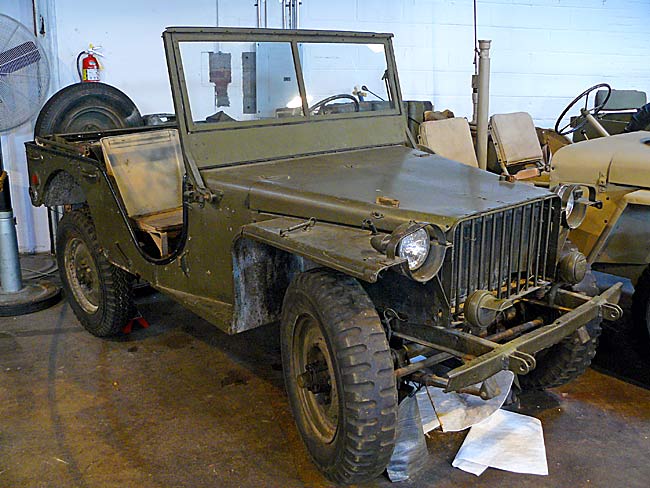
I have not located much information about the Nuffield, though it was featured in one of my early favorite book called The Jeep. I believe this was based primarily on Willys parts, though it was lightened as much as possible, with a removable steering wheel and fold down windshield to maximize compactness. The tests of this were successful, though it was deemed unnecessary by the time it was completed in 1944. Nuffield would go on to develop another 4wd vehicle called the Nuffield Gutty.
Here are some images of an exact copy (as possible) of the Nuffield lightweight jeep from a british website.
And some photos of the original:
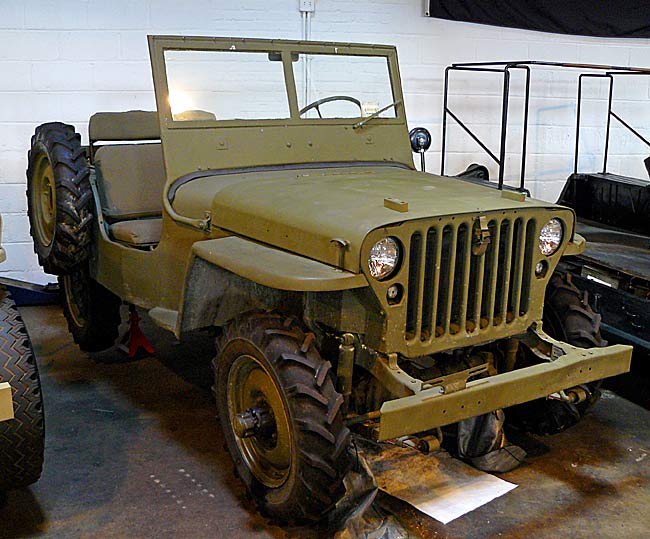
3. CHEVROLET EXTRA LIGHT (CEL): Hemmings reports Chevrolet developed 2 prototypes with an “Indian 90-degree V-2” 45.44 cid motor. They adapted it from the Indian Military motorcycle. One prototype is located in the Militia Museum of New Jersey. This image was taken by Bill Maloney.
Here’s an image of the CEL this is in a variety of places.
4. KAISER: There were several versions of the Kaiser Extra Lightweight Jeep. Mark Askew in his Rare WW2 Jeep book has images of a couple different versions. For example, the Kaiser ‘midjet’ weighed about 1370lbs and the ‘1160’ weighed 1520lbs.
5. FORD “JUNIOR JEEP”: This prototype still exists and is owned by Ted Wisniewski of Belleville, Michigan and was highlighted in an article at Hemmings. A commenter to the article noted he had done some jeep research in the Ford archives and uncovered a wooden model of this prototype, images of which I have never seen.
From Fred Crimson’s Book “U.S. Military Wheeled Vehicles,”, via the Hemmings website, comes this paragraph explaining more about Ford’s prototype.
“For reasons which can only be speculated on, the little miniature Jeep was not entered in the competition, and the tests proceeded without Ford’s contribution. The engine for this vehicle was a 71 cubic inch agricultural tractor powerplant which produced good torque, but not much horsepower. Perhaps ford realized that the combination of low horsepower and downsized components resulted in an unacceptable vehicle. The other manufacturers did not seem to realize this until the tests were completed and all vehicles had failed. The tires were 5.00x17s with agricultural type tread. It was a clean and well integrated design, even if the offset grille looks a little strange. The radiator had been offset to allow clearance for the steering column. A blackout driving light is recessed below the left headlamp.”
6. WILLYS: Naturally, Willys also developed a series of light jeeps. Here are a few. Mark’s Rare WW2 Jeeps has some pics of both the Willys MB-L and L2. From Jedsite.info had a photo of the first MB-L. It’s also known as the “Gypsy Rose Lee” Jeep (Unity Magazine, Dec 1947).
Here’s a photo of the Willys MB-L2:
and a photo of the MB-L2 next to a standard MB
Willys Pilot WAC or Jeeplet (harley davidson engine)
Willys WAC or Jeeplet (harley davidson engine)
Willys Aero Jeep (bobcat). This looks very similar to the CJ-4 prototype.
I’ve never run across another reference to this story, but Sam (who runs the Motor Pool) shared a story from his friend Lee (recently deceased) about an experimental Jeep Glider. Not unlike the Rotabuggy, which was a jeep transformed into a helicopter, the Government also transformed a Jeep into Glider, built to carry 8 personnel plus the jeep. The Army accomplished this by attaching glider pieces to a jeep. The jeep was then pulled into the air, like any other glider, and it would fly to a landing spot. Once down, charges would be ignited and the pieces would fall off. The Jeep could then drive away.
Unfortunately, while the tests were successful in the U.S. in anticipation of the D-Day invasion, a test of the glider system in Britain failed to the point that the army considered this idea unfeasible, with the differences in climate said to be the main reason they succeeded in the US and failed in Britain.
I have yet to run across any photos or drawings of this project, but perhaps someone else has?
I’ve decided to create a new category that tracks the early jeeps located in museums.
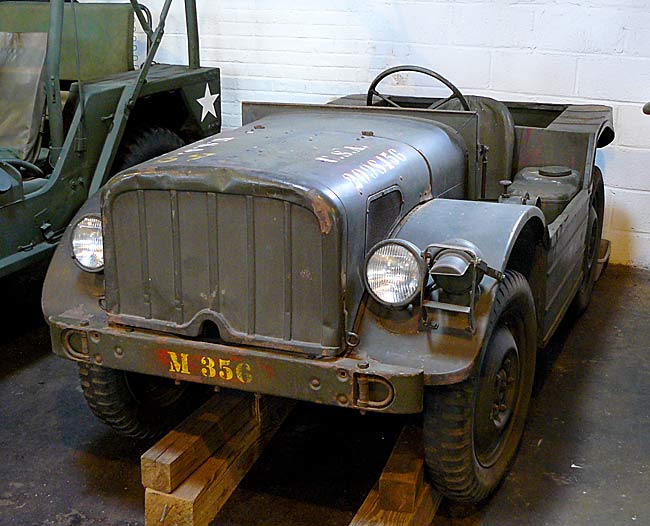
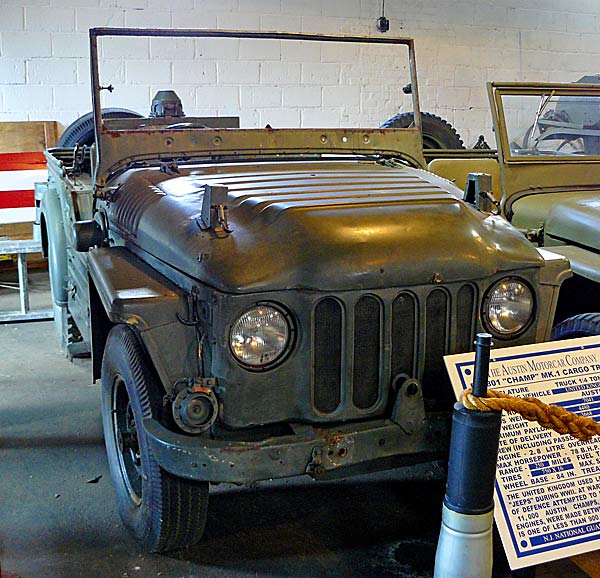
Bill Maloney has shot a variety of early jeeps, among other vehicles, that appear in eastern US Museums. Below are some of the images he has taken at the Militia Museum of New Jersey, in Sea Girt, NJ. One of the more unique vehicles is the Prototype Extra Light Air Drop (see other lightweight jeeps here). Bill doesn’t provide any info about this particular light weight jeep, however Mark Askew, in his book RARE WW2 JEEP, identifies the vehicle below as a later version of a light weight jeep made my chevrolet. There is an earlier version of this vehicle that had, at the very least, a slightly different grill and different lights.
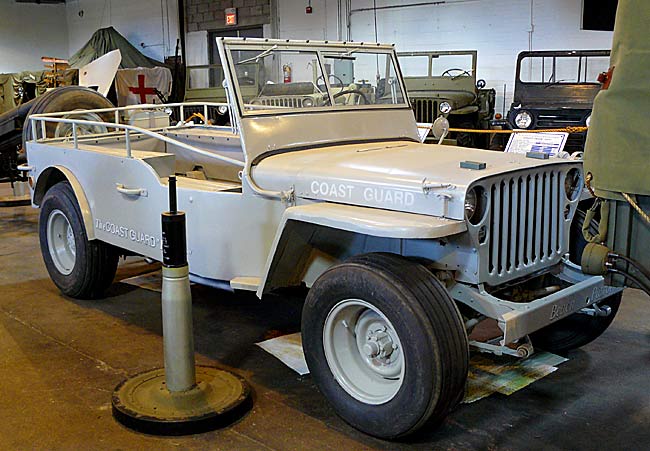
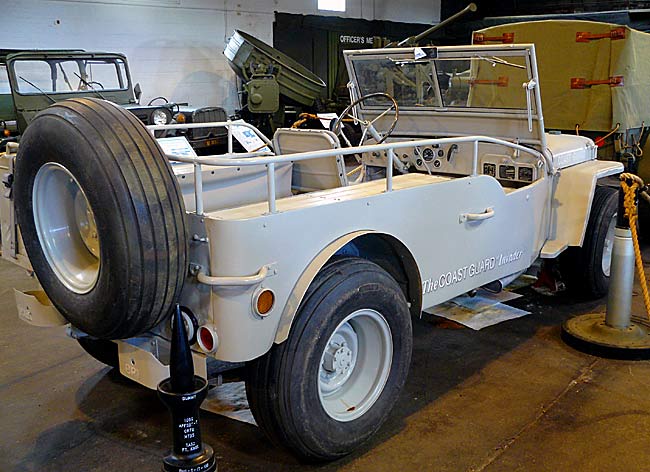
Here’s an extended MB Transport Willys (Ok, I don’t really know what the official name for this is). I assumed these were built special for the Coast Guard?
This is a pilot version of the CJ-2A. Note the location of the spare tire.