emailNeed to contact me and don't have my email? Click on email button.
About eWillys
Welcome to eWillys.com, a website for vintage jeep enthusiasts. I update this website nearly every day with jeep deals, jeep history, interesting reader projects, jeep related info, and more.
These quick searches can help you find things on eBay. People list in the wrong categories all the time, so don't be surprised to see brochures in the parts area for example. This section used to be split into jeeps, parts and other categories, but recent changes to eBay will require this information to be recoded.
The links to posts below show jeeps grouped by models, condition, and other ways. Some of these jeeps are for sale and others have been sold. If you are unsure whether a vehicle is still for sale or not, email me at d [at] ewillys.com for more info.
Importantly, the allure of buying a project jeep can be romantic. The reality of restoring a jeep can be quite different, expensive and overwhelming without the right tools and resources. So, tread carefully when purchasing a "project". If you have any concerns about buying a vintage jeep, or run across a scam, feel free to contact me for help, comments or concerns .
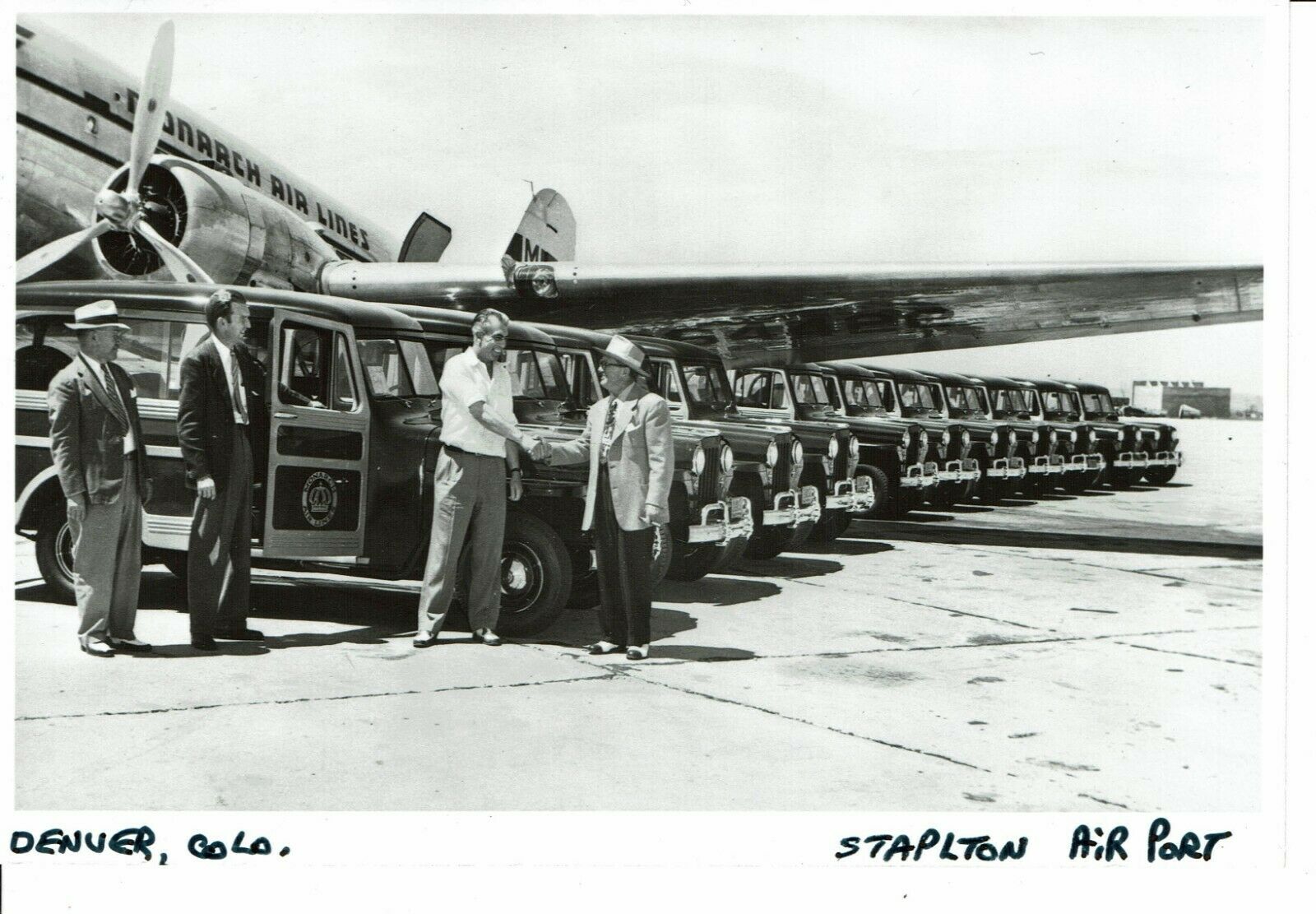
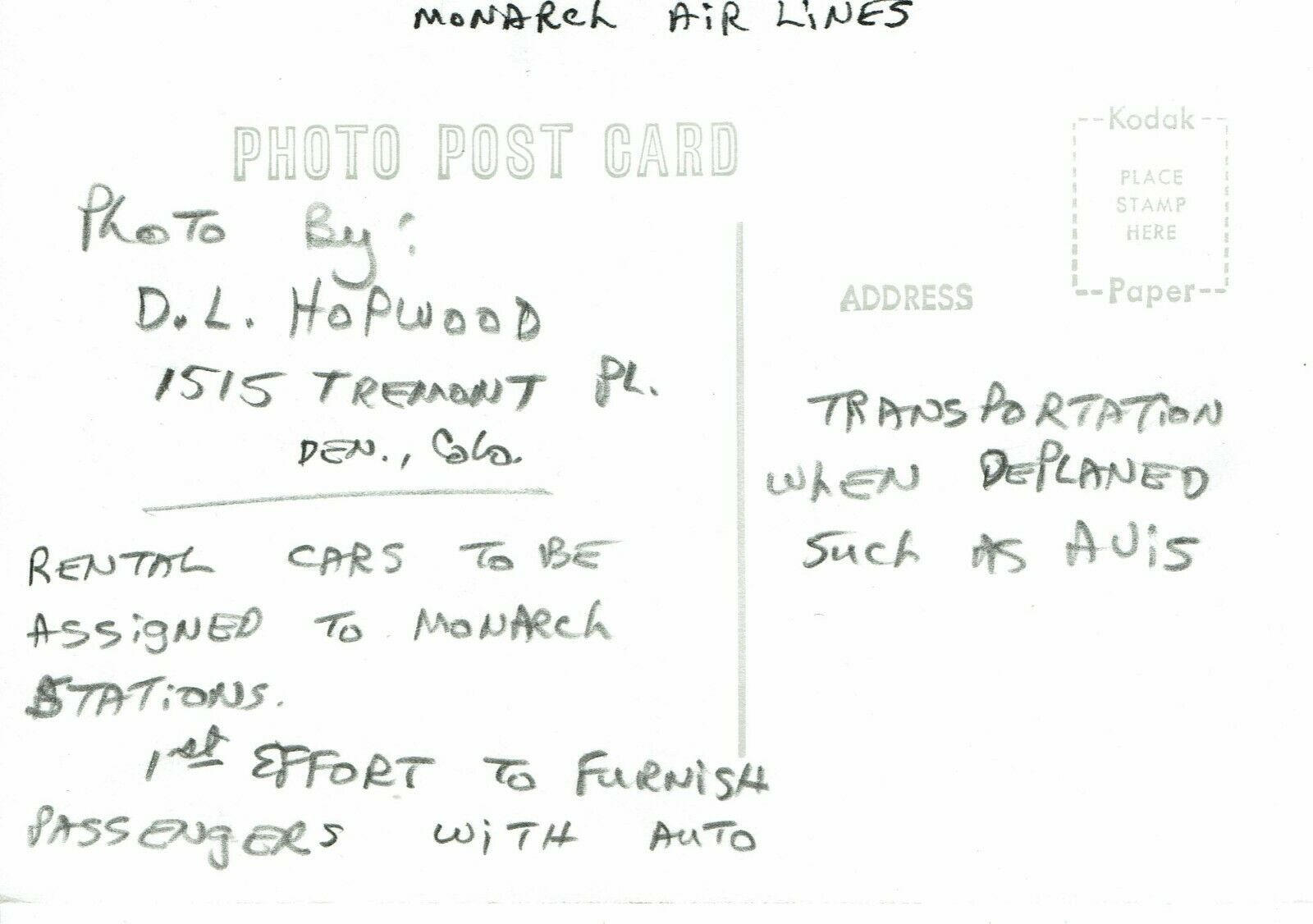
There’s a neat postcard from what I believe is the late 1940s that shows a line of Willys Wagons ready to be rented by passengers of Monarch Airlines. a regional carrier based in Colorado. This postcard is available on eBay:
“Post card shows a great SHOT OF ABOUT A DOZEN NEW WILLY’S JEEP STATION WAGONS AT STAPLETON AIRPORT IN DENVER, COLORADO.”
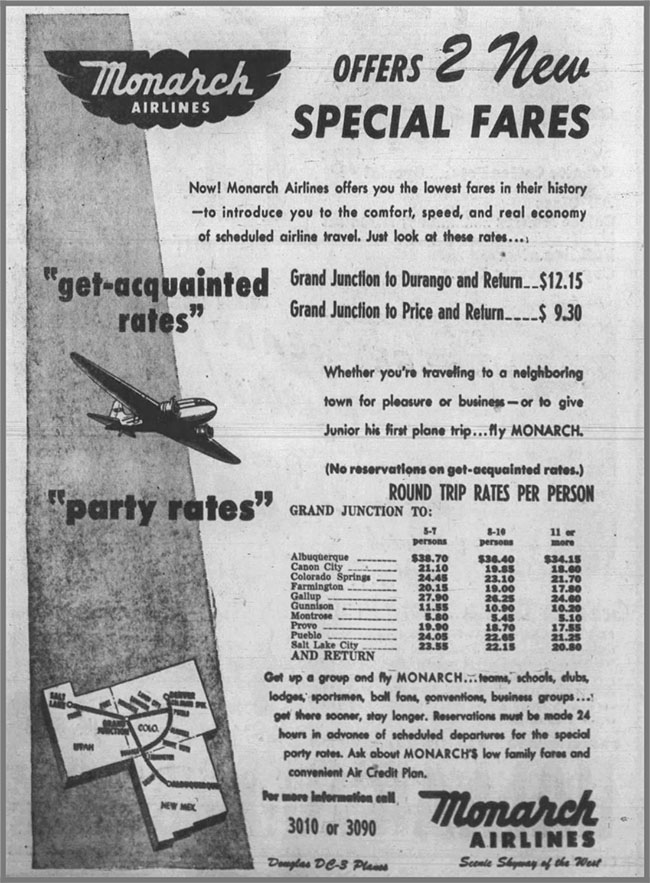
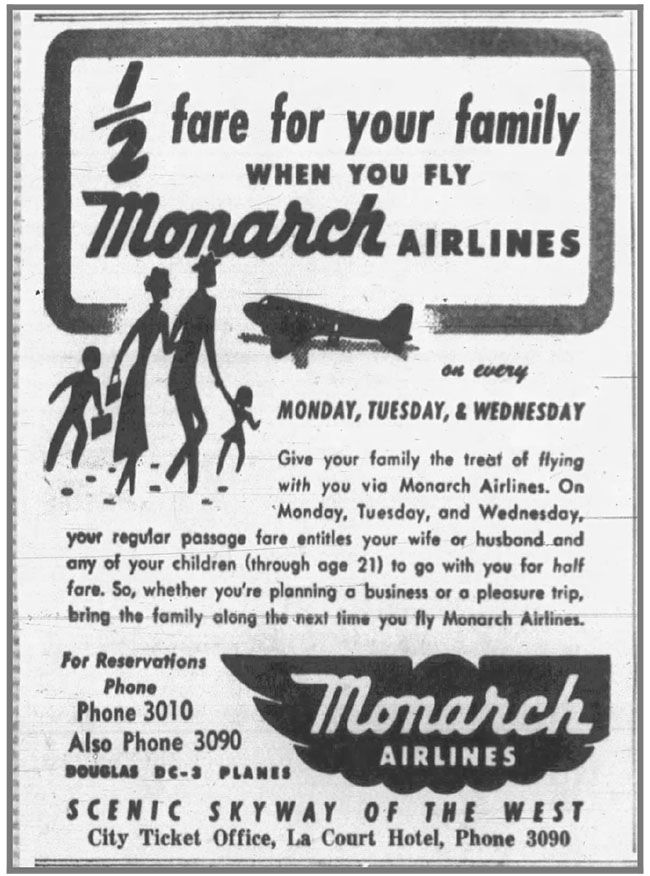
My guess is that the idea for the wagon rentals coincided with the introduction in early 1949 of Monarch Airlines’ “family-fare” program, as reported in the February 11, 1949, issue of the Daily Sentinel out of Grand Junction, Colorado. The head of the family paid full price for a ticket, while the remaining family members could fly at half-price. Unfortunately, I have been unable to find a news report that confirms when the wagons were purchased for rental.
Below are two subsequent newspaper ads highlight the program:
May 20, 1949, ad in the Daily Sentinel, Grand Junction, Colorado
April 08,, 1949, ad in the Daily Sentinel, Grand Junction, Colorado
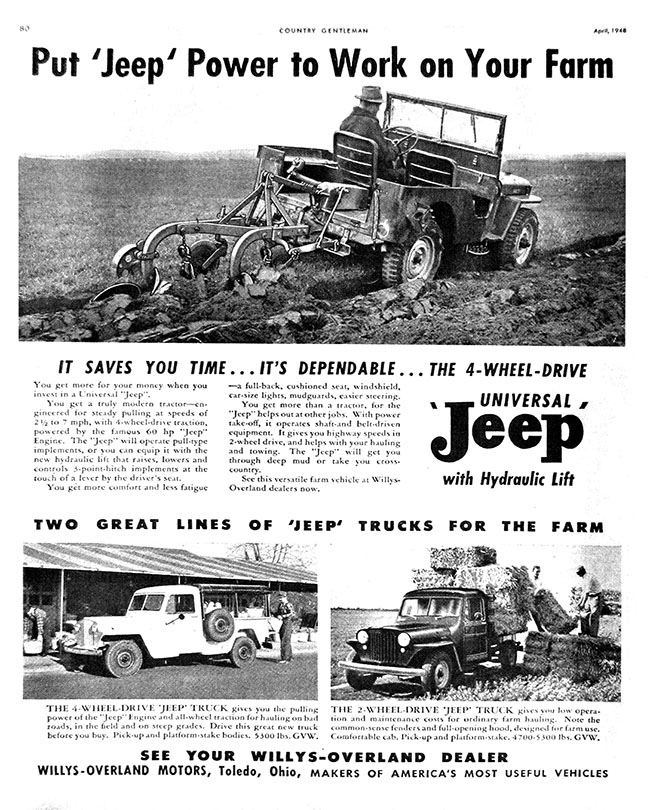
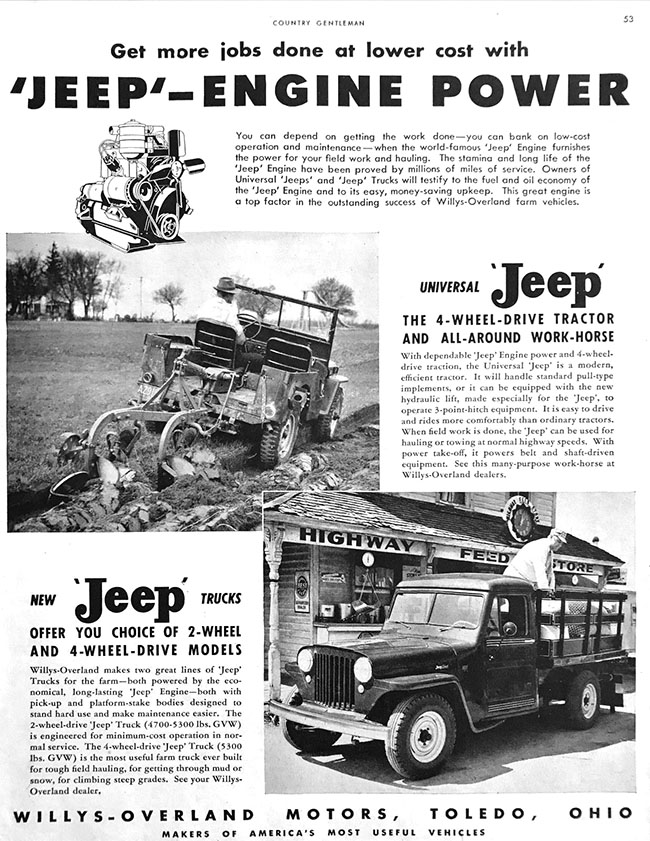
This April 1948 “Put Jeep Power to Work on Your Farm” advertisement appeared in the Country Gentleman magazine. It also appeared in the May 1948 issue of the Farm Journal.
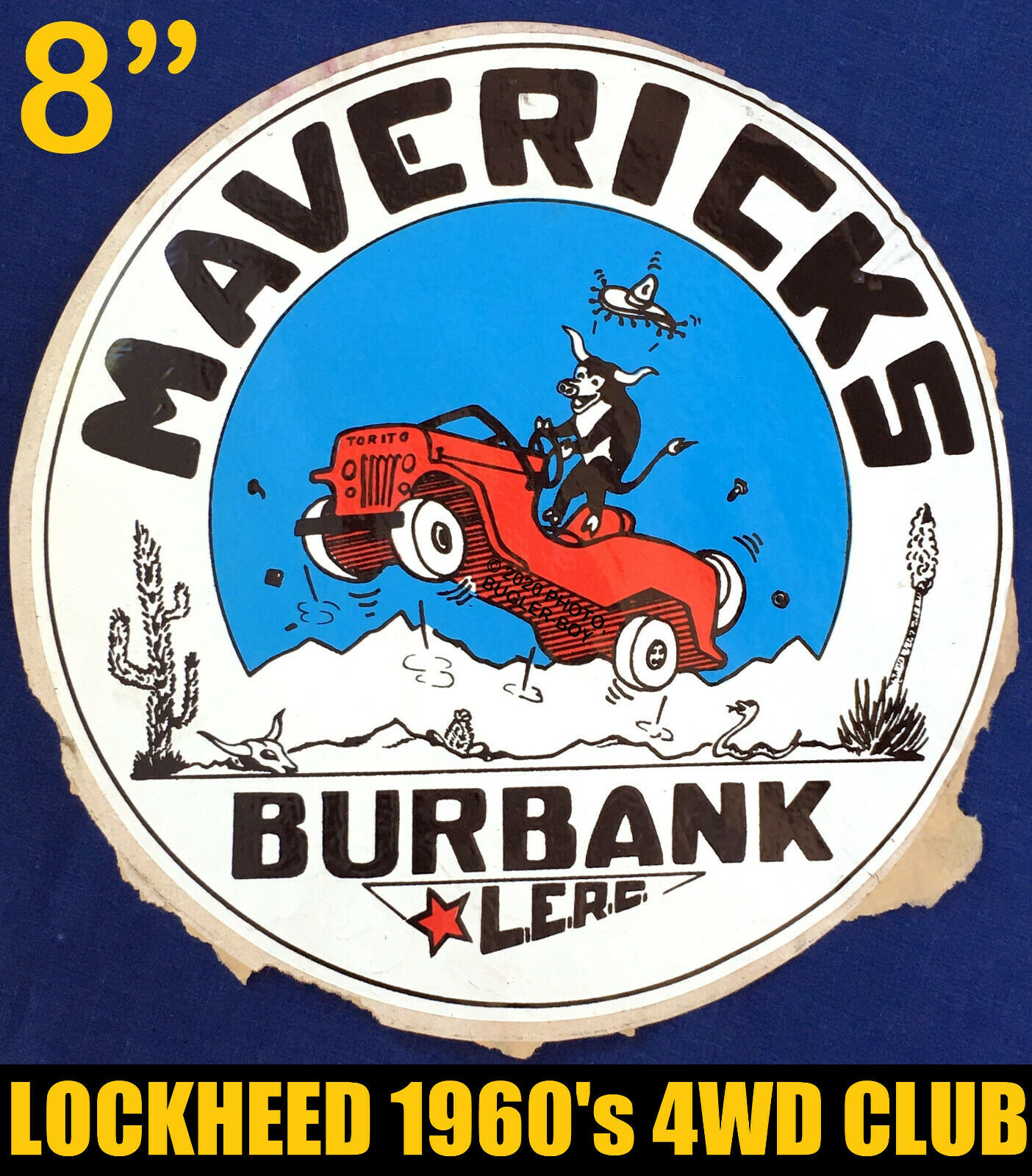
This is an original 8″ diameter sticker from the Lockeed Employees Recreation Club (LERC), located in Burbank, California. I don’t know how many jeep clubs were formed out of Lockeed, but there were several Seattle area jeep clubs with members from Boeing (the Wandering Willys Jeep Club was one).
“ONE 8” VINTAGE “MAVERICKS” 4WD CLUB VEHICLE
STICKER – LOCKHEED, BURBANK, CA – Circa 1968
★ 52 Year Old Never-Used Ephemera ~ Outdoor Sticker for Vehicle Front Quarter Panel ★
• Very, very rare collectible Lockheed, Burbank, CA ephemera! In fact, this is probably the only one left in the world!
• One (1) VINTAGE ORIGINAL “MAVERICKS” FOUR WHEEL DRIVE CLUB 8″ VEHICLE EMBLEM STICKER from the Lockheed Employees’ Recreational Club (L.E.R.C.) in Burbank, CA circa 1968. Never used. Still has it’s original kraft paper backing (for peel-&-stick) in very nice condition.
Age:
About 52 Years Old (although it has never been used, the adhesive is not guaranteed due to item’s age).
Original Use:
Typically these were placed on the 4WD vehicle’s front quarter panel to identify club membership.
L.E.R.C. = “Lockheed Employees’ Recreational Club” originally on Empire Road, Burbank, CA in the 1970’s.
Size:
About 8″ in diameter (see photo with measuring tape).
Note:
The ink on this decal is very heavy, almost with a brush texture (see photo #11), to be robust for outdoor use back in the day.
Details:
Has been stored in a file cabinet for about 40 years.
This is the ONLY one on eBay.
Very rare collectible Lockheed, Burbank, CA ephemera!
• Quote from the January 1968 Mavericks BULLHORN newsletter, the description of a four wheel drive club —”A bunch of damn fools driving out across the desert in a wide variety of corrupted vehicles looking for a place they can’t go so they can.” From back in the days when Joe Mokracek & Doug Carter were club presidents.
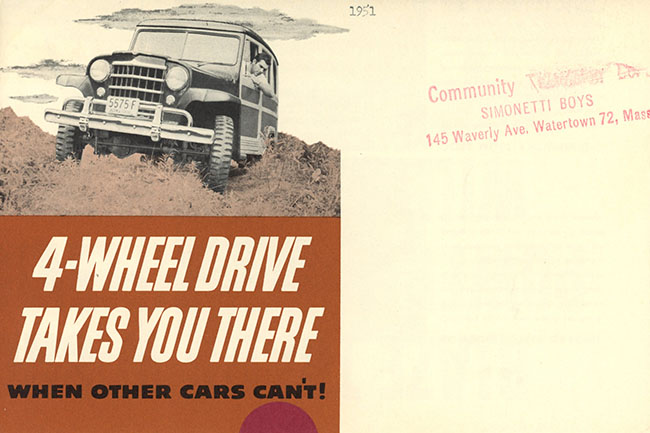
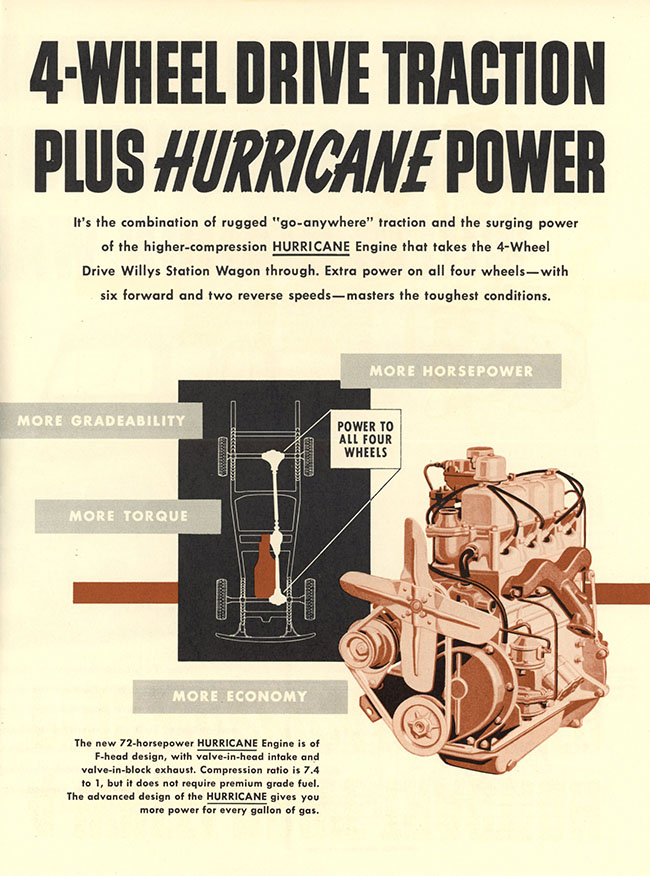
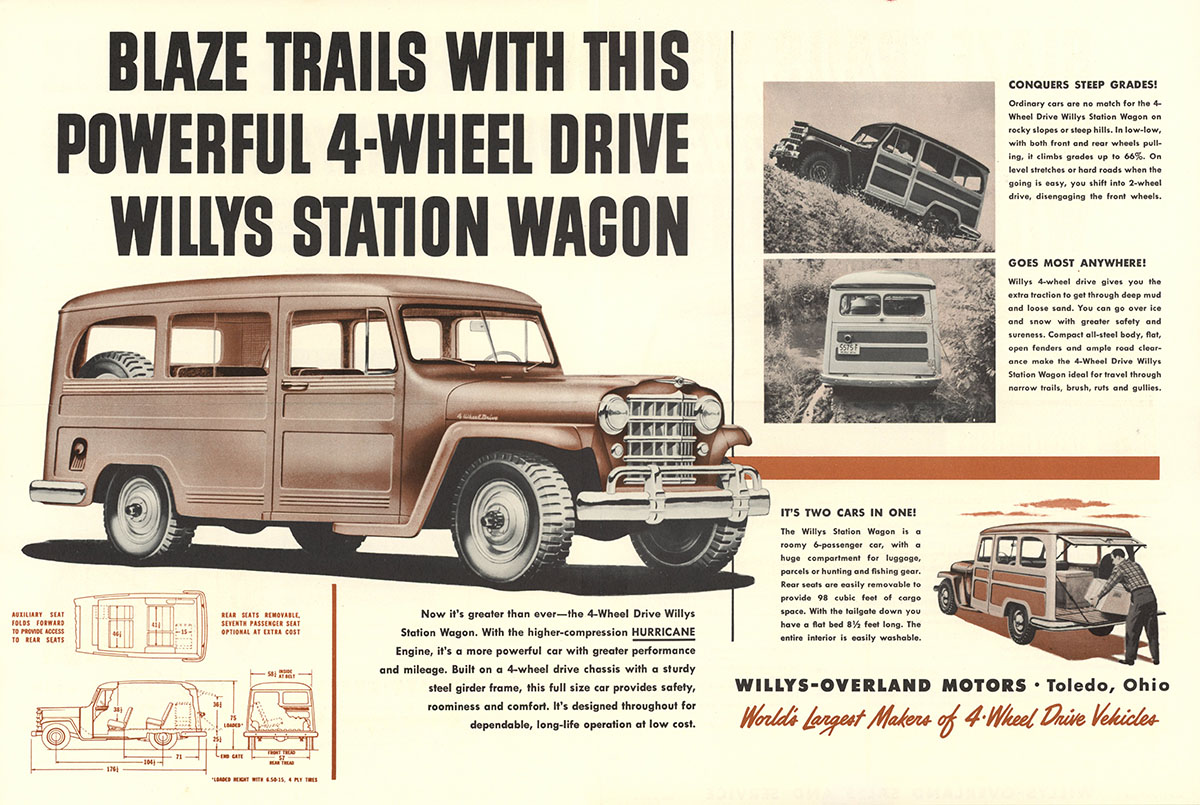
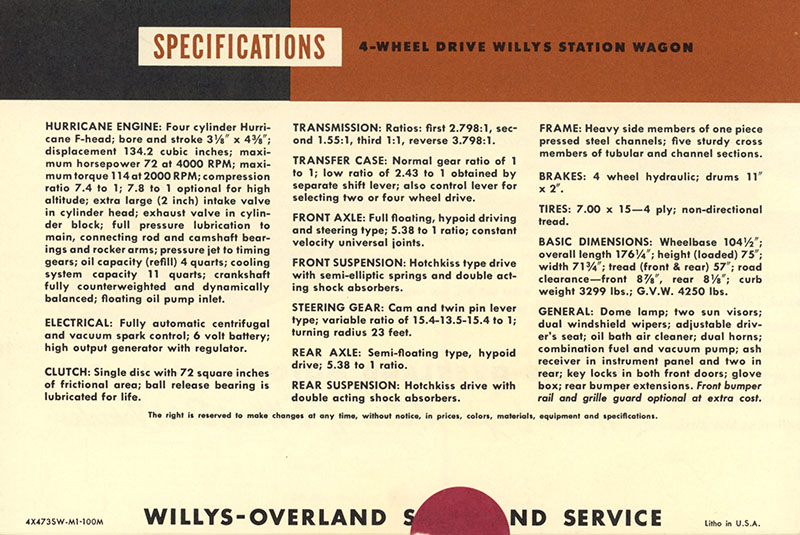
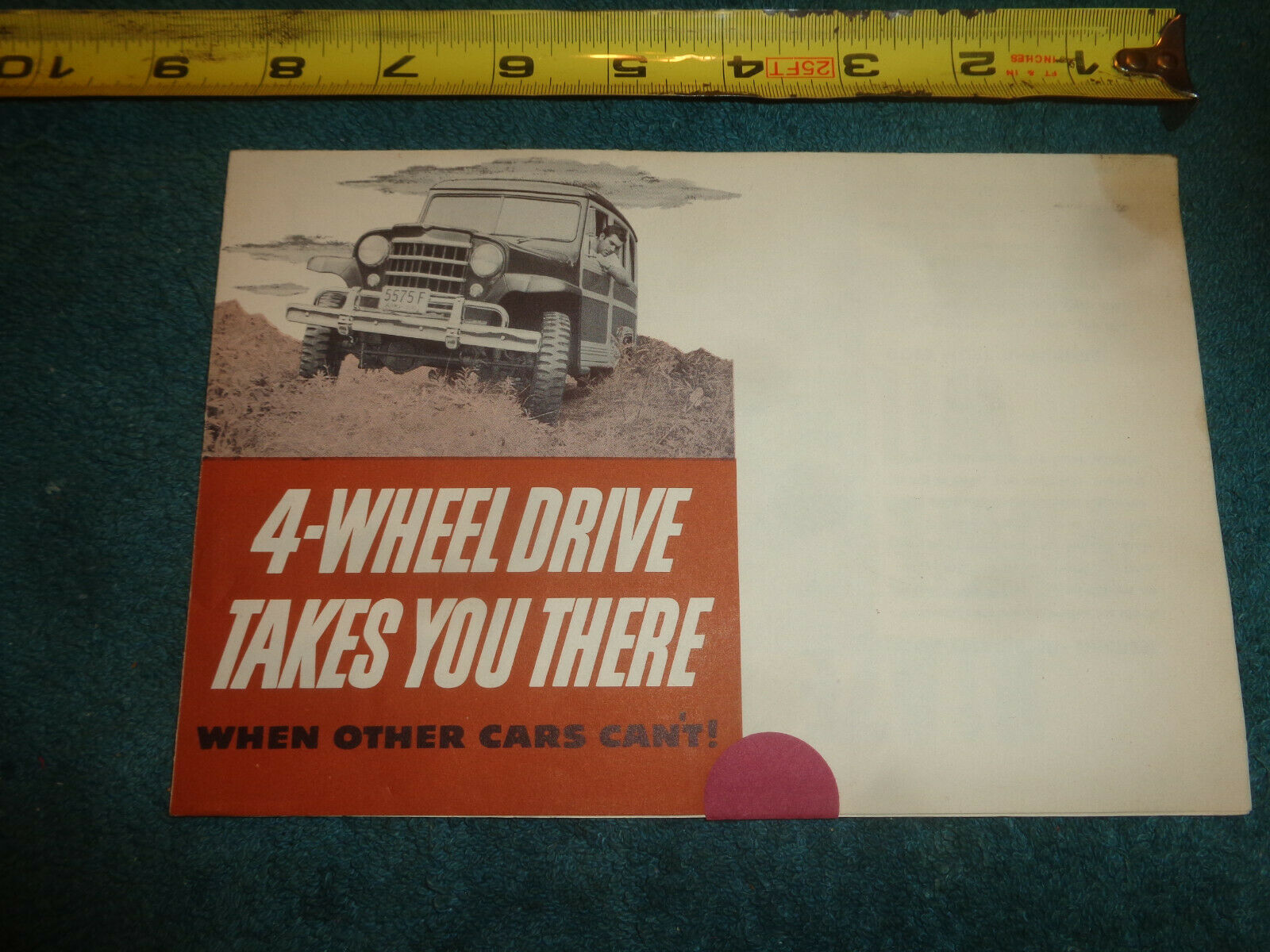
In 1951 Willys-Overland launched a “4-Wheel Drive Takes You There brochure” for the Willys Wagon. Subsequently, there appear to have been two additional versions of the brochure, numbered differently, but with seemingly no additional substantive text changes. Each form folds out to a 17″x11″ large format brochure.
The first example of this brochure is burdened with an unusually long form identifier: Form 4X4735W-M1-100M, a number which leverages the wagon-model-type (4x473SW) as part of the numbering system.
This second version of the brochure is available on eBay. Given the grille style doesn’t change for this iteration, I can only assume that this version of the brochure was also printed in 1951. It has the updated form name of 4X4735W-M2-100M-251. It is possible the “251” at the end of the form number means it was printed in February of 1951.
UPDATE: Additional content has been added about Sandifur Motors.
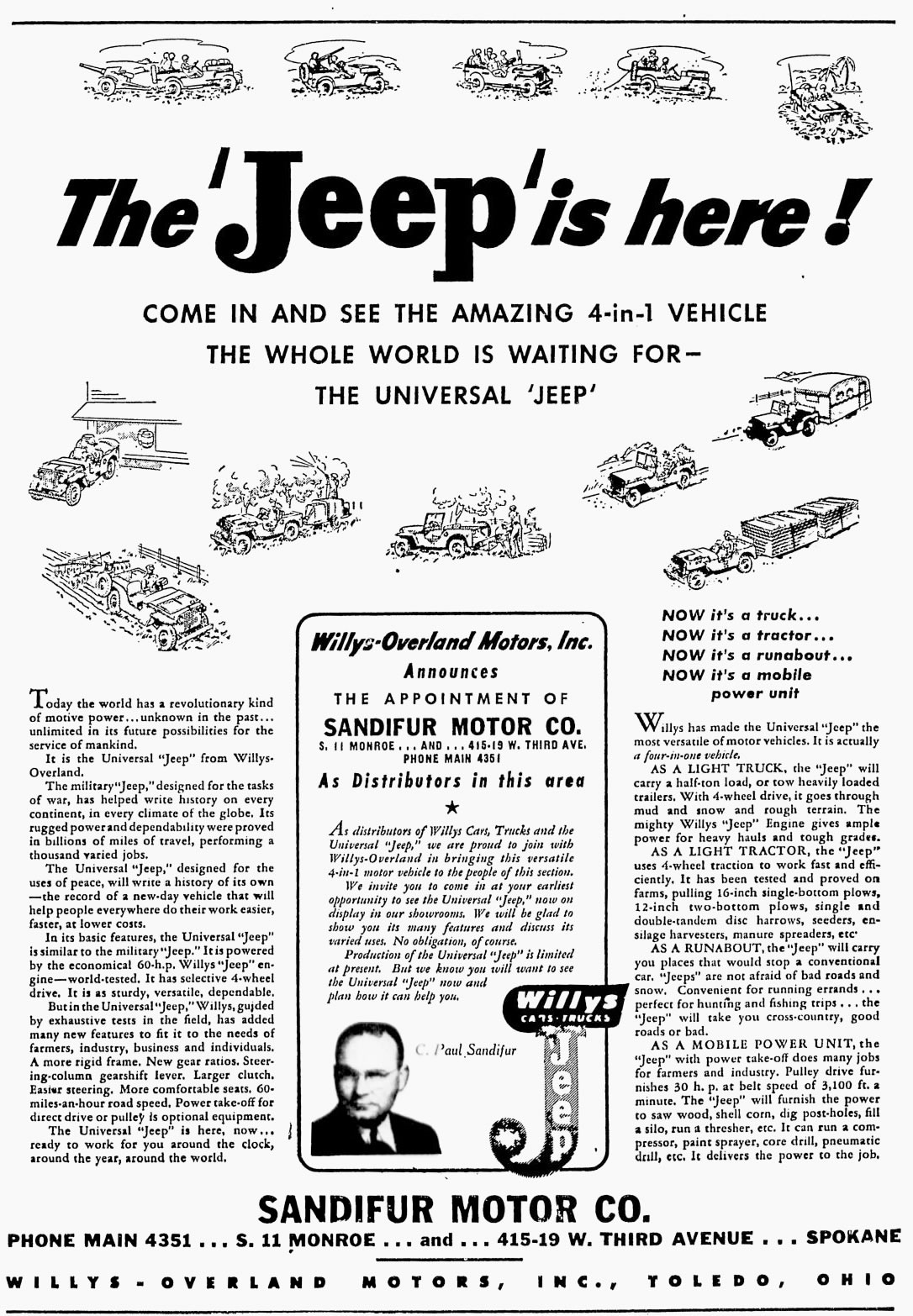
Originally established in 1937, the Sandifur Motor Company out of Spokane, Washington, was operated by Charles and C. Paul Sandifur. Brothers and business partners, by 1938 the two men were involved in taxi cabs, used cars, life Insurance, and other business pursuits in the Spokane region.
October 21, 1945, ad published in the Spokesman Review
As best as I understand it, being a distributor meant Sandifur Motors could both sell jeeps and signup other dealers.
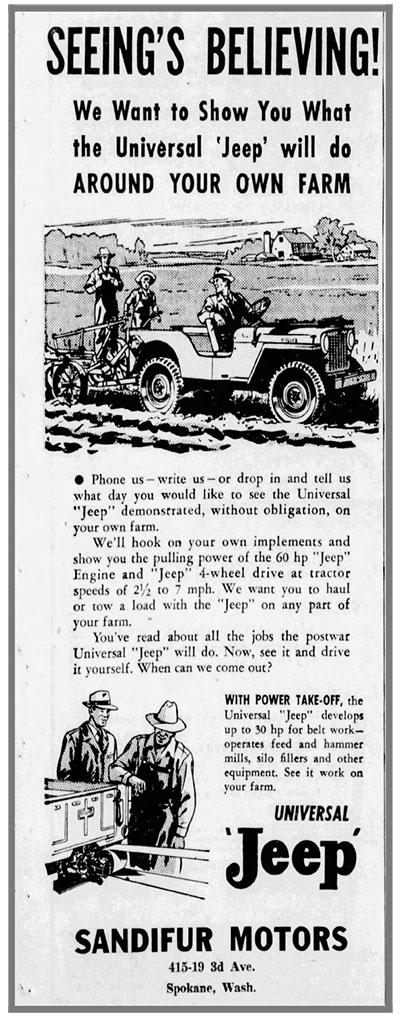
The company seems to have followed the standard line of advertising, as this 1947 farming ad shows:
As we’ll see in a moment, Sandifur was successful at selling jeeps, but I can’t imagine CJ-2A was very practical for farming in the Spokane region, in part due to the size of the farms. For example, my maternal grandparents obtained a 160 acre farm 35 miles southeast of Spokane on the small banks of Fighting Creek, Idaho, a place they won in a lottery around 1910, then secured by homesteading. In the 1920s they founded the local Fighting Creek store and operated one of the first phones in the area (we still have some of the books that documented the calls). They also made money logging the local forest and, after WWII, electrifying the area. Had they thought a jeep was practical, I believe they could have afforded to purchase one. Instead, they preferred to use tractors.
My family’s decision to abstain from buying a jeep did little to slow the success of Sandifur Motors. It’s possible the company was doing better selling wagons and trucks versus CJ-2As. I could imagine four wheel drive versions of the trucks and wagons being very handy navigating the endless forests and deserts of the Inland Empire area. This may also explain why both long-wheel base CJ-2As (likely the CJ-2Ls) and CJ-2As with 6ft extended beds were available for sale from both Spokane and Montana dealers (more on this in an upcoming post).
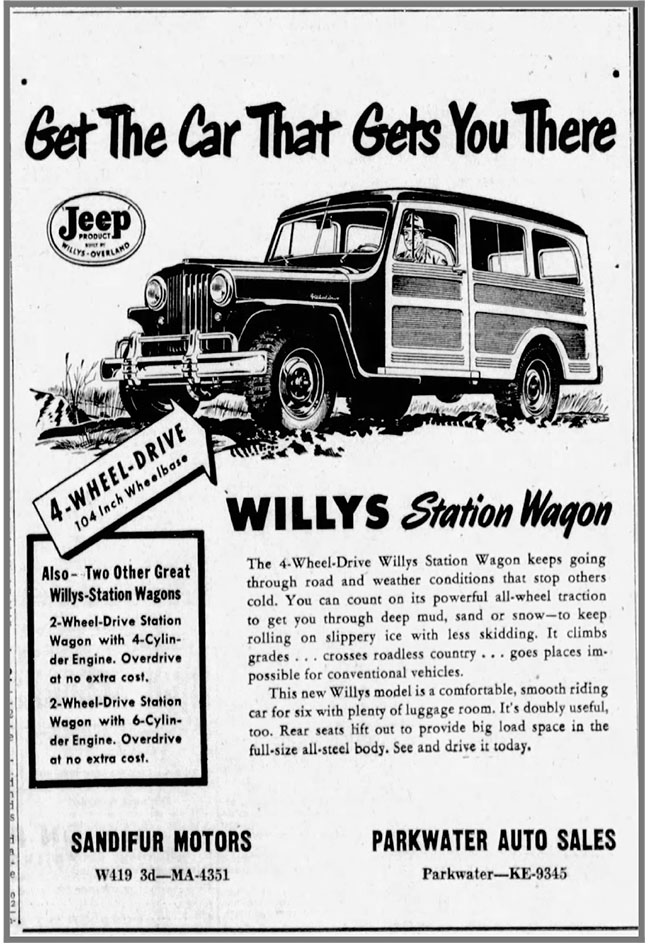
Here’s a 1949 ad promoting the wagon:
October 17, 1949, Spokesman Review
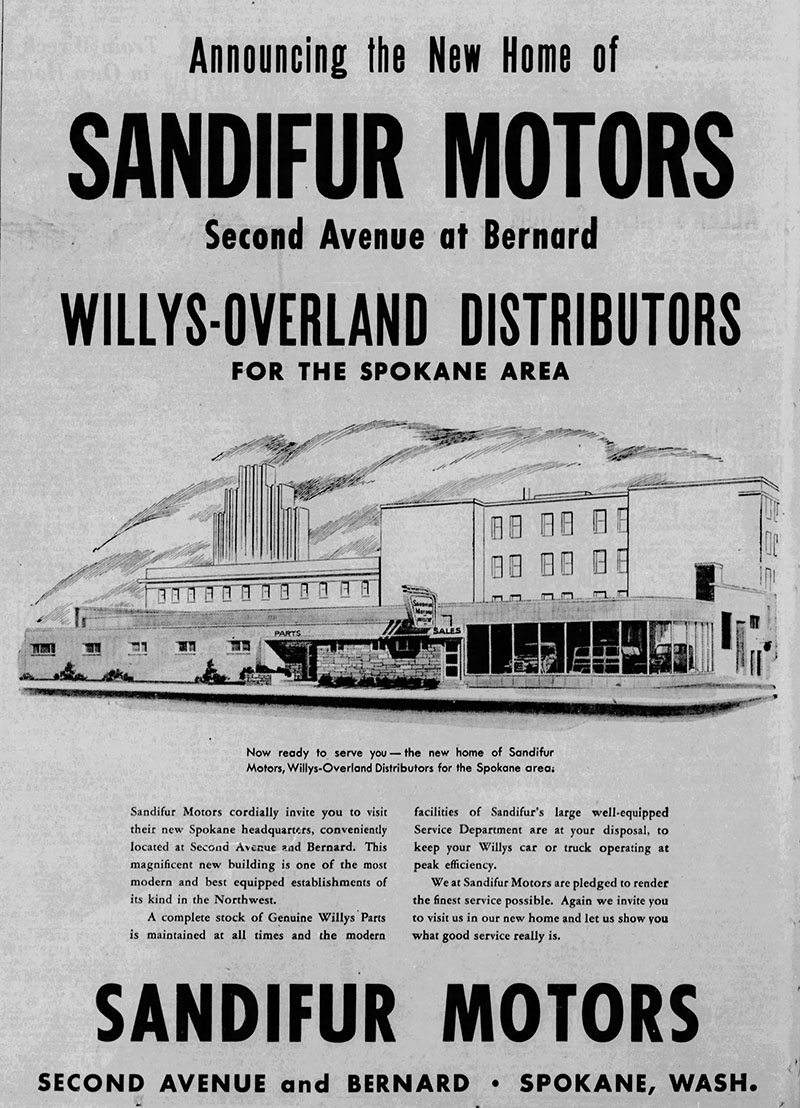
Whatever the company was selling, it was selling enough of them to justify new digs. In early 1951, the Willys dealer moved from its original location at W419 3rd Avenue, to W228 2nd Avenue in downtown Spokane:
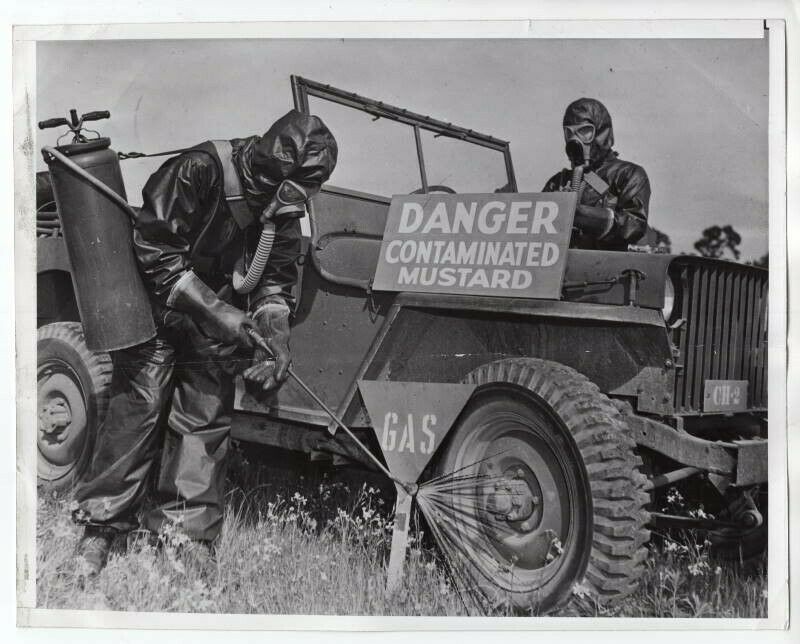
I can only imagine how awful those suits were to wear in the California desert, even in March. My wife tells me that even the modern-day chemical warfare suits are terrible.
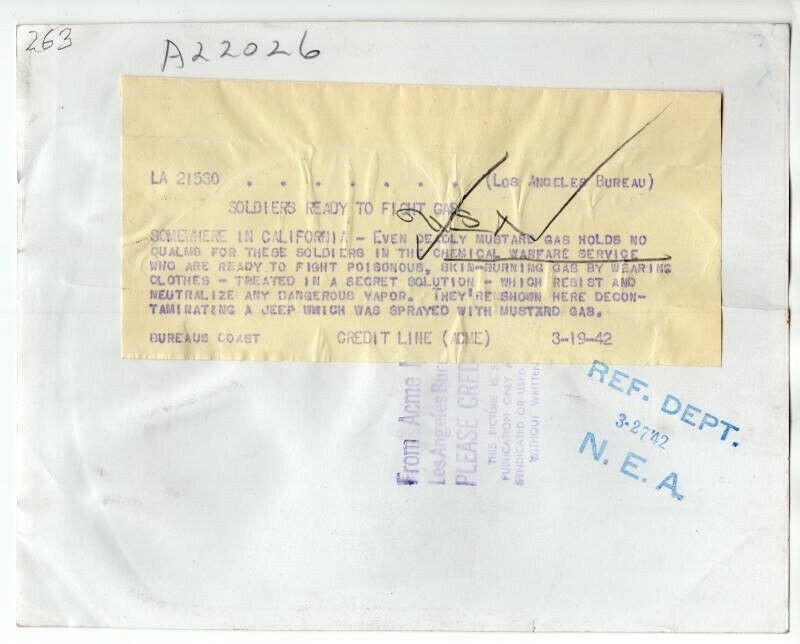
“SOMEWHERE IN CALIFORNIA — Even deadly mustard gas holds no qualms for these soldiers in the chemical warfare service who are ready to fight poisonous, skin-burning gas by wearing clothes–treated in a secret solution–which resist and neutralize any dangerous vapor. They’re shown here decontamination a jeep which was sprayed with mustard gas. 03-19-42”
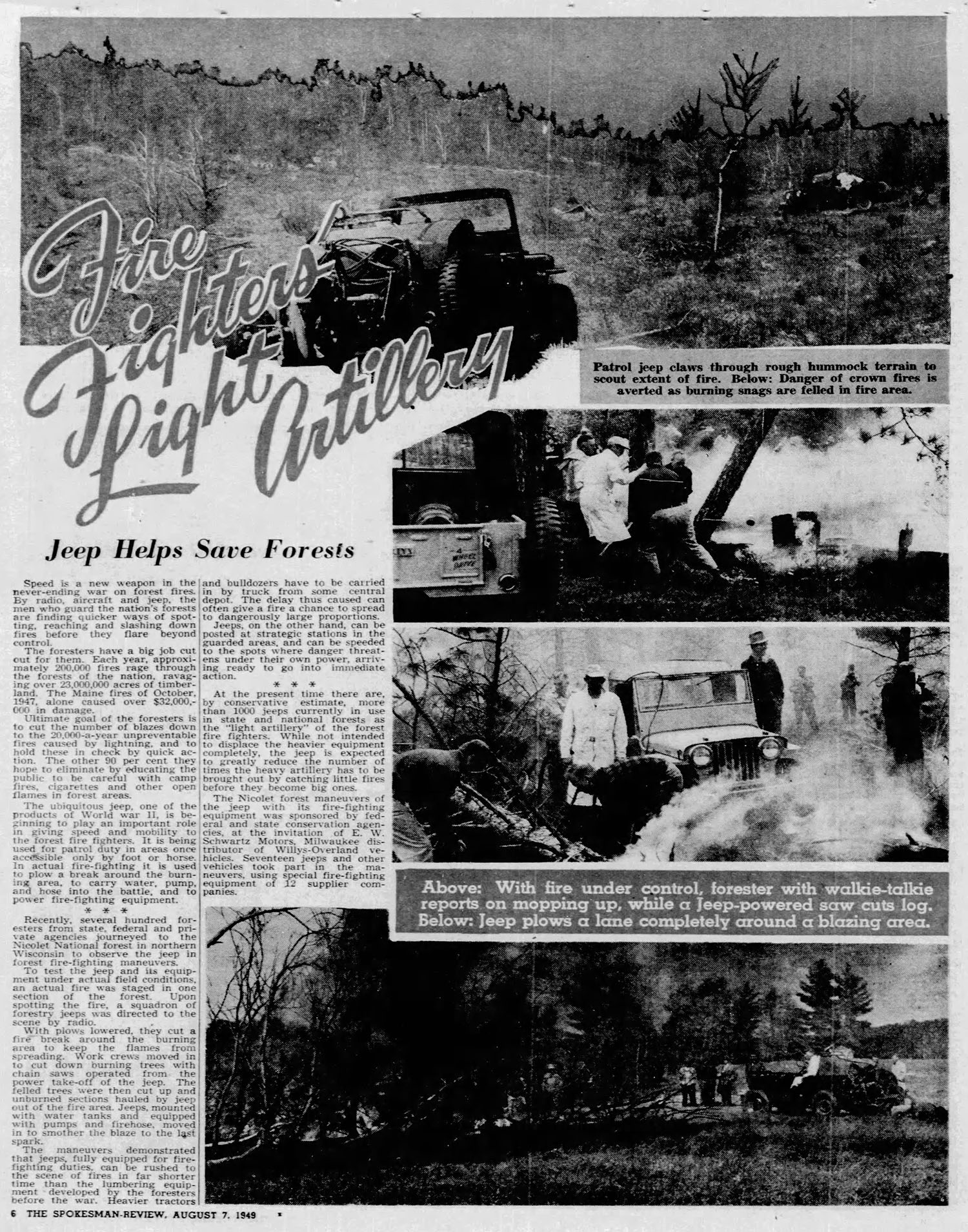
(Given fireworks have arrived, this article seemed appropriate …) This August 07, 1949, article was published in the Spokesman Review out of Spokane, Washington, but it likely originated from a Wisconsin news report. The article mentions Nicolet National Forest, which is located in Northern Wisconsin, and the event was sponsored by E. W. Schwartz Motors out of Milwaukee, Wisconsin. One interesting statistic noted was that conservative estimates put the number of jeeps in service in state and national forests at over 1,000 jeeps by the summer of 1949.