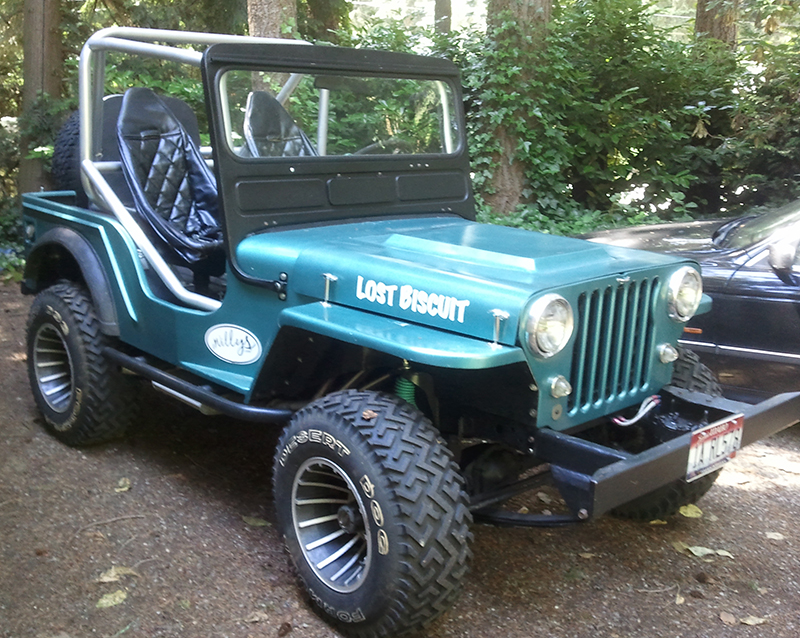
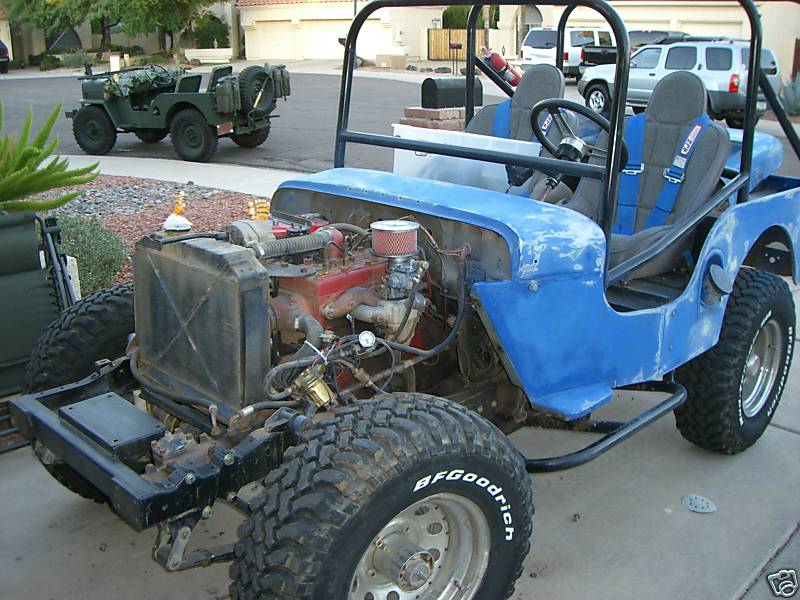
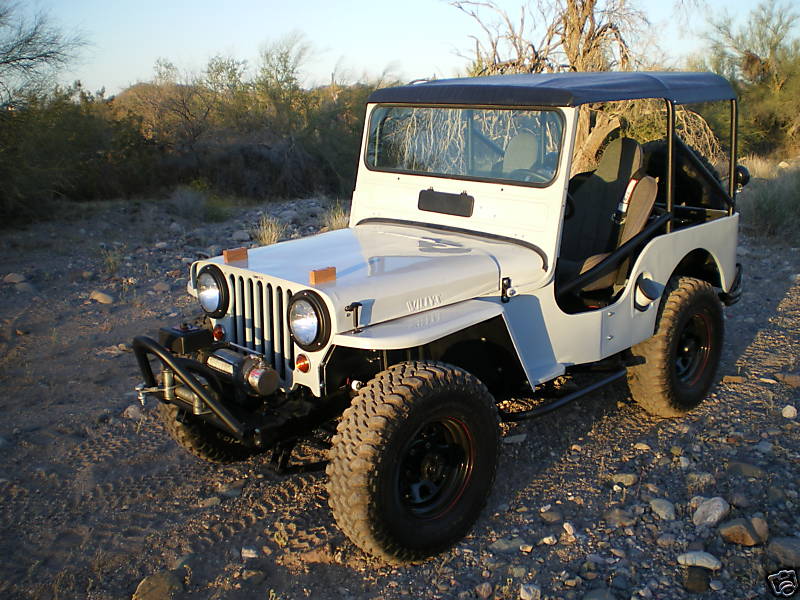
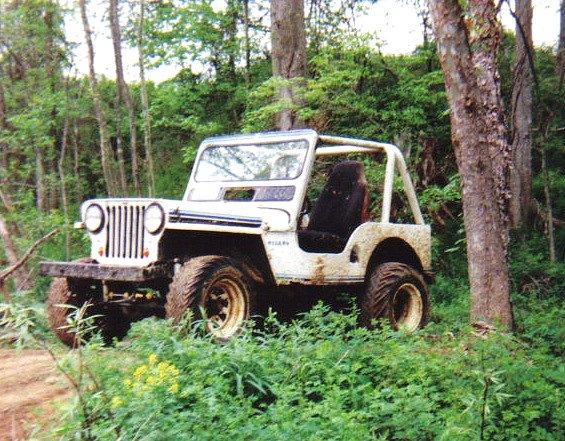
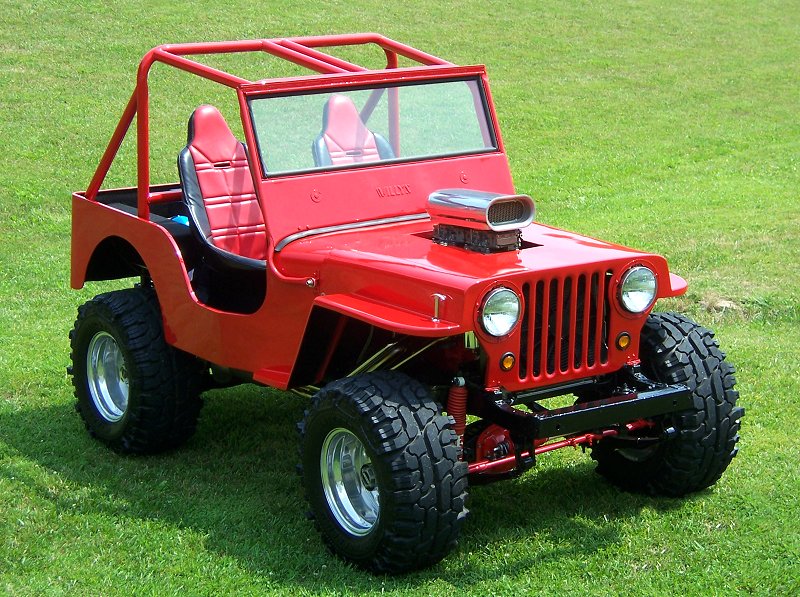
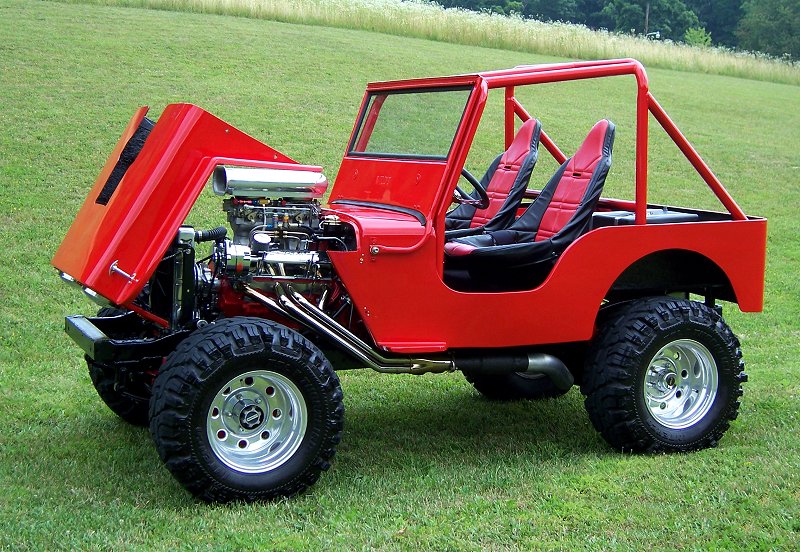
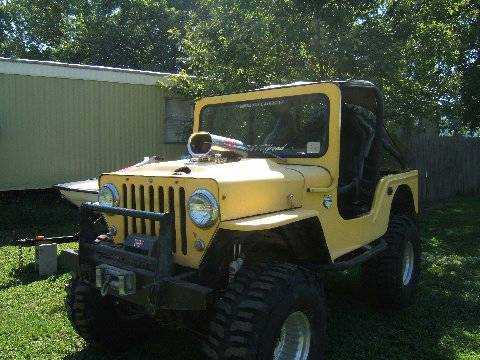
As you can see in the pics below, just taking off the metal and painting it green has done wonders for this old M-38.

As you can see in the pics below, just taking off the metal and painting it green has done wonders for this old M-38.
I gotta say I like this jeep. There’s enough old school stuff to make me smile. Check out the battery, the roll cage, the art on the back, the dashboard, the gauges, the gas pedal … I could go on.
The owner of this jeep is 16 year old Trevor, who inherited it from his father. Trevor’s going to make some updates to this jeep, such as adding power steering. He asked for some advice regarding steering so naturally I asked for pictures.
Trevor wrote, “thanks so much for your time and advice! it really means a lot to me cause i wanna get this thing out on the trails like my dad did back in day.”
If you weren’t following it, Boomer, James and I were have a short conversation about Slat Grilles and how there are only a few Slat Grilles buit with a Glove Box. Apparently, early MBs (1941 dated slat grill) did not come with a glove box (maybe I was the only person who didn’t know that …). Glove boxes were not added till ser# 120680 (early to mid Feb. 1942). It made realize how little I actually know about Slat Grilles beyond the slat grille itself.
Boomer mentioned that he has a MB with the serial# 122723 born February 26, 1942. Glove boxes were added about a week before his was built. Of course, at that point I said ‘tell me more & send me pics’! Thanks for sharing!
Boomer not only sent some pics, but provided some nice history. My slat came from the original owner, who bought it 1946. It was originally bought from an Army Air station in Maine.
Total slat grill production was approximately 25,000 units or approximately 3 percent of total WW2 jeep production. Of those, only about 10 to 15 percent were equipped with a glove box. My research suggest there are barely 150 running/restored slat grills left in existance world wide.
Regarding the trailer, it was saved by me from a local farm. It was being used as a horse trough. Date of delivery was June 1943. It was made by Willys, otherwise known as MBT.
This is how I found it;

http://i33.photobucket.com/albums/d55/boomerangsrd/MBT%20June%2043/004-5.jpg?t=1253553944
Nearly finished,
UPDATE: James wrote me tonight saying he’s made additional progress. Check out the paint job: beautiful! You can check it out at his website.
(Aug 11, 2009) I ran across this website today where James is thoroughly documenting the rebuild of a 1947 that was parked by his wife’s grandfather 40 years ago in a barn and left there. One observer voiced some concern that it was the jeep holding up the barn and if they moved it, the barn might just give up and topple over.
According to the blog, James has been working on this about 2 years now. In the picture below, MetalRehab had just finished cleaning all the body parts. Recently, the parts were dropped off at Everman Paint and Body to get some body work done and paint (I think I’m right about the paint part).
And below is the engine running after a great deal of work cleaning all the parts.
James, obviously a man of high taste (I can tell this as I found a link back to ewillys on his site 🙂 ), would make a grandpa proud with this rebuild.
Yesterday (and today) I have enjoyed some correspondence from Sebastian, who hails from Colombia and currently resides in Pittsburgh, Pennsylvania.
In 1994, Sebastian and his father (who owns a blue CJ-3A), rebuilt a red 1954 CJ-3B, which can be seen to the right and viewed at the CJ-3B Page (sixth down from the top).
He writes, “My Willys is still in Colombia, so I only ride a couple times a year. Last May I went there for a week and put more than 250 miles on the jeep in less than five days. A couple years ago I became aware, and joined, the “Flat Fender Club of Butler” which is close to Pittsburgh. Butler is the place where the “Bantam” factory was located (the building is still there) and, therefore, it is the place where everything related to the Jeep started. The club is formed by a very nice group of people who are crazy about old willys. You can see some of the recent events and history of the club at: http://flatfenderclubofbutler.wordpress.com/ This blog also shows some pictures of the owners and our new T-shirts and Caps!”
For all the customizations I’ve done, I have to say I was still surprised, delightfully so, to receive this update from Brian about his metamorphasis of a GM sending unit into a Willys tank. Maybe it is just me, but it simply never occurred to me to try something like this. Moreover, as I turned Brian’s work into a post, I learned a great deal about gas tank sending units. Thanks Brian!
A quick note. After doing some research, I discovered one of the most common reasons for the older gas gauges to stop working correctly is a bad ground. So, if you are having problems with your old gas gauge, check the ground at the gauge and/or sending unit.
Take it away Brian:
I have tackled a variety of planned tasks on my CJ-3B, but as with any project, I’ve run across some unexpected issues as well. My gas tank sending unit is a perfect example.
*** DISCLAIMER: Before I begin, please be advised that when doing modifications to a gas tank it would be prudent (understatement) to drain and dry the gas tank. I hear gasoline is very explosive!!! ***
Prior to installing my gas tank, I decided to use an ohmmeter to test my sending unit to make sure it was in good condition. Unfortunately, I connected my ohmmeter and discovered my unit was dead. So, I thought this was a perfect chance to install a modern sending unit.
Btw, you can visit the 1945gpw website to get a nice overview about how to use an ohm meter to trouble shoot your old Willys sending units.
The stock unit on my CJ-3B is 40-0 ohm’s (which means the ohm meter would read 40 ohms when full and 0 ohms when empty). As I am upgrading my gauges to auto meter gauges, I had to make sure I selected a gauge that would work. There were four different gauges to choose from: 90-0, 30-0, 8-73, and 33-240 ohms. Note that the last two gauges are backwards for our purposes — the gauges would have read full when empty, and empty when full (if they worked at all). Also with my new gauge, I felt I would run into a problem with the ground, so I decided to replace the sending unit and make it work right.
I had replaced a GM in-tank pump and sending unit on a friend’s truck and found a GM sending unit would fit though the tank opening of a Willys. So, with that in mind, I started by disassembling the old Willys unit. First, I removed the sending unit and the sending unit base from the gas tank. Next, I separated the sending unit from the base as I will be reusing this base (with some modifications) using my drill press.
With that apart, I turned my attention to the GM Assembly. I removed the sending unit off the GM assembly by cutting the tube up high. I went over to Mick C. and we machined a plug for the old unit (a machinist is a good friend to have!). This GM unit is 90-0 ohms, a perfect match to the Auto Meter 105-2641 gage. It is also internally grounded, note the two wires.

Here is the unit assembled. The new plug had a hole in the center so I could run the new gas line through it. Also, the plug had a hole for the wires as well. I drilled three holes around the radius of the sending unit base and welded the plug in place. You can see the welds in the image below.

Note the J-B Weld. There is about 1/8″-3/16″ between the top of the plug and top of the unit. I used J-B Weld to pot and seal the unit. J-B weld (http://www.jbweld.net/products/jbweld.php) claims to be resistant to gas (from the website: “It’s strong as steel and impervious to water, gasoline, chemicals, and acids.”). DO NOT USE SILICONE!!!
[Editor’s note: Mitch mentioned months ago that he had a problem using J-B Weld to seal an old gas tank. Given the claims by J-B, maybe Mitch’s problem was more an adherence to the old tank rather than J-B itself? Any thoughts Mitch? This should be a good test of J-B and gasoline. ]
Now, I had to adjust the float to work correctly with the new unit. I cut the arm at the first bend from the float then turned it 90 degrees. I also cut the float down an inch.

Note: there is a pattern to the bolt circle on the old unit. Index the sending unit on assembly so the float will clear the internal wall in the tank. The wall runs across side-to-side; the float will have to do the same.

Adjusting the float was easy. I just held it to the top of the tank and bent the arm as needed.
One good thing about this modern sending unit is the rheostat can be replaced by removing two screws. You would have to get another one from a junk yard but can easily be rebuilt.
This works really well … I love these types of projects.
Brian
UPDATE: There was some interest in the Capstan winch from David’ part’s jeep that I featured the other day. Here’s some additional views of it.
You can still find parts for Capstan winches here, though they are out of the Capstan kits (which cost $2,650). Brian also runs a ‘Capstan’s for sale’ page, but appears all sold out at the moment. And here’s a little nautical history of the Capstan winch from wikipedia. And here’s some info from the CJ-3B page on the Ramsey Capstan Winch, including some pics of the brochure.

On his website about the CJ-5 he writes, “The restoration work was started in August 2005 and substantially completed nine-months later in May. During that period seven-months labor and about $4,500.00 in parts and material was devoted to this restoration. The job took longer than expected due to the deteriorated condition of the body, and me — relearning the restoration trade and techniques, and reading everything available dealing with old Jeeps and their restoration. This Jeep is a RESTO-MOD. It’s a stock chassis and drive-train with minor modifications in the electrical, brake system and body….”

Dan writes, “Sometime in the 1960’s my grandfather’s friend purchased a new Jeep and immediately swapped out the little four banger for a V8. My grandfather bought the new (at the time) 134 F head from his friend and installed it in his own 1955 CJ5 replacing the tired original 134. Over the years this second engine was rebuilt three or four times.

Today I just came home with an engine for the old CJ5. It’s a Kaiser odd-fire Dauntless V6. I found it behind a barn in a Jeepster C101 sporting a Volkswagen Bug body. (It was the ugliest “Jeep” I have ever seen). But the engine was still in tact and was running when parked. I made the guy an offer for $100. He pulled the engine and had it sitting on a pallet for me the next week. I took home everything from the radiator to the bell housing. He wanted the transmission which is fine with me. Someone had painted the valve covers red but you can see the original paint underneath. There was a power steering pump scabbed on which I will remove since I have a manual Saginaw box. It will be nice to breath the life into the CJ5 that my grandfather had wanted.

I have attached a few pictures of the V6. In one of them you can catch a glimpse of the old CJ5 in the garage.
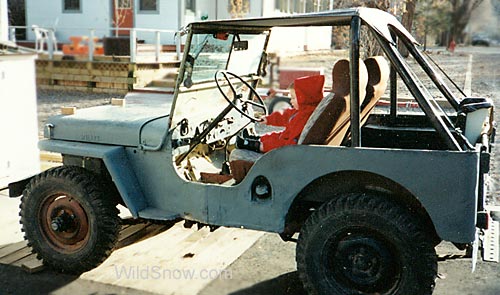
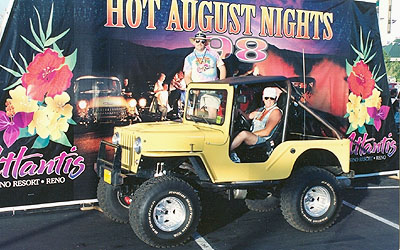
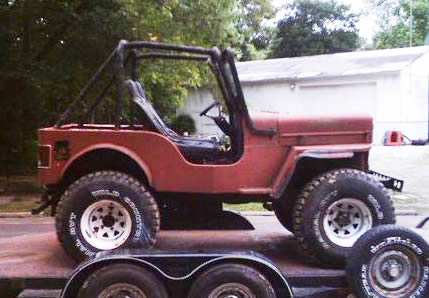
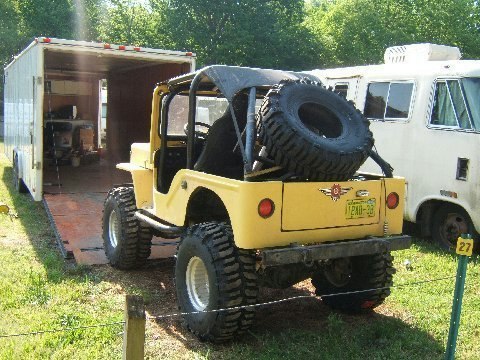
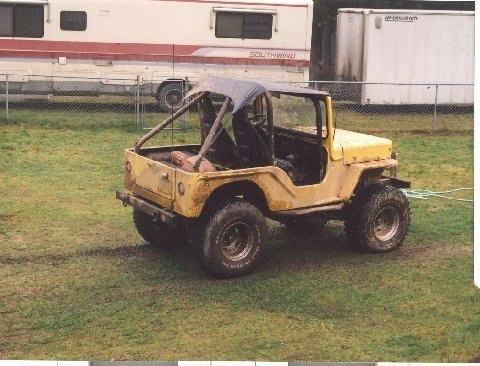
Chris is a 15 year old who wrote to me last week about a wiring question. Since then, he and I have been working through some wiring and brake drum issues. Here’s a little bit about his jeep and some pics.
Chris writes, “It’s a 1947 cj2a mostly stock, with a few mods. It’s got the stock engine and 6 volt wiring (I want to update it to 12 volt). I got it last summer from my grandpa down in oregon. He had picked it up in a field in Idaho (I think Emmet). Thats supposedly where my great grandapa had parked it after he used it on his cattle ranch since it was new. It sat there for about 20 to 25 years. At some point somebody took all of the brake lines, the master cylinder, and the brake pedal (but my grandpa found me a new pedal). The picture of the engine is when i dropped the transmission to put in a new cluch fork (you can see the old one on the radiator).”