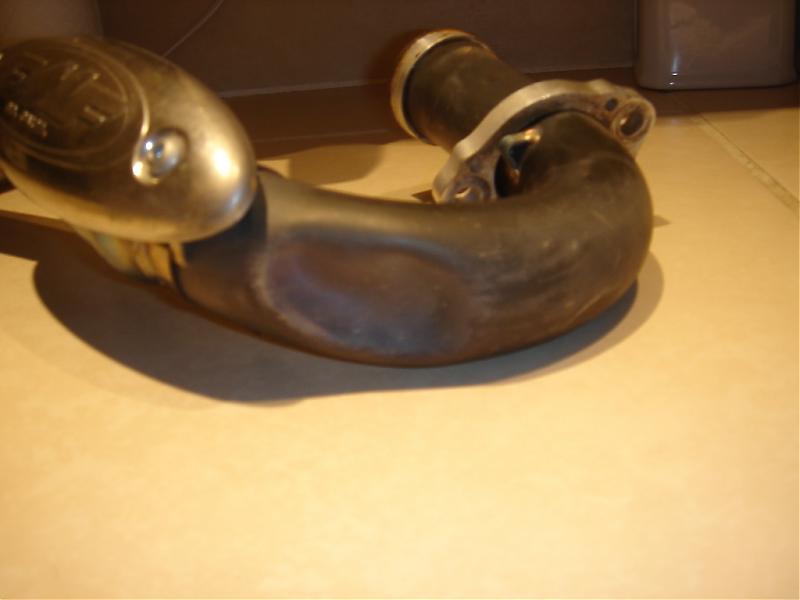
Have a dented header you want to fix? While combing the internet for advice on making my headers work, I came across this interesting solution for fixing dented headers. It involves water, a freezer, and some time. Note: I have not tried this, so cannot speak for its effectiveness
Features Research Archives
My Build — Operation Fender Lengthen Started
I've started the process of lengthening my fiberglass fenders. I've determined they need to be extended 4.5".
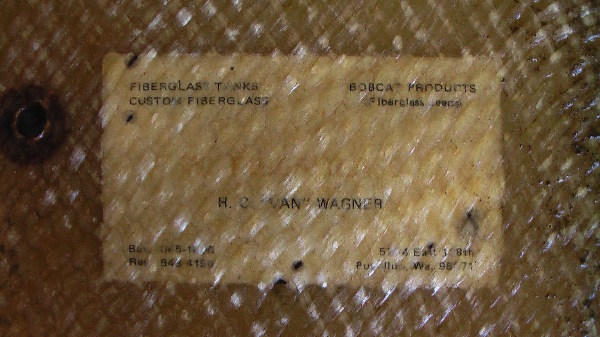
My first task was to clean the fenders. This yielded a surprise: Business cards from the builder of the body were embeded into both fenders. To the right a shot of one of them. The information suggests the seller was H.C. "Van" Wagner out of Puyallup, Washington. He sold Custom fiberglass products including Bobcat products. The name of the company has faded, but I have the address and phone info.
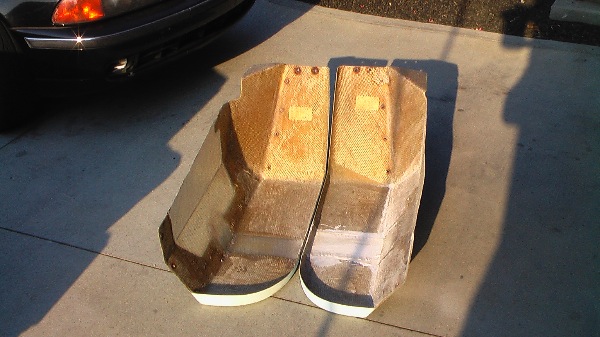
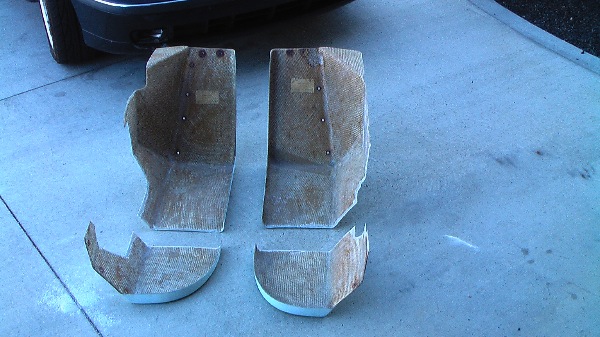
Once the fenders were cleaned, I cut them in half and I cut out the indent (traditionally for the battery) out of the passenger side. Once they were cut, I tapered down the cut pieces. To the left are the cut fenders.
The next step is to fiberglass them. I'm going to try laying down a layer of gelcoat and then lay the fiberglass over the top of it. I' haven't used gelcoat in my previous patching jobs, but am trying to gain experience so that I can use it when I do my custom hood project.
Craigslist — A study in honesty
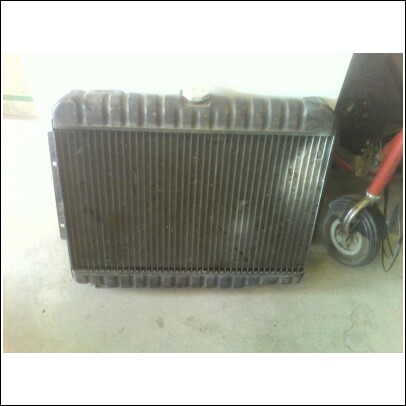
As a number of readers can attest, I've done a variety of craigslist deals (probably close to 40). This time, I had a '73 CJ-5 radiator I wanted to sell, so naturally I listed it on Craiglist. A potential buyer contacted me and said he was very interested, but couldn't come look at the radiator until after I had left for Seattle. So, I told him I would put the radiator outside and if he wanted it, to put the money into an envelope I pinned to the house.
Sure enough, two days later the radiator was gone and the money was inside the envelope. I was happier about the honesty than about the money 🙂
In fact, I've only had one deal where I didn't get all my money. I swapped a dirty 350 Cadillac motor I really didn't want for some guages, competition coil and a few other parts. The kids I swapped with was maybe 18 and didn't have a way to pickup the engine, so I said I'd charge him gas money to deliver it. When I got there he said he didn't have the money yet, but would mail it. Unfortunately, despite a couple reminders, I still haven't gotten the money. I plan to stop by his house next time I'm driving by (he's over an hour away) and remind him in person again.
The Former Pittle Power
I just got some pics from the owner (who shall remain nameless until he sends me his name 🙂 ) of the jeep formerly known as Pittle Power (I remember it as Piddle Power though). I don't remember the history of the Jeep prior to Jim and Patty Carter purchasing it, but I believe they purchased it so their growing boys, Tim and Steve, wouldn't have to squish themselves into the back of Otis. They purchased a stock CJ-3A, installed a chev 4cyl and attached desert dogs. Otherwise (I'm told) they left everything else stock. Pittle might not have had much power (hence the name), but it could go 99% of the places the modified WWJC jeeps could go.
The Carter's had a habit of naming all their vehicles. There was Otis (the jeep), tote-us (the jeep trailer), Brutus (their first motorhome) and more.
Our To-Be-Named contributor writes:
"The Jeep I bought was owned by Jim Carter(original member of the WWJC). The race name was Pittle Power. Skip Baird helped me with my first swap with a V-6 and a top loader. Al Hamilton and I became very close infact I still have one of his pups Mandy she is a very stubborn German Shorthair."
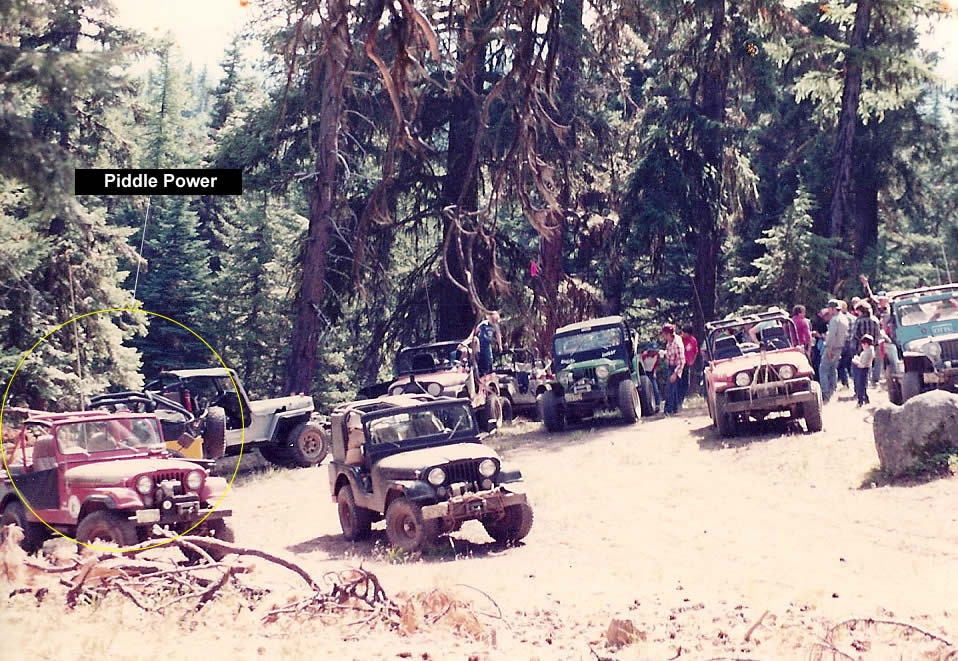
Editor's note: To the right is the only picture I have of Pittle Power from 1983 (and it's only the hind quarter) hidden behind Danny's CJ-5. While the Pittle Power was never actually raced, I do remember a club trip to Liberty Trail one weekend. After we made camp, Tim Carter decided he wanted to head down to the store and asked me to ride shotgun (somehow he knew there was a remote store at the bottom of the hill we were camped on). So, he drove me down that hill in Pittle Power, a ride I remember vividly because we were travelling sideways down the constantly turning gravel road for a good portion of it. Come to think of it, one time Tim took me for a ride in his late 60's camaro and we travelled sideways heading onto the cloverleaf on ramp to I-405. Maybe Tim always travelled sideways or I just brought it out of him.
Fiberglass Body and Grille
Here's a few pictures of the Body and Grille I grabbed while down in Springfield, Oregon a couple of days ago. I need to get a few better pics of it. I've got it listed for $450 on Craigslist.
The outside of the body is in excellent shape and would make a great racing shell for PNW4WDA racing. The interior of the body is well designed and strong and could make a good jeeping/street body, however the plywood attached to the bottom is bad in spots, but could be fixed pretty easily. Also, the firewall has an extra large opening that needs to be closed. Otherwise, the body looks straight and is pretty light.
Willys Woodies
I wandered across this website in 2008 that showcases old woodies. There’s a jeep section with a variety of woodies. The woodie at the bottom is made from an old MB/GPW.
“A French coachbuilder’s modification of the American Jeep into a wood-bodied fire fighting squad truck is similar to the work of Duriez.”
My Build — Transfercase Shifter
While you can purchase a dual shifting unit from Novak for your Dana 20, it's also possible to fashion one from scratch. Note that I've never used the dual shifter on a Dana 20 transfercase without removing the center pins that move between the shift rods in the the shifting tower. To remove the pins, you have to remove the shift levers, drill out the plugs on the sides (note where the red gasket sealant is on the side of the shift tower, and then slip out the oblong pins (they are elongated metal balls). With these removed, you can push and pull the levers all you want (but don't try running high range in the front and low range in the back unless you feel the need to break something).
How the transfercase shifting works
There was a question about how the shifting in my transfer case works. (http://www.ewillys.com/?p=797)
The shifting might seem unusual, but it's not. What's unusual is that I have removed the pins from the shifting tower that slide back and forth between the shift rods. This allows for more shifting options. To take advantage of those options, I installed two rather than one stick. You can see that here in this video I made.
Here's an image the also demonstrates how the shifting works. Please note if it doesn't make sense:-)
Builds — Brian’s working furiously on his CJ-3B
Brian sent me some updated pictures of his CJ-3B project. He just finished reversing the springs in the front. As a part of that reversal, he had to replace the front of the frame. After conquering this task, he turned his attention to the rear differential, only to discover a big problem (which he'll update all of us about as he progresses through the issue).
Brian explains more below about his spring reversal experience below ….
"I wanted to do a spring reversal so I started by getting some universal after market parts to make things a little easier. Then I bought a early Cj5 frame for the front 8 inches then sold off a chrome bumper and ring and pinion at a small profit.
Here's what I did to lengthen the frame.
I cut a block to use as an template to cut off the front of the 3b frame. (Stan H. — from the Wandering Willys Jeep Club — always said to cut at a 45 degree angle though the frame.) I did the same with the pieces to be added. They lined up really nice.


My Build — A Custom Data Plate
Yesterday I made a first pass at a design for the gauges on the dashboard. As a part of that exercise, I tried to find a space for the data plate I have. The data plate is original to the CJ-3A I have and in good shape, except that it is faded, so it is hard to read. In fact, I tried to scan it into my scanner and the scanner couldn't pick up the words or pictures at all. After pondering the situation, I decided to recreate a data plate graphic and take it into a print shop to see if I can make a raise print or sticker of some kind. As part of the customization, I've tried to recreate the fonts as closely as possible, however, much to my surprise, the data plate uses several different fonts, some of which are the same font but stretched or bolded or both. Also, I've updated the data plate to better reflect the drive train I have installed.
Here's the current favorite mockup so far (note the font kerning and arrangement will be more precise on the final high resolution version).