emailNeed to contact me and don't have my email? Click on email button.
About eWillys
Welcome to eWillys.com, a website for vintage jeep enthusiasts. I update this website nearly every day with jeep deals, jeep history, interesting reader projects, jeep related info, and more.
These quick searches can help you find things on eBay. People list in the wrong categories all the time, so don't be surprised to see brochures in the parts area for example. This section used to be split into jeeps, parts and other categories, but recent changes to eBay will require this information to be recoded.
The links to posts below show jeeps grouped by models, condition, and other ways. Some of these jeeps are for sale and others have been sold. If you are unsure whether a vehicle is still for sale or not, email me at d [at] ewillys.com for more info.
Importantly, the allure of buying a project jeep can be romantic. The reality of restoring a jeep can be quite different, expensive and overwhelming without the right tools and resources. So, tread carefully when purchasing a "project". If you have any concerns about buying a vintage jeep, or run across a scam, feel free to contact me for help, comments or concerns .
For you Desert Dog lovers out there, Gordon shared a 1977 magazine ad that showed Chuck Conners pitching Dodge Trucks. Interesting enough, the truck was equipped with Desert Dogs (unmentioned in the ad).Unfortunately, I downloaded the pic a week or so ago and can’t locate it at the moment.
However, I was able to locate a commercial, also featuring Chuck, that has a
shows off a 1977 Dodge Pick Up PowerWagon D-200 with Desert Dogs on it (possibly from the same photo shoot). The tires are given a closeup at the 19 second mark.
UPDATE: I mistakenly listed this as an M-59, but I must blame the chills, fever, and general immune-system mayhem caused by my booster shot. That booster kicked my butt! But, I am all better now.
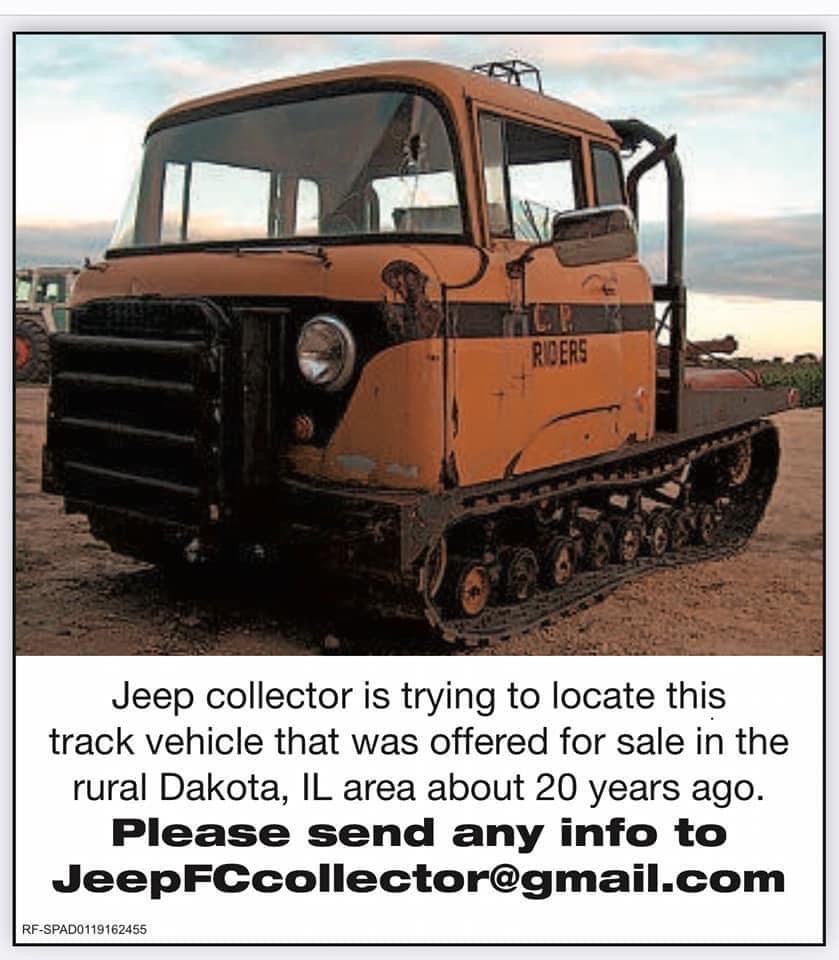
Grace’s husband and brother-in-law are searching for this M-29 Weasel FC. If anyone can provide help, please contact jeepFCcollector @ gmail.com (remove the spaces around the @).
“They have been looking to locate this M29 Weasel based FC cab vehicle. They have traced it from CP Riders (letters on the doors), to an Illinois farmer, to a broker 20 years ago in Dakota Illinois. They have made contact with that broker who says he sold it to a company in Pennsylvania who intended to use it for rescue and recovery on a Pa. mountain pass.”
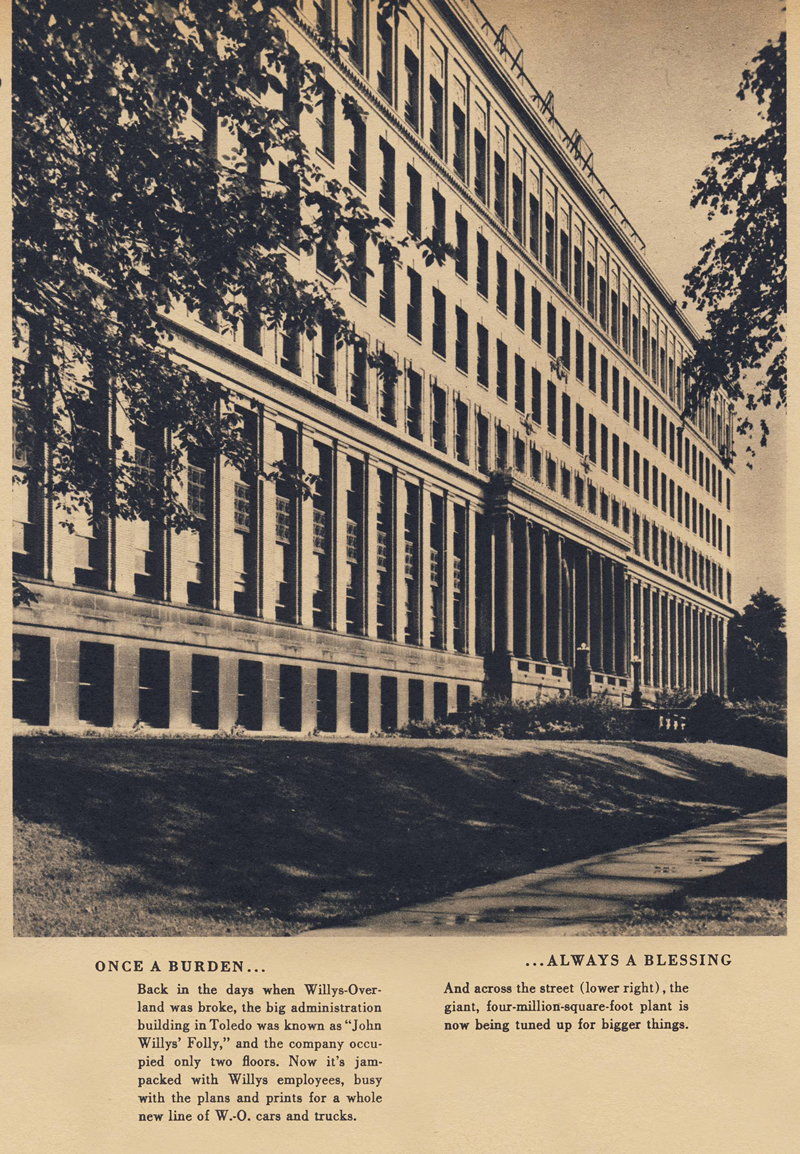
UPDATE: This post was published on eWillys November 15, 2014. I don’t normally post whole articles, but there is a great deal of interesting information within it. I’m reposting this today because there is some additional information about Mr. Clement Miniger and his Auto-Lite company leading a syndicate to buyout John North Willys’ stock in 1929 (Learn more about Miniger And Willys Light here).
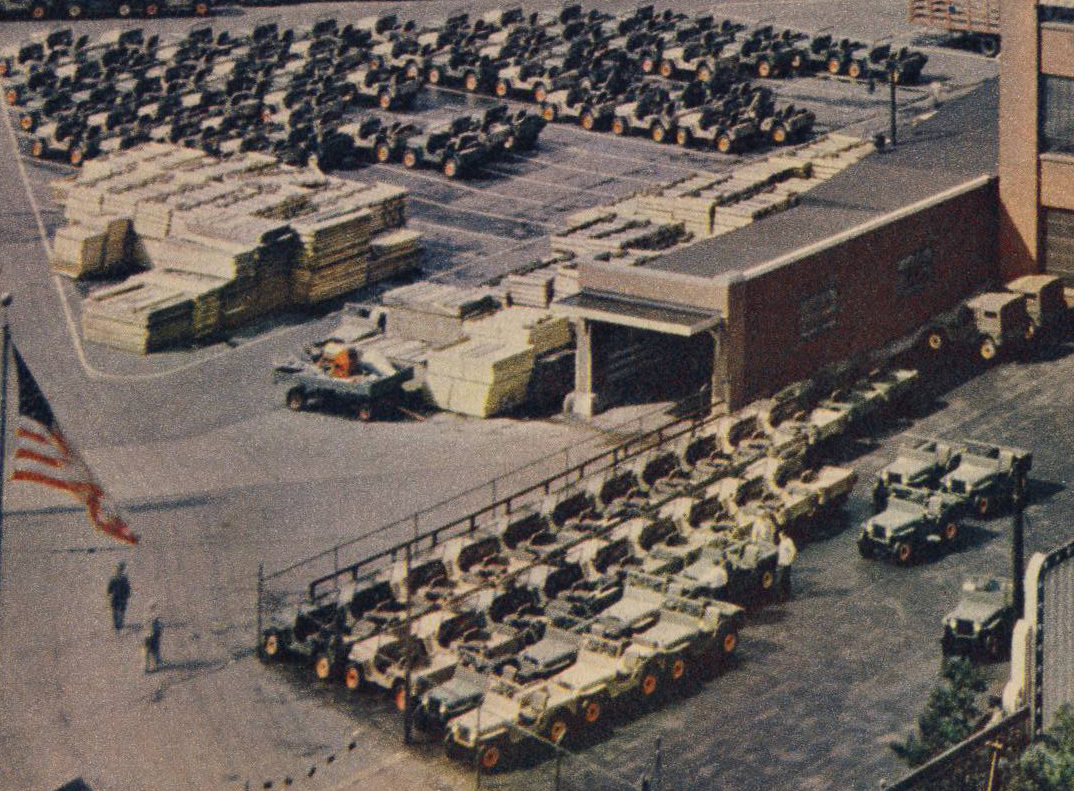
A variety of pre August 1946 CJ-2As in different colors waiting to be shipped from Willys-Overland’s Toledo plant.
This fascinating article was published in the August 1946 issue of Fortune magazine. It’s a LONG article that covers the history of Willys Overland Corporation from it’s bankruptcy in the early 1930s to it’s post-war market positioning. There is not much information specifically about jeeps, nor many jeeps photos. But, if you want to understand how the corporate structure evolved, it’s a good article.
One particular chart published in the article was Willys’ research on paved roads. The company felt that jeeps would be very popular in outer countries, due both to the brand and the lack of paved roads. To meet that demand, Willys planned to export 25% of all jeeps.
WILLYS-OVERLAND
THIS JEEP-RIDING AUTO INDEPENDENT IS TAKING NEW LEASES ON LIFE AND ITS OWN REAL ESTATE • THE BOYS IN THE BACK ROOM ARE DOING FINE
ln the years between the depression and the second world war, the once great Willys-Overland Co. clung by its nails to a niche in the U.S. automobile market. Gamely, it tried to sell the public a mousy little car, with a tough, four-cylinder engine, which was the cheapest thing on the road to run. Itself battered into receivership and reorganization by the depression, Willys had the patently sensible idea that such a car, guaranteed to get people from here to there at a minimum expenditure for fuel and upkeep, would be a blessing to a hard-pressed public that had not been similarly served since the demise of the models T and A Ford. But the public was proud, if poor, and more conscious of the millinery than the engineering of a car. When it had to buy cheaply it found the used-car market much more tempting. During most of those years Willys’ production ranged below the break-even point. bln 1940, a mere 27,000 cars were built. Now Willys-Uverland is coming up for the postwar round with a product line still topped by a light passenger car-with a four or a six-cylinder engine, buyer’s choice. It will probably be as cheap to buy, give or take a few dollars, as any 1947 car on the market, and possibly less expensive to operate and support than any of its competitors. And though it will be considerably more stylish, inside and out, than the prewar Willys, it will have, at most, simple good looks rather than breath-taking beauty. If that were the whole story, one might wonder why some people think Willys-Overland is an exciting proposition among the auto independents today, and why some mighty big boys in the automobile industry appear to be sparring for position in the peculiar, complicated Willys-Overland hierarchy.
Unquestionably Willys has fresh charms. To name four:
1) The tough, four-cylinder motor that was the bread-and-butter item in the prewar Willys is the same motor that powered the Army Jeep, which became an international byword during the war. As the largest producer, by far, of the Jeep, Willys-Overland became the beneficiary of this enormous, war-born prestige (and also added a tidy sum to its treasury). Ten days after V-J day, Willys was in production on its civilian or Universal Jeep, of which it had sold around 28,000 by June 1, despite plant shutdowns totaling eighty-three days owing to strikes in suppliers’ plants.
2) Under way at its giant Toledo plant is a Jeep-inspired line of Willys utility vehicles including (a) an all-steel, all-purpose station wagon, (b) a sedan delivery truck, and (c) a low-weight, medium-duty truck with a combination four and two-wheel drive. All are powered by an improved four-cylinder Jeep engine and feature the Jeep snub nose and square fenders. All will be produced in 1946, and can be run through the same assembly line if necessary.
3) Because the rugged, lightweight vehicles in the Willys line are peculiarly suited to the exigencies of foreign motoring, in which the paucity of paved roads and the steep price of gasoline are forbidding factors, the company has decided to throw 25 per cent of its production into export. The development of a foreign market of such proportions is steadying to the seasonal economy of an automobile company. And Willys’ new top management is richly experienced in the export field.
4) Finally, many an economist, foreseeing an era of inflation, high taxes, and high gasoline costs, will agree that the hour in the oiiing is ripe for an automobile that places operating economy above fashion appeal. Willys is confident that its traditional economy car is, at last, accurately attuned to the times, and that its 1947 passenger model can bite into a solid and sustained market, both here and abroad.
Recently, I learned that Akismet, the plugin I pay $100 year to manage my spam, announced that eWillys get too many spam requests (which isn’t my fault), so I must now upgrade to the $400 a year program.
Yeah, that’s not happening, especially given I’ve shifted into fewer updates and am no longer charging advertisers (thanks again for your past support guys). So, I’m testing out a highly rated, but free, version, called Antispam Bee. I may also need to add a captcha addition window to comments (where you are given 2 + 2 and you have to enter “4” … I think you fine folks can handle that math).
So, I don’t know how well Antispam Bee will work or if it will interfere with non-spam comments. If you feel like your comments aren’t posting, please email me at d @ deilers.com, and I will see what needs to be adjusted.
For those interested, here are the spam comments from the last few months:
UPDATE: First posted in 2010, this is a follow up to the post below which shows my family’s first jeep, a somewhat modified CJ-5.
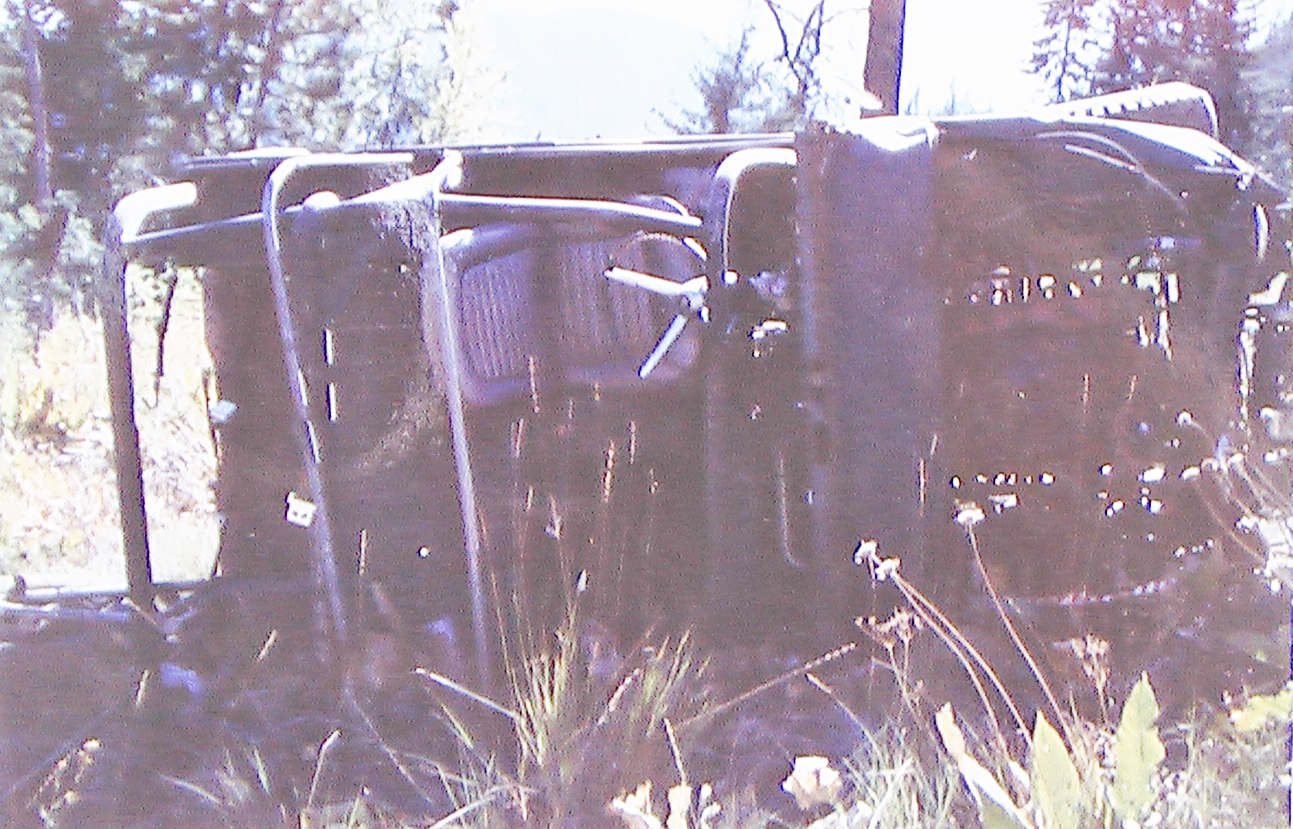
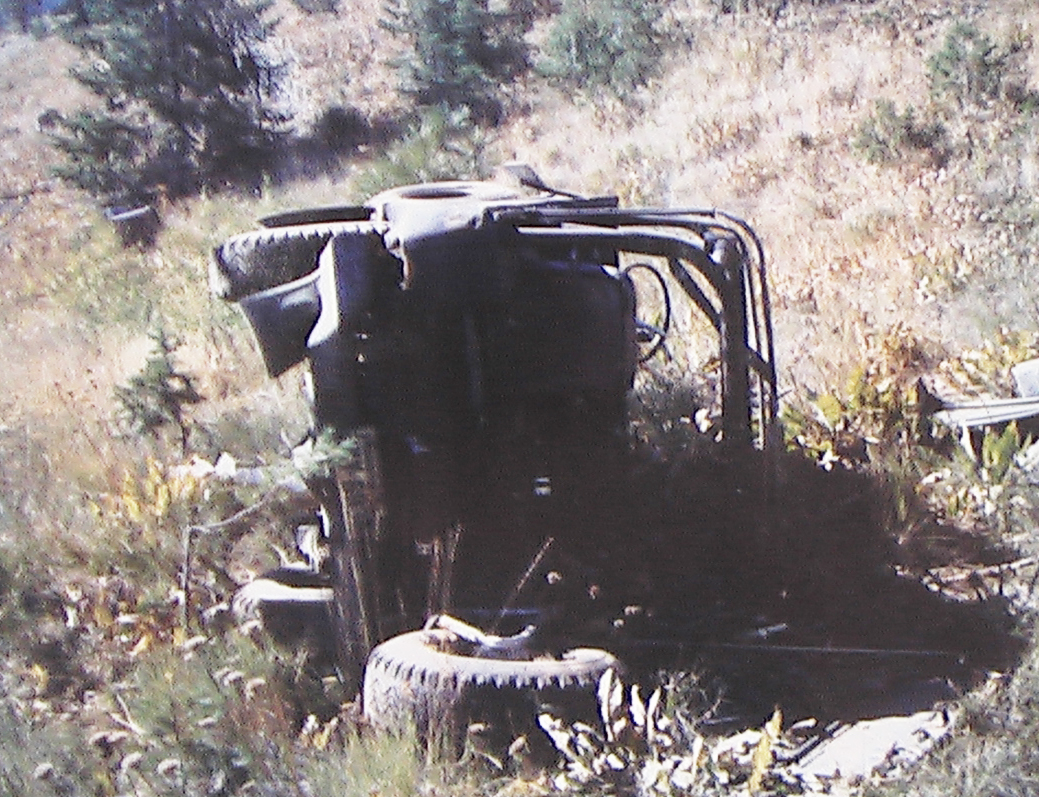
One fine, sunny, beautiful Saturday during the summer of 1975 (or thereabouts – no family member can quite remember the exact year) my father drove his CJ-5 up a chuck-hole filled hillside trail at Icicle Creek, near Leavenworth, Wa. He didn’t make it to the top; instead, he rolled his CJ-5 down the hillside. Herein is the story and images.
I suppose it is appropriate that the images of dad’s wreck in the WWJC Scrapbook aren’t as clear as I had hoped, because the memory of it is also fuzzy. I’ve tried to color correct and sharpen the pictures as best as I could, but even the clearest of pictures can’t really tell the story of the impact of his tumble down that hill.
It was a club weekend on the ‘east side of the mountains’ in Leavenworth, Washington. For Washington Jeepers, the east side of the mountains means anything on the east slope of the Cascade Mountain range, where the surroundings transform from western muddy trails, deep dark green of cedar trees, and gray, drizzly, cool weather into Ponderosa Pines, sunshine, sagebrush, and dust. Within an hour of Seattle, you could (and still can) transform your jeeping experience entirely.
This particular weekend I remember, and say this without certainty as these are more like flickers of a 10-year-old’s memory, that we were staying in some kind of community-center-like building where we all slept on the floor in sleeping bags in a large open community room (I later learned this was a University of Washington property). For the club, it was one big campout.
For me this seemed perfectly normal as the club really was a big extended family — these were people I saw more than my own aunts and uncles, grandma and grandpas.
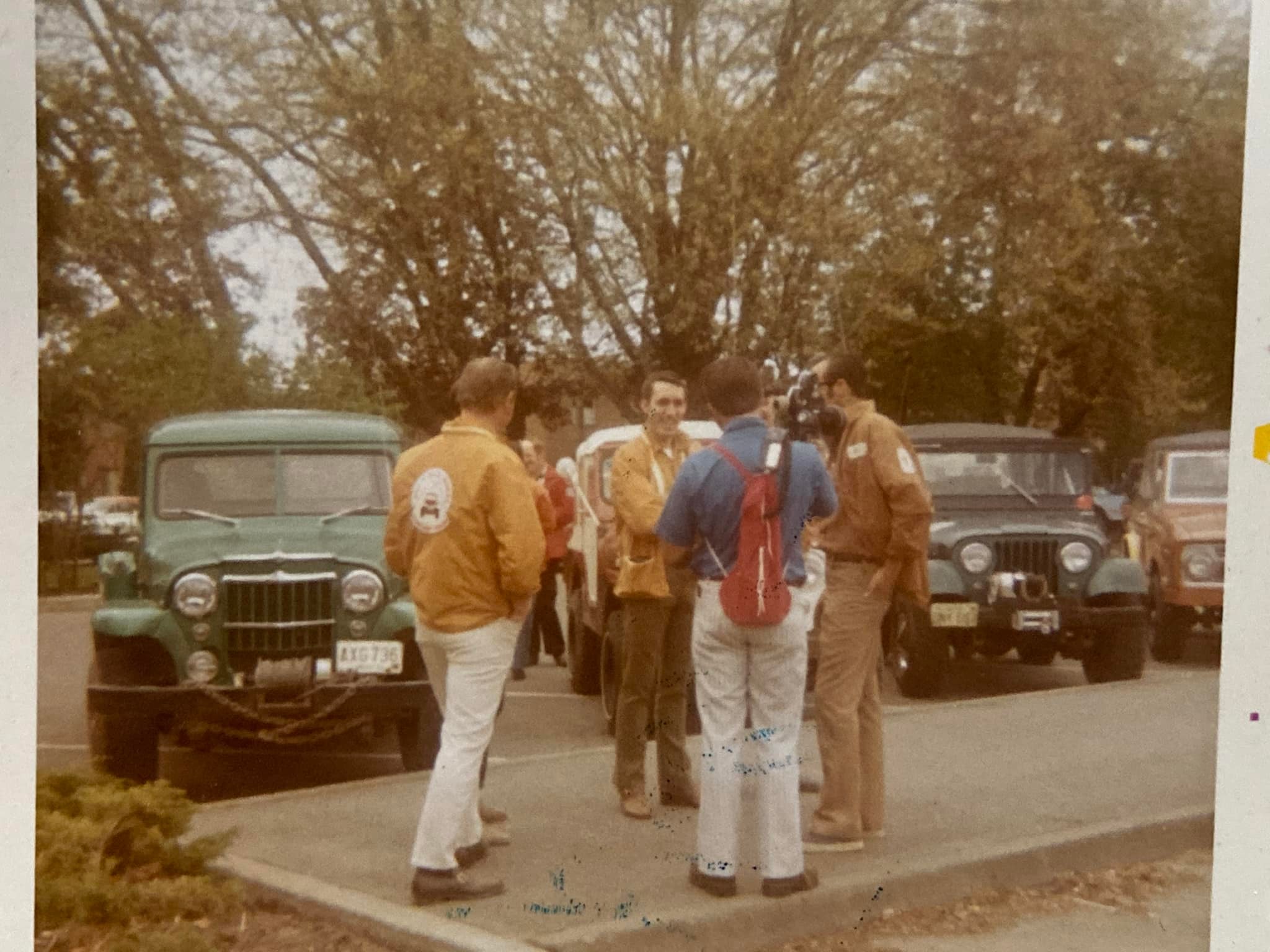
Chris Holmes posted this photo to the PNW4WDA Facebook group the other day. The first thing I spotted was the brown jacket worn by the man to the right of the group; it’s the color of the Wandering Willys Jeep Club. Looking closer, I realized that guy was none-other than my father! Apparently, he had taken part in the shuttle of special needs kids into the Woodland Park Zoo in North Seattle.
Looking more closely, I realized that the front of our CJ-5 was pictured just to the right of Dad’s back. one tell-tale sign is the horseshoe welded to the front of the winch plate. Given the jeep pictured was before Dad’s topsy-turvey roll down the hill at Icicle Creek outside of Wenatchee (summer of 1974 or 1975), this photo was likely taken in the early 1970s.
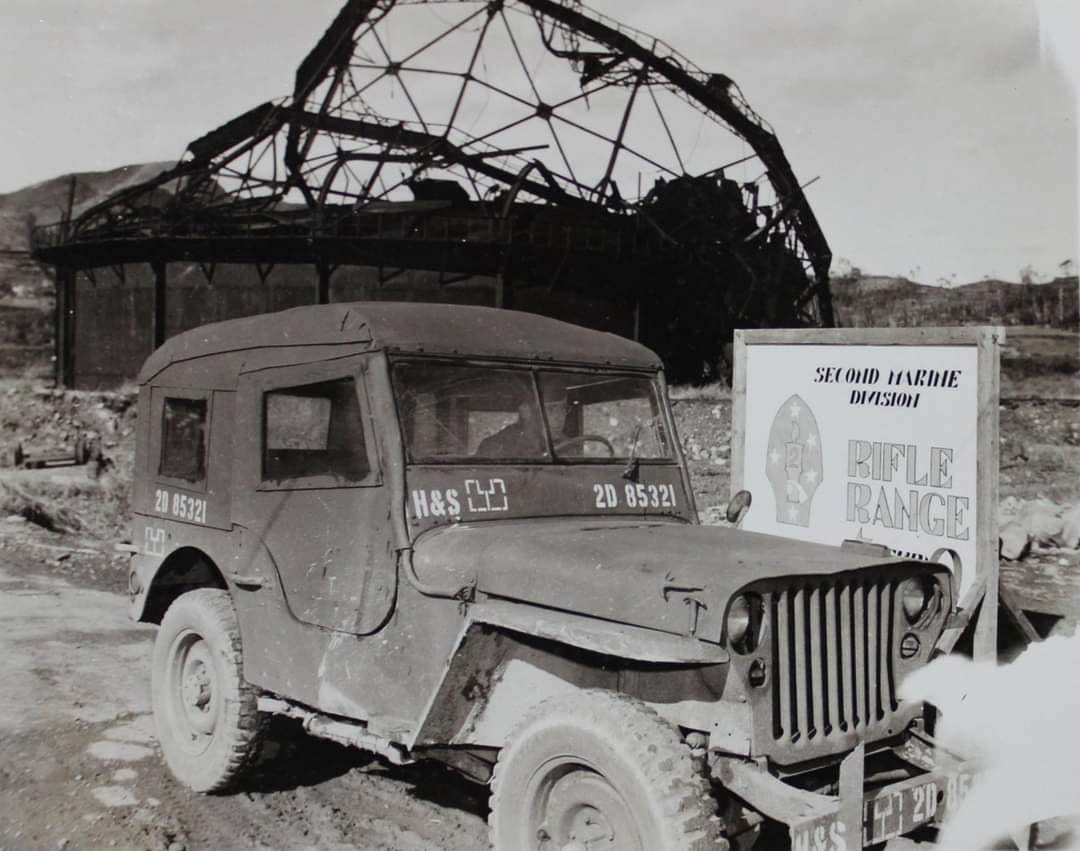
Morihisa Ochi posted this photo on FB of a GPW in Nagasaki after the Atomic Bomb. The top is interesting. According to him, “GPW in Nagasaki, Occupied Japan 1945 After a big factory near Ground Zero was blown off by Atomic Bomb, USMC used this area as a rifle range.”
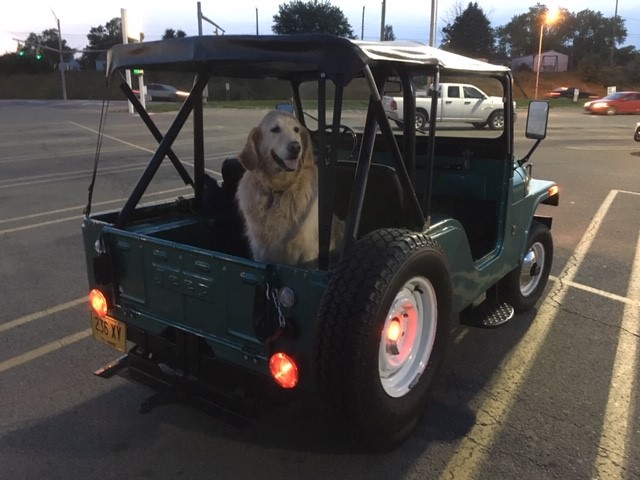
UPDATE IV: Barney sent a photo of his rare Whitco Bikini Top attached to a 1971 CJ-5 (with his dog Manny smiling in the back). While not exactly like the bikini tops we saw in the later 1970s, it likely represents the first production example of what became the bikini top (if defined by attached to the windshield in the front and held in place by straps in the back)
UPDATE III: It appears the definition of the Bimini top is that it is open in the front, which isn’t consistent with the tops we’re discussing below …. I’m trying to determine when/where the top cover originated that, in the front, connects to the windshield, then goes over a mid-bar (usually a roll bar), and, in the back, is held in place by two straps from either side of the top.
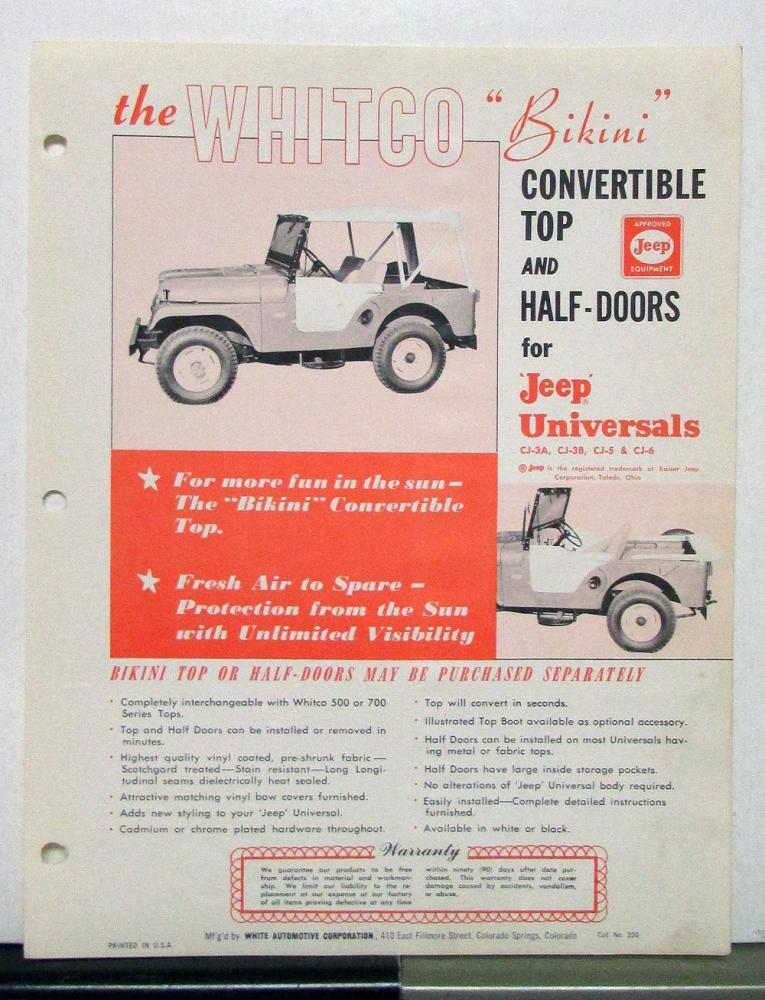
UPDATE II: This Whitco brochure shows that the company was advertising a “Bikini” top during the 1960s, though it isn’t the design of top (like the one below) I was hoping to document. This top is closer to a Surrey top design.
UPDATE: Vernon notes that these were also called Bimini tops, a term I think came from the boating world?
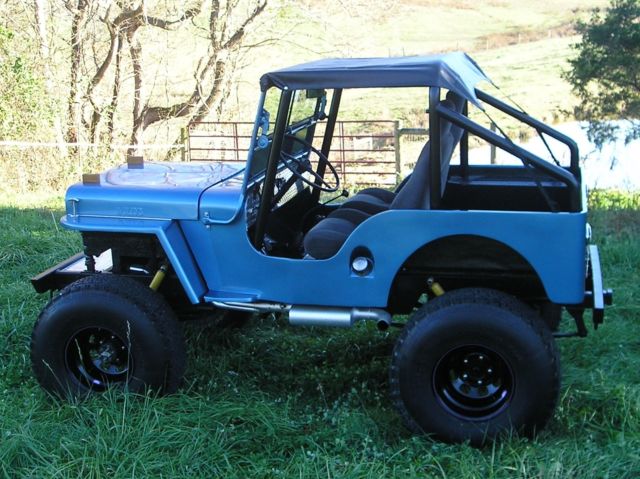
Maury asked me if I knew when bikini tops were first produced. I don’t have any information on this. My guess is they arrived for jeeps in the mid-1970s as none of my earlier parts catalogs show the bikini top as an option. Anyone remember when they first started seeing them?
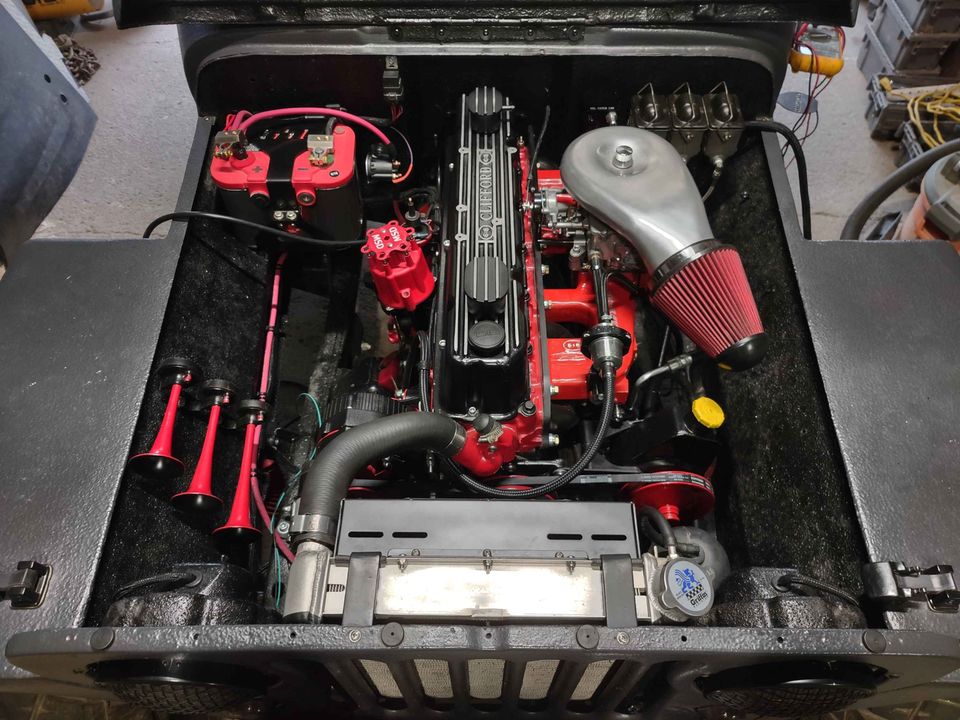
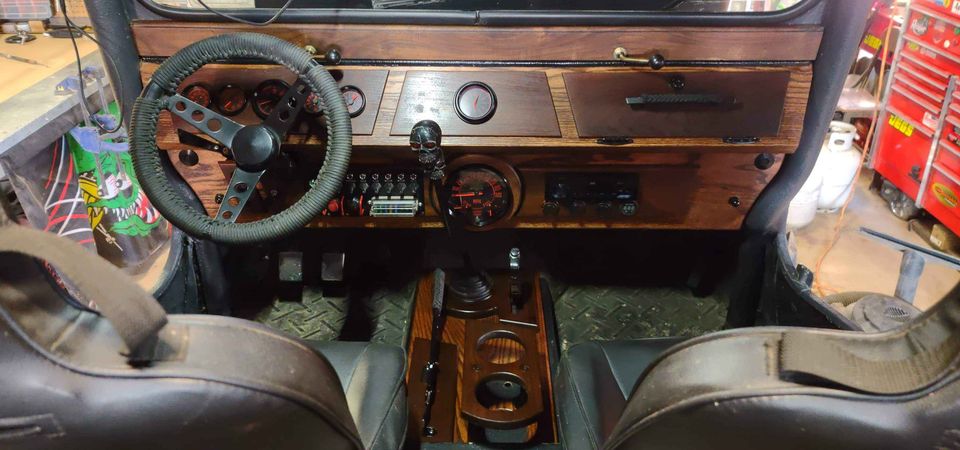
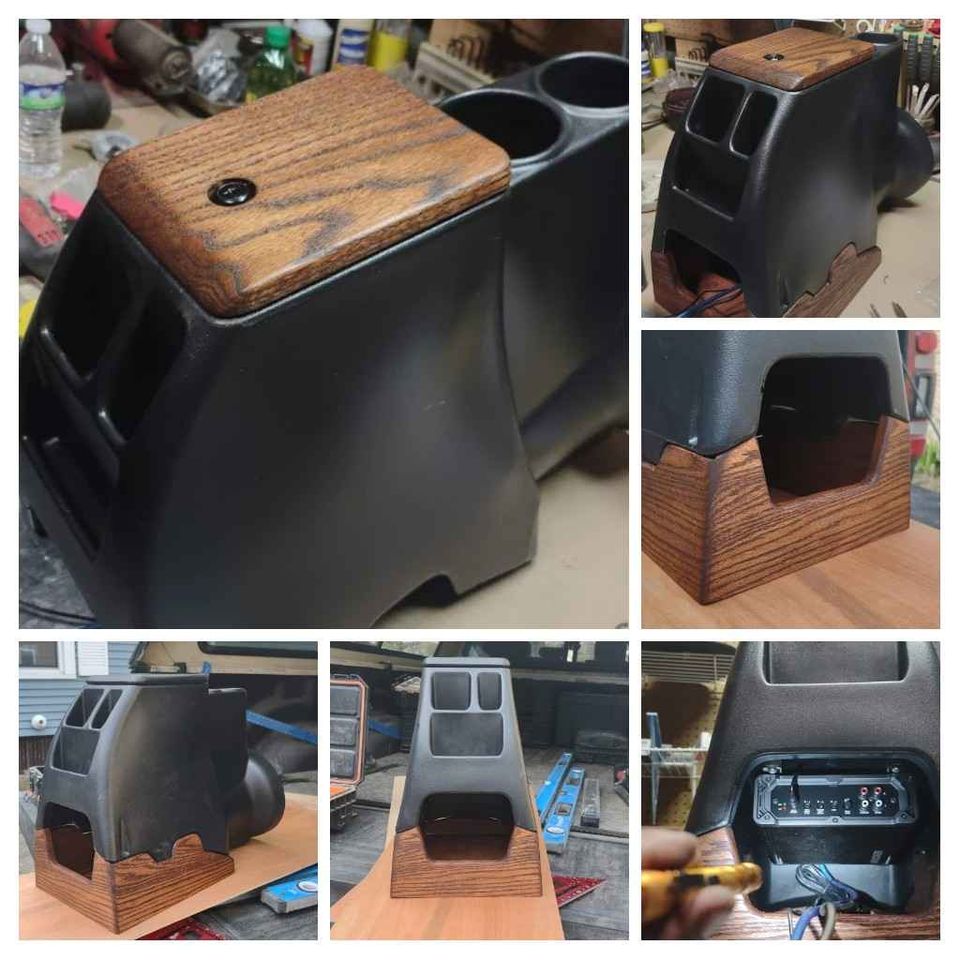
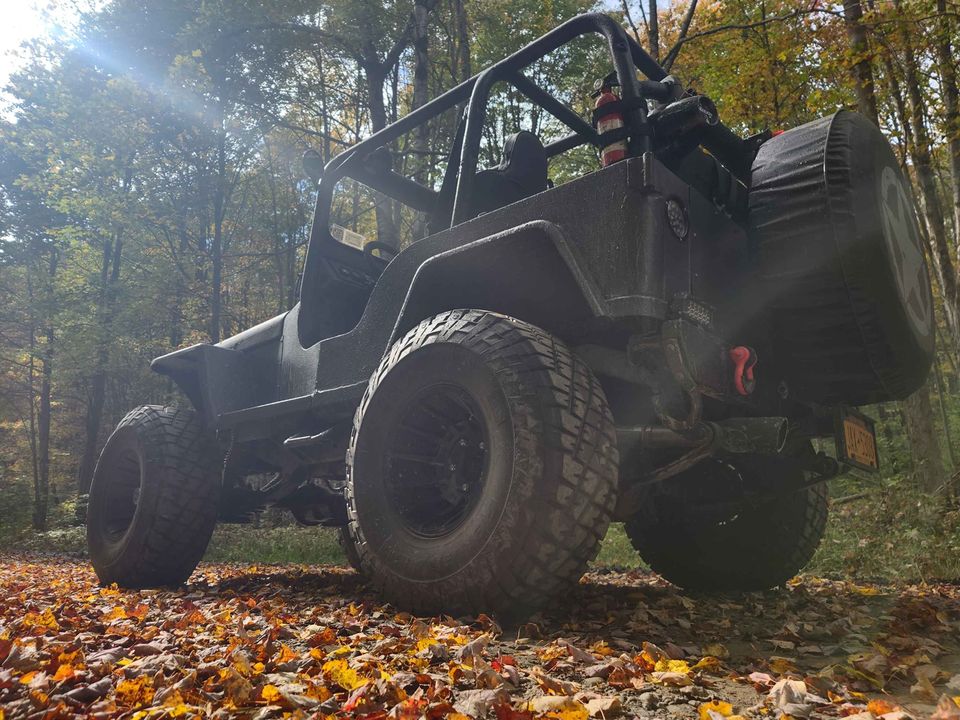
“Looking for trade offers only really, not even sure I want to let it go. Just bored and looking for the next thing to tinker on since I don’t have room to store them.
1947 steel tub Willys CJ2a stretched about a foot and sitting on a 1979 CJ5 chassis. YJ springs, fresh built 258 (built by Steve Damon) oil catch can, crane cam/lifters, heavy crankshaft (early model with 7 counterweights great for low rpm no-stall) Keith black pistons, head and block surfaced, T18 4 speed with 6.32:1 low gear, D20 transfer case, Ford 9″ rear end & D30 front (with lockers) 3:54 gears, 35×15 tires, custom oak dash/center console with all SpeedHut gauges (GPS speedo), hi-output single wire charging system, Kicker speaker pods, kicker amp/10” sub, integrated roll bar, Griffin radiator, MSD ign, “monstaliner” coating on body, no rust many more pics and parts but this is getting long.
I like all sorts of vehicles so shoot me a [worthy] trade offer and if I’m interested I’ll message you back to exchange more”
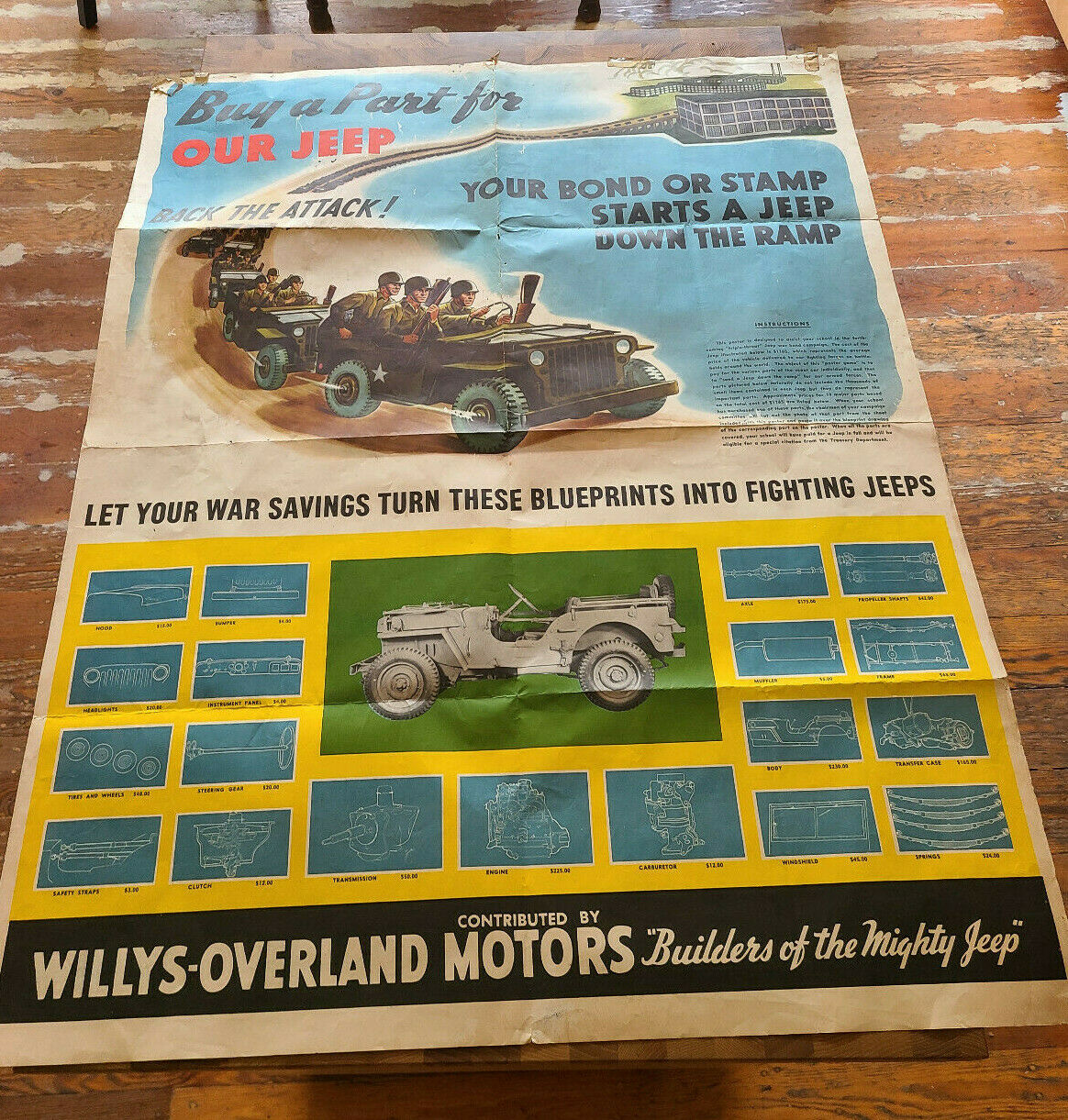
“Great original WW2 poster sent to schools for bond or stamp drives to buy jeeps. It measures approximately 35 by 45 inches. Some condition issues, but a great vintage poster. See other auctions for more WW2 posters.”
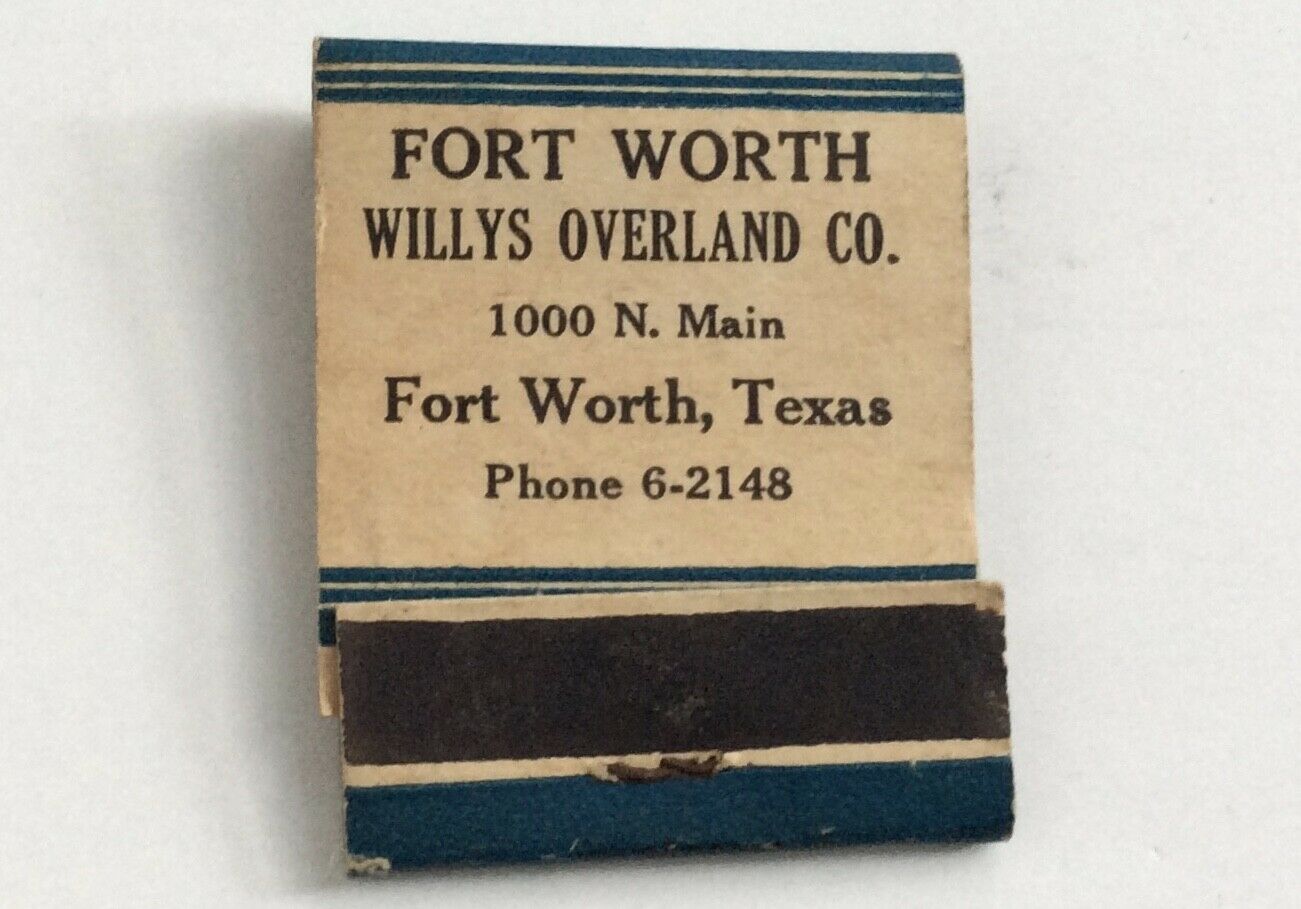
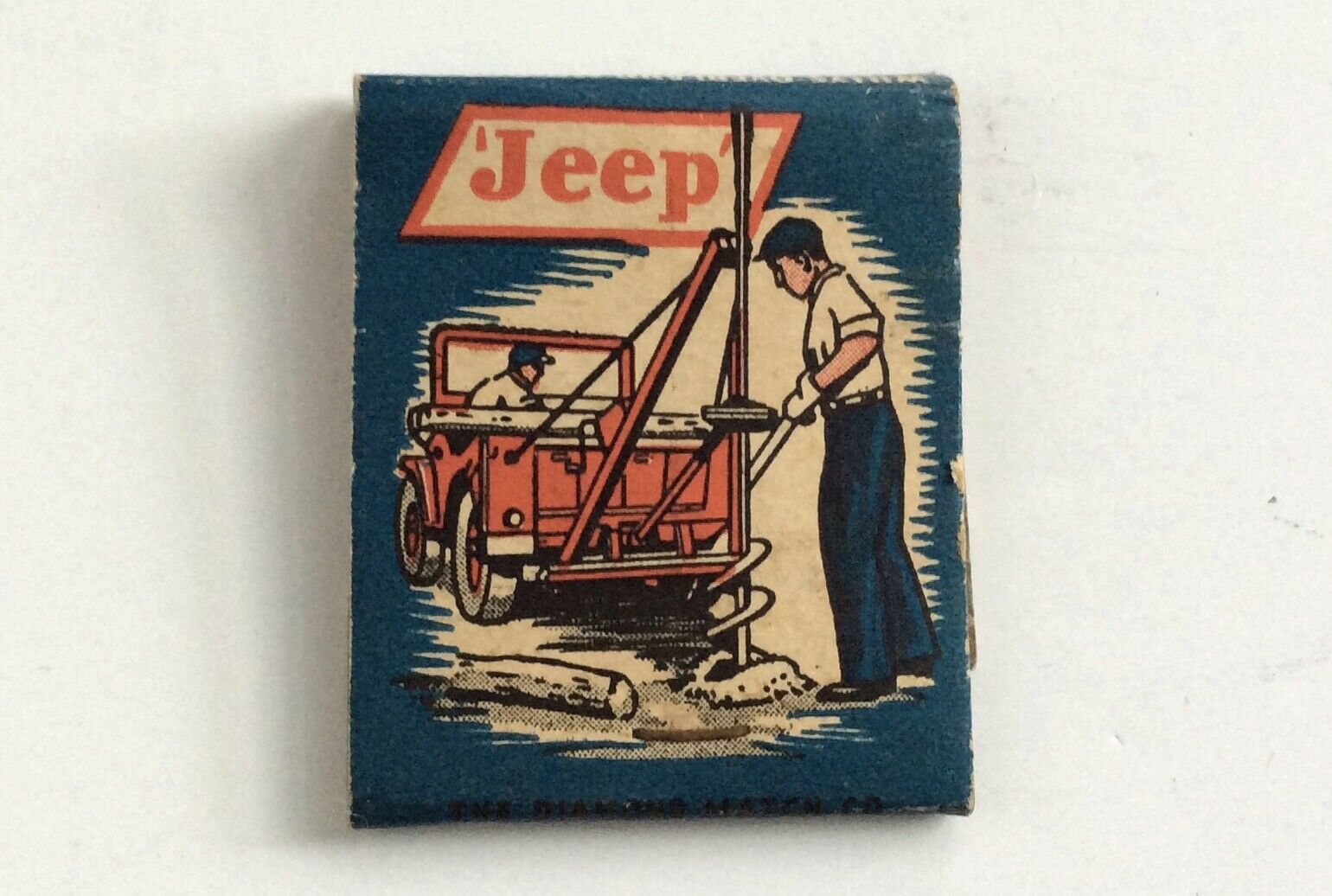
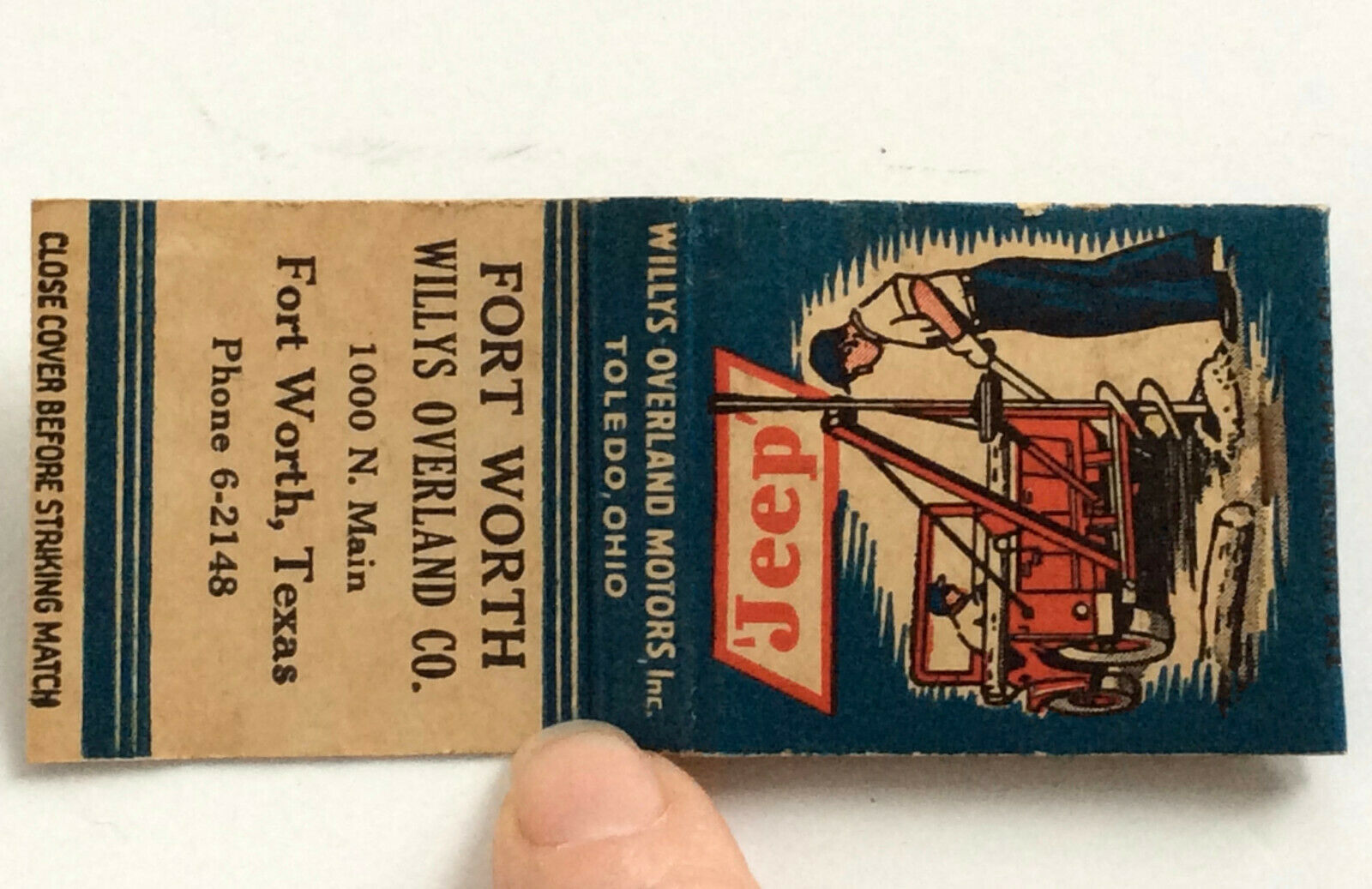
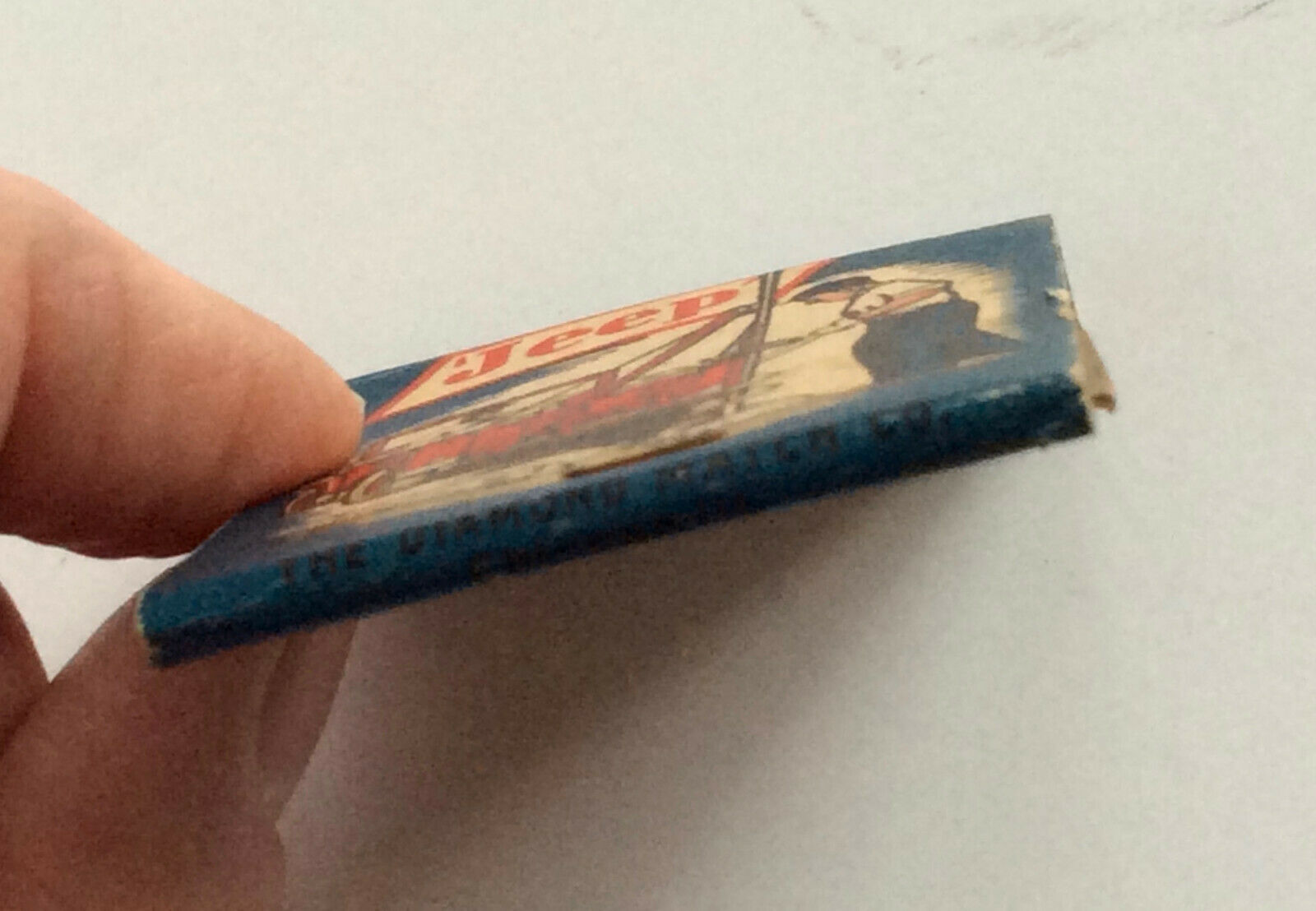
“Post WWII vintage matchbook for Jeep – Fort Worth Willys Overland Co., Fort Worth, Texas. Willys Overland Motors, Inc. Toledo Ohio. Great image is very similar to the 1945 press release of the CJ-2A Post-hole digger demo.”