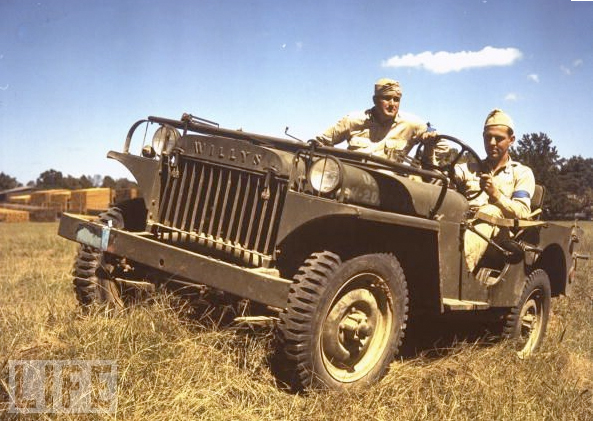
Here’s an unusual color photo of soldiers posing in a Willys MA from Life Magazine. I couldn’t find the original source of this on the Life Magazine site (I stumbled upon it through Google).
emailNeed to contact me and don't have my email? Click on email button.
Welcome to eWillys.com, a website for vintage jeep enthusiasts. I update this website nearly every day with jeep deals, jeep history, interesting reader projects, jeep related info, and more.
These quick searches can help you find things on eBay. People list in the wrong categories all the time, so don't be surprised to see brochures in the parts area for example. This section used to be split into jeeps, parts and other categories, but recent changes to eBay will require this information to be recoded.
The links to posts below show jeeps grouped by models, condition, and other ways. Some of these jeeps are for sale and others have been sold. If you are unsure whether a vehicle is still for sale or not, email me at d [at] ewillys.com for more info.
There are plenty of interesting, unusual, historic and surprising stories related to Jeeps and their owners. In addition, some of these features have nothing to do with jeeps. This link will display all featured stories starting from the latest.
Looking for parts and not sure where to go? There are a variety of large and small new and used parts sellers both online and offline.
Importantly, the allure of buying a project jeep can be romantic. The reality of restoring a jeep can be quite different, expensive and overwhelming without the right tools and resources. So, tread carefully when purchasing a "project". If you have any concerns about buying a vintage jeep, or run across a scam, feel free to contact me for help, comments or concerns .
Here’s an unusual color photo of soldiers posing in a Willys MA from Life Magazine. I couldn’t find the original source of this on the Life Magazine site (I stumbled upon it through Google).
UPDATE: Derek’s got much more information on the CJ-3B site.
This image was on Vulcanhammer.net, but no longer seems to be there. In it, you can see Raymond Concrete Pile Company’s Gow Division’s SPT rig using a PTO to bore a hole for soil research. This is actually an advertisement for the Jeep.
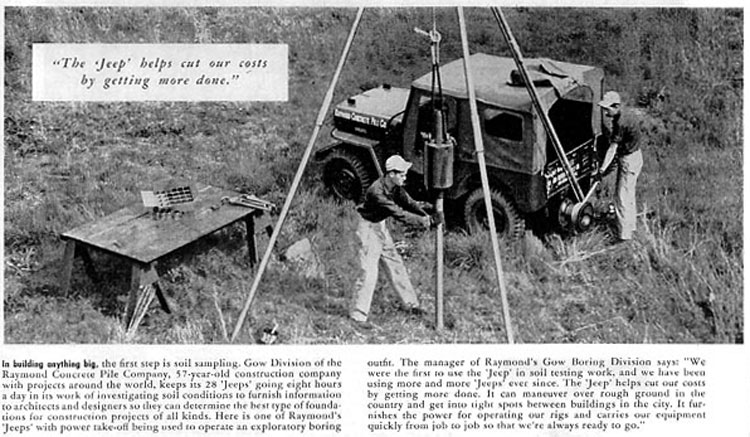
The caption with the image is, “The Jeep helps cut our costs by getting more done”.
And the text below the image is:
In building anything big, the first step is soil sampling. Gow Division of the Raymond Concrete Pile Company. 57-year-old construction company with projects around the world, keeps its 28 ‘Jeeps’ going eight hours a day in its work of investigating soil conditions to furnish information to architects and designers so they can determine the best type of foundations for construction projects of all kinds. Here is one of Raymond’s “Jeeps” with power take-off being used to operate an exploratory boring outfit.
The manager of Raymond’s Gow Boring division says: “We were the first to use the “Jeep” in soil testing work, and we have been using more and more “Jeeps” ever since. The “Jeep” helps cut our costs by getting more done. It can maneuver over rough ground in the country and get into tight spots between buildings in the city. It furnishes the pwoer for operationg our rigs and carries our equipment quickly from job to job so that we’re always ready to go.”
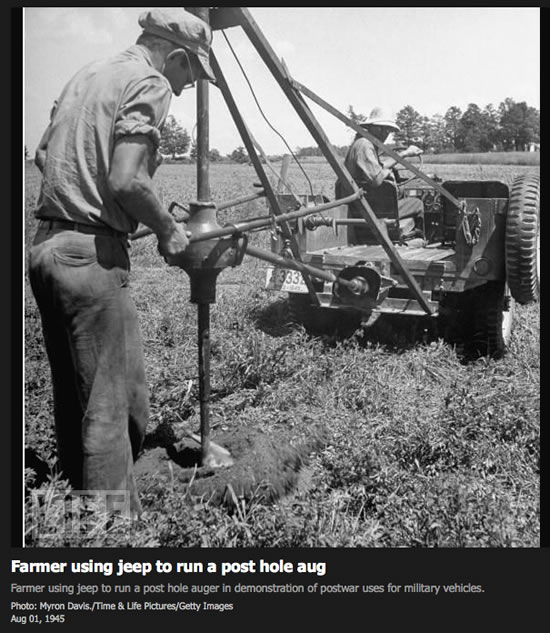
Here’s an example of a post hole digger. So, maybe they ‘dig’ with some kind of custom corer and then use the PTO to lift it (which is what they appear to be doing in the photo above)?
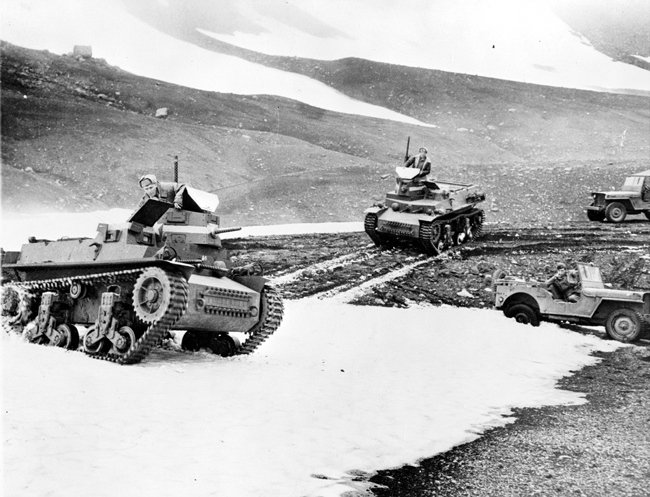
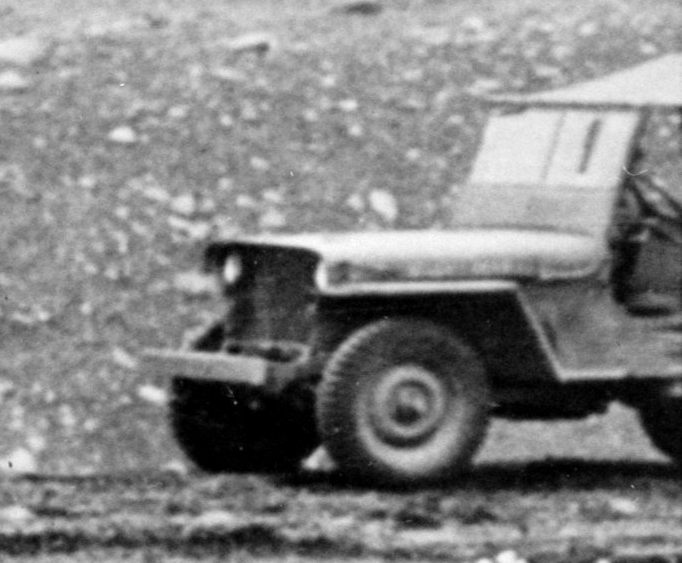
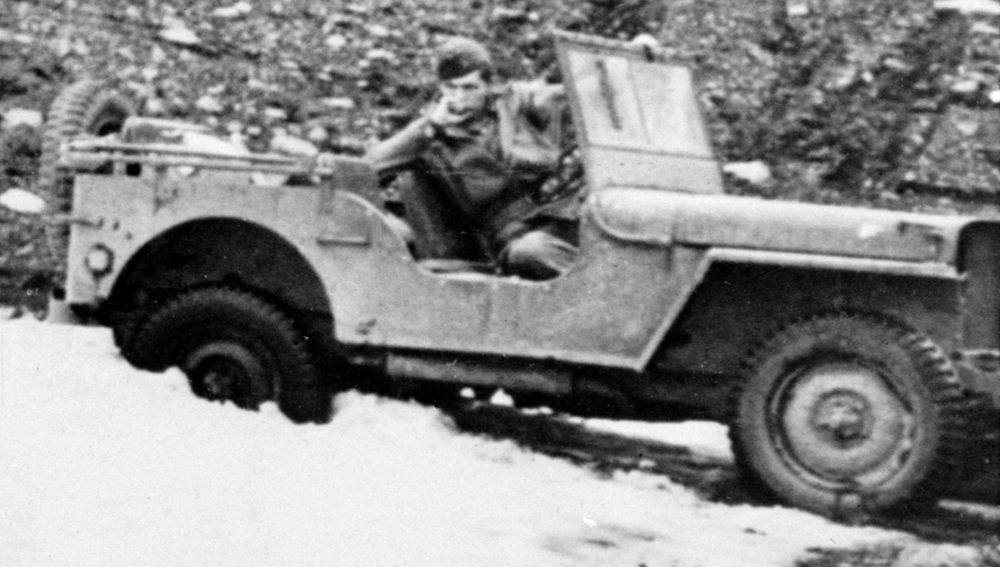
Here’s an image from 1942 that Hugo spotted at wikipedia. The picture is high enough resolution that I was able to get a couple closeup pics as well.
Regular readers will remember Claus and his brother from the CJ-2As they restored in South Africa.
Claus also made contact with the Northern Flagship Institution, a national museums institution that falls under the auspices of the Department of Arts and Culture in South Africa. The NFI provided Claus with a detailed response that lists, based on their research, the jeeps that had entered the country.
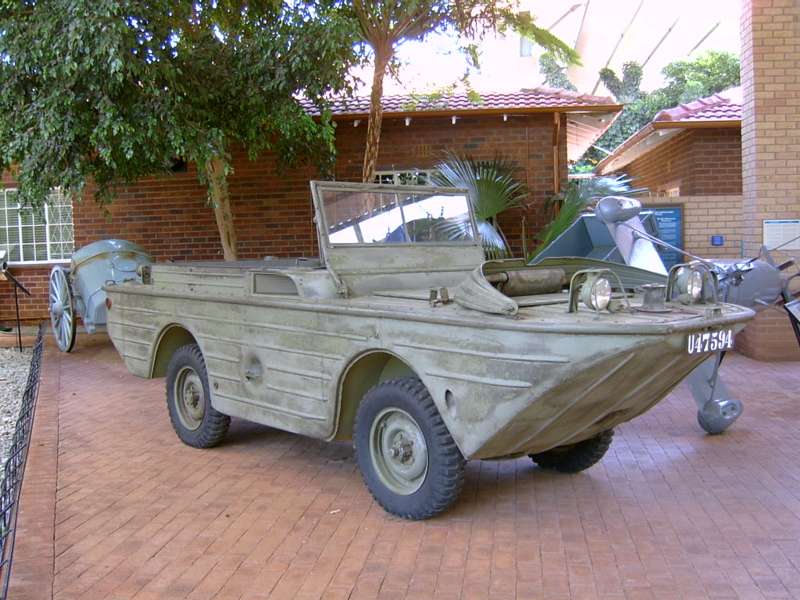
Curiously, they don’t mention the SEEP (shown below) that is located at the South African Military Museum in Johannesburg. Gavin Walkers Willys MA site has a couple photos of it.
Based on Claus’s suggestion, I did a quick search of the CJ-2A Page Forum and learned here are a few other South African CJ-2A owners as well. So, I thought I’d publish this NFI historical information in hopes it helps others.
Thanks for sending it on Claus!
===============
From the NFI to Claus —
Thank you for your email query of 14 July 2008. The South African National Museum of Military History, a component of the Northern Flagship Institution does not have complete records of Willys Jeep purchases by the Union Defence Forces or by the later SADF. We have found some information which might assist you. Much research is still required to fully answer your query.
Since the Willys Jeep was manufactured in the United Sates of America, all issued American equipment to British Commonwealth countries came via the Lend Lease agreement. The Union Defence Forces had to work through the British War Department to obtain American Equipment via the Lend Lease. The first Jeep, a Willys MB seems to have arrived in South Africa in about October 1943. This Jeep was allocated the Union Defence Forces (UDF) number U 47505 and was used by Capt A A van Niekerk MC, Officer Commanding the paratrooper company of the newly formed SAAF Regiment undergoing training at Premier Mine, Pretoria.
During November 1943, a Willys MB Jeep – U 46-04, was used as a command vehicle during training in the Barberton district, by the Officer Commanding, S A Armoured Brigade, Brigadier C L de W du Toit.
At about the same time (November 1943 – April 1944) some Willys MB Jeeps were allocated to the 6 SA Armoured Division (6 Div) in training at Khatatba in Egypt, the numbers were small but unknown. We believe that 6 Div drew more Jeeps from British stores at Bari at the end April 1944, once they had landed in Italy. The numbers are unknown but this information may be at the SANDF Archives in Pretoria – sandfdoc@mwebco.za.
Photographic evidence shows that the following units used Jeeps in Italy:
During the advance of 6 Div from Cassino to Rome – end May to 6 June 1944:
6 Div Postal Unit
12 Field Squadron, South African Engineer Corps
North of Rome and into Gothic Line:
6 Div Headquarters
11 South African Armoured Brigade Group Headquarters
Prince Alfred’s Guard
First City / Cape Town Highlanders reconnaissance platoon were issued with Jeeps
The Natal Mounted Rifles also had Jeeps by October 1944
During the spring of 1945 and after 6 Div had broken through the Gothic Line the following units are known to have had Jeeps:
7/64 Battery of the Transvaal Horse Artillery
Imperial Light Horse / Kimberley Regiment
The war in Italy ended on 2 May 1945. On 14 May the 6 South African Armoured Division held a Victory Parade at the Monza Racetrack in which all their vehicles were paraded. After the parade the vehicles were handed in to the transport park. Later the vehicles were railed to Genoa to the 6 South African Armoured Division Vehicle Park. A small number of men chose to stay on in Italy after the other servicemen had been sent home to the Union. Many of these men had girlfriends and wanted to stay on and prepare the vehicles for shipping to the Union. The first ship left Genoa for Durban at the end of April 1946. The ex British equipment was shipped first in eleven ships. The American equipment was last to leave Genoa on SS Standridge on 3 May 1947, after much discussion on numbers and payment to the USA.
Only two Willys Jeeps and two 10cwt General Service Jeep Trailers were shipped to South Africa. A third Jeep, purchased by Captain D C Clarke under authority dated 23 September 1946 was shipped on the SS Samarina on 24 September 1946. This Jeep had the British War Department number WD 5662164. These are the only Jeeps to officially come from Italy to the Union.
In 1948, the UDF ordered two hundred and eighty nine Willys Jeeps, the model is unknown. These were allocated the U numbers . U 75800 – U 76088.
Forty three, 1951, Willys 7 seater station wagons were also ordered by the UDF and allocated the U numbers U 76177 – U 76219.
In 1960, twenty-five CJ-3B Jeeps were ordered as well as sixty-one of the more modern CJ-5s. Of the total eighty- eight ordered, only eighty-five were delivered at first, the rest arriving at a later date.
In about 1963/64 the SADF purchased one hundred and nine CJ-6 Jeeps. It is not known if they were manufactured by Willys Motors Incorporated or by the Kaiser Jeep Corporation.
In 1992 there were fourteen CJ-6 Jeeps at 4 Vehicle Reserve Park, Walmanstal, north of Pretoria. These had the following registration numbers.
BCL 953 M BCL 948 M BCL 941 M BCL 952 M BCL 939 M BCL 944 M
BCL 943 M BCL 937 M BCL 938 M BCL 945 M BCL 934 M BCL 950 M
The above listed Jeeps were powered by 4 -cylinder engines.
BDF 775 M and BDF 760 had 6-cylinder engines.
The Museum would appreciate any information you may find regarding Jeeps in South African service.
Yours sincerely
NORTHERN FLAGSHIP INSTITUTION
Incorporating — Transvaal Museum, National Cultural History Museum, SA National Museum of Military History, Kruger Museum, Pioneer Museum, Sammy Marks Museum, Tswaing Crater Museum, Willem Prinsloo Agricultural Museum.
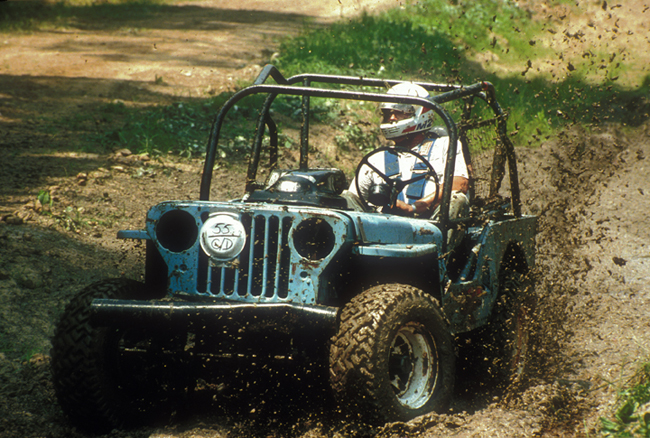
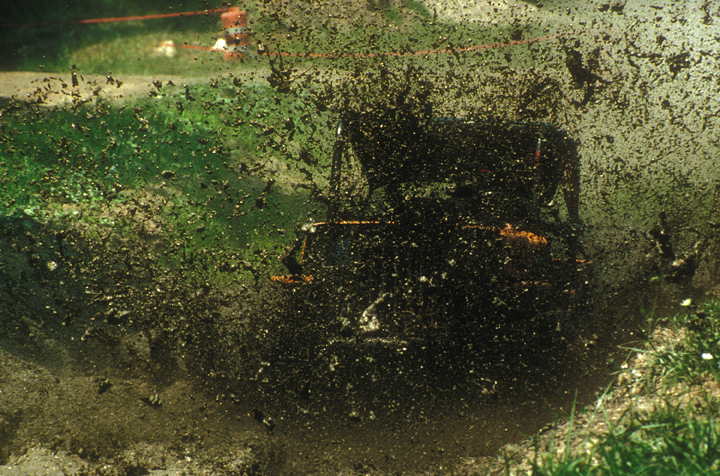
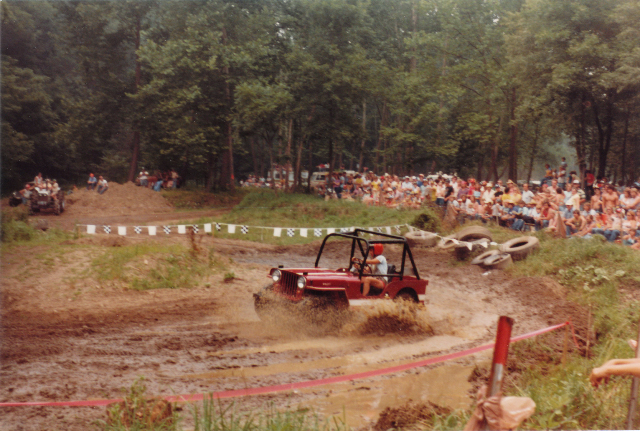
Bob admitted he couldn’t remember much about the races in these photographs, other than they were shot in the mid-90s in Lisbon, Ohio; but he got some great photos. Ok, truth be told, any photo that combines a flattie, desert dogs, and some mud is something I’d consider a great photo 🙂
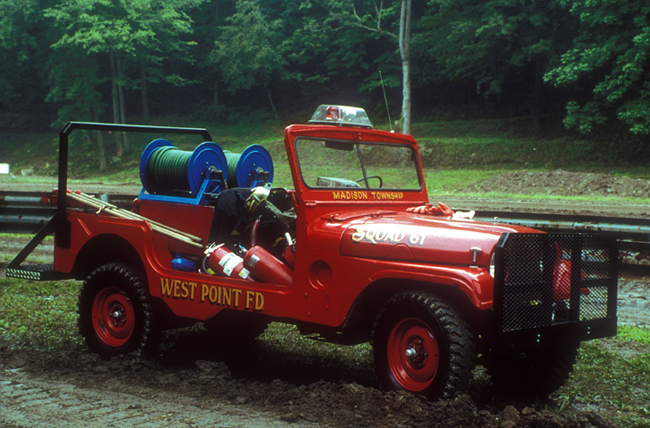
And here’s a great M-170 Fire Jeep that was watching the action
Inspired by the playday post, I had several emails about racing on the eastern shore of the US in the EC4WDA.
HOG explained how he used to race outlaw races to make money and those would give him money to attend the EC4WDA races for fun.
He writes, “I ran the East Coast 4 Wheel Drive Association from New York to Jacksonville Fla & from Ohio to the eastern shore. I would hit the outlaw races on one weekend & race EC4WDA with the winnings from the outlaw races. I miss doing that & the good friends I had back then.
I drove a 1978 CJ-5 with a 70 AMC AMX 360 motor with T-18 tranny & dana 20 transfer case. Its name was Wind Walker. It was Bright Red & I ran NOS on her to get me out of a class that was too crowded. My ex wife ran it in Powder puffs & won more than me.”
I asked HOG what an Outlaw race was. “Outlaw races were races for anything 4×4 put on by a local group. Mostly, they were hosted by Firemen. Best of all, they paid cash prizes (The EC4WDA didn’t pay cash, instead they gave you a $10 trophy).
I did well as my Jeep looked like a stocker jeep. In fact, I drove it as a daily driver & to the races. Also, when you’d get inspected by someone that had a Chevy or Ford hat you knew he didn’t know nothing about a AMC motor as they look so much the same. My 360 was mistaken for a 304 many times, with its the stock air breather (everything was covered in mud) sitting on top of a Holley spreadbore. I even had a cassette player to play my ZZtop, & a baby seat on the rear seat. Then all I had to do was just (key word) beat the guys I ran against.”
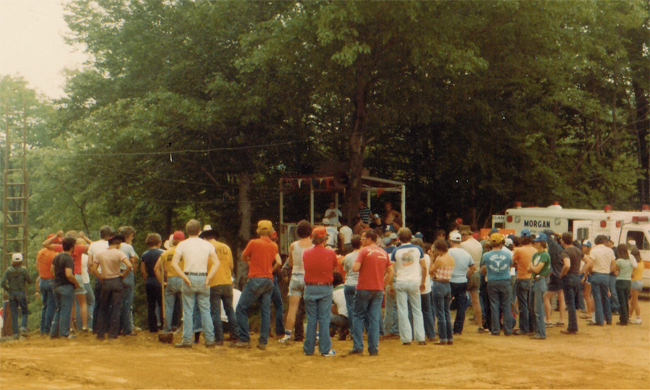
Gerald grew up in the EC4WDA with his brother and family. He forwarded me these pics from his days racing in the EC4WDA.
Here’s a scene familiar to all race days — the morning driver’s meeting:
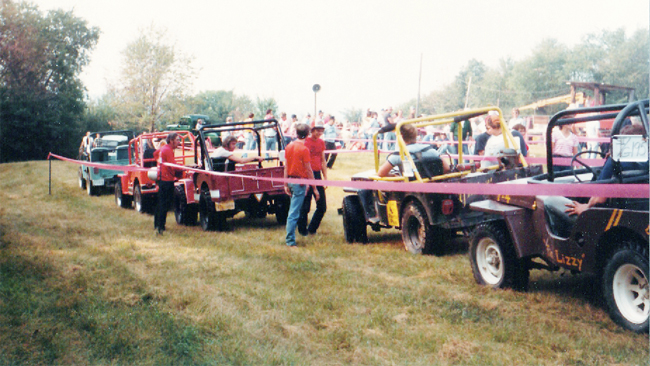
Gerald tells me this is the line up for the Drags. I remember flatties just like these on the west coast:
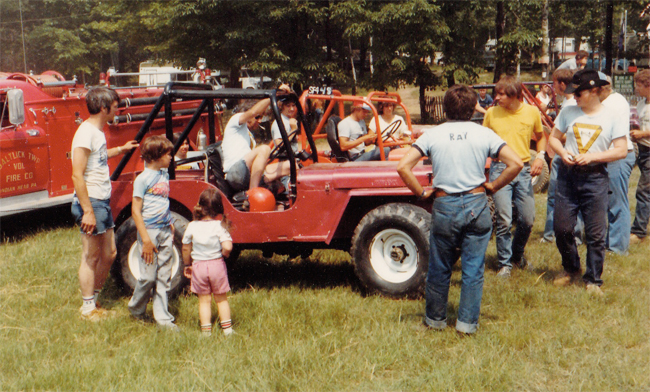
You can see the family’s racer at rest and in action in the next two shots. If I remember correctly, the front loop from this race jeep is now in Gerald’s brother’s new build.
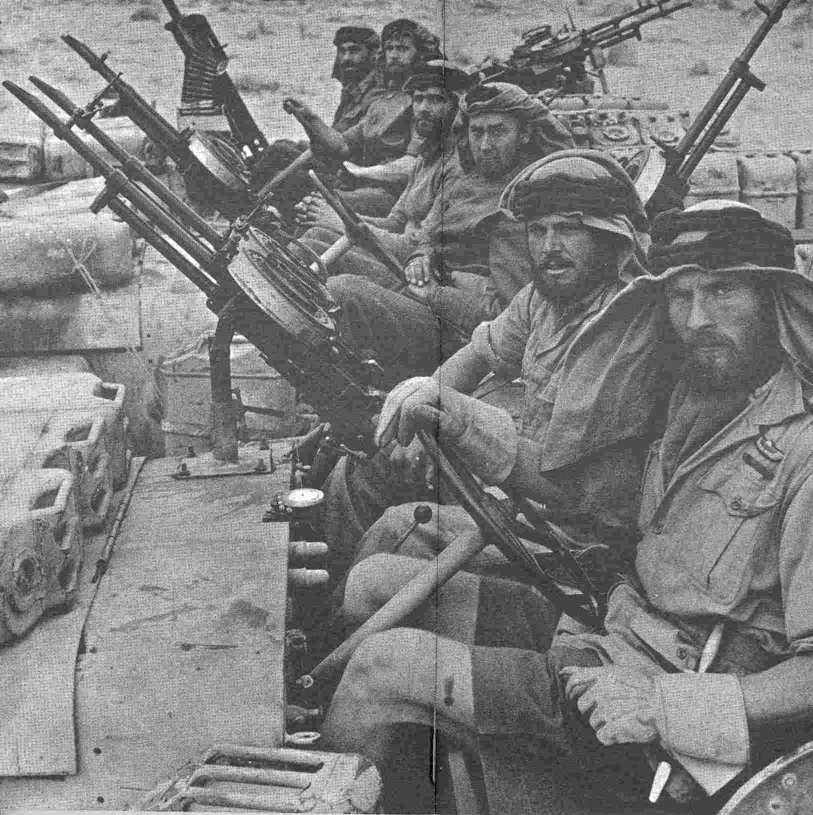
As I was researching yesterday’s article on the LRDG, I wanted to learn more about the Bagnold sun compass. After reading the explanation, I’m am quite sure that I’m not yet ready to be thrown in the middle of the desert with a Bagnold.
However, as I did my research this unique ‘time’ piece on a French Sundial website, I happened to see the amazing image below.
EVENT: The LRDG Preservation Society will be participating its 2nd biggest event of the year October 2-3 2010 at Prado Dam Park in Chino Hills California. They are one of 85 different re-enactment groups from nearly every time period and culture in history. It is a Military Time Line Event which will feature everything from Roman Legionnaire’s to Viet Nam Re-enactors and many other periods in between.
Kim wrote me last week after seeing drafts of the “Africa SAS” T-shirt I’d like to produce (I am working on refining the shirt design btw). As the membership chairman of the Long Range Desert Group Preservation Society (LRDG), he’s particularly interested in the SAS jeeps and Long Range Desert vehicles. So, he introduced himself and the organization.
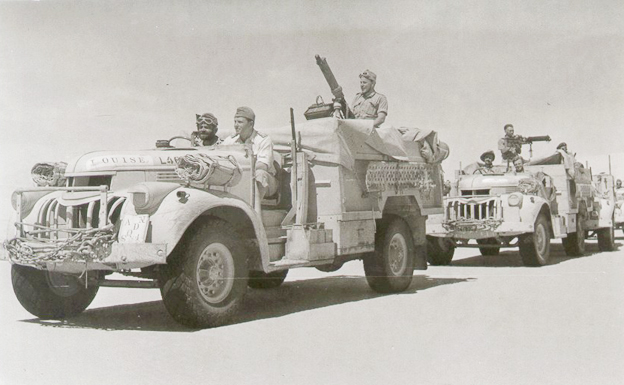
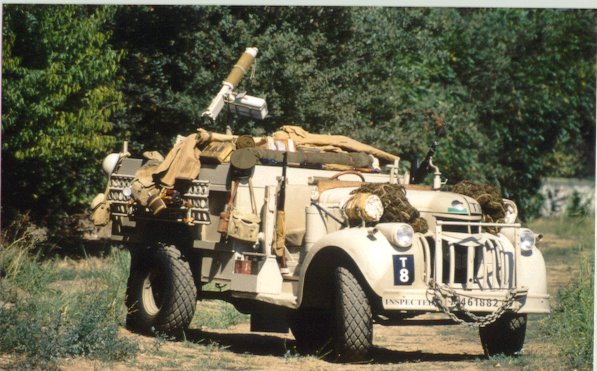 The LRDG Preservation Society is a non-profit organization established “to learn as much as possible about the unit, the men in it and the equipment and tactics they used. Then to share that information with all whom wish to learn. To that end this group has built a replica of a classic WWII LRDG truck (1942 Canadian Chevy, right hand drive, India format) and outfitted it with “historically correct” military equipment, gear, provisions, and uniforms. The vehicle was built by Rick Butler in Yreka California from several vintage trucks and parts from around the world. Converting a left hand drive vehicle to right hand drive was one of many challenges.”
The Society has supporters and members throughout the world, including the US, England, Canada, New Zealand, Australia, Portugal, South Africa and more.
About the Long Range Desert Group:
During the 1930s, the British developed the idea of creating a motorized guerrilla/recon group in northern Africa to provide intelligence to British Forces. After studying the terrain and needs for such a group, the Brits formed the LRDG, which according to the LRDG website “was very much like a “private army”, formed to meet the particular conditions of desert warfare.” The LRDG was made up of volunteers and, because of this, they could wear beards and were given latitude that regular military soldiers did not have.
Learn more about the LRDG by clicking here and scrolling to the bottom of the page.
I’ve seen them in old pictures, but Kim is the first owner of a Long Range Desert Group S.A.S. Willys to contact me and share pics. Of course, you can’t but help but think of the old Rat Patrol shows when you see these vehicles. After reading through the LRDG.org website, one of the things I’ve learned is that there was plenty of thought, research and recon work that went into the supplies these jeeps and truck would need to carry with them as they sailed long, desolate seas of sand.
Kim writes, “The jeep I bought is mechanically perfect. The previous owner put all his money into the motor, brakes and trans. The body on my jeep needs some help and eventually I will replace the rear and floor sections of the tub as there is some rust. Fortunately, It came to me painted in the proper color and had many extras including a Bagnold sun compass.
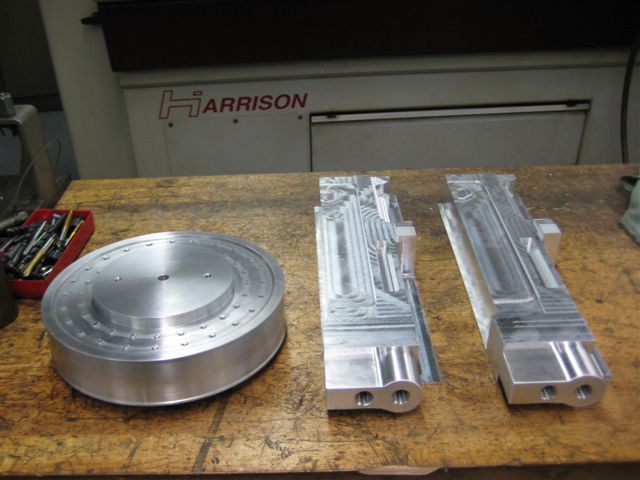
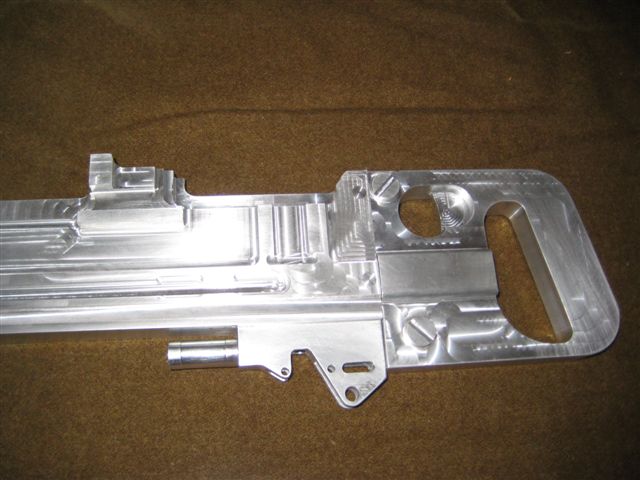
As a special addition to this jeep, I re-built a WW2 Italian de-milled M37 machine gun and converted it into a gas gun M.G. simulator. It sounds like a M.G. but no blanks are needed and it can not shoot a projectile. That is mounted on the front cowling. As I have been a machinist and tool maker for 30 years I machined a set of Twin Vickers machine guns out of aluminum for the rear mount. These are strictly dummies with no moving parts.
I did not buy this jeep to be a Trailer Queen. This is a re-enactment jeep and as far as I am concerned it looks like it just got back from Kufra Oasis and that is exactly what I want. My ultimate dream is to have 2 WW2 jeeps. The S.A.S (which is not street legal) and an American OD jeep that is licensed and ready to drive to work.”
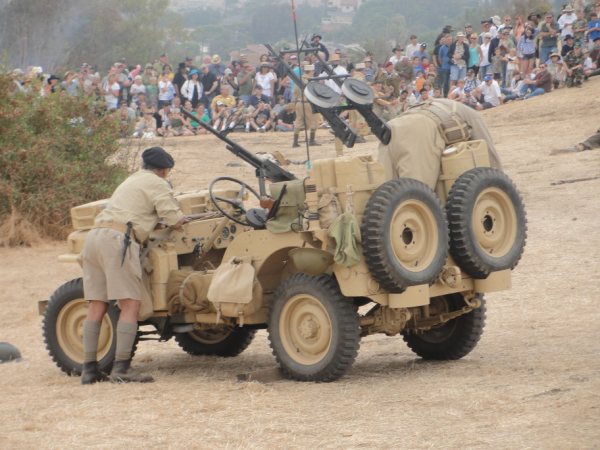
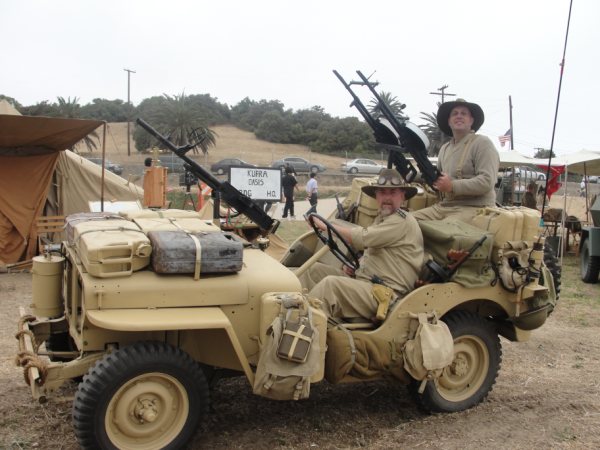
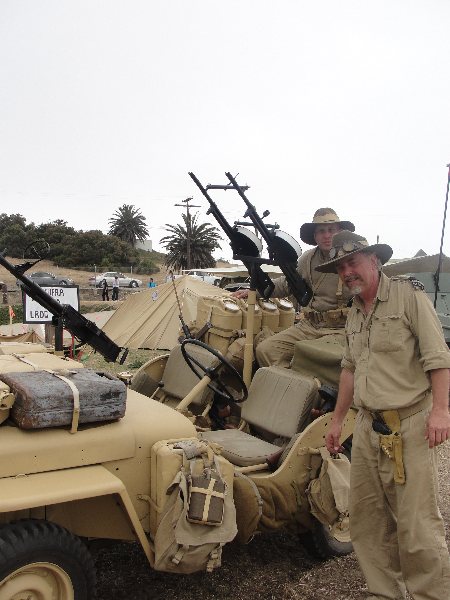
And a couple pics of the Twin Vickers Kim made. In this pic, some basic outlines and contours have been created in the aluminum stock.
Here you can see many more details are apparent.
UPDATE 3: Cblynch posted an update to this information on g503.com site. He notes that Randy Withrow in Alabama owns the below GP and also owns all the original photos. Apparently, the woman driving the GP died a few years ago. (Thanks Simon). Also, you can see an additional photo from Bergs yard in this thread. Finally, to GP1942 from G503, I’m glad you are enjoying the content, but please add a link saying you found the info at ewillys when copying and pasting it into other sites.
UPDATE 2: After further review, and based on Lindsay’s comments, I would say that the first BRC is a BRC-40. The TWO jeeps in front of that are BRC-60s (made after the original BRC prototypes and before the BRC-40).
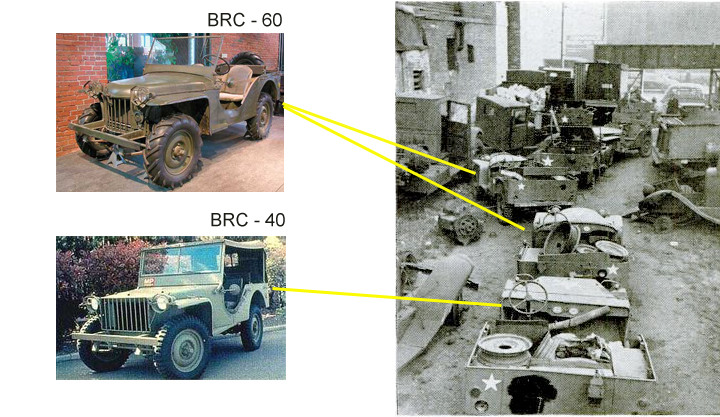
UPDATE: A reader named Lindsay was kind enough to provide an update to this story:
Lindsay writes, “An interesting note about the article with the mayor that purchased the GP in 1944. That vehicle was tracked down by Ken Hake years ago and restored several years later. The 3 smaller photo’s at the bottom bottom right is a photo of Bergs Jeep parts in Chicago note the first one is a Bantam BRC 40 the one in the front of that is a very early “round nose” BRC of which only one still exists and belongs to the Smithsonian. This proves that round nose BRC’s were released and sold to the public. I sure would like to find one of those in a barn.”
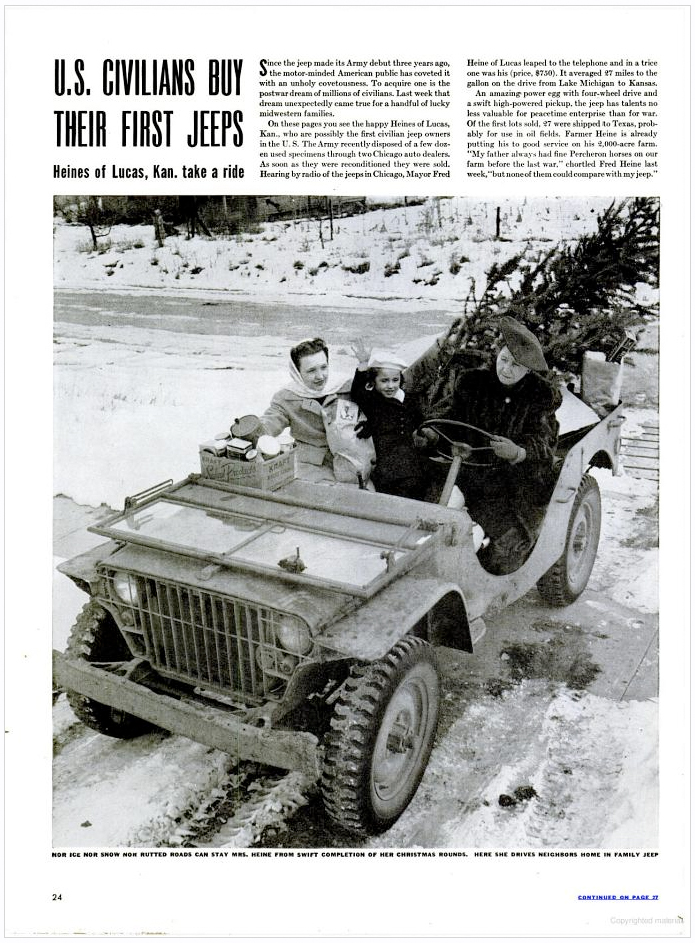
The military started selling jeeps to civilians in 1944. By all accounts, Mayor Heine, of Lucas Kansas, and his family were the very first purchasers of a Military jeep for civilian use. Here is a Life Magazine Article about the Heines and the related images from the January 4, 1944, issue of Life Magazine (page 24 & 27). I bet they wished the jeep came with a top and a heater!
NOTE: The jeep below is a Ford GP
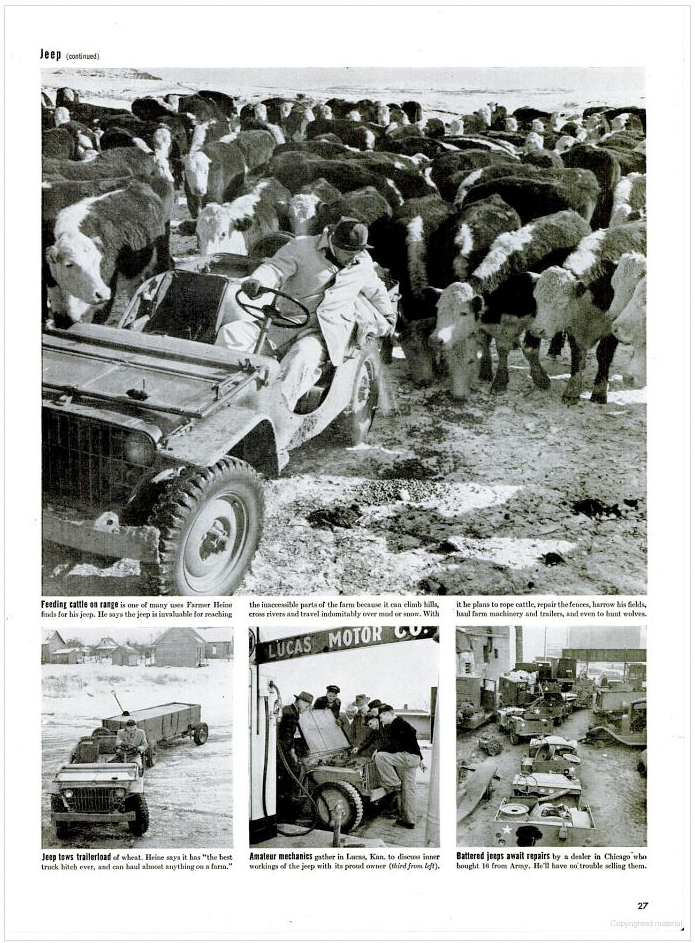
====================
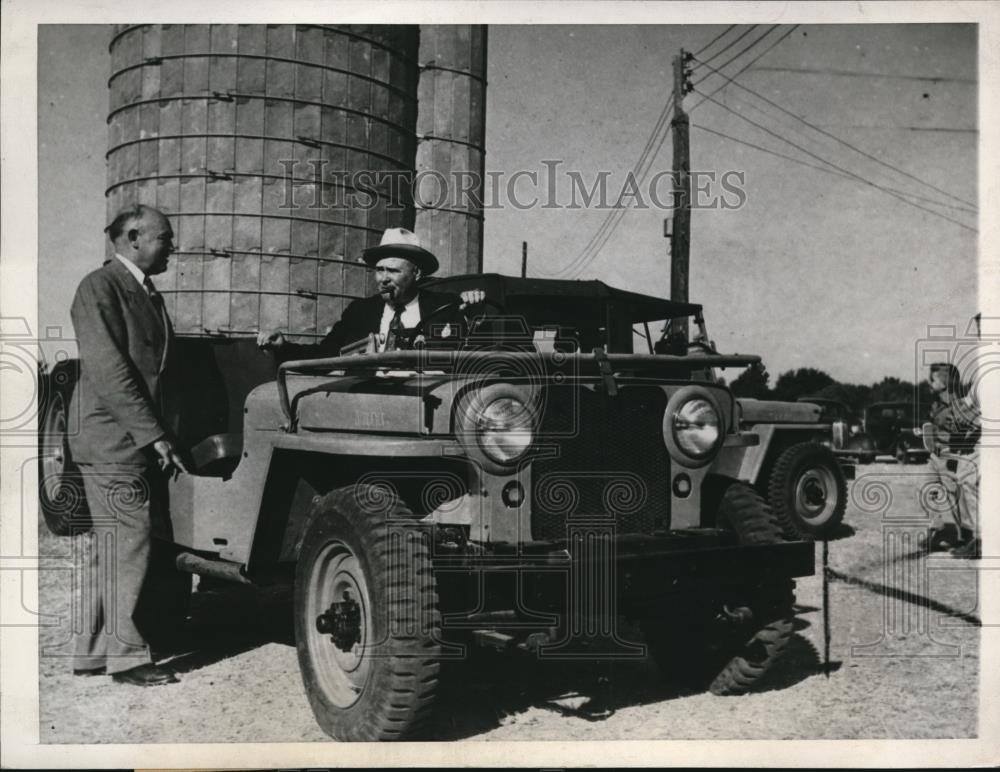
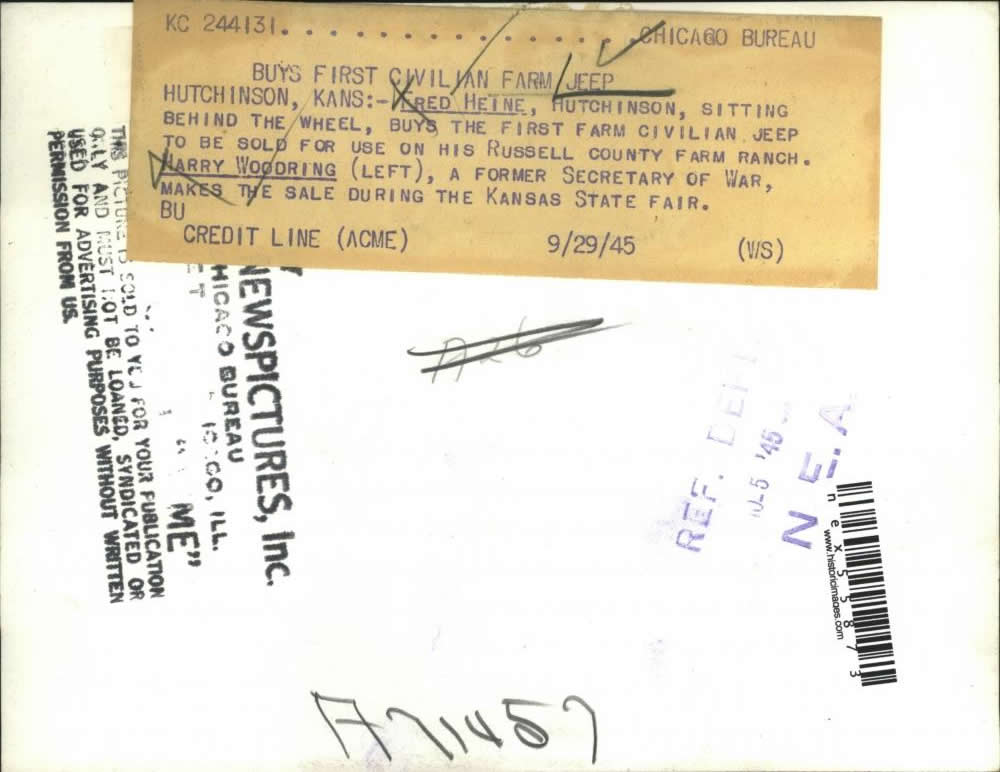
Fred Heine would late purchase an early CJ-2A, as captured in these press photos that landed for sale on eBay in 2014:
This is a second press photo of a photo sold two months ago. The caption is the same, though it has slightly different marks.
“1945 Press Photo Hutchinson Kansas Fred Heine buys Jeep for farm, H Woodring”
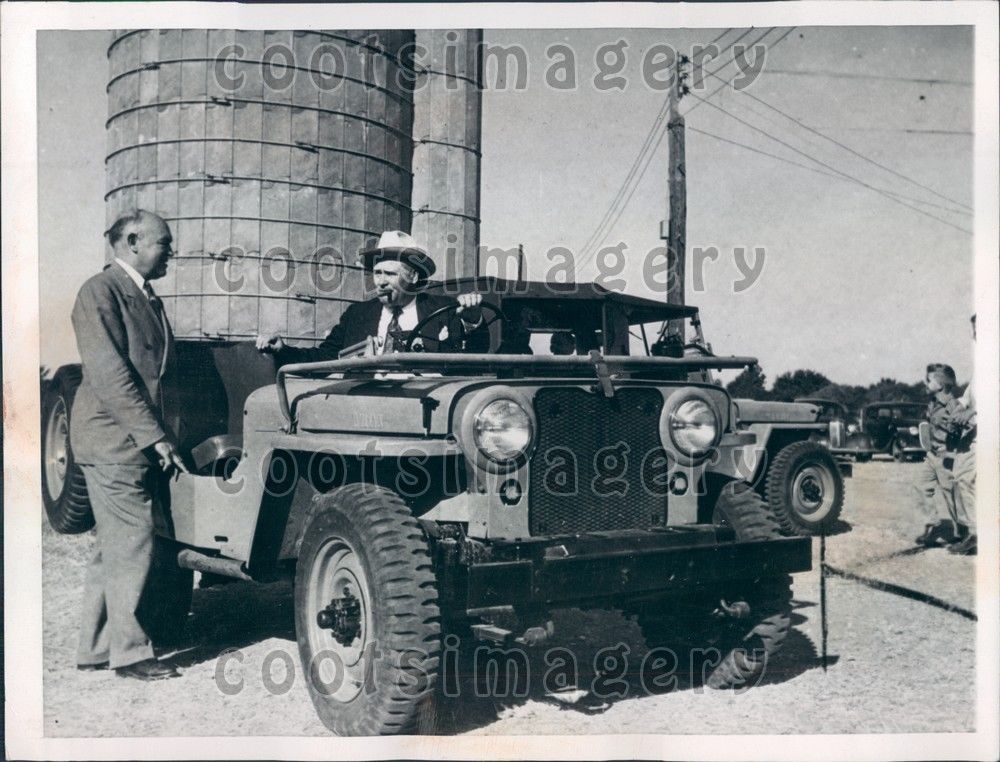
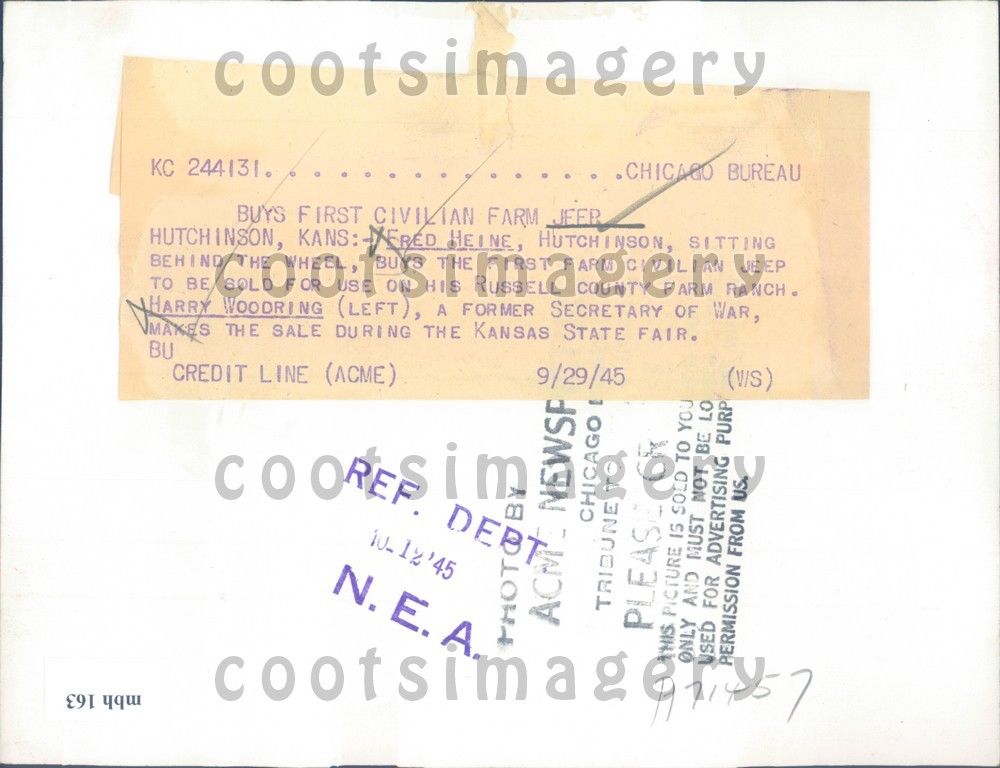
For comparison, here is what the photo and caption from October 2014 looked like: