emailNeed to contact me and don't have my email? Click on email button.
About eWillys
Welcome to eWillys.com, a website for vintage jeep enthusiasts. I update this website nearly every day with jeep deals, jeep history, interesting reader projects, jeep related info, and more.
These quick searches can help you find things on eBay. People list in the wrong categories all the time, so don't be surprised to see brochures in the parts area for example. This section used to be split into jeeps, parts and other categories, but recent changes to eBay will require this information to be recoded.
The links to posts below show jeeps grouped by models, condition, and other ways. Some of these jeeps are for sale and others have been sold. If you are unsure whether a vehicle is still for sale or not, email me at d [at] ewillys.com for more info.
Importantly, the allure of buying a project jeep can be romantic. The reality of restoring a jeep can be quite different, expensive and overwhelming without the right tools and resources. So, tread carefully when purchasing a "project". If you have any concerns about buying a vintage jeep, or run across a scam, feel free to contact me for help, comments or concerns .
While doing some research on brakelines, I came across certifiablejeep.com, a website that appears to mostly follow CJ-5s and CJ-7s. There’s some good information on the website.
“This site is dedicated to all that is Jeep. Mostly CJ’s are depicted and discussed on this site, but it isn’t limited to just CJ’s. We have been live now for for a little over 3 years and in that time we have met and talked with many people. The site has grown by leaps and bounds since its inception. It is still geared towards those who want to enjoy the Jeep lifestyle and gain and share knowledge about Jeeps.”
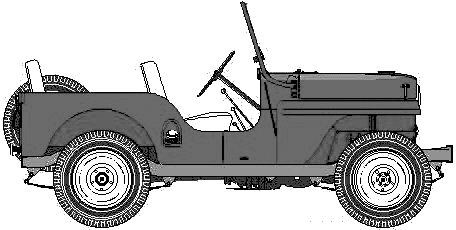
Here's an interesting site I found. Blueprints.com claims to have over 24,000 automobile blueprints online (though they appear more like a single drawing rather than full blueprints), including a variety of jeeps. To the right is a jeep labeled CJ-4. The site manager states:
"I do not claim to have made, scanned or drawn all of the blueprints on this website. I did on the other collect, edit and host all of them, free of charge, in my spare time.
I wandered across this website in 2008 that showcases old woodies. There’s a jeep section with a variety of woodies. The woodie at the bottom is made from an old MB/GPW.
“A French coachbuilder’s modification of the American Jeep into a wood-bodied fire fighting squad truck is similar to the work of Duriez.”
UPDATE: It appears this site has changed — at least I don’t remember it quite like this …
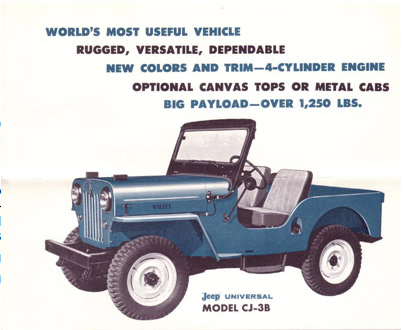
The “Jeepsterman” Morris Ratner has a variety of old brochures for sale on his jeepsterman website. You can see an example of one of those to the right, which is about the roper digger. Did you know the roper digger can be used in multiple ways? Now you do … Another interest brochure compares the jeep to the scout.
“The mission of the American Sand Association is simple: “Unite, Inform and Mobilize: We accomplish that mission throught the use of the volunteers. We believe in responsible resource management for the people. The American Sand Assotiation supports a national cooperation of local and regonal sand sport organization and shares with them ideas and infomration to help them Unite, Inform and Mobilize.”
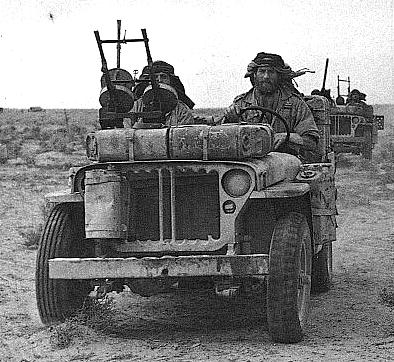
From day 1, adapting the jeep was a necessary part of using or owning one. In my mind, this is one of the attributes of jeeps that differentiate them from most other vehicles, even from other 4x4s. Andy Carter highlights early desert modifications in this story with pictures from jeeps used in Africa by the British Special Air Service (SAS) during WWII. Check out the grille in the picture on the right. If you read through the site, you'll note that this was a modification done to many of the jeeps, not just this one. They look like a boxer who has been through a few rounds!
Here's an excerpt from the website about SAS Jeeps:
"The jeeps were stripped of all non-essential parts including the windscreen, most of the radiator grille bars and even sometimes the front bumper to increase the effective load carrying capacity of the vehicle. Thus the large amount of fuel and water needed for fast long-range raids could be carried avoiding the need for slower support vehicles. A water condensing unit was fitted to the front to reduce loss from the radiator which would otherwise have had to be topped up from the limited drinking water supplies…"
 While doing some research on brakelines, I came across certifiablejeep.com, a website that appears to mostly follow CJ-5s and CJ-7s. There’s some good information on the website.