emailNeed to contact me and don't have my email? Click on email button.
About eWillys
Welcome to eWillys.com, a website for vintage jeep enthusiasts. I update this website nearly every day with jeep deals, jeep history, interesting reader projects, jeep related info, and more.
These quick searches can help you find things on eBay. People list in the wrong categories all the time, so don't be surprised to see brochures in the parts area for example. This section used to be split into jeeps, parts and other categories, but recent changes to eBay will require this information to be recoded.
The links to posts below show jeeps grouped by models, condition, and other ways. Some of these jeeps are for sale and others have been sold. If you are unsure whether a vehicle is still for sale or not, email me at d [at] ewillys.com for more info.
Importantly, the allure of buying a project jeep can be romantic. The reality of restoring a jeep can be quite different, expensive and overwhelming without the right tools and resources. So, tread carefully when purchasing a "project". If you have any concerns about buying a vintage jeep, or run across a scam, feel free to contact me for help, comments or concerns .
Mark Smith was the leader of the 1978 Jeep Expedition of the Americas (also known as the Expedicion de Las America), a 20,000-mile, 120 day odyssey that covered the Americas. Much of the trip was on roads, with the offloading of the the Darien Gap, the section of land between Colombia and Panama, the focus of the trip.
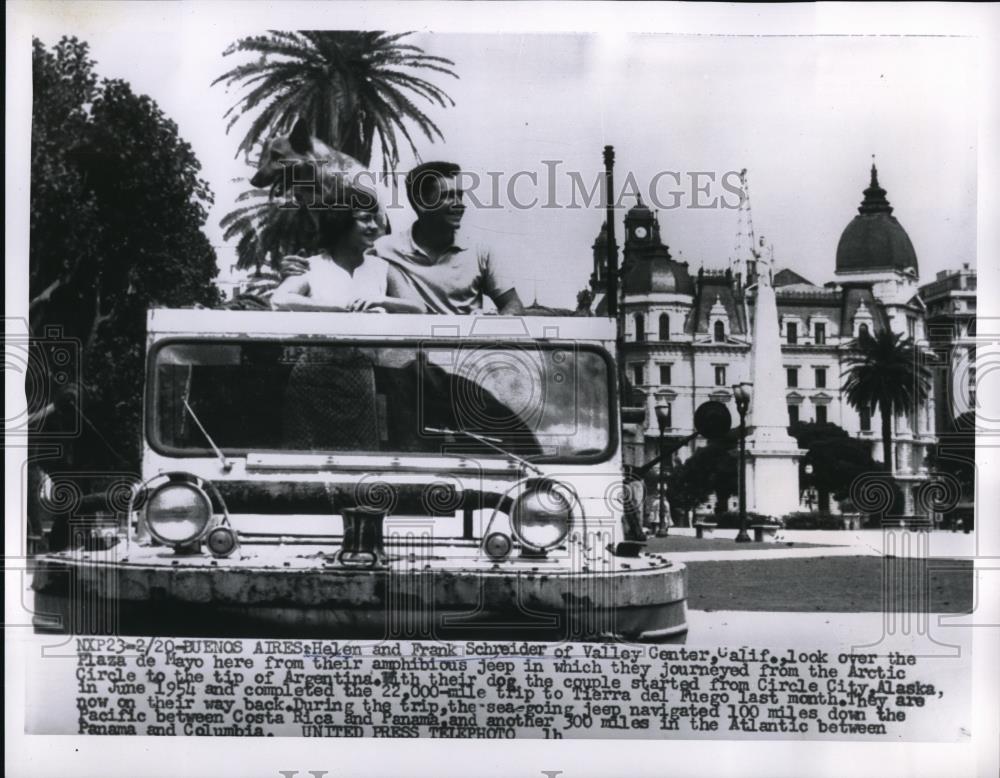
The narrator in the movie notes, rather dramatically and erroneously, that the Gap had only been crossed once before by the British Army. In fact, the Darien Gap had been crossed at least once before in 1960 by a group in a Landrover and a Willys truck, the story of which was published in National Geographic and clearly titled “We Drove Panama’s Darien Gap“. Though Frank and Helen Schreider drove the entire length of the Americas in their SEEP, Tortuga, in 1954, one place they didn’t attempt to drive, but instead floated around, was the Darien Gap.
Fortunately for us, the 1978 trip was captured on video, so we can enjoy some of what they saw during their adventure. Vimeo currently has a twenty-seven minute video of the trip. It’s a little dated at times, but still interesting to watch:
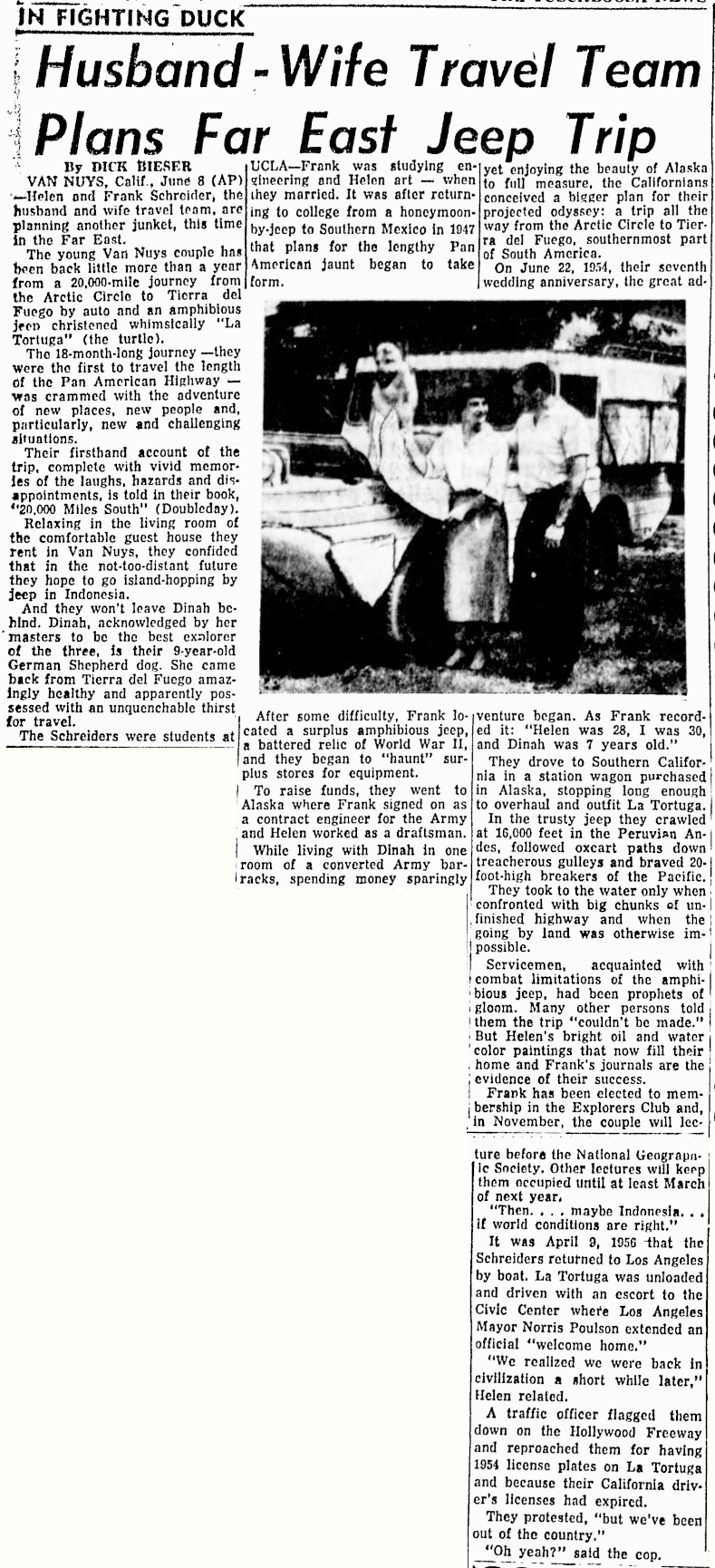
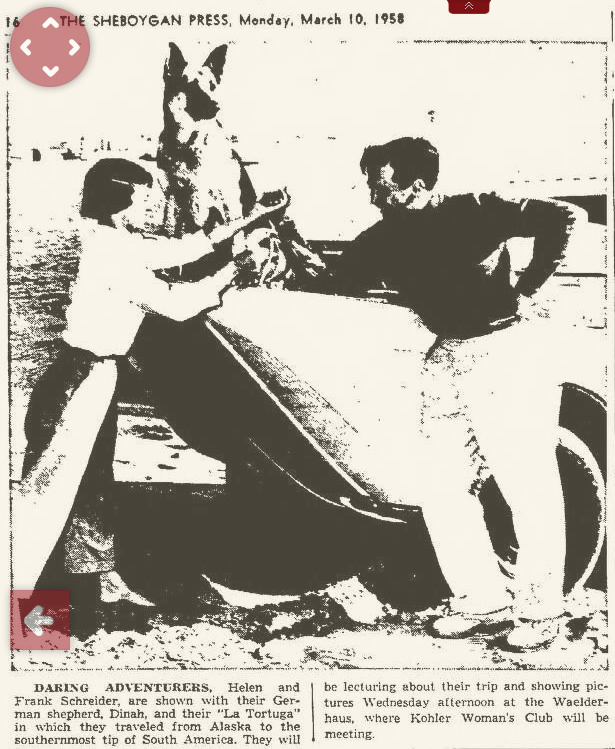
This article appeared in the June 9, 1957 issue of the Tuscaloosa News. The photo shows Frank and Helen Schreider , their dog Dinah, and their Ford GPA, La Tortuga. The report covers the period after their Pan American trip. Because of the journey, the Shreiders were elected to the Explorers Club. In the article they tease about going to Indonesia, which of course the eventually did.
Ann and I and my boys are camping near Lake Stevens for a day and then will be up at Deception Pass for a couple days. I expect updates will be spotty, but I’ve got a few things to read for Sunday.
I authored an article for Mark Smith’s War Jeeps site on five major trips undertaken with a Ford GPA Seep. It was a fun article to write. During my research I learned that Helen Schreider is still alive and living in Santa Fe, New Mexico. There’s a producer working on a film about her. The producer volunteered to ask her some questions I composed, but I’ve yet to hear back form them.
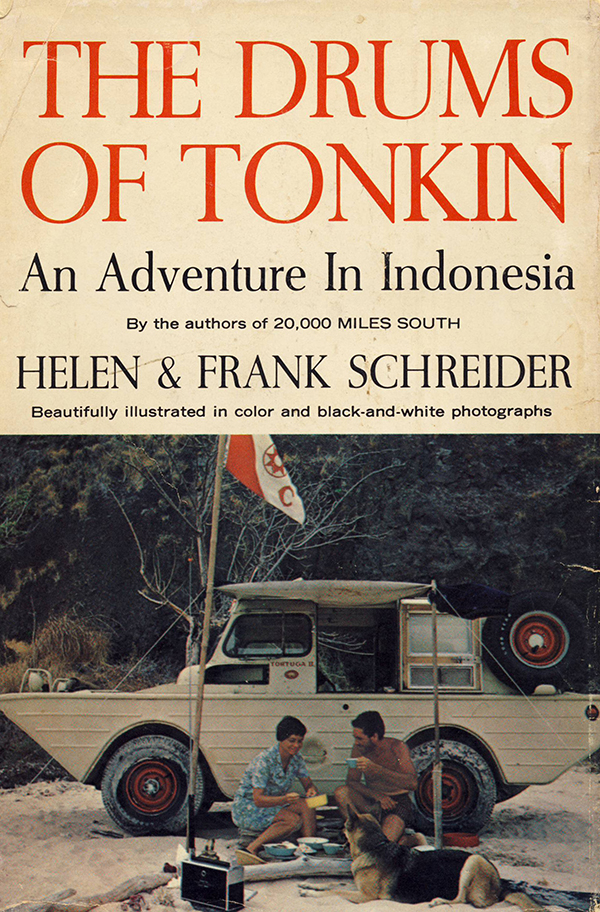
Following a successful 1954-1955 Pan-American trip and lecture series, Helen and Frank Schreider began working with National Geographic in the late 1950s. They apparently struck a two part exploration plan. First, the couple would travel along India’s Ganges River Plain in a Ford GPA from the mouth of the river to its source and report on their experience. Second, they’d head toward Indonesia for a much longer adventure, which they described in the Drums of Tonkin.
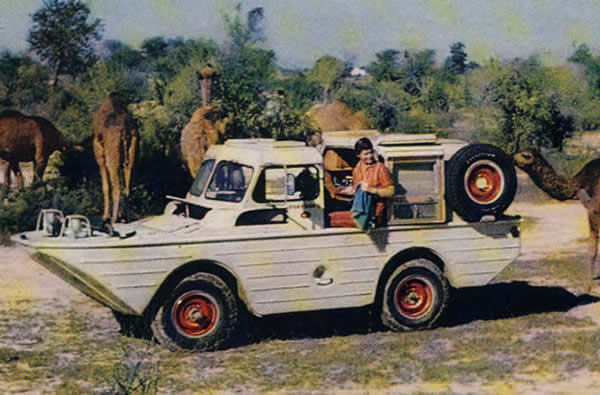
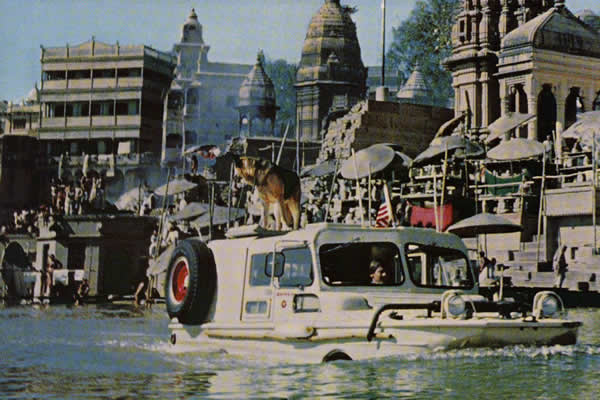
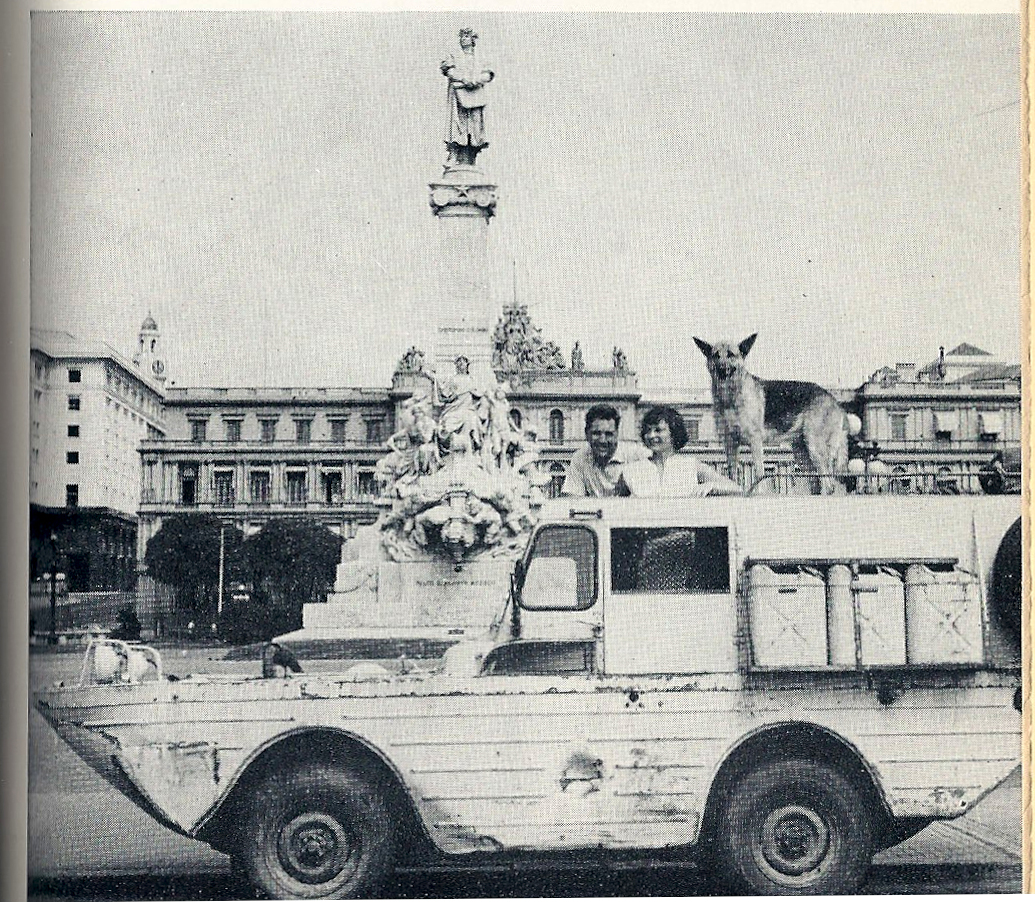
The 1954-1955 drive through Central and South America beat up their original Ford GPA, ‘La Tortuga’, badly. While they shipped La Tortuga back to California after reaching Tiera Del Fuego, it appears the damage was bad enough that they didn’t attempt to use that GPA to travel again. So, for their new adventure to India and Indonesia they modified a second GPA, calling it La Tortuga II. One way to tell the difference between I and II is the location of the exhaust pipe. On I it is farther behind the lights than it is on II. One reason for this is that the cabin extends farther forward on II than on I. Here are comparison photos:
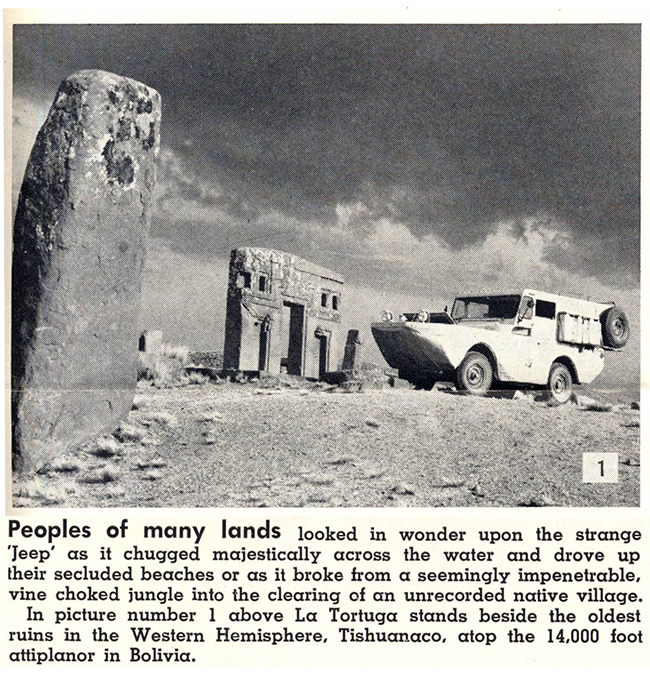
Tortuga I – Pan American Trip Frank and Helen Schreider. Note the damage to the sides. It is for sale in Norway.
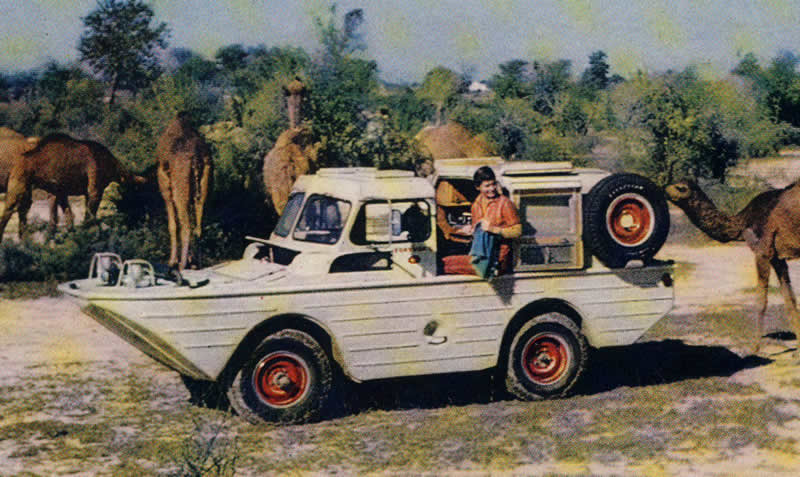
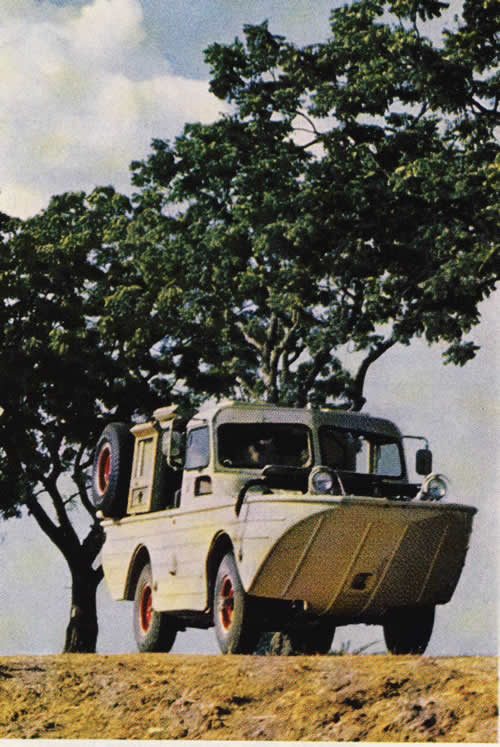
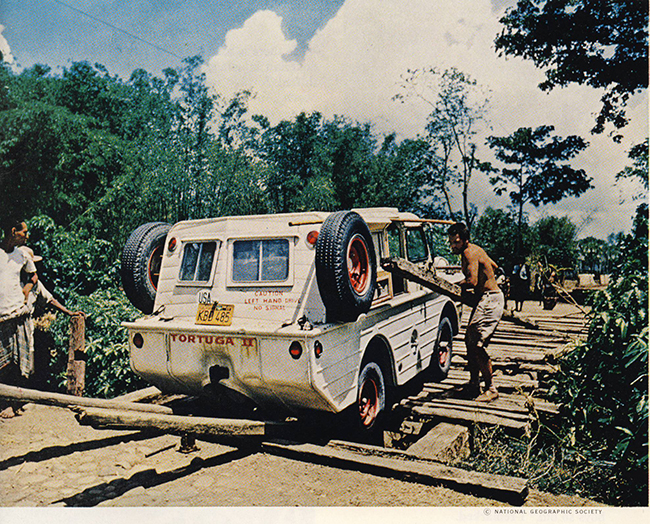
Tortuga II in India. Note how the cabin reaches farther forward and the muffler is closer to the lights. The fate of this GPA is unknown at this time.
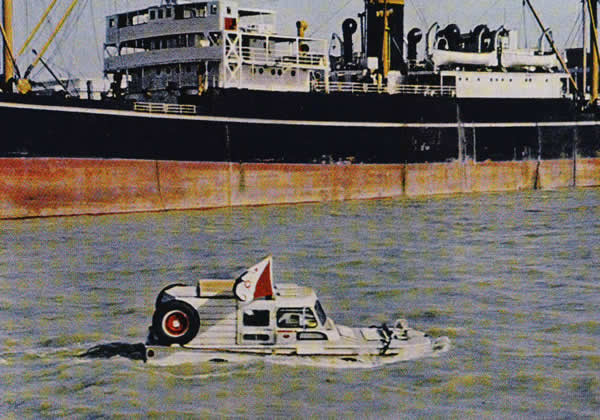
Their five month 1960 India adventure from the mouth of the Ganges to it’s source filled forty-two pages of the October, 1960, issue of National Geographic. There’s a definite shift from reporting about their seep and their obstacles, as they did in their first book, to an emphasis on the people and cultures they encountered. In other words, they focused less on adventure and more on anthropology and biology. Still, there are a few photos of La Tortuga II as they explored the waters and plains of the region.
In 1960, Helen and Frank began a new adventure in India. For unknown reasons, Tortuga was replaced by the Tortuga II (Amphibious Vehicle website has a great comparison information between Tortuga I and Tortuga II). Perhaps the original Tortuga was too damaged to undertake another long trek. The goal of their Indian adventure was to explore the Ganges river plain and write an article for National Geographic (which appeared in the October 1960 issue). I have the article, but have yet to read it.
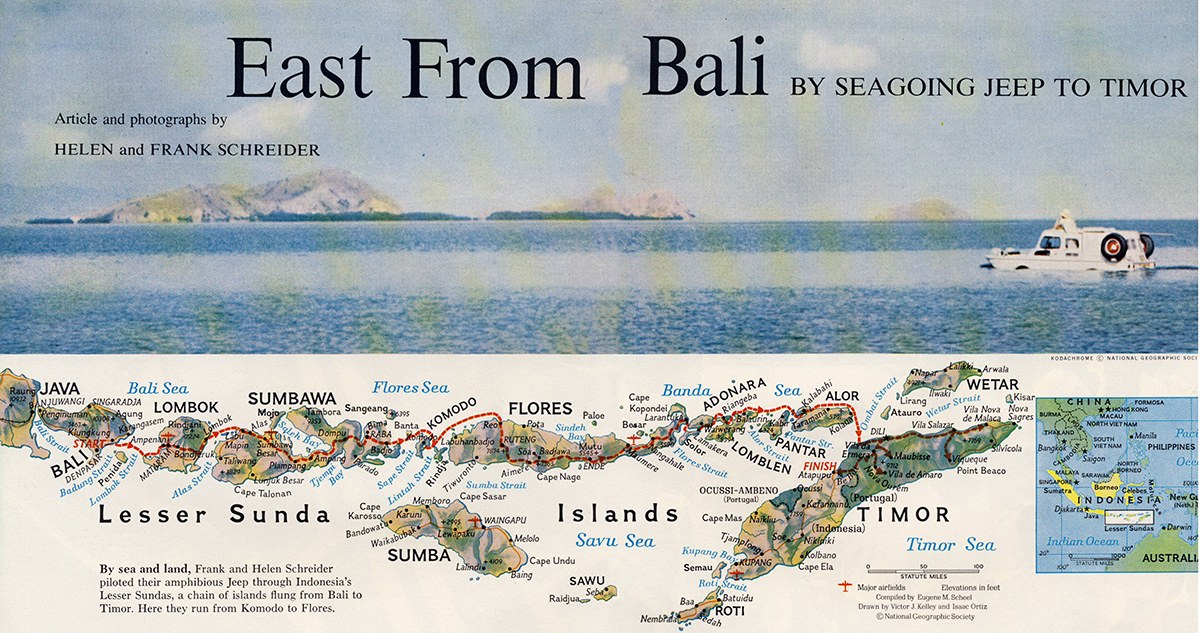
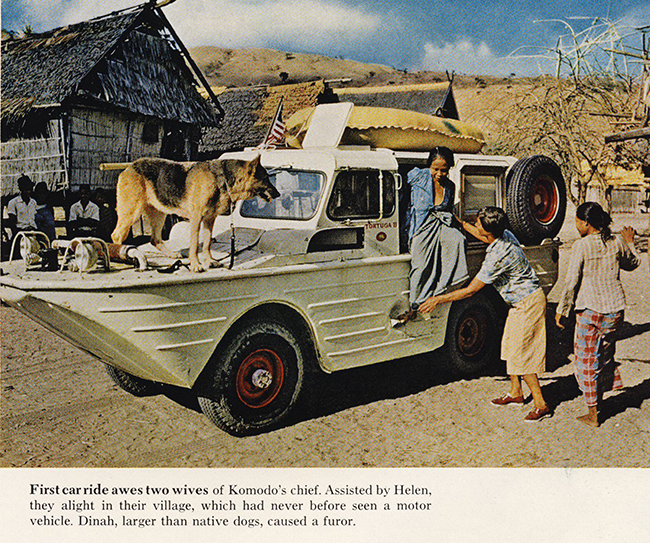
In 1961, following their India adventure, the pair undertook an even longer expedition. They wanted to explore Indonesia’s Lesser Sundas, a chain of islands stretching 3000 miles from Bali to Timor. Their adventure filled two large articles for National Geographic (Indonesia: Young and Troubled Nation in the May 1961 issue and East from Bali by Seagoing Jeep in the August 1962 issue). They also published a book in 1963 called the Drums of Tonkin: An Adventure in Indonesia.
Both the National Geographic articles about Indonesia and their Drums of Tonkin book are dense with cultural references and photographs. Unfortunately, both the articles and the book over-burdened me with local references to such a degree that for me the story was less compelling than their 20,000 Miles book. This likely reflects a larger emphasis on anthropology, geography, and biology, a result of their funding by National Geographic.
Despite the compelling prose, there were plenty of photographs to enjoy. Here’s just a few. This first one is pretty self-explanatory.
According to the New York Times obituary for Frank, who died in 1994 in Crete, the couple joined National Geographic in 1967 and continued to have additional adventures by vehicle, foot and boat. However, there is no record that they ever traveled by GPA.
UPDATE II: Not only did they publish a book, but they also filmed a documentary in color, called We Made the “Impossible” Tour, that was part of a lecture tour. In addition, their adventure was serialized in the Saturday Evening Post in 1957:
January 12, 1957, We Made the “Impossible” Tour, Part One: How We Motored Through the Jungle
January 19, 1957, We Made the “Impossible” Tour: Part Two: How We Went to Sea in a Jeep
January 26, 1957, We Made the “Impossible” Tour, Part Three: Island-Hopping the Spanish Main
February 2, 1957, We Made the “Impossible” Tour: Part Four: Trigger-Happy Territory
February 9, 1957, We Made the “Impossible” Tour: Conclusion:The Land of Fire – three agonizing miles of travel in southern Argentina.
UPDATE: This same book is published under a different name with some different photos: “La Tortuga an amphibious journey from Alaska to Tierra del Fuego”. I could not find a copy for sale when I last looked.
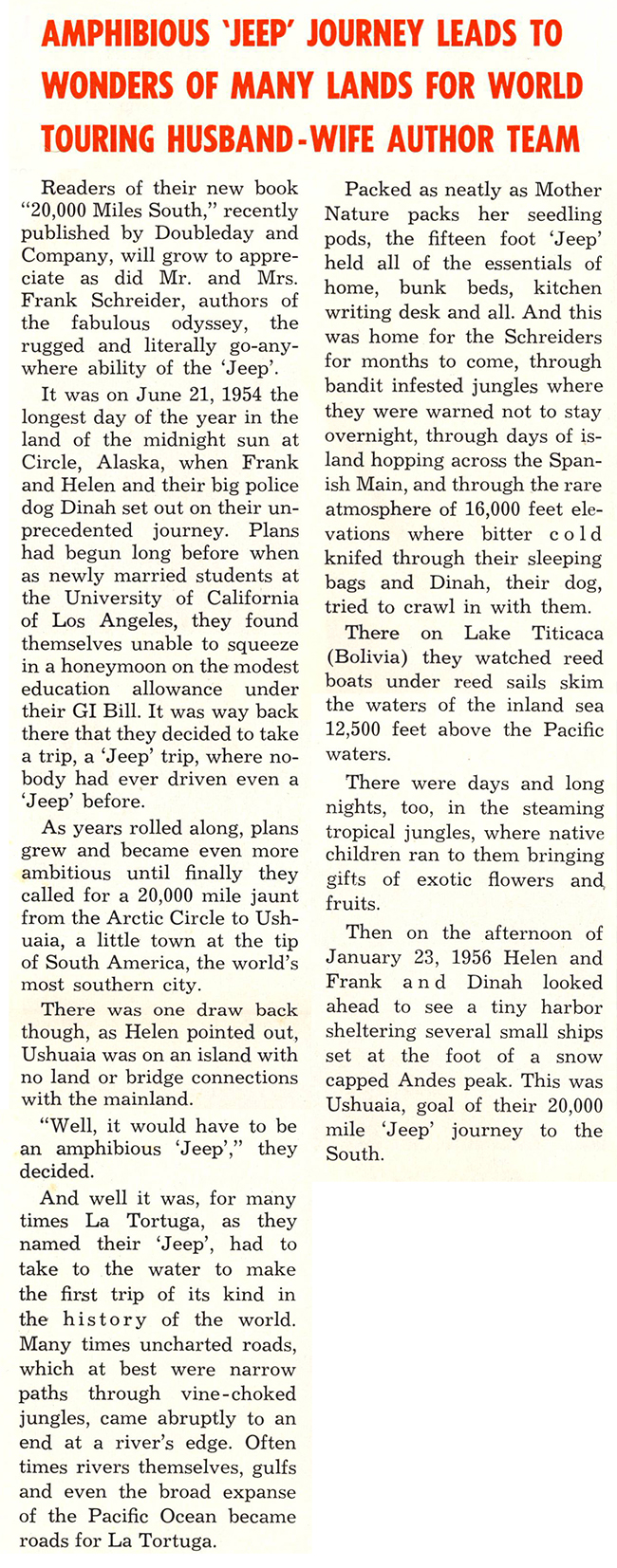
“20,000 Miles South: A Pan-American Adventure in a Seagoing Jeep from the Arctic Circle” by Helen and Frank Schreider is a great read. In the book they relate their first failed attempt to travel south in a Willys Wagon, which leads to their decision to try it in a SEEP (named La Tortuga). In 1954, they started their journey south, sharing in the book their struggles, successes and failure. At one point they try to drive down a railroad track, but are forced to give up the effort due to the damage the track inflicted on the SEEP. At another point they enter the country of Colombia by water, only to be told when they attempt to exit the country that they didn’t get the proper stamp (because they entered via the water). These are just some of the challenges they face.
I’d have to say this is one of my favorite jeep related books that I have read. After the “20,000 Miles” book they wrote the “Drums of Tonkin“, which is about a trip through Indonesia, and “Exploring the Amazon.” They also joined National Geographic as photographers and authors.
Frank died in 1974 at the age of 70. He suffered a heart attack in the cabin of his sail boat, Sassafras, while anchored off the island of Crete. I suspect that’s the way he would have wanted it. Helen was still alive and living in New Mexico at last report.
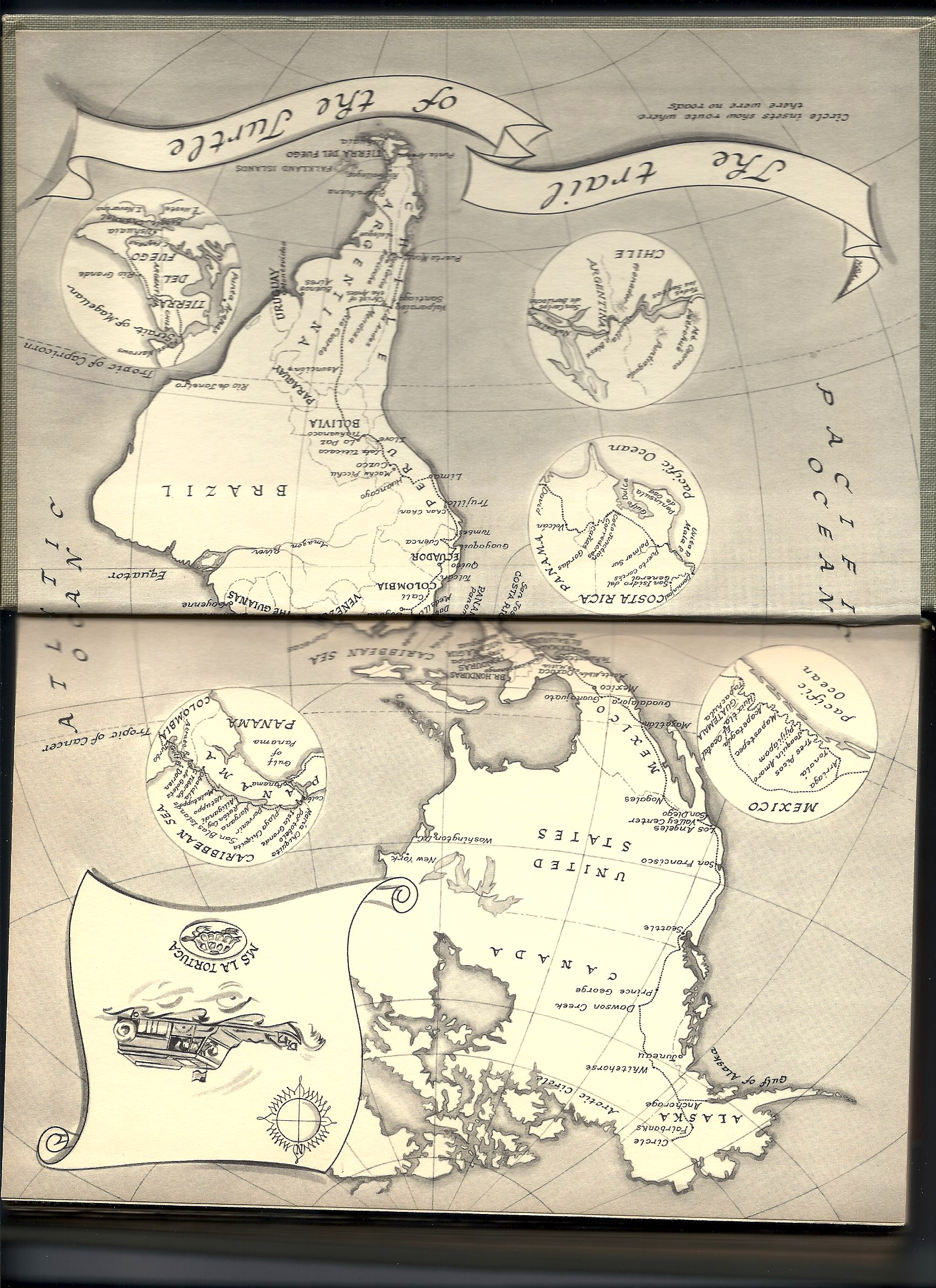
It appears you can borrow a copy of the book through the open library project. Learn more here. Here are some photos. This is a shot of the inside cover which shows the path they drove/boated:
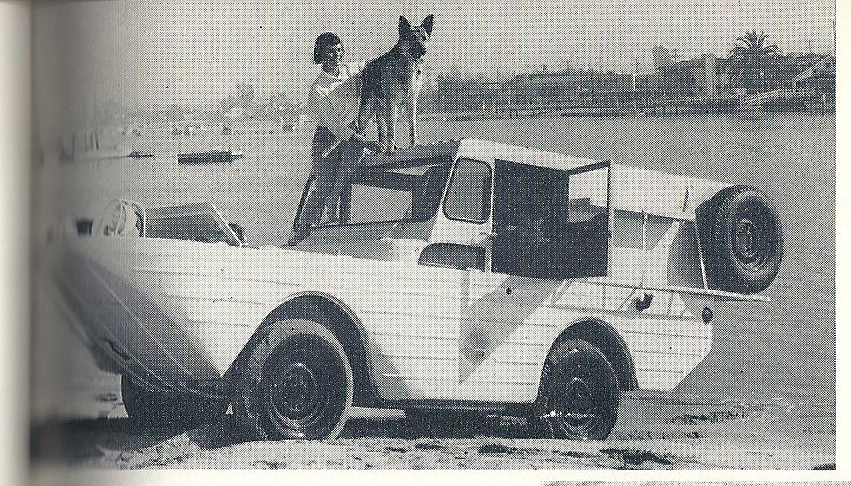
This photo was taken after the maiden voyage in Balboa Bay, California. Helen is holding onto their dog, Dinah, who could often be found riding on top of the cabin.