emailNeed to contact me and don't have my email? Click on email button.
About eWillys
Welcome to eWillys.com, a website for vintage jeep enthusiasts. I update this website nearly every day with jeep deals, jeep history, interesting reader projects, jeep related info, and more.
These quick searches can help you find things on eBay. People list in the wrong categories all the time, so don't be surprised to see brochures in the parts area for example. This section used to be split into jeeps, parts and other categories, but recent changes to eBay will require this information to be recoded.
The links to posts below show jeeps grouped by models, condition, and other ways. Some of these jeeps are for sale and others have been sold. If you are unsure whether a vehicle is still for sale or not, email me at d [at] ewillys.com for more info.
Importantly, the allure of buying a project jeep can be romantic. The reality of restoring a jeep can be quite different, expensive and overwhelming without the right tools and resources. So, tread carefully when purchasing a "project". If you have any concerns about buying a vintage jeep, or run across a scam, feel free to contact me for help, comments or concerns .
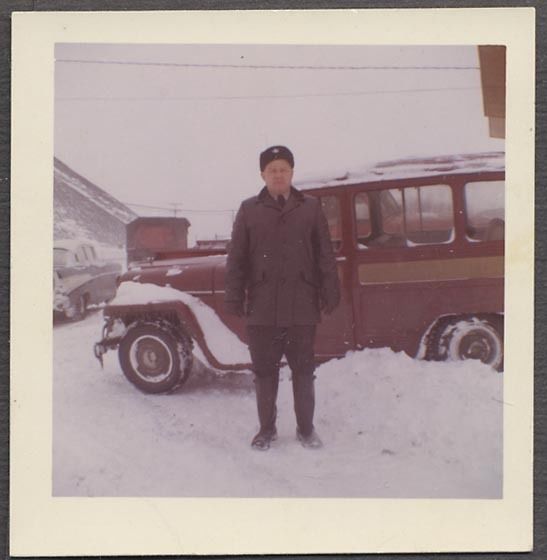
UPDATE: As Mark notes, and I missed, the truck pictured is a 1954 at the earliest, so the pic must have been taken after that.
This is likely a reprint, but it’s still a neat photo. It also show the early “J” logo sign. I’m not a Packard expert, but I’d say based on the grille on the car in the window of the auto shop that this photo must have been taken circa 1954-56.
“1943 Press Photo Soldiers and jeeps, Bizerte, Tunisia. This is an original press photo. World War II – Africa. As these years rolled into Bizerte in their jeeps to capture the city, snipers opened fire and the Yanks took over behind the jeeps and a handy well. Official Signal Corps Radiophoto. Photo measures 8.5 x 6.25 inches. Photo is dated 5-12-1943.”
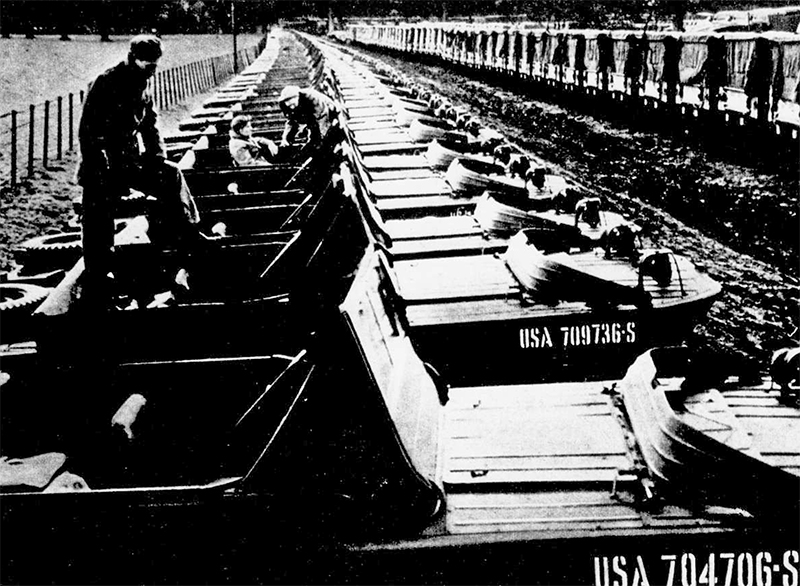
A strike grounded these jeeps before they could be loaded onto ships.
“1952 Press Photo U.S. Army Jeeps at Caven Point pier in Newark, New Jersey. This is an original press photo. Trucks – United State. Newark, New Jersey. Walkout yesterday of longshoreman on Jersey City waterfront brought loading of these jeeps at Army-leased pier at nearby Caven Point to standstill. Photo measures 9 x 7.25 inches. Photo is dated 3-13-1952.”
“1942 Press Photo U.S. Army Soldiers ride down London street in Military Jeep. .This is an original press photo. Four American doughboys ride down a London street in a peculiarly American vehicle, one of Uncle Sammy’s jeeps. Note how they are overshadowed by the familiar London double-deck bus. U.S. Army in London Photo measures 6.25 x 9.5 inches. Photo is dated 03-15-1942.”
This version of the photo was auctioned in 2013 on eBay. It has the date of March 13, 1942. The caption includes the verbiage, “A ‘Jeep’ comes to London Town”.
“1960 Press Photo United States Army Transportation Corps Jeep and Carrier. This is an original press photo. United States Army Transportation Corps Jeep and Carrier. Photo measures 10 x 8.25 inches. Photo is dated 08-25-1960.”
There’s a newsreel about the capture of Goch, which credits the Canadian fighters. The photo seen at the bottom includes a medic and jeep ferrying wounded surrounded by destruction.
“1943 Press Photo Soldiers in jeeps park outside of building & old church, Sicily. This is an original press photo. World War II – Sicily. … glory flies from a building in Gela in southern Sicily after the city fell … invading Americans. A column of jeeps pauses near an ornate old church which looks out of place beside modern military machines. Photo measures 7.5 x 7 inches. Photo is dated 7-24-1943.”
in 1961, President Kennedy signed the Peace Corps Executive Order. Since then, over 1/4 million volunteers have served around the world. Given the rough conditions, especially in the early days, jeeps were a natural fit for the volunteers heading to remote areas. Folks were even trained on how to used jeeps as a part of their introduction to the Peace Corps.
There seems to have been a wide variety of jeeps used by the Peace Corps. How the jeeps were obtained isn’t clear, but at least some in 1965 were donated by Oakland Motor Sales. I imagine the military versions, like the M-170 seen below, could have been transferred to the Corps. After a few years of service, some areas of the world abandoned jeeps. For example, a deteriorating jeep fleet in Sierra Leone led to the abandonment of jeeps, at least according to this article. In another example, according to Ron Horton, who wrote a somewhat risqué look at his time in the Peace Corps, jeeps were quickly phased out in favor of bicycles, because the bikes were considered more friendly by the person who oversaw the Brazilian Peace Corps units.
Here are a few photos related to the Peace Corps and Jeeps:
PEACE CORPS TRAINING:
1964, NATIONAL ARCHIVES, CAPTION: Peace Corps trainees on the D.H. Lawrence Ranch near Taos, New Mexico. Three men in jeep on sandy hill, sand flying through air.
1964, NATIONAL ARCHIVES, CAPTION: Peace Corps trainees on the D.H. Lawrence Ranch near Taos, New Mexico. Six women driving in snow-covered dirt road, juniper bushes in background.
1964, NATIONAL ARCHIVES, CAPTION: Peace Corps trainees on the D.H. Lawrence Ranch near Taos, New Mexico. Jeep ascending steep dirt hill. [THIS MIGHT BE A CJ-3A GIVEN THE SIDE MOUNTED TIRE]
JEEPS IN THE PEACE CORPS:
Here’s a wonderful photo of Perdita Huston, former Peace Corp Director of Mail and Bulgaria, in a WWII jeep:
Peace Corps, late 1990s, Perdita Huston
This photo of a CJ-3B with a Koenig hardtop in Chile was taken around 1965:
CAPTION: Peace Corps volunteer Emory Tomor waiting for a farmer and his oxen to pull his Jeep out of the mud. Photograph, c1965. View the photo at fireartamerica.com.
Finally, there’s no caption with this image of the back of a jeep, possibly a 1948 CJ-2A given the spare tire location:
“1944 Press Photo Henry L Larsen talks to Alexander A Vandegrift in jeep, NC. This is an original press photo. Vandegrift, Alexander A. (Lieutenant General). Lieutenant General Alexander A. Vandegrift, Commandant of the United States Marine Corps, recently made a four-day inspection tour of the Marine Corps training base at Camp Lejeune, New River, North Carolina.
It was his first visit since he became commandant and the first trip back there since he left it in the Spring of 1942 to lead the Marine assault forces that drove the Japanese out of the Solomon Islands.
Lieutenant General Alexander A. Vandegrift (front seat of Jeep), listens to Major General Henry L. Larsen (right), describe a re-enforced rifle company’s field problem on a musketry range Camp Lejeune, New River, North Carolina, during his inspection tour. General Larsen, Commanding General of Camp Lejeune, and Colonel William N. McKelvy (rear seat), of Washington, District of Columbia, Commanding Officer of the Instructors’ Group, Replacement Battalions, accompanied General Vandegrift during the field problem. Photo measures 10 x 8.25 inches. Photo is dated 3-2-1944.”