emailNeed to contact me and don't have my email? Click on email button.
About eWillys
Welcome to eWillys.com, a website for vintage jeep enthusiasts. I update this website nearly every day with jeep deals, jeep history, interesting reader projects, jeep related info, and more.
These quick searches can help you find things on eBay. People list in the wrong categories all the time, so don't be surprised to see brochures in the parts area for example. This section used to be split into jeeps, parts and other categories, but recent changes to eBay will require this information to be recoded.
The links to posts below show jeeps grouped by models, condition, and other ways. Some of these jeeps are for sale and others have been sold. If you are unsure whether a vehicle is still for sale or not, email me at d [at] ewillys.com for more info.
Importantly, the allure of buying a project jeep can be romantic. The reality of restoring a jeep can be quite different, expensive and overwhelming without the right tools and resources. So, tread carefully when purchasing a "project". If you have any concerns about buying a vintage jeep, or run across a scam, feel free to contact me for help, comments or concerns .
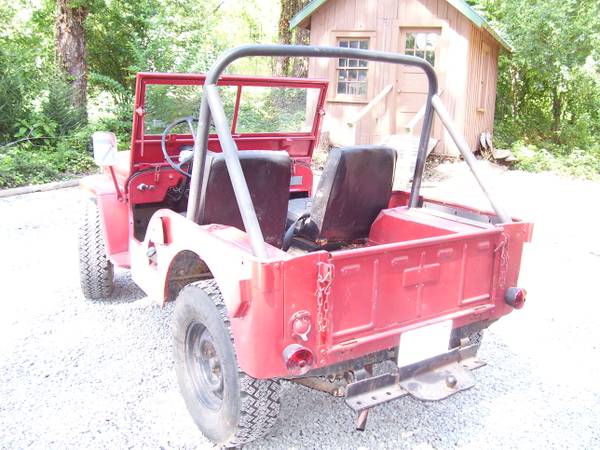
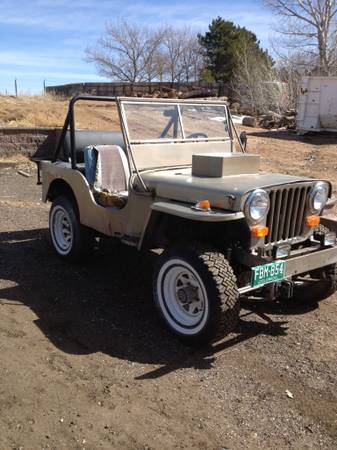
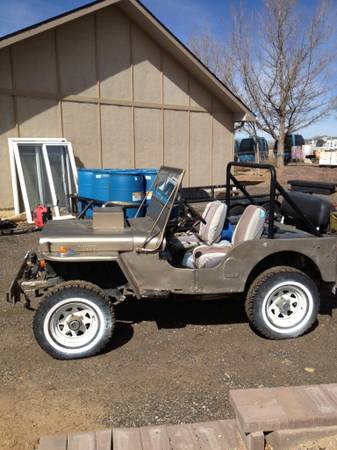
“1947 Willys CJ2A, engine rebuilt less than 1,000 miles, brakes rebuilt, 4WD, weekly driver, no top, roll bar, tow bar, front wheel locking hubs. Could use new springs. Must see and drive to appreciate.”
“Pictures tell all, but craigslist only allows 12 small pics.. If interested and a serious, cash in-hand buyer, message me and I will send 66 pictures.
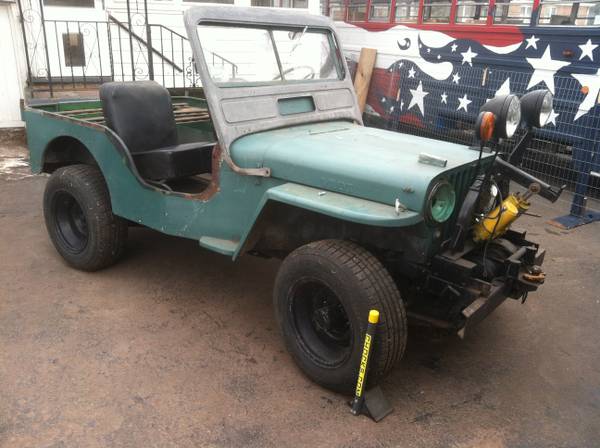
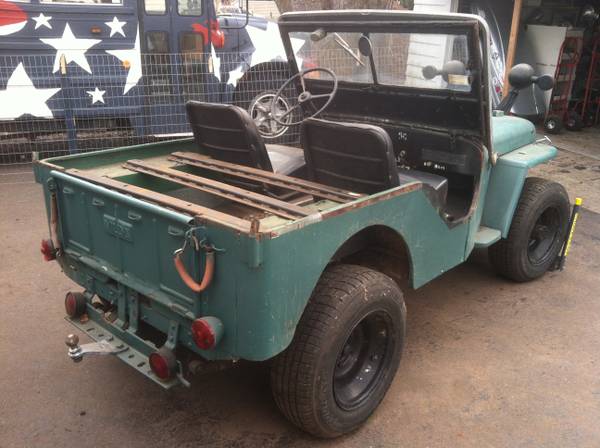
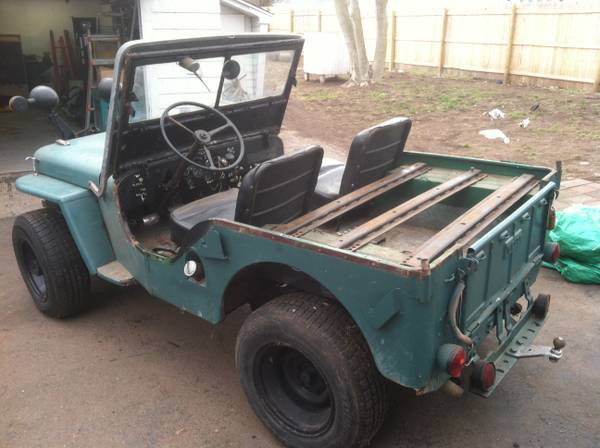
Purchased her about 2 years ago. Was with the PO since the early 90s — An old skooler, who had a few early CJs – was used as a plow vehicle for his driveway, stored in his barn. He passed away, sat for a year and then wouldn’t start. Got it home, drained the fuel, ordered up a rebuilt carb, electronic fuel pump, inline filter and pressure regulator — fired right up. Found the ignition to be a bit taxing on the 12v system (6v starter), so I ordered up a floor switch, added some new battery cables and cleaned all connectors and the ground contacts. No more drain/draw, fires up after sitting for a month — all better. Has not seen the road, but has been driven in endless circles and circles in the backyard, HI/LO.. 2wd, 4wd — through the gears with no problem. In need of some body work, floors and detail work. Frame is straight and solid — boxed forward section for the plow hardware. Plow hydraulics work great — freshly rebuilt, haven’t been used since rebuild. PTO winch is complete from driveline to cable. (more info on Craigslist).”
“I am currently trying to sell my 1946 Willy’s Jeep. It’s in mint condition for the year. It does still run, and includes a hard top. However it does have quite a bit of wear on the interior of the jeep (please see photos), and needs some TLC.”
UPDATE: This appears to have sold. Was listed at $4100.
There’s been plenty of work done, but still some left.
“I bought this 1948 Cj2A Jeep Willys from a guy in Genoa IL in 2001 when I got out of the Army. I bought it because I wanted a flat fender jeep and specifically, one that had not been modified. I had a 1969 Cj5 and a 1993 Wrangler and when people have done their own modifications they are a real challenge to work on afterwards. This one was old, but it looked original, minus the inside windshield frame which they had replaced with a piece of Plexiglas screwed into the outer windshield. It ran when I bought it but needed breaks. My intentions were to update the breaks and then enjoy driving it around. Once I started, it just got out of control and the next thing I know I had the body off and the engine out. Since then I have worked on it a few summers when I had time and it sat for the rest of the time when I was called back to active duty in the Army. Two trips to Afghanistan, college, and a family later, and I don’t have the time I thought I would. In the end it has evolved into a nice looking Jeep. That same summer I got a 1955 Cj5 for a few parts but ended up only using the front bumper. (more on Craigslist).”
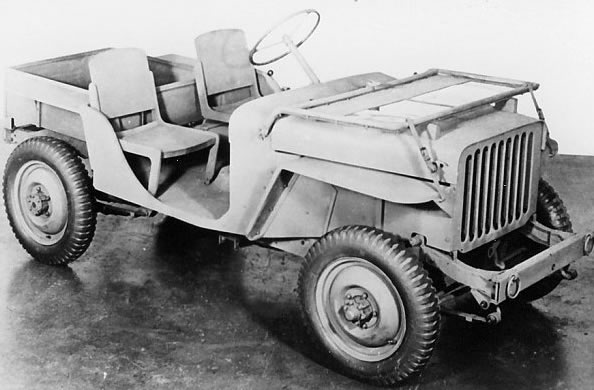
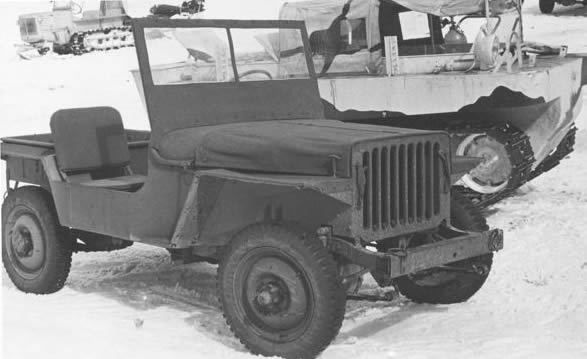
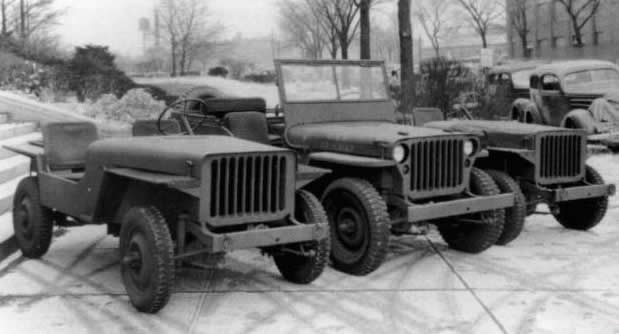
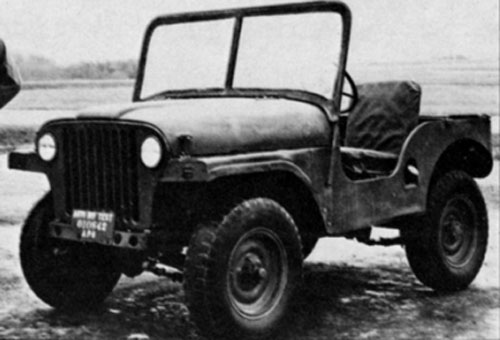
During World War II, trying to get vehicles, especially Jeeps, onto the ground where military personnel could use them was of paramount importance for obvious reasons. But, how to accomplish that goal was less clear. A variety of strategies were used. One idea that was opened up to bids by companies was a program to create an air-droppable Jeep, a lightweight jeep-like vehicle known as extra lights (EL) or lightweight jeeps or jeeplets that could be boxed and flown into areas where they were needed.
Similar to the original jeep prototype program, where multiple companies (in that case Bantam, Ford and Willys) submitted prototypes and pilots for review and testing, during World War II the military announced their lightweight jeep program and welcomed designs from a variety of manufacturers.
This program resulted in a variety of different vehicles that have been showcased across the web, mostly through old photos. In the article below I organize them using newer photos (whenever possible) to provide the most up-to-date look at most of these vehicles (I don’t have pics of all versions of every vehicle). For a fuller story of the history behind the lightweights, check out this 1977 article from Hemmings.
The image below shows a photo taken by Patrick Coovert in 2008 at Hallsville, Ohio. In order, from left to right are a CT3 Crosley Pup, the Chevrolet Extra Light (CEL), Willys WAC (Willys Air Cooled), and a Kaiser Extra Light (KEL). These are just a few of the jeeps developed.
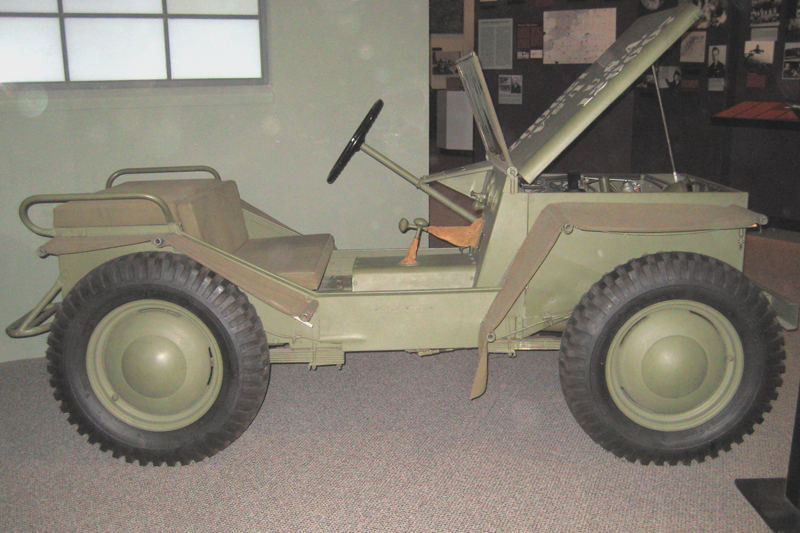
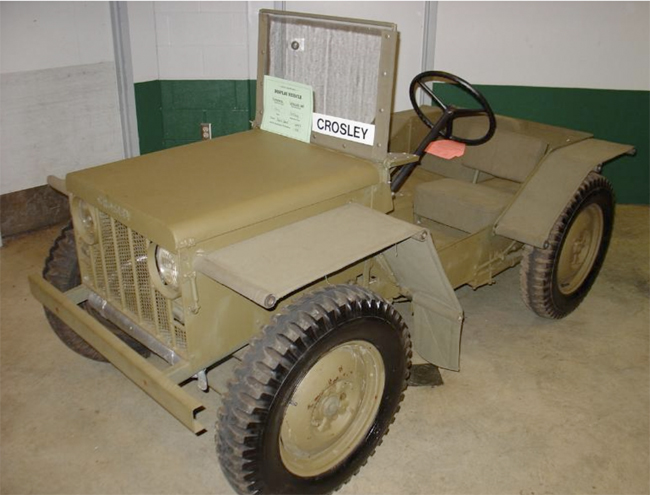
CT-3 Pup: According to Hemmings, 36 Crosley CT-3 Pups were built during 1942 and purchased for testing in several locations. of the 36, 6 of these would make the trip to Europe. This would make the Pup the most successful of all the early lightweights produced. The Pup had a 2-cylinder 13hp engine air cooled motor and weighed 1125 lbs. Hemmings notes, “they could only carry the driver and one passenger, and the military testers, initially enthusiastic about the Pup, found weak steering knuckles, weak springs and a weak steering column.”
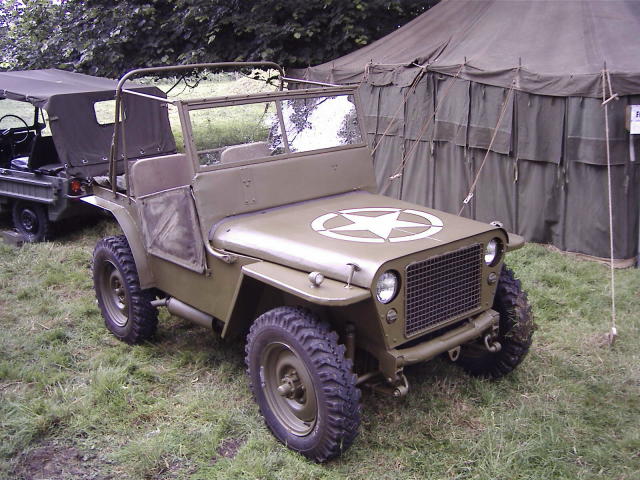
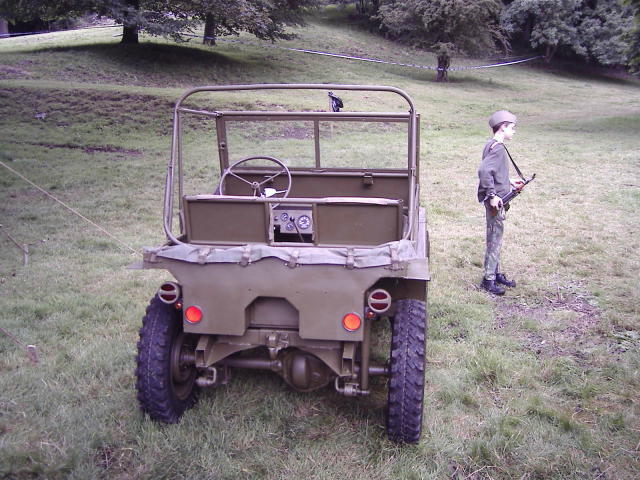
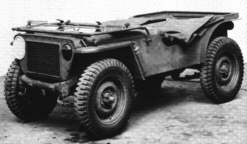
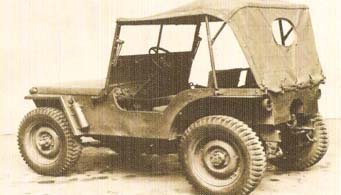
I have not located much information about the Nuffield, though it was featured in one of my early favorite book called The Jeep. I believe this was based primarily on Willys parts, though it was lightened as much as possible, with a removable steering wheel and fold down windshield to maximize compactness. The tests of this were successful, though it was deemed unnecessary by the time it was completed in 1944. Nuffield would go on to develop another 4wd vehicle called the Nuffield Gutty.
Here are some images of an exact copy (as possible) of the Nuffield lightweight jeep from a british website.
And some photos of the original:
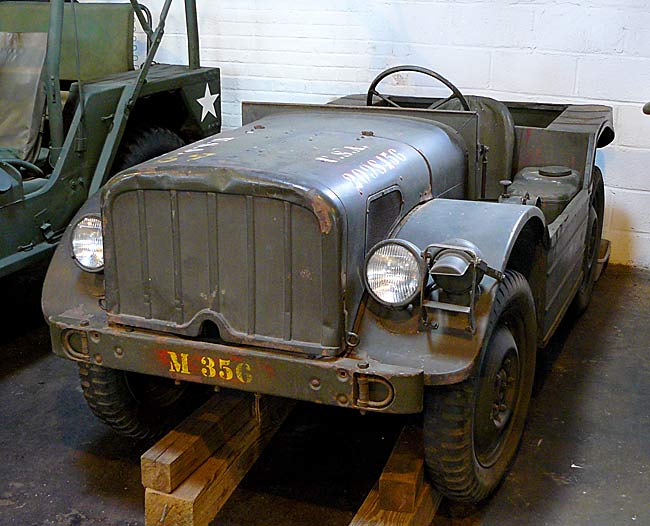
3. CHEVROLET EXTRA LIGHT (CEL): Hemmings reports Chevrolet developed 2 prototypes with an “Indian 90-degree V-2” 45.44 cid motor. They adapted it from the Indian Military motorcycle. One prototype is located in the Militia Museum of New Jersey. This image was taken by Bill Maloney.
Here’s an image of the CEL this is in a variety of places.
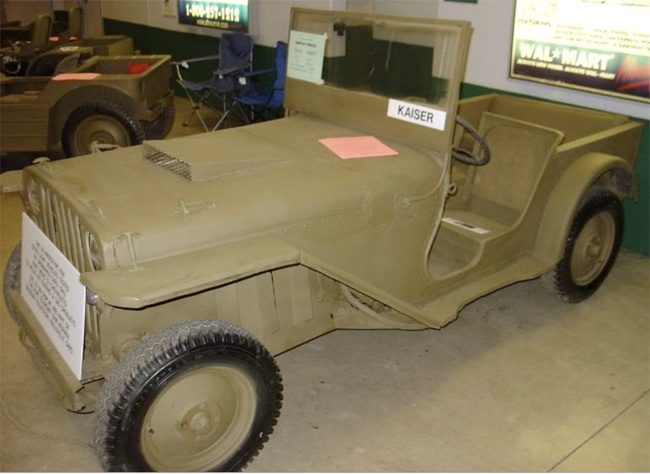
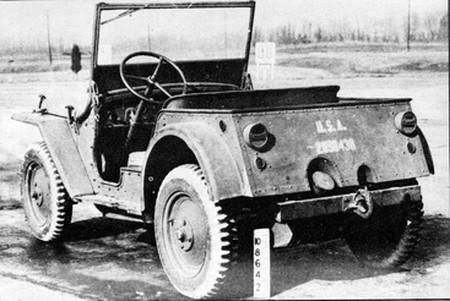
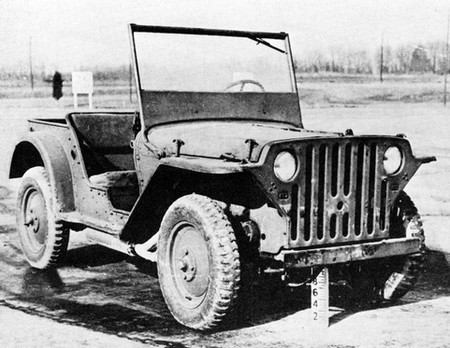
4. KAISER: There were several versions of the Kaiser Extra Lightweight Jeep. Mark Askew in his Rare WW2 Jeep book has images of a couple different versions. For example, the Kaiser ‘midjet’ weighed about 1370lbs and the ‘1160’ weighed 1520lbs.
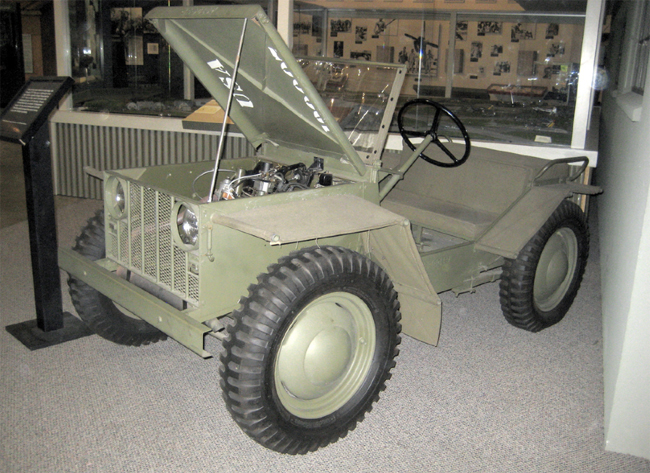
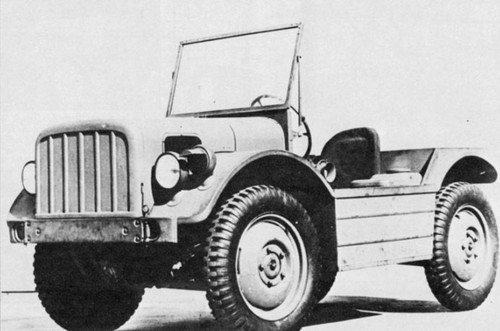
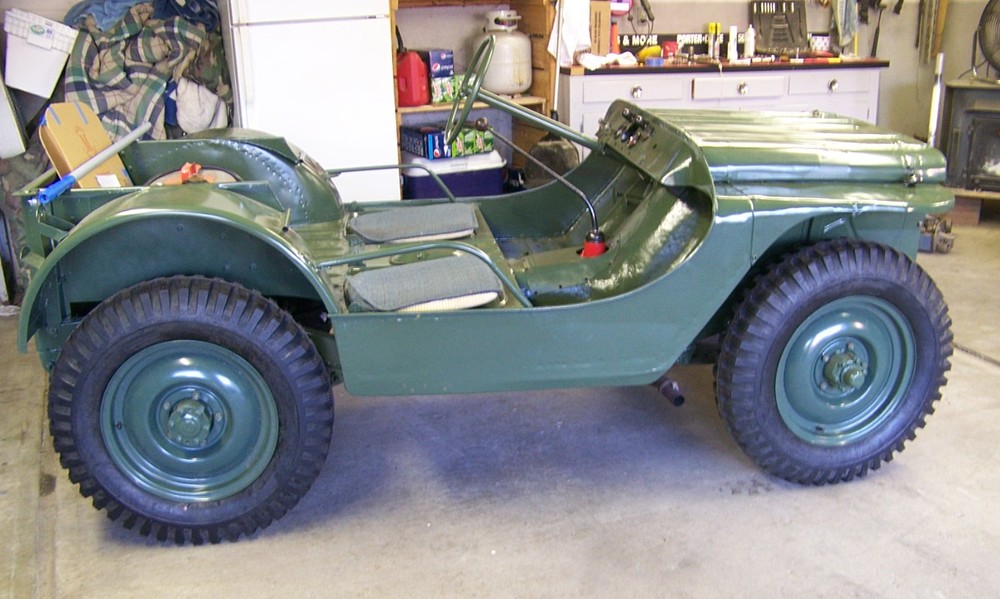
5. FORD “JUNIOR JEEP”: This prototype still exists and is owned by Ted Wisniewski of Belleville, Michigan and was highlighted in an article at Hemmings. A commenter to the article noted he had done some jeep research in the Ford archives and uncovered a wooden model of this prototype, images of which I have never seen.
From Fred Crimson’s Book “U.S. Military Wheeled Vehicles,”, via the Hemmings website, comes this paragraph explaining more about Ford’s prototype.
“For reasons which can only be speculated on, the little miniature Jeep was not entered in the competition, and the tests proceeded without Ford’s contribution. The engine for this vehicle was a 71 cubic inch agricultural tractor powerplant which produced good torque, but not much horsepower. Perhaps ford realized that the combination of low horsepower and downsized components resulted in an unacceptable vehicle. The other manufacturers did not seem to realize this until the tests were completed and all vehicles had failed. The tires were 5.00x17s with agricultural type tread. It was a clean and well integrated design, even if the offset grille looks a little strange. The radiator had been offset to allow clearance for the steering column. A blackout driving light is recessed below the left headlamp.”
6. WILLYS: Naturally, Willys also developed a series of light jeeps. Here are a few. Mark’s Rare WW2 Jeeps has some pics of both the Willys MB-L and L2. From Jedsite.info had a photo of the first MB-L. It’s also known as the “Gypsy Rose Lee” Jeep (Unity Magazine, Dec 1947).
Here’s a photo of the Willys MB-L2:
and a photo of the MB-L2 next to a standard MB
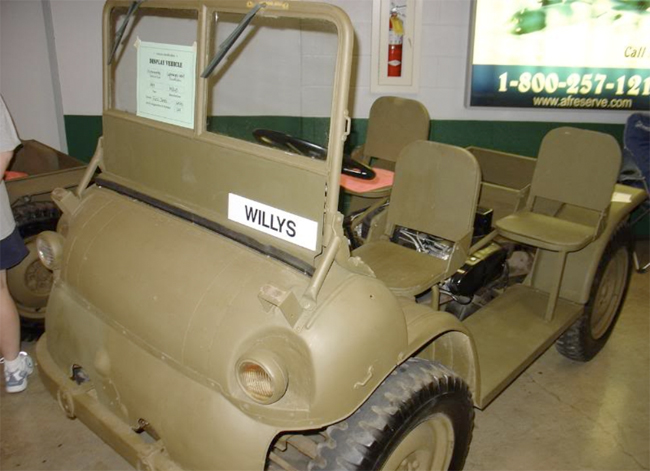
Willys Pilot WAC or Jeeplet (harley davidson engine)
Willys WAC or Jeeplet (harley davidson engine)
Willys Aero Jeep (bobcat). This looks very similar to the CJ-4 prototype.
I’ve never run across another reference to this story, but Sam (who runs the Motor Pool) shared a story from his friend Lee (recently deceased) about an experimental Jeep Glider. Not unlike the Rotabuggy, which was a jeep transformed into a helicopter, the Government also transformed a Jeep into Glider, built to carry 8 personnel plus the jeep. The Army accomplished this by attaching glider pieces to a jeep. The jeep was then pulled into the air, like any other glider, and it would fly to a landing spot. Once down, charges would be ignited and the pieces would fall off. The Jeep could then drive away.
Unfortunately, while the tests were successful in the U.S. in anticipation of the D-Day invasion, a test of the glider system in Britain failed to the point that the army considered this idea unfeasible, with the differences in climate said to be the main reason they succeeded in the US and failed in Britain.
I have yet to run across any photos or drawings of this project, but perhaps someone else has?
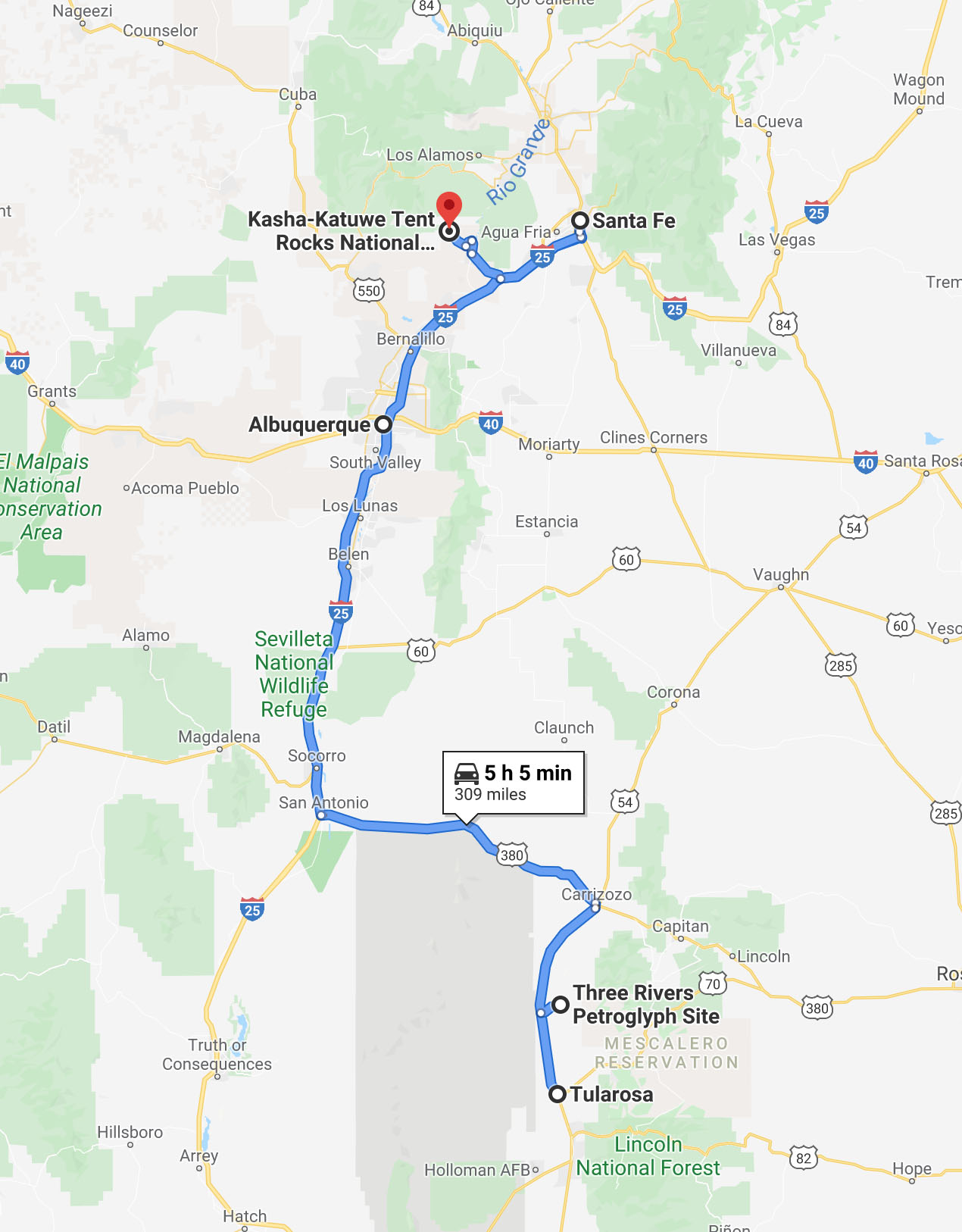
Today we drove north from Tularosa to explore Santa Fe and “Tent Rocks”. Our final destination was Holbrook, Arizona.
Thursday’s drive from Tularosa to Santa Fe.
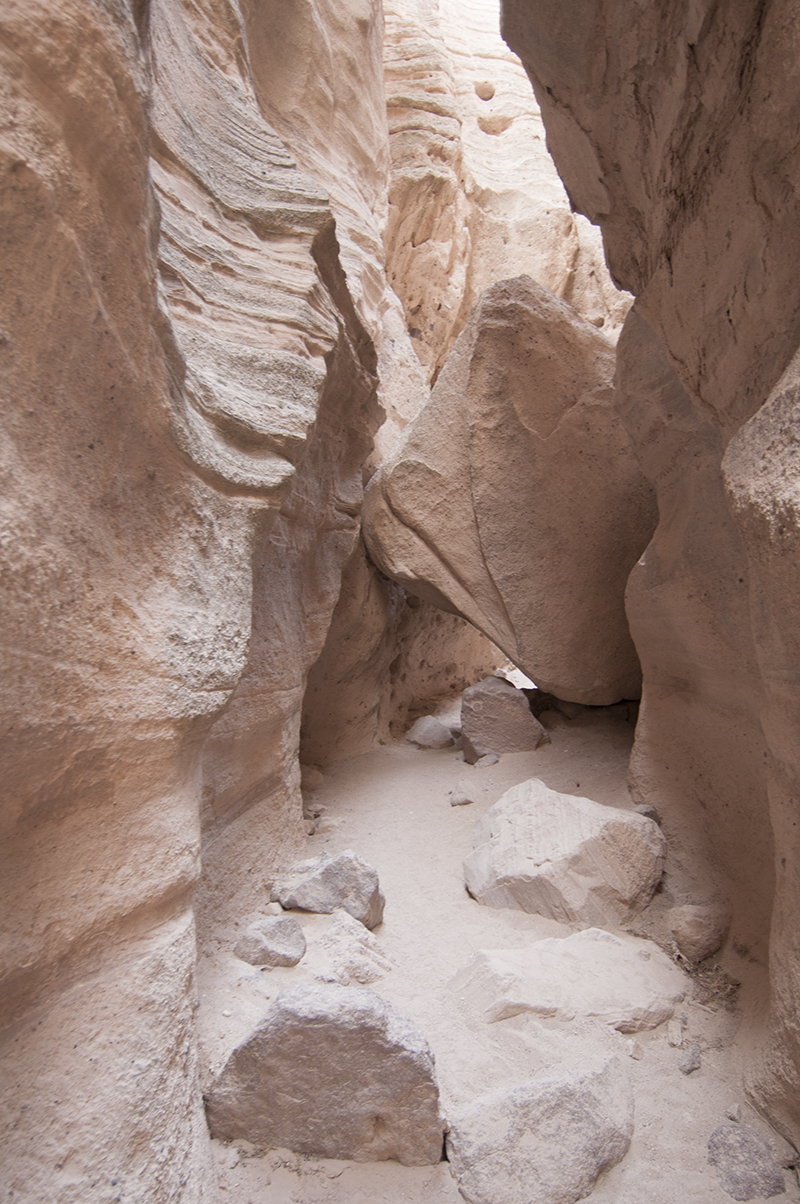
Part of the slot canyon at “Tent Rocks” National Monument
There is no way you can start off a morning wrong when you have hash browns smothered in green chiles and cheddar cheese. It was delicious dish we enjoyed at the local Tularosa gas station restaurant.
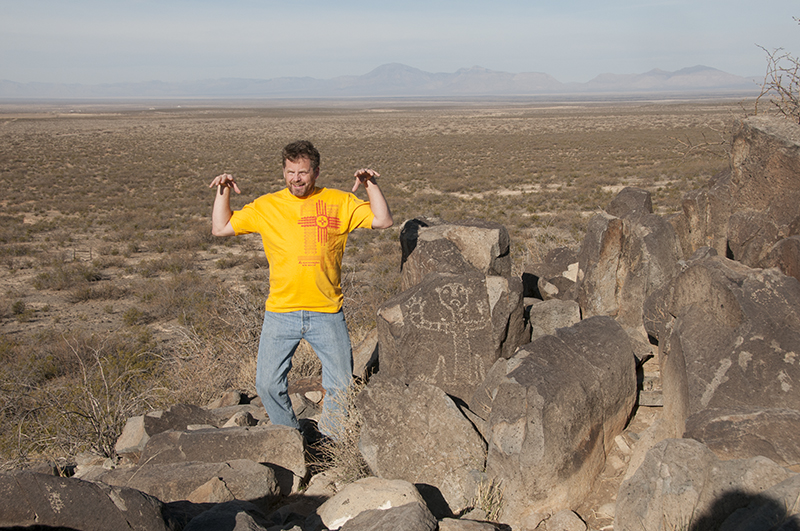
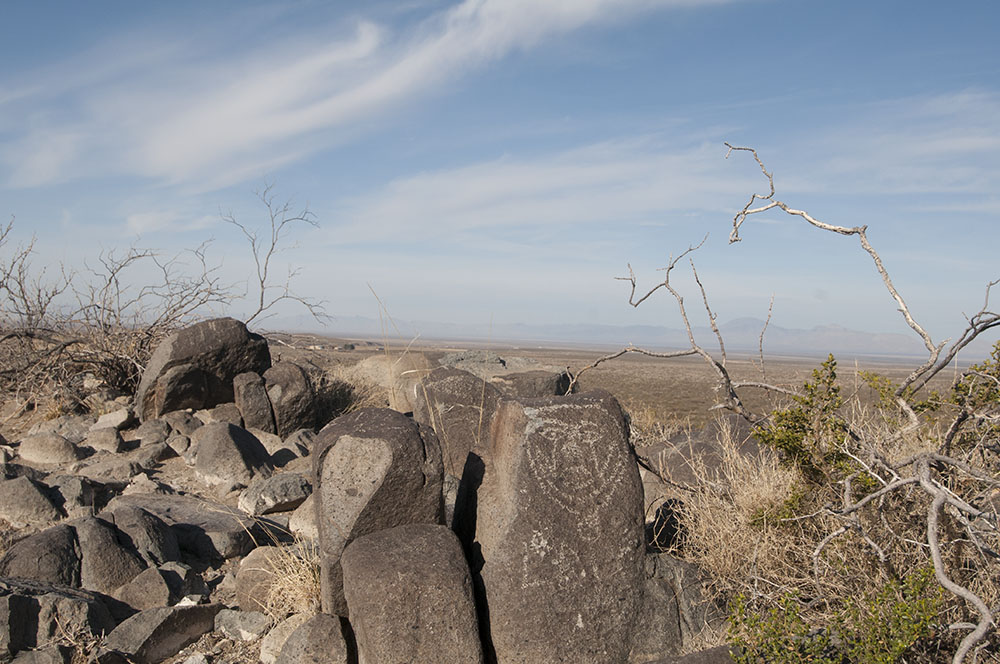
Following breakfast, we trekked north for a stop at Three Rivers Petroglyph Site run by the BLM. Within a relatively small area 21,700 petroglyphs have been identified. Within five minutes of hiking we were surrounded by petroglyphs of all sizes and shapes. It seemed every rock was marked.
After Three Rivers, we renewed our drive northward. On the way we discovered that Tinkertown wouldn’t open until Friday. Moreover, not too far from Tinkertown is Madrid, the town made famous by the WILD HOGS Movie. After pondering our options, we decided that we would have to save Madrid and Tinkertown for some other time.
Bob sent me a crime report. This jeep is sitting outside at the Akron/Canton, Ohio, Airport with no protection, a lost sole without a loving home. There’s another sitting there too. Both have been left to nature (as best as Bob can tell). Note the rear tires is flat and the front tire is close behind.
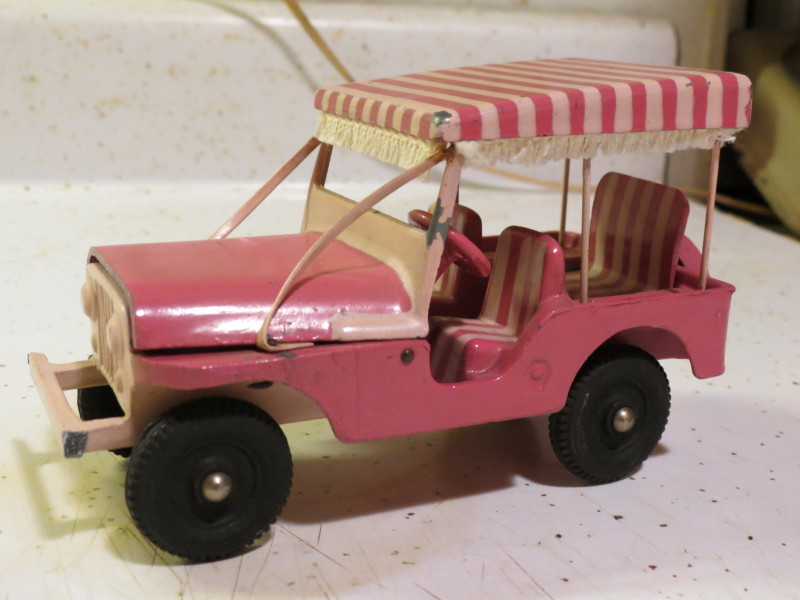
“THE ULTIMATE JEEP TOY COLLECTORS FIND. THIS TOY I AM TOLD WAS MADE FOR THE WILLYS OVERLAND EXECUTIVES WHEN THEY RETIRED. OR THE OTHER STORY IS THEY WERE MADE FOR DEALERSHIP PROMOS, EITHER WAY THEY ARE VERY RARE AND SCARCE. IT IS MADE OF A HEAVY CAST METAL , IS 6″ LONG 2.5″ WIDE AND 3.5″ TALL. VERY COOL AND VERY CLEAN. AS YOU CAN SEE IN THE PICS IT IS ORIGINAL AND COMPLETE WITH THE WHITE SURRY FRINGE VERY CLEAN AND NICE. NOW THE DOWNSIDE. THERE ARE A COUPLE OF MINOR PAINT CHIPS, THE LEFT SIDE OF THE BUMPER IS BROKEN OFF (THIS IS QUITE TYPICAL ON THESE)AND ONE OF THE PLASTIC STRAPS IS LOOSE FROM THE TOP AND MAY COME OFF IN SHIPPING (BE FOR WARNED).”
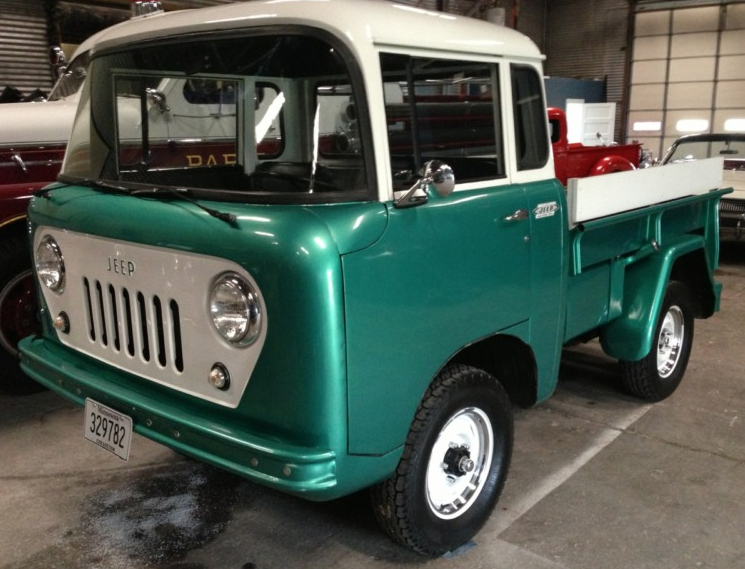
“Sweet 1961 Willys FC 150. This pickup was restored several years ago and is still in really good shape. It has the 4 cylinder motor and is four wheel drive. The engine and drive line work great. Pretty reliable old truck, and also very rare. You just don’t see these forward control pickups in as rust free condition as this one is. As you can see from the pictures, the undercarriage is in great shape and the body is quite nice with very few blemishes and scratches. Glass is in good shape. Interior is very clean and nice, with recovered seats and a new headliner. The only glitch is that the seal in the transfer case has a slow leak. It’s nothing terribly serious, but it will leave an oil spot on the floor over time. This, of course, is not unusual in these older Jeeps. The truck is located in Denver, CO near I-70.”
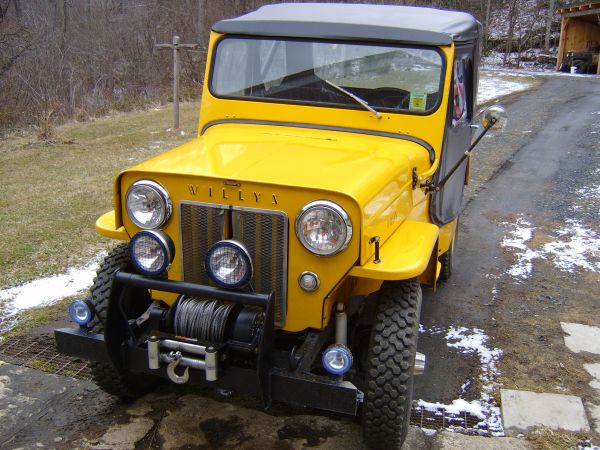
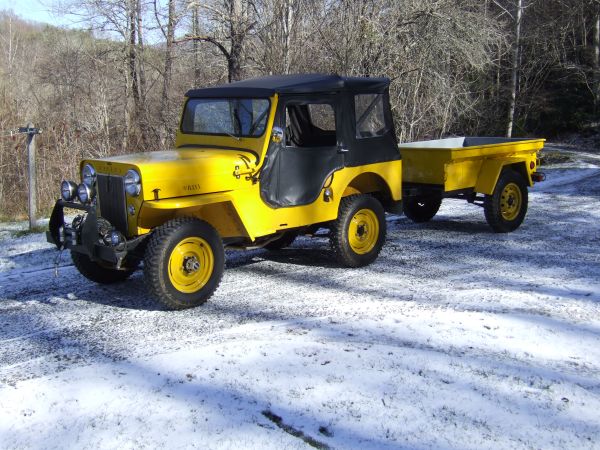
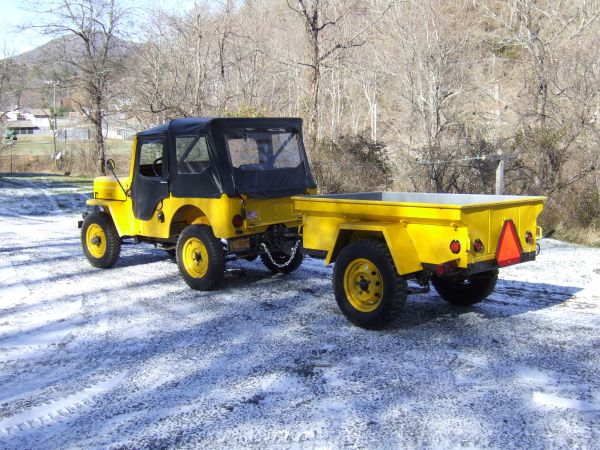
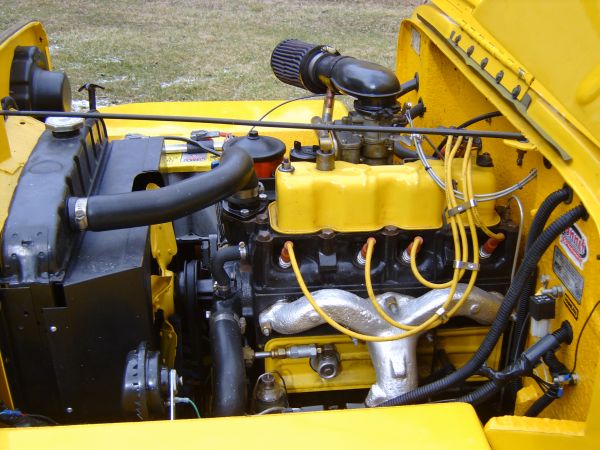
“1954 Willys CJ3B Jeep with 1/4 ton army trailer. Total frame off rebuild in 2005 including new body. All mechanical parts rebuilt or replaced including engine overhaul, re cored radiator, new gears in transmission and transfer case as needed, and both differentials inspected.
Upgrades include 12V alternator electrical system, Auto Meter all electric gauges, 11″ brakes with braided stainless lines, sprayed bed liner inside and under the body, and an 8000 lb PTO front mounted winch.
I’m disabled and unable to use it, so it’s been sitting in the shed for a few years and will need some clean up. I will answer all questions.”