emailNeed to contact me and don't have my email? Click on email button.
About eWillys
Welcome to eWillys.com, a website for vintage jeep enthusiasts. I update this website nearly every day with jeep deals, jeep history, interesting reader projects, jeep related info, and more.
These quick searches can help you find things on eBay. People list in the wrong categories all the time, so don't be surprised to see brochures in the parts area for example. This section used to be split into jeeps, parts and other categories, but recent changes to eBay will require this information to be recoded.
The links to posts below show jeeps grouped by models, condition, and other ways. Some of these jeeps are for sale and others have been sold. If you are unsure whether a vehicle is still for sale or not, email me at d [at] ewillys.com for more info.
Importantly, the allure of buying a project jeep can be romantic. The reality of restoring a jeep can be quite different, expensive and overwhelming without the right tools and resources. So, tread carefully when purchasing a "project". If you have any concerns about buying a vintage jeep, or run across a scam, feel free to contact me for help, comments or concerns .
I liked this one, had not run across this one before.
Not to say it’s not already posted here on eWillys there is alot of content here! But either way from time to time what’s old is new again, at some point the plan will probably included to go over the archives and pull up some of the older stuff. It’s probably new to alot of us.
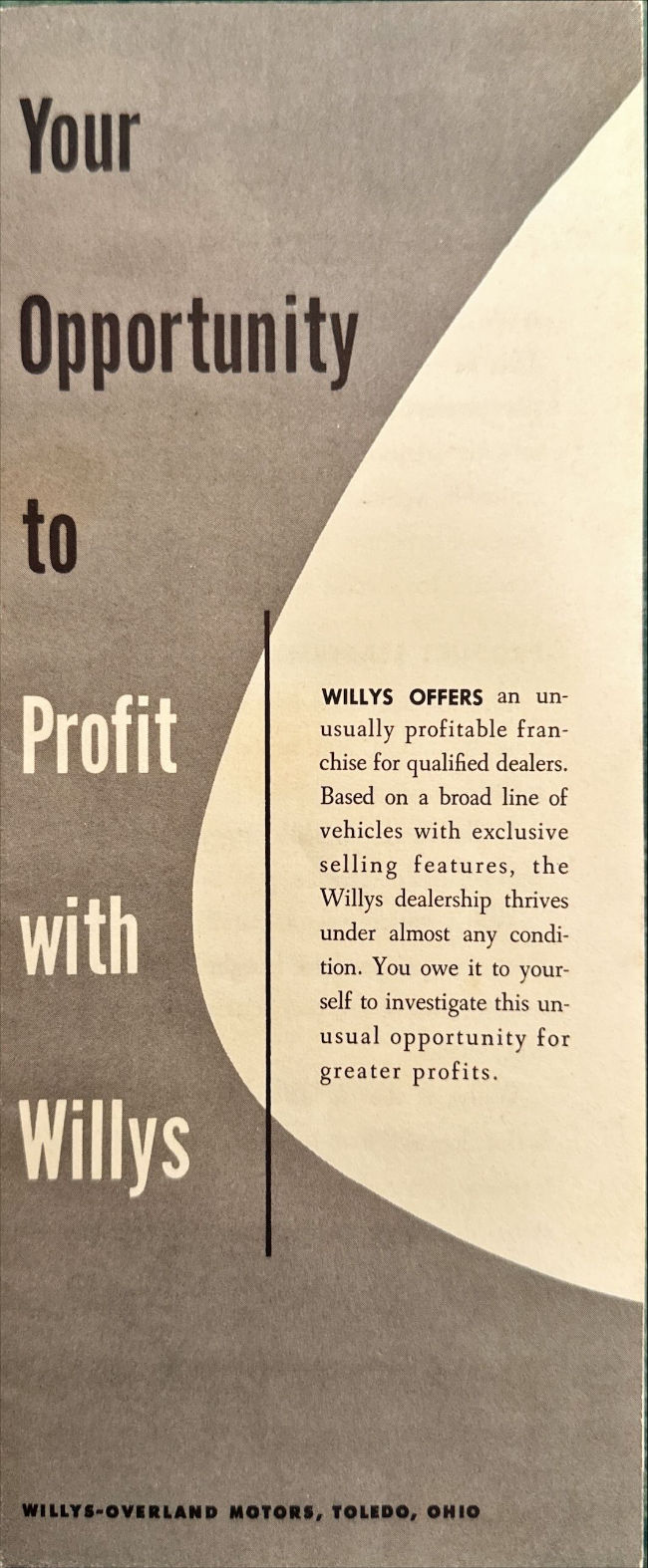
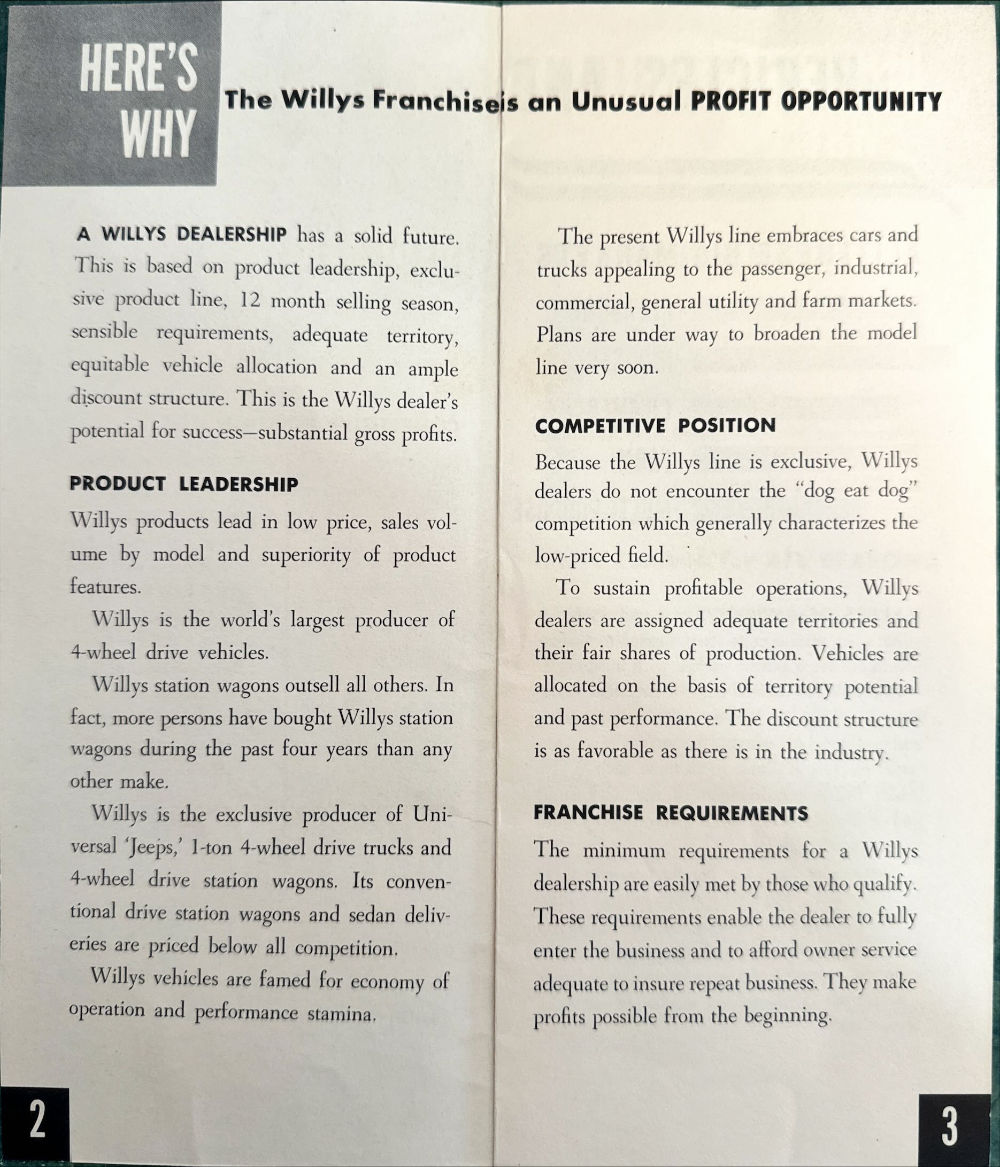
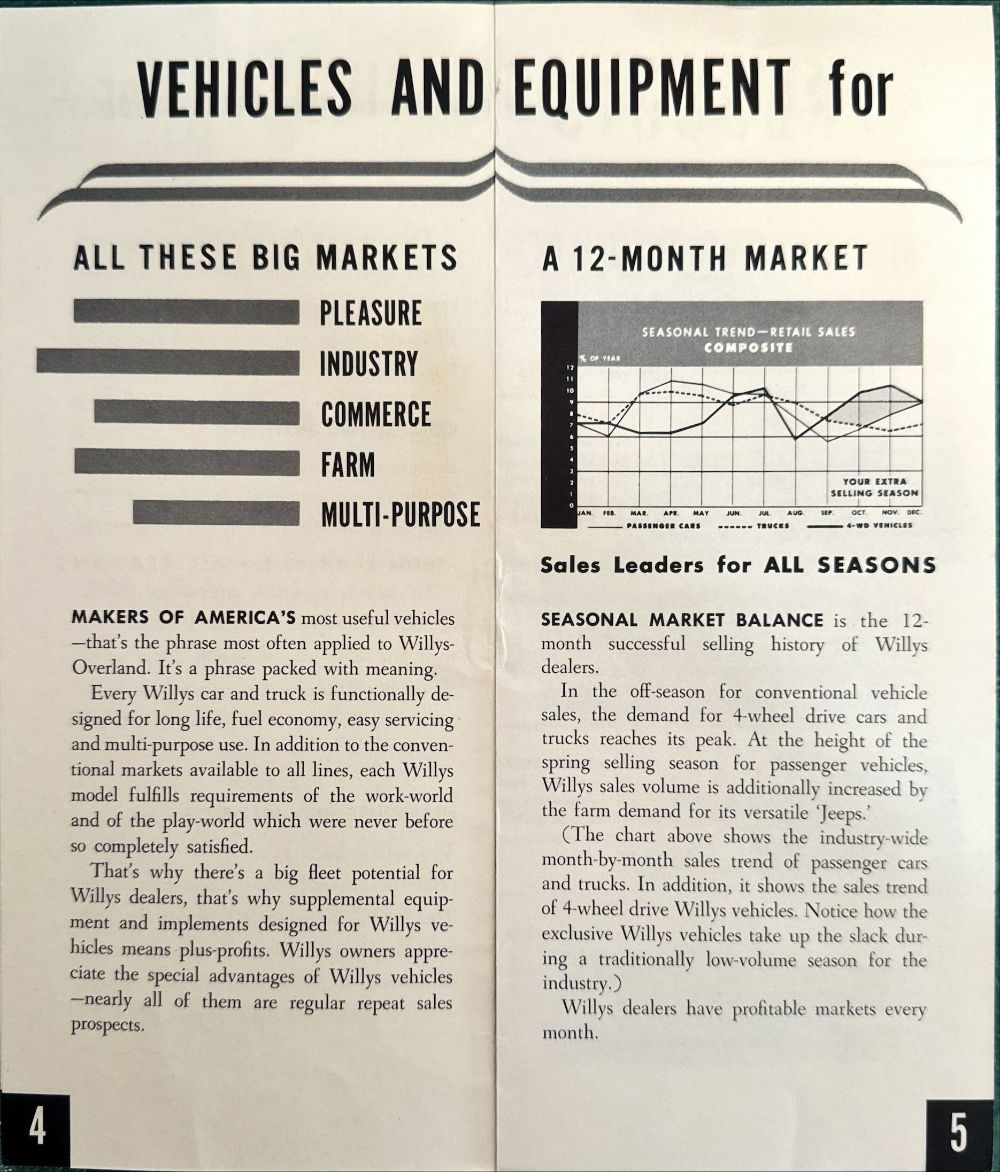
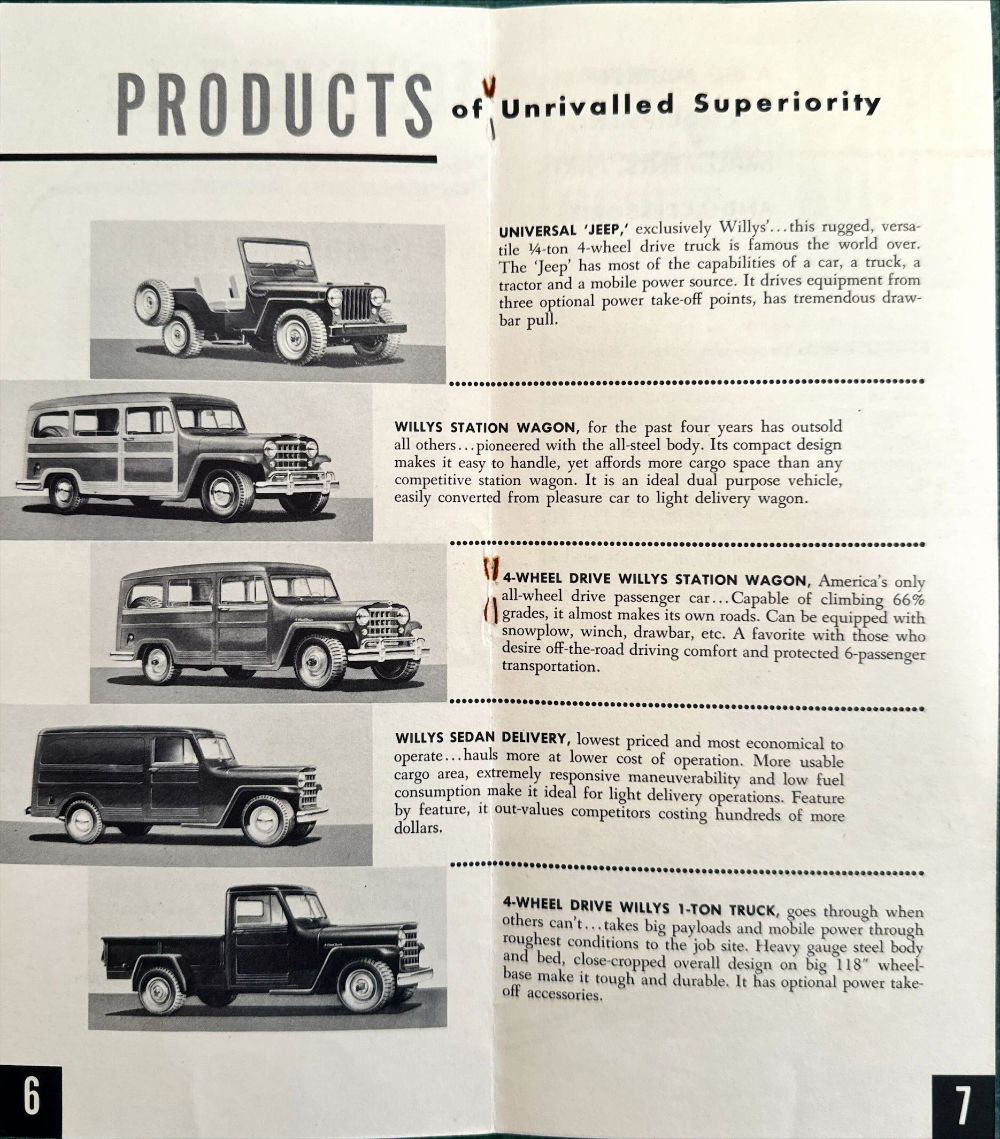
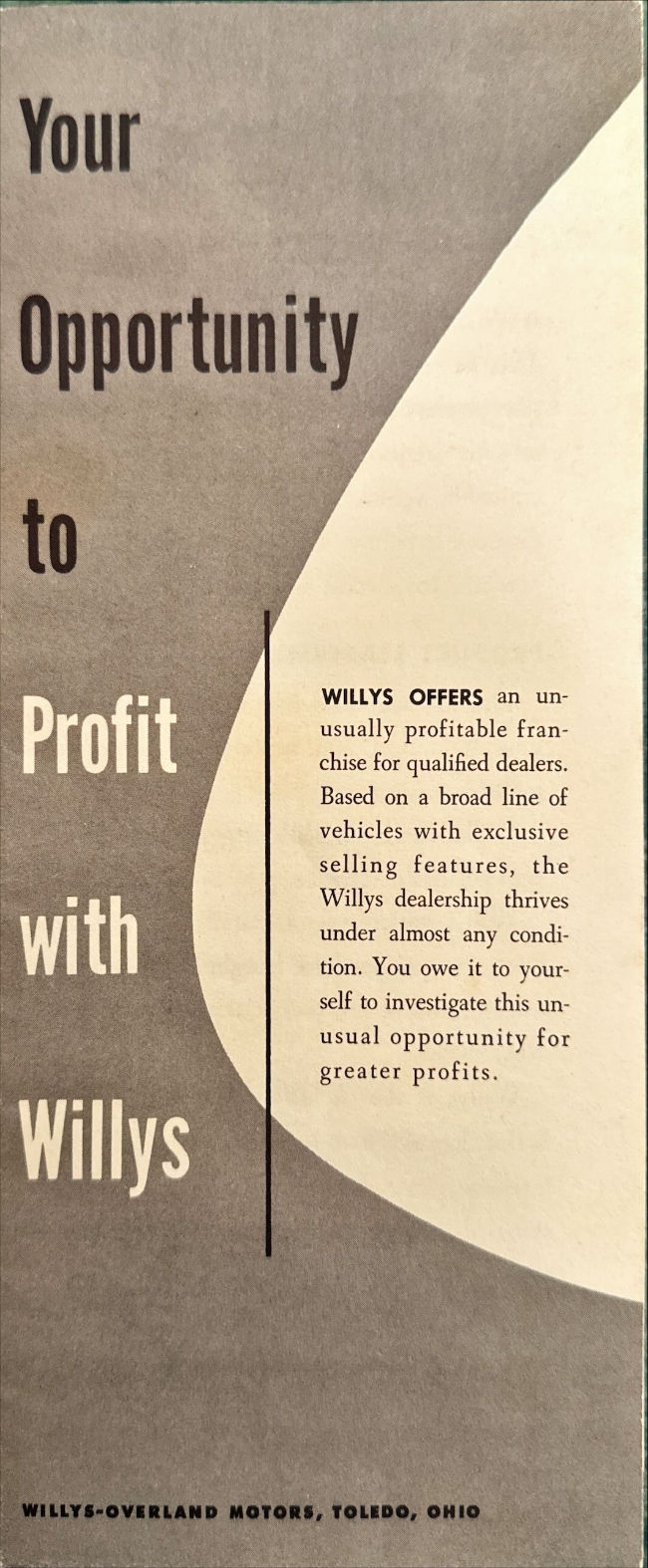
I 2012 I purchased this July 1951 brochure, an 11-page “Your Opportunity to Profit with Willys” (from number FB 1 4CM-751 GG). At that point, I hadn’t bought many brochures before winning it on eBay. Unlike 99% of Willys-Overland brochures, this one was unique, because it targeted potential Willys Dealership owners.
The reason I bought it, and the reason I never published it (only now remembering that I hadn’t), was that it was the foundational piece for my idea for a jeep museum. It was the backbone, the narrative that I wanted to course through the entire experience. It was the type of business case study (example study), that I had read many times while getting my MBA, but rather it being on paper, it was an experience.
The overriding question centered on the brochure. If it was 1951 and you had the means and opportunity to invest in a Willys-Overland franchise, should you?
A ROUGH MUSEUM OUTLINE:
Folks would begin the museum in a room with a 1950s feel. A presentation would begin with the look and feel of a 1950s commercial, except this would be trying to sell folks on the WO franchise. The video would end encouraging folks to take.a walk through history to better get to know Willys-Overland’s roots, starting with a Pre-WWII display, with 1920s and 1930s music, showing and explaining the history. It would be intimate, quiet, peaceful.
The next room would be the drums of war, the approach of WWII, the early development of Recon car options, ending with the Bantam/Ford/Willys options, with Willys winning the bid, just in time for the US to enter WWII.
Folks. would enter to the sounds of war. Maps would show jeeps being lease-lent all over the world, Britain, Africa, Indonesia, Australia, etc. The room underscores the the wide uses for the jeep (and GPA and other oddities).
As the war was being waged, visitors would encounter a more pastoral room, a relief from the war, showing WO experiments with jeeps and farming. It would also demonstrate Willys attempts to advertise the jeep, linking the willys and jeep brand, whenever they could, until the FTC case and the Ford lawsuit caused WO to shift their branding ideas.
The next room would be the introduction of the CJ-2A, the ads, the multiple implements, the implement companies. The next room would show the competitive landscape, with Willys adding other vehicles, and how the big three were responding (and how consumers were responding). Also highlighted would be WO’s continuing shift in brand marketing, the shift away from Jeep as the overriding brand to Willys as the over riding brand.
Subsequently, visitors would be taken into a unique room, showcasing the newly introduced Hurricane engine, but this would be a bigger-than-life walkthrough engine in plexiglass, so folks could look below at a crankshaft turning, a camshaft above, pistons to one side, etc. It would be a truly unique experience.
At this point in the museum, visitors would face reach the time period of the brochure. It’s the point in all business cases: What’s the decision, to invest or not to invest.
At this point visitors transition to the troubles at W-O and the decision to sell out to Henry Kaiser. The finally room showcase the Kaiser years, as the company took control of Willys assets and focused back on the unique 4WD capabilities of the jeep lineup, while also embracing “JEEP” as the brand.
The museum ends at 1963, when Kaiser shifts to more modern vehicles, such as the Wagoneer and Gladiator, and how those vehicles pushed sales to new heights, as well as a push away from jeeps as pure utility vehicles and more as a fun, family, or sporty vehicle.
Anyway, that was the plan, but time and resources never quite materialized.
Ann and I visited a lot of museums on the way to developing ideas in hopes of creating an experience that would bring in folks from outside of the jeep world, because based on my early research into auto museums, if it doesn’t cater to non-jeep folks, it likely won’t generate the income necessary to sustain itself.
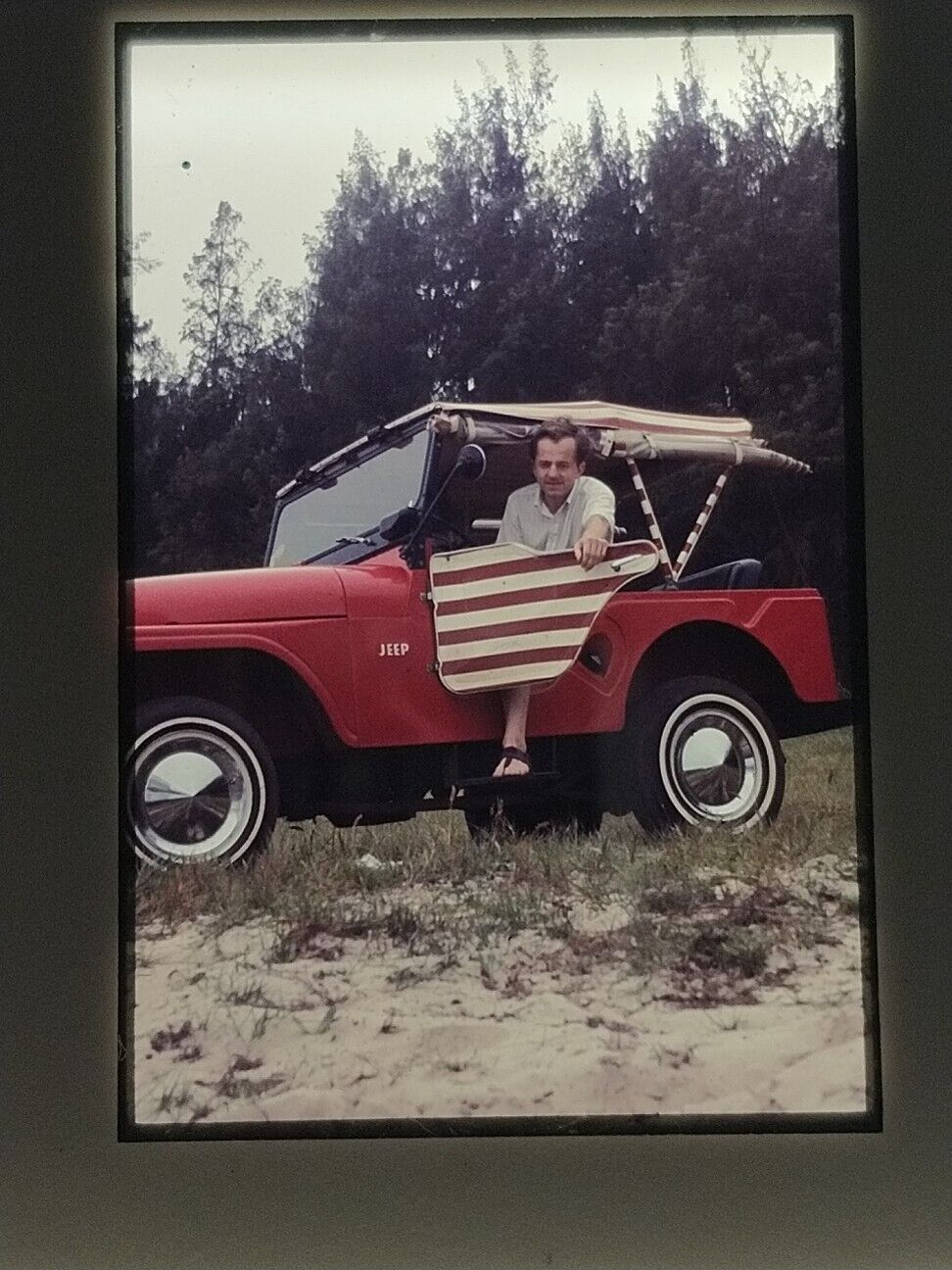
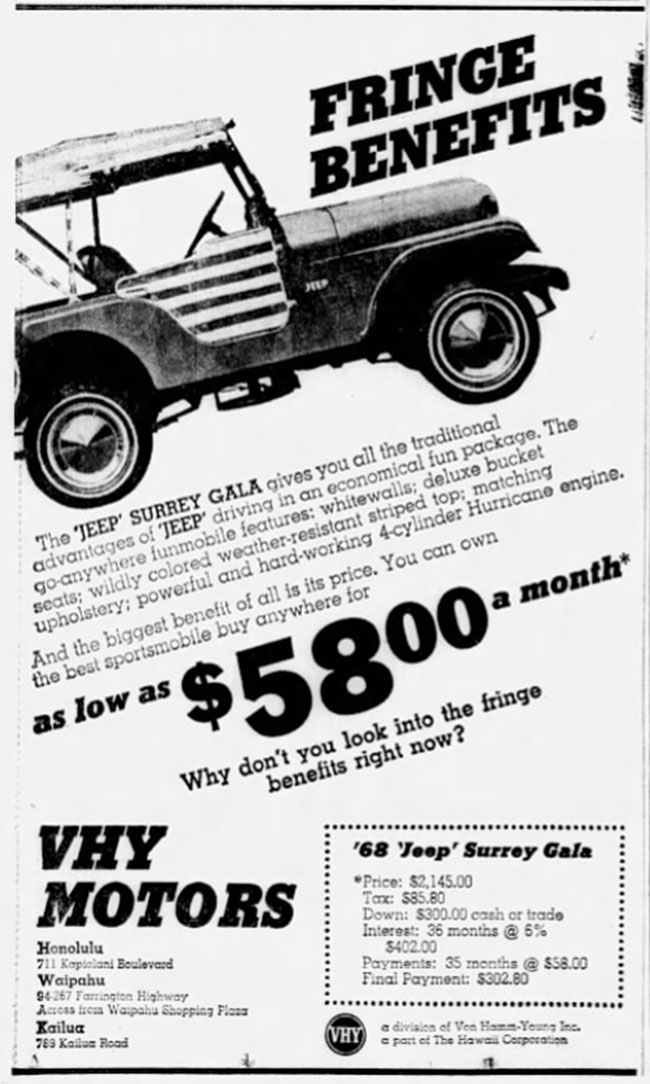
Originally Published May 21, 2020: During the late 1960s, a couple different Jeep dealers in Hawaii offered DJ-5 Jeep Galas for sale. There were at least two different styles of ads published. The Gala was a Surrey that was sold by the export arm of the company.
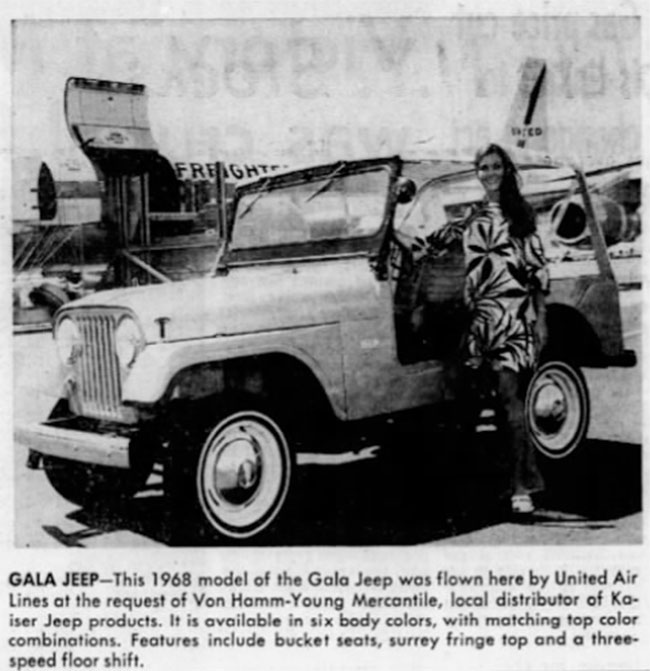
In 1967, a Kaiser-Jeep dealership owned by Von Hamm-Young Mercantile, flew the 1968 model of the DJ-5 Gala Jeep to Hawaii. From the story below, it would seem that this may have been the first example of a DJ-5 Gala Jeep arriving in Hawaii. Note that the photo’s caption only describes this jeep as a Gala.
Over the next two years, the dealer published ads hoping to spur sales. We’ll likely never know how successful sales were, but I’d suspect not too many were sold.
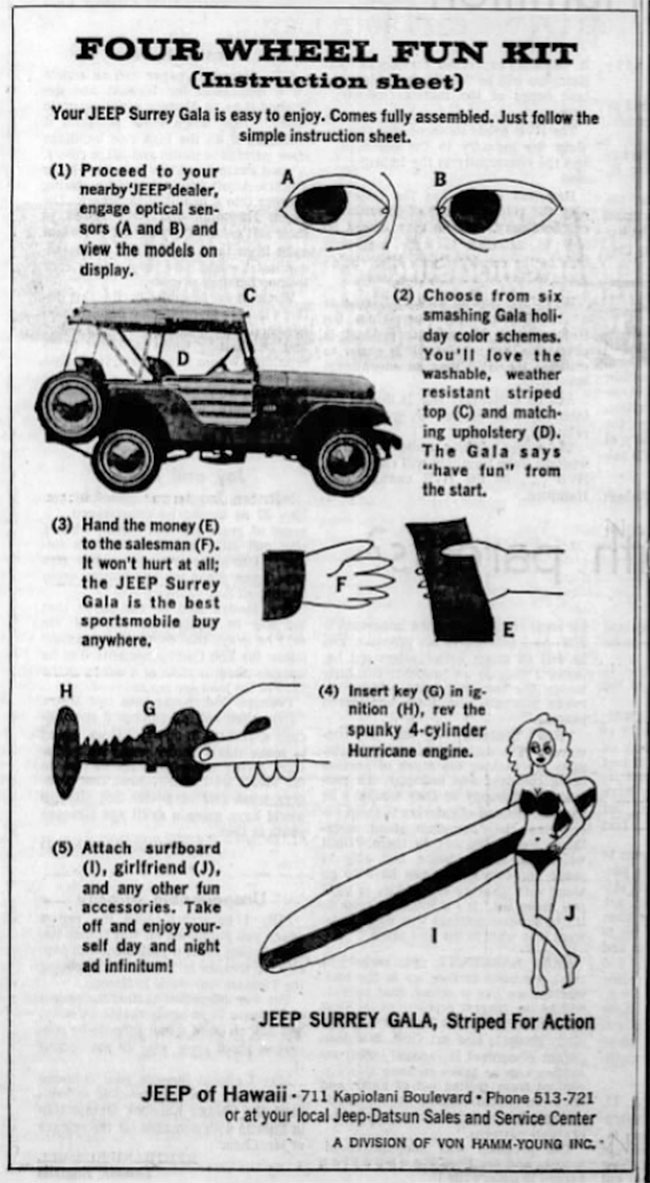
1) The first ad appeared between April and September of 1968. The example shown below was published in the May 30, 1968, issue of the Honolulu Star-Bulletin. There are a variety of things that struck me with this ad. First, it’s the first ad I’ve seen for a DJ-5 Surrey/Gala. Second, it is advertised as a “Surrey Gala”, rather than one or the other. Third, it came in six different color schemes. Fourth, later in the year (specifically September 24th in the Hawaii Tribune Herald), Big Island Rambler was the dealer name at the bottom of the ad, with no specific link made to Von Hamm-Young.
Apart from all those points, it’s generally just an odd ad for a vehicle!
2) This ad appeared multiple times, but only during April of 1969 (I could find no other ads for any other month in 1969), isn’t quite as odd as the 1968 campaign. The ad also doesn’t mention the multiple package options. This particular example was published in the April 4th, 1969, issue of the Honolulu Advertiser.
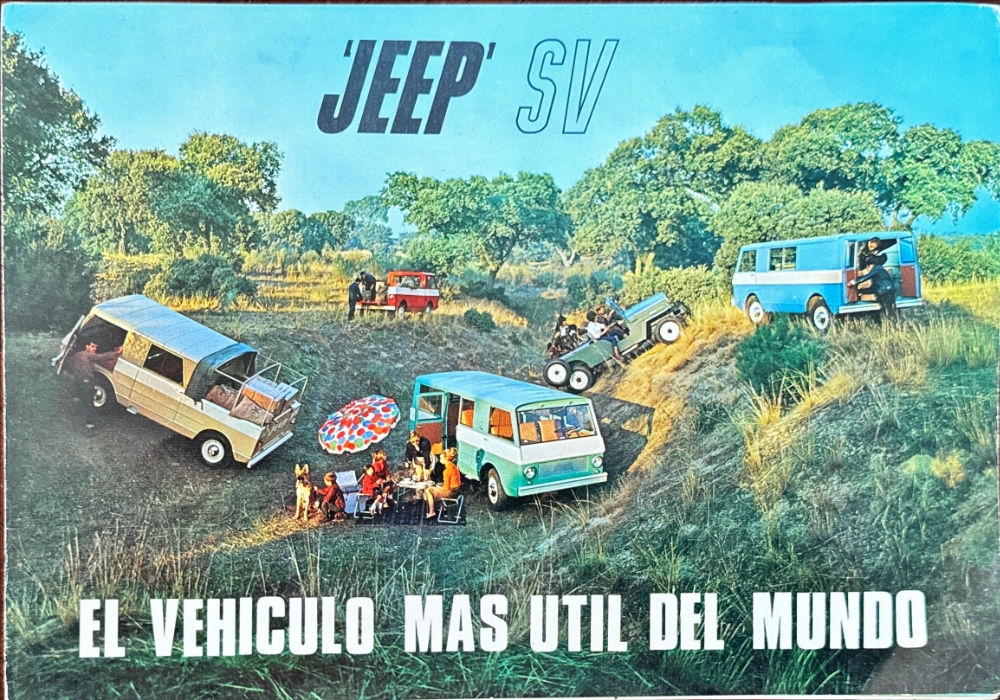
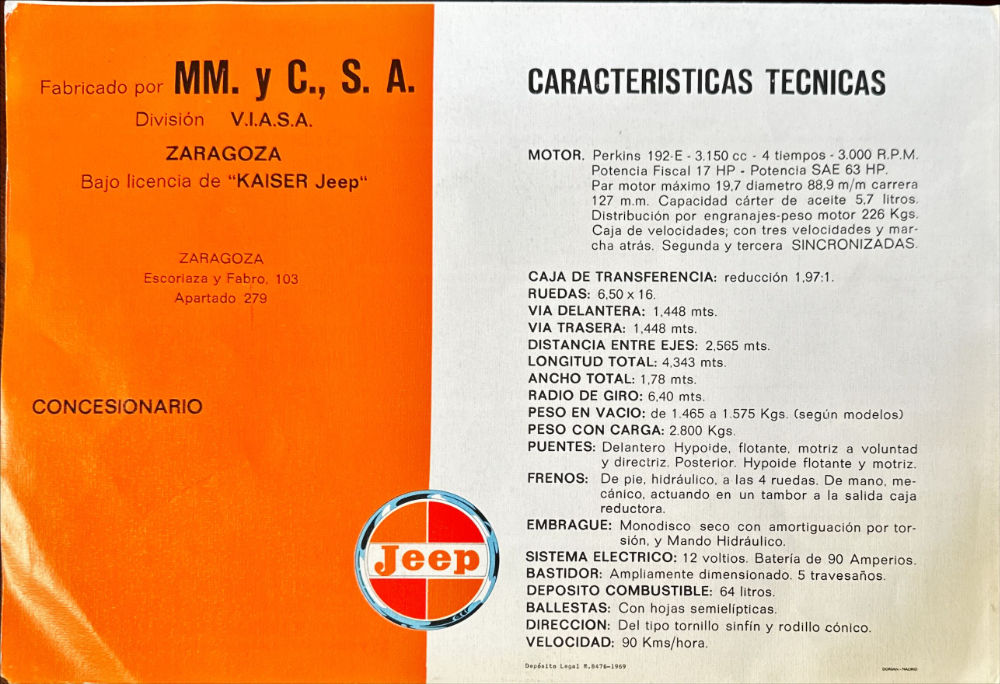
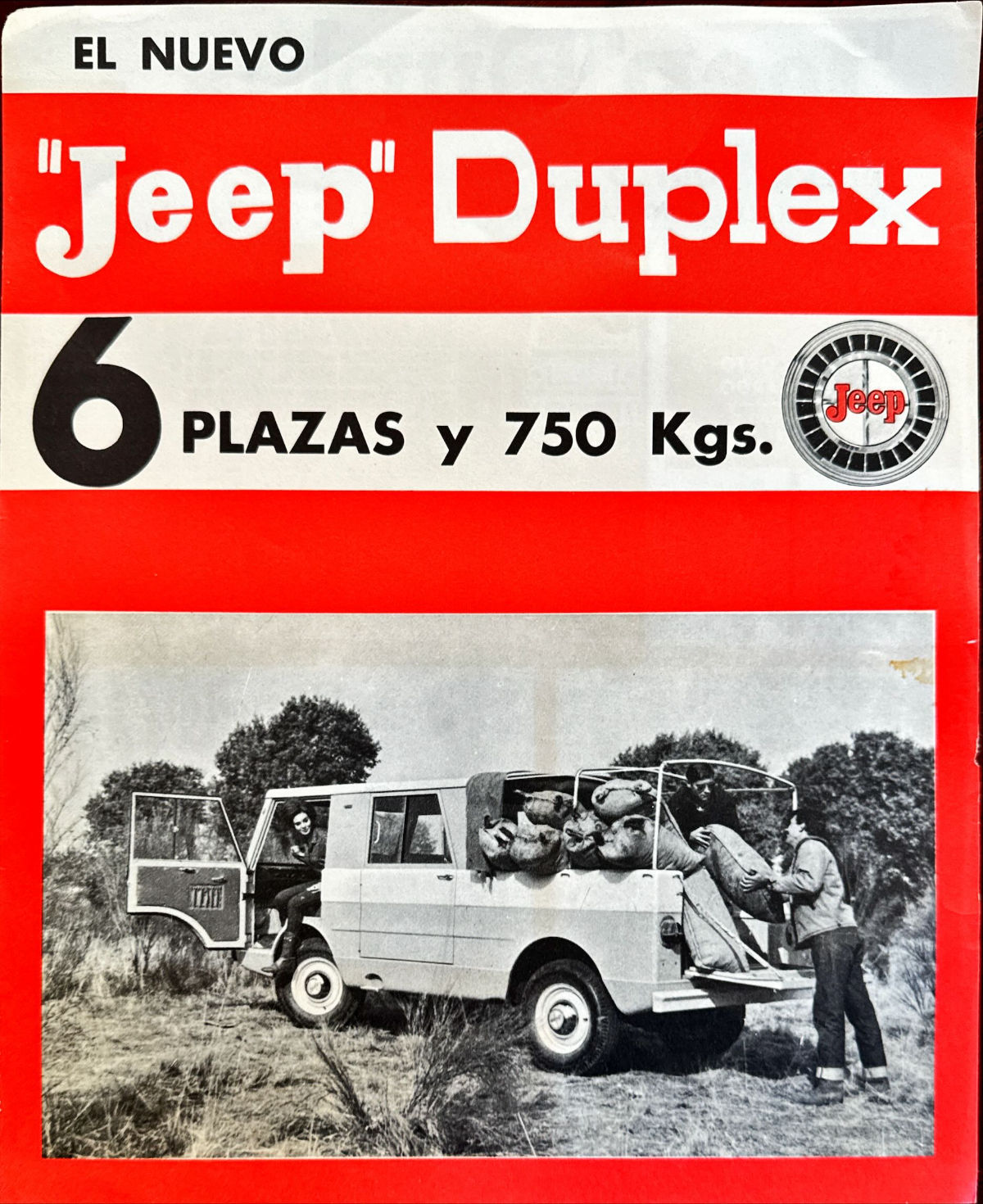
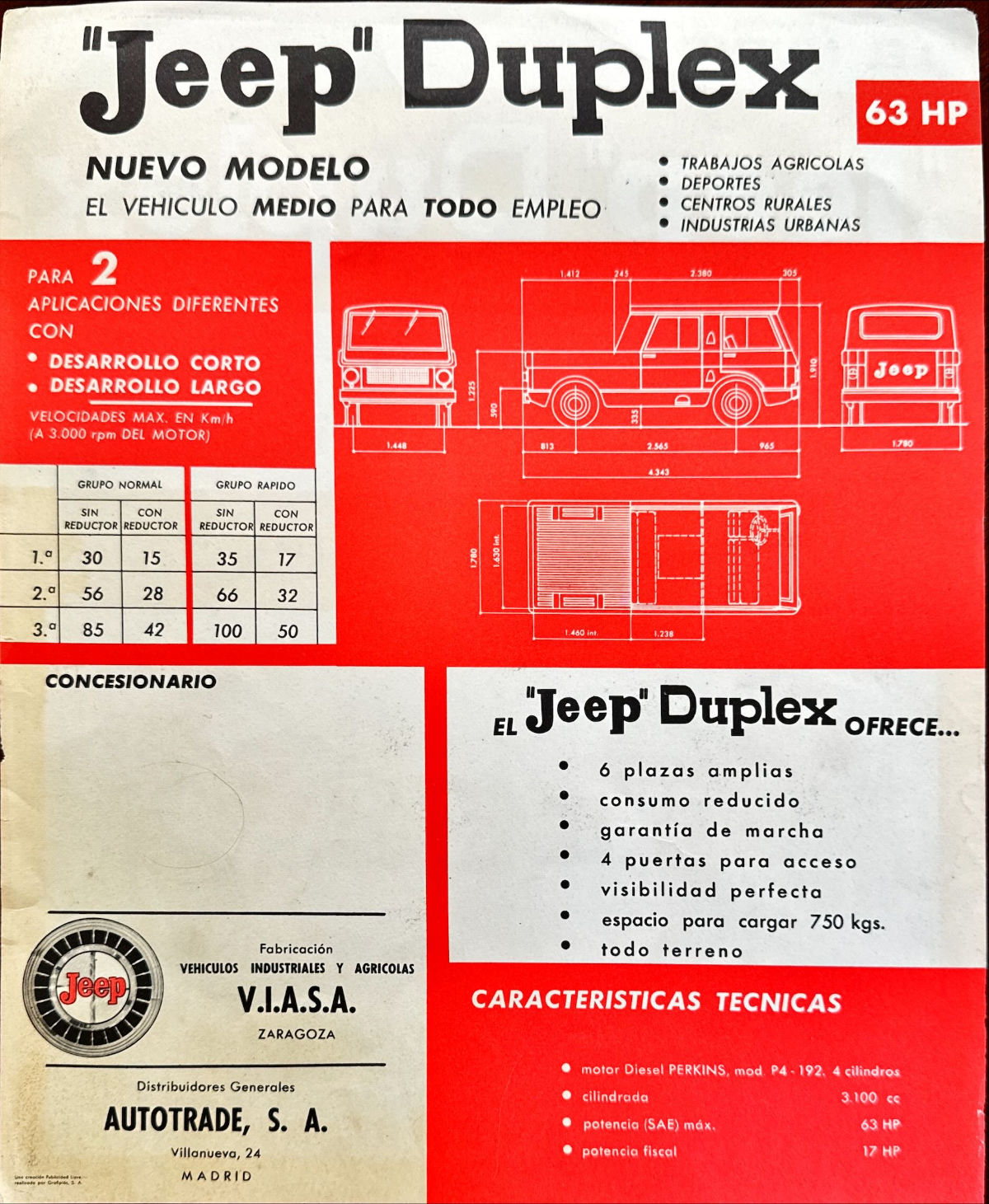
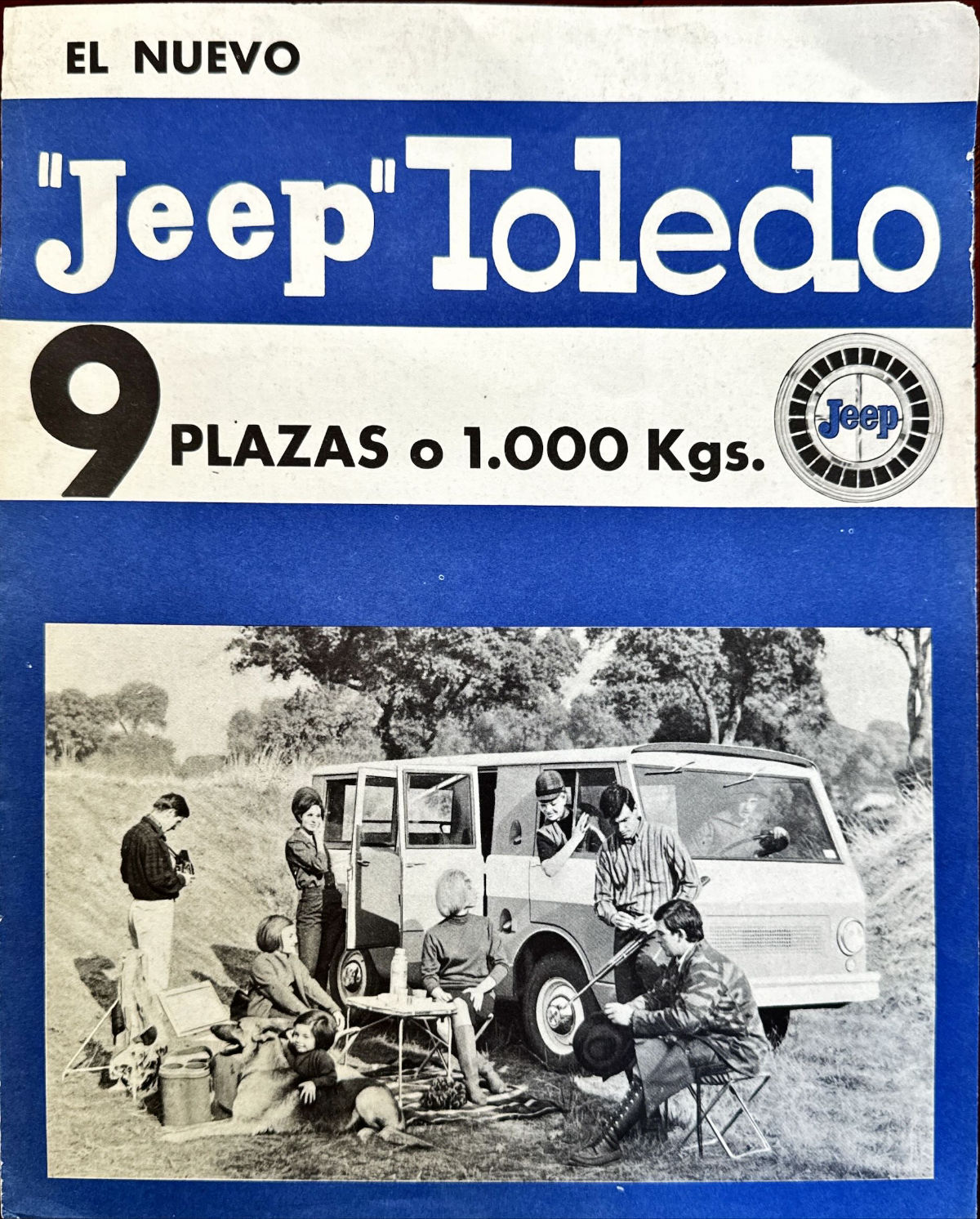
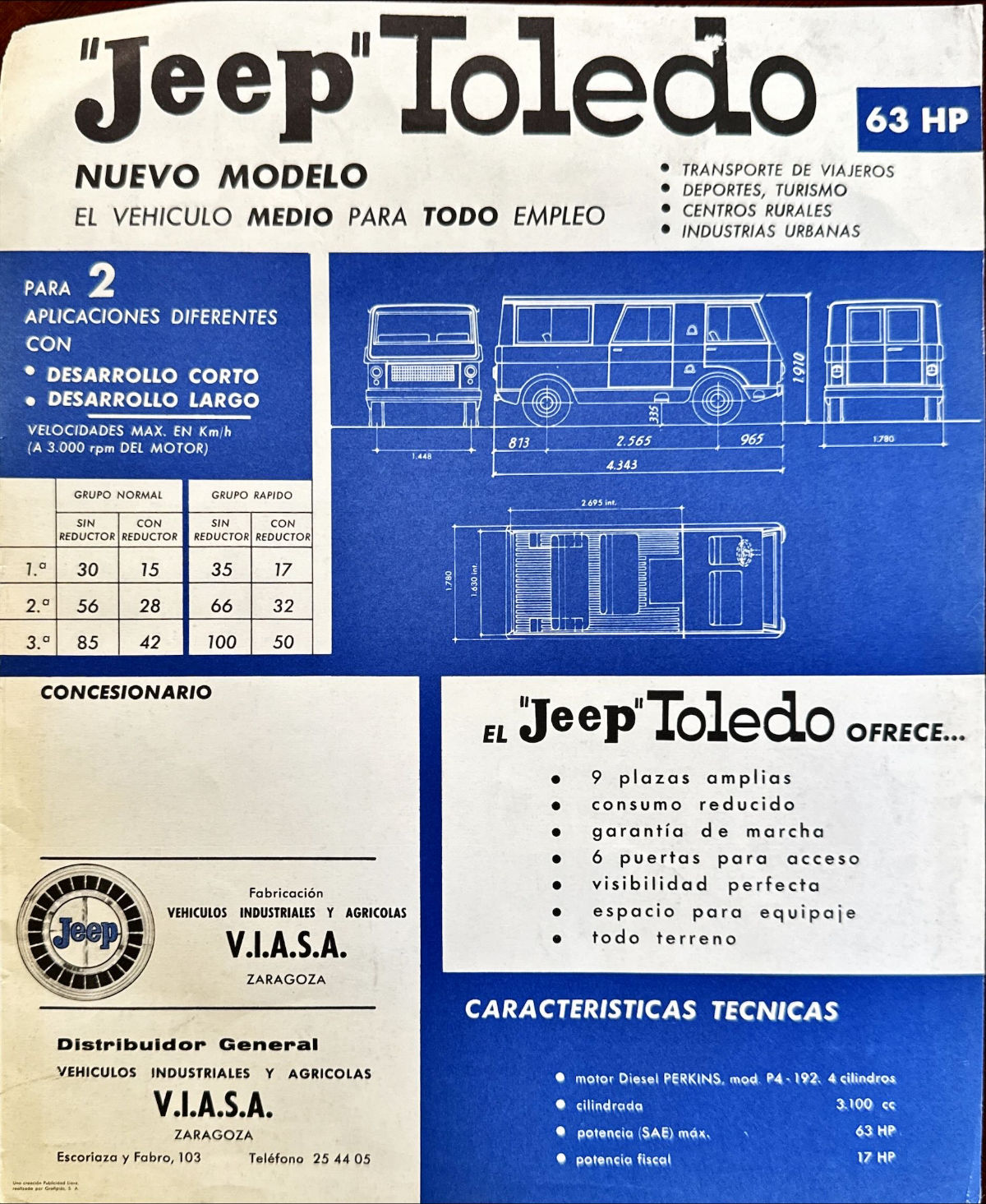
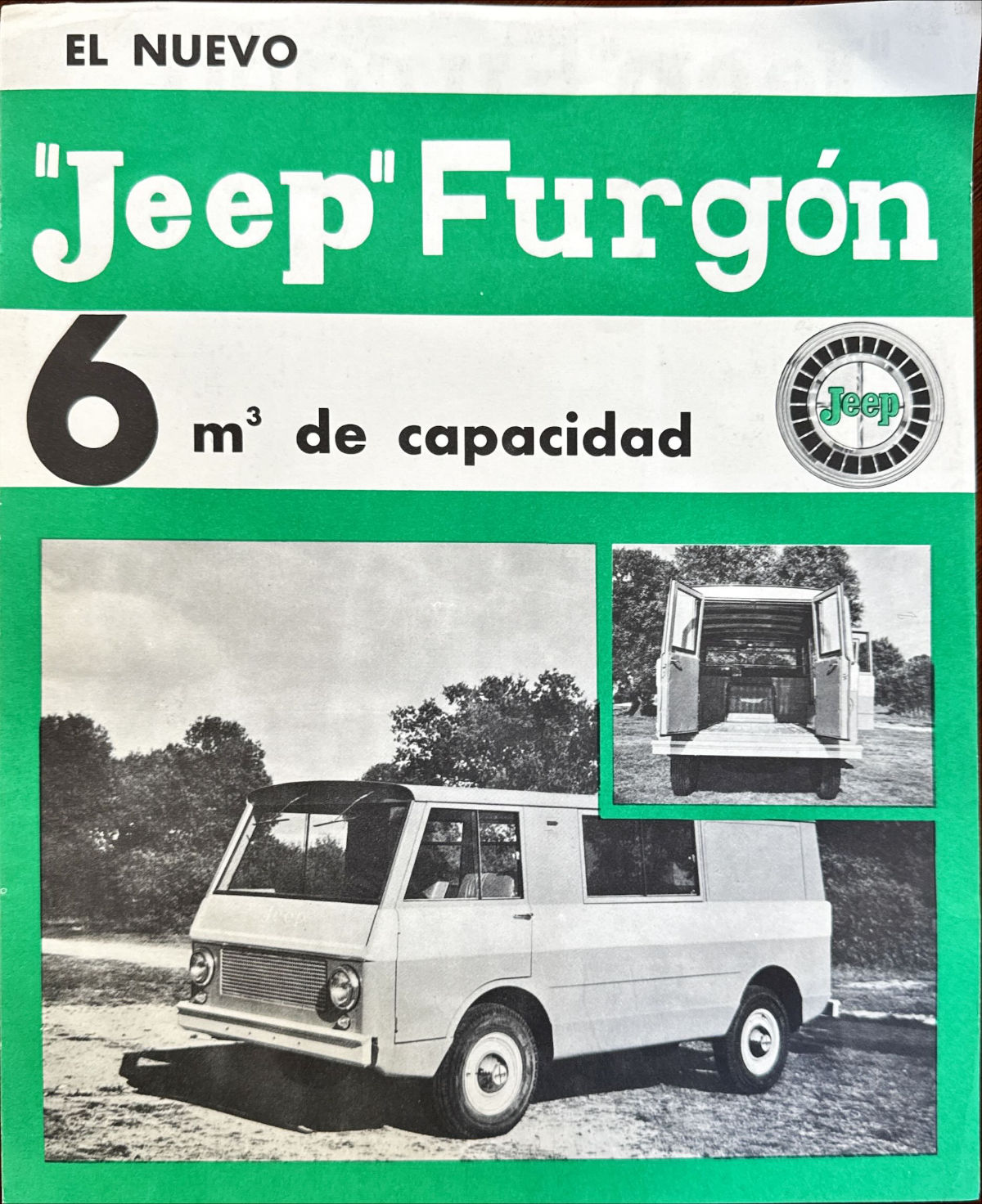
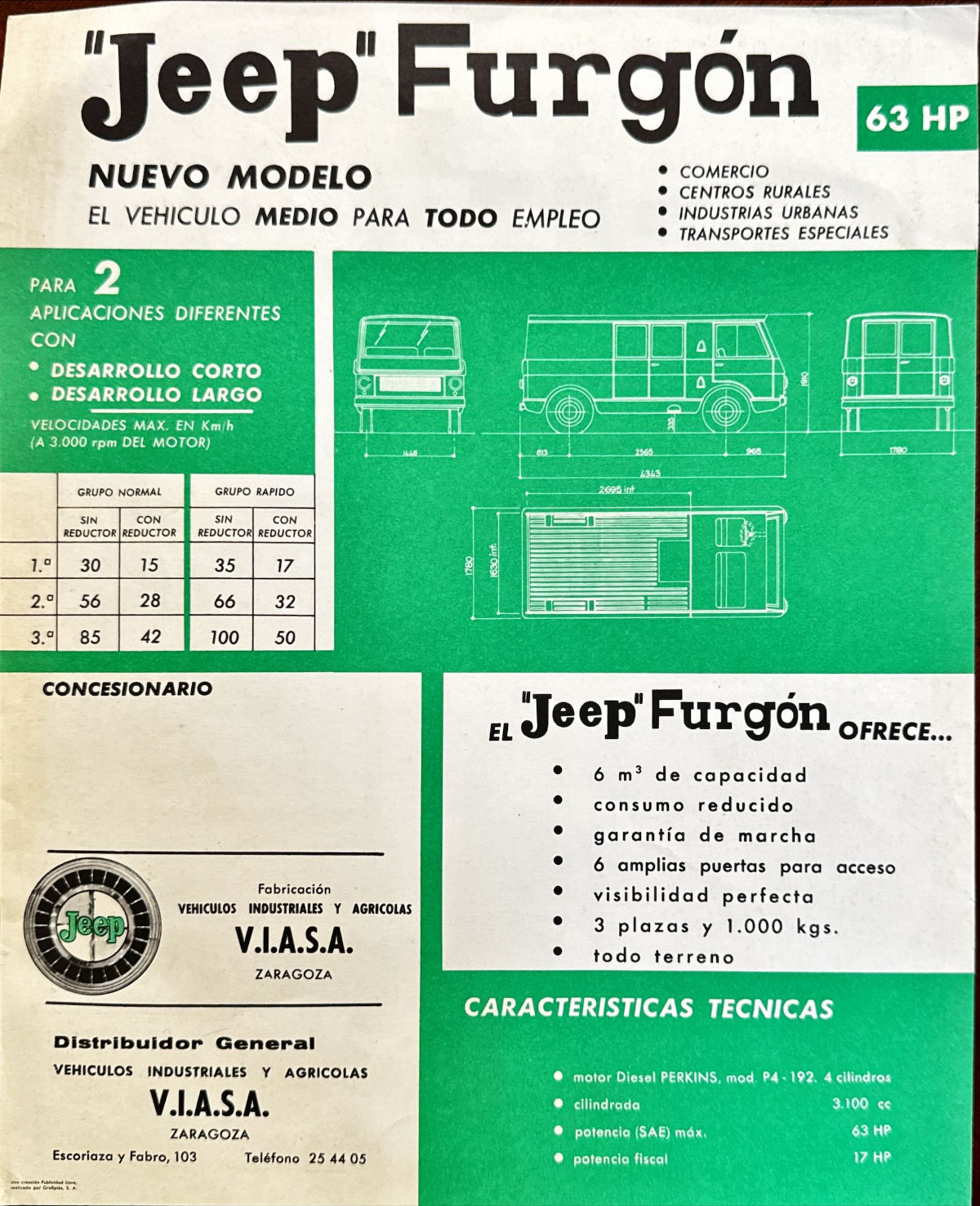
I just picked up this Viasa brochure from Egypt via eBay (along with some other 1 sheet brochures). Note that these rigs are all powered by the Perkins Diesel. I’ve dated this using the legal notice at the bottom of page three that ends in “1969”.
This front page is about 8.5″ x 11″ landscape oriented:
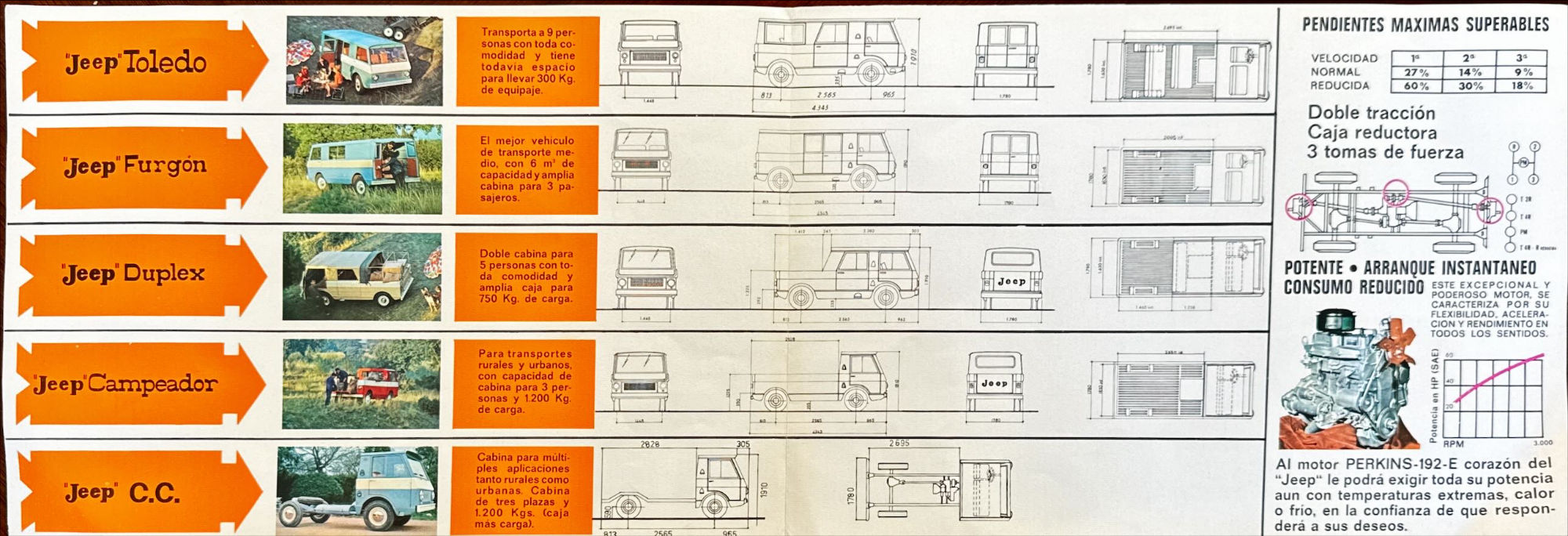
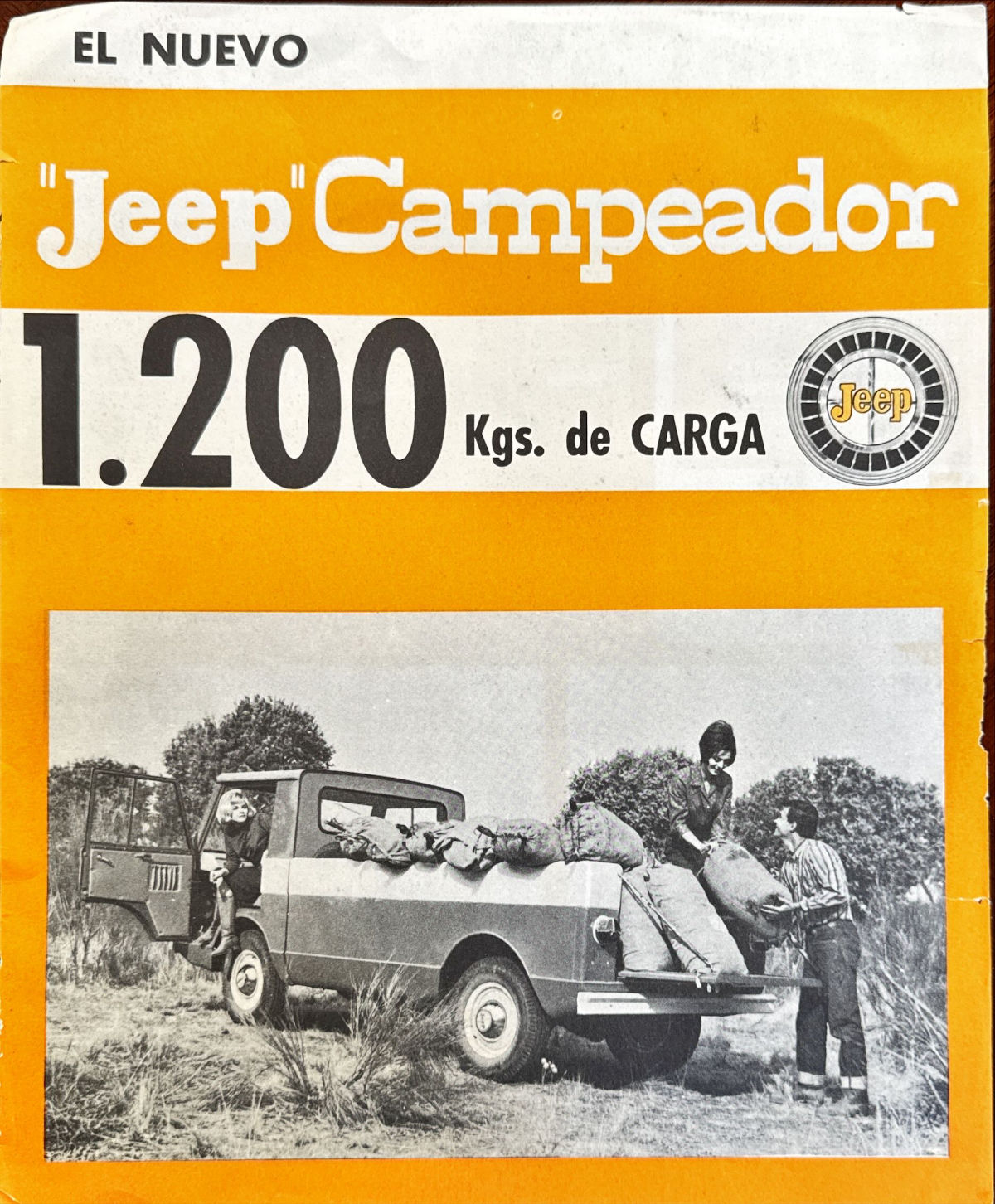
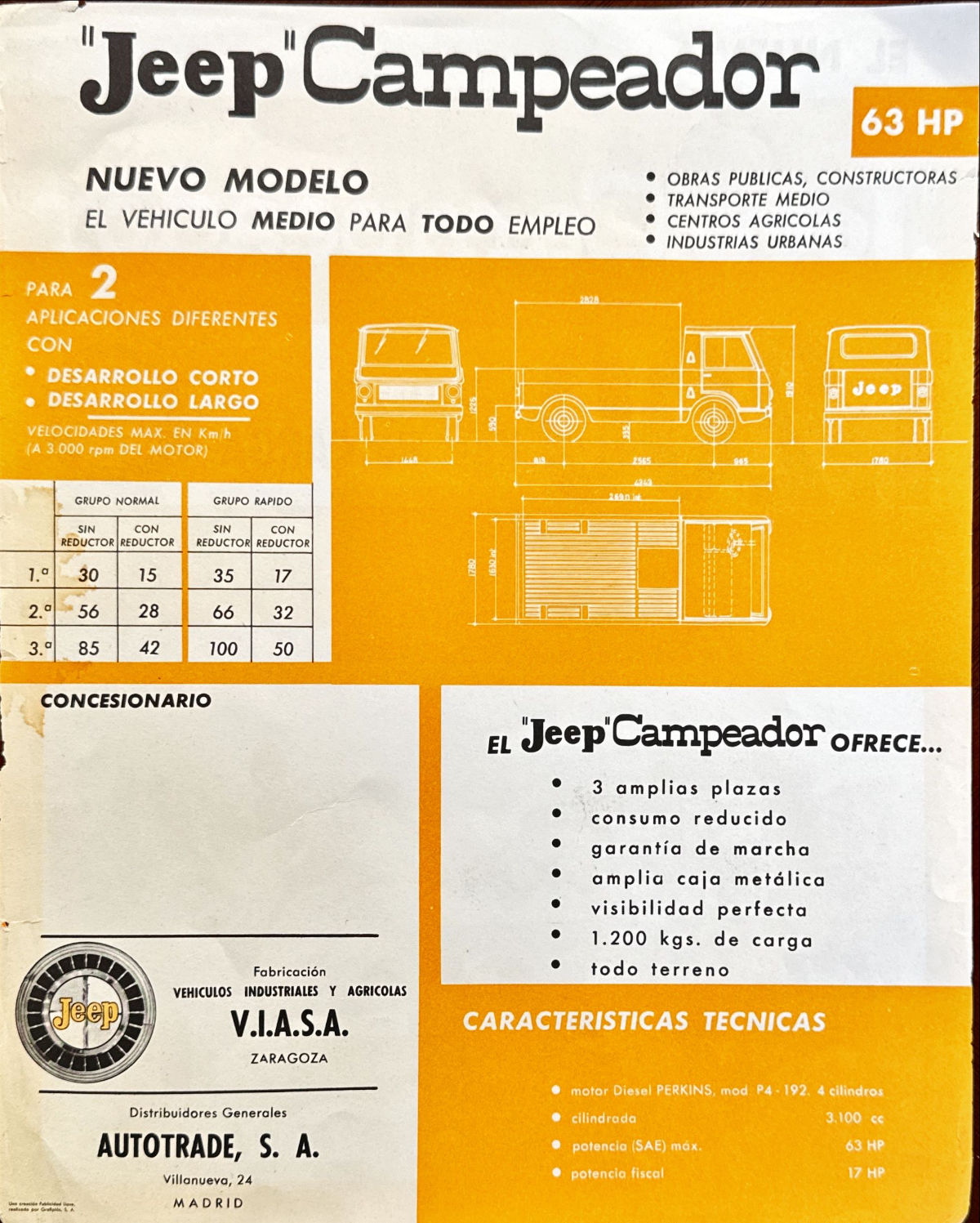
I could not find dates on these, but the models and designs look very similar to the 1969 brochure, so I can only guess these are from around 1969. Each of these models are similar to the M-series forward control designs.
The “Jeep” Campeardo is reflective of the M-676; just a basic forward control truck:
This “Jeep” Duplex has four doors and a small truck bed, similar to the M-677:
The “Jeep” Toledo is similar to the M-678:
This “Jeep” Furgon has few windows than the Toledo model above, sort of like the M-679:
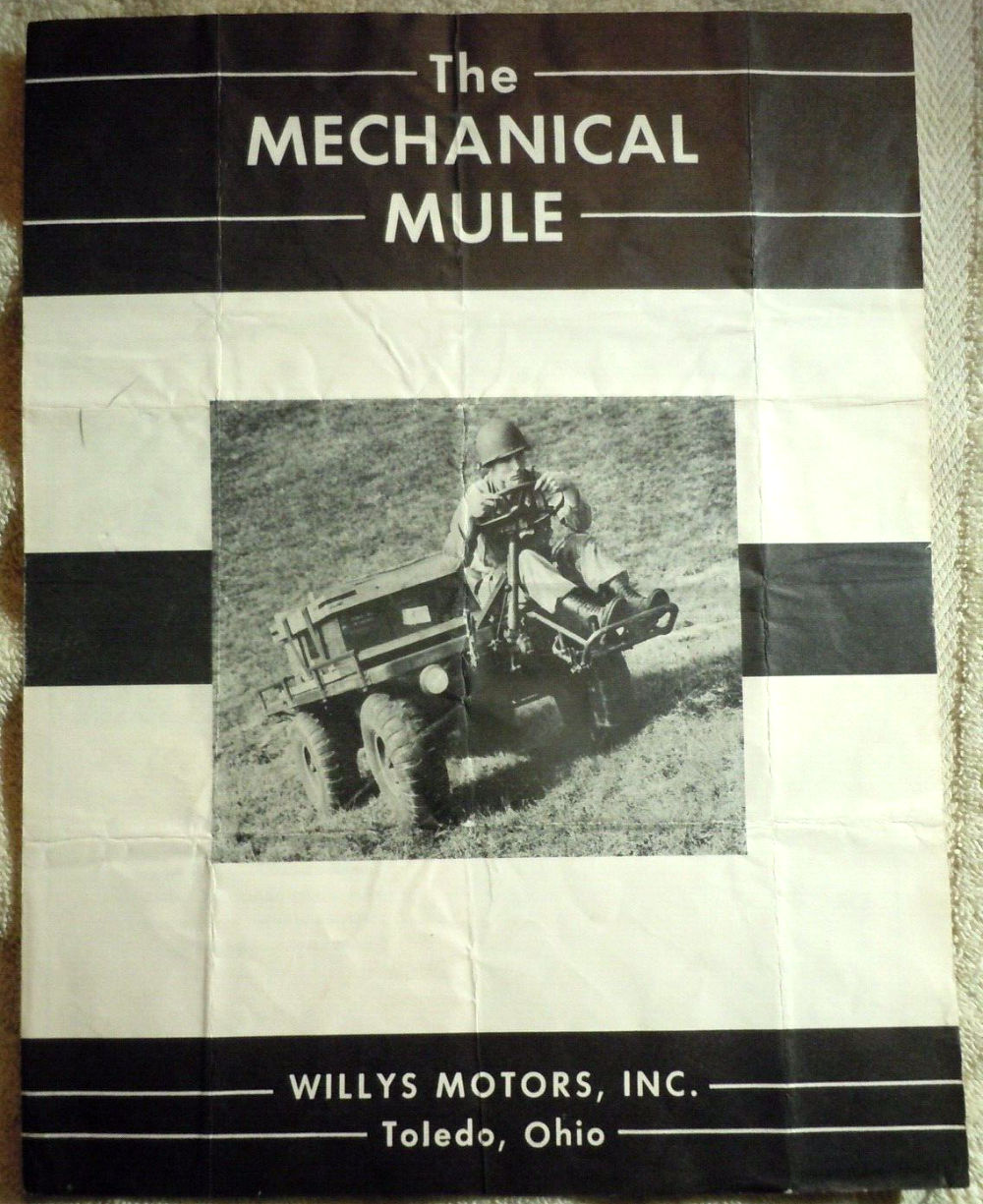
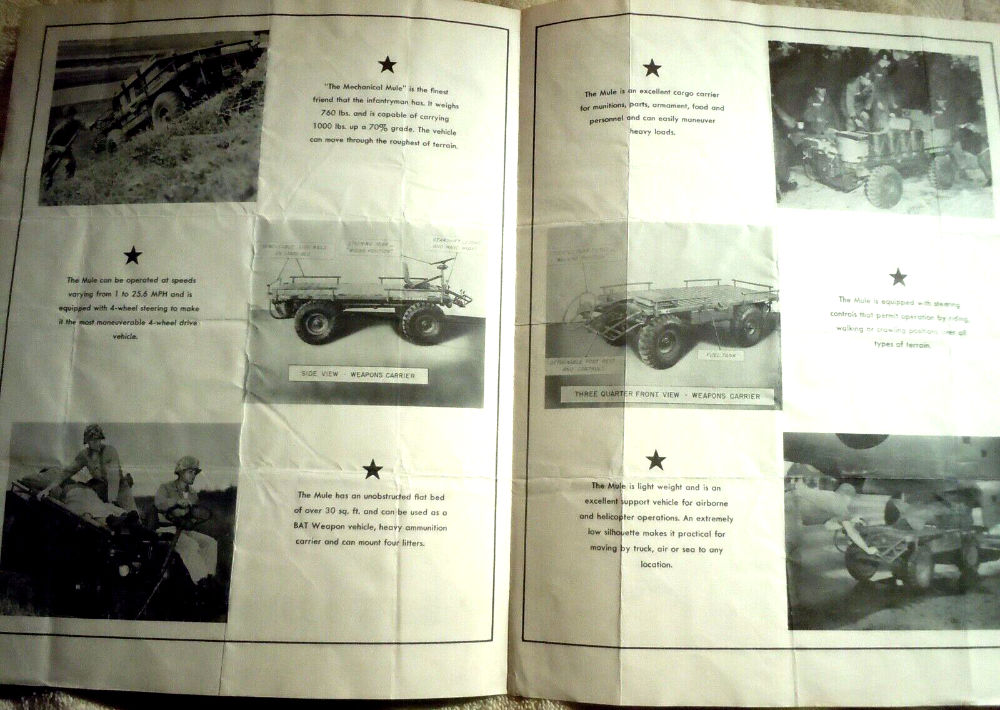
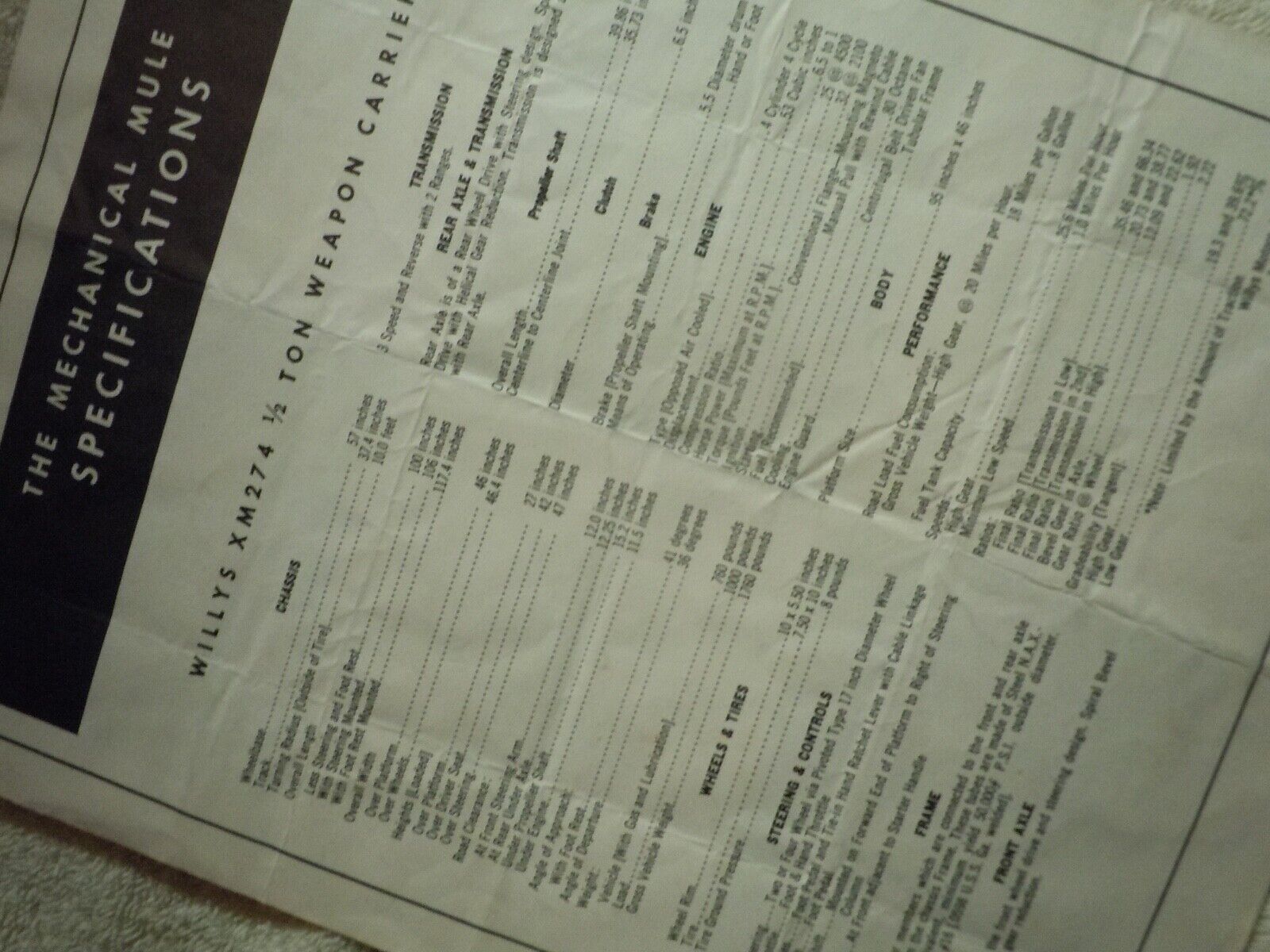
“THIS AUCTION IS FOR A WILLYS MOTORS INC, BROCHURE FEATURING “THE MECHANICAL MULE” ALSO KNOWN AS THE WILLYS XM 274 1/2 TON WEAPONS CARRIER.
THE X IN THE VEHICLE TITLE MEANS PROTOTYPE AND EXPERIMENTAL.
IN GOOD SHAPE. COMPLETE, INTACT, WITH GOOD COLOR AND GRAPHICS. WEAR, FOLD LINES, AND WRINKLES FROM AGE AND STORAGE, AND USE, BUT VERY READABLE, COMPLETE AND CLEAN.
THE BROCHURE CONTAINS PHOTOS AND DESCRIBES FEATURES AND USES OF THE VEHICLE. BACK PAGE OF BROCHURE HAS THE SPECIFICATIONS ON THE WILLYS XM274 1/2 TON WEAPONS CARRIER (MECHANICAL MULE).
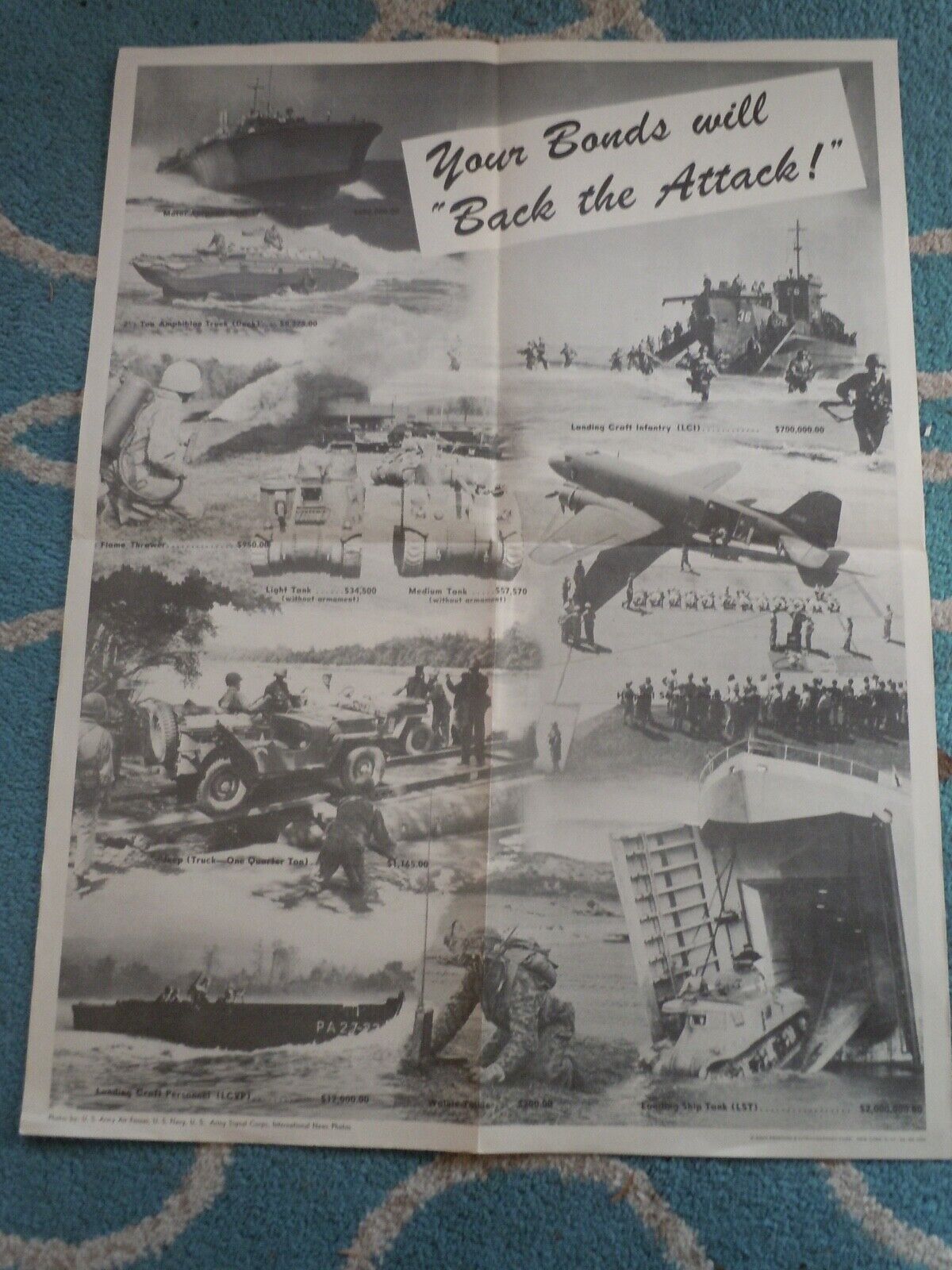
“THIS AUCTION IS FOR A RARE, ORIGINAL WW11 POSTER TITLED “YOUR BONDS WILL BACK THE ATTACK”
ORIGINAL – NOT A REPRODUCTION.
DATED 5/17/1944
D’ARCY PRINTING AND LITHOGRAPHING CORP, NY
POSTER HAS PHOTOS OF MANY WW11 TRANSPORTATION VEHICLES INCLUDING:
PT BOAT, DUCK, JEEP, TANK, PLANE, LST, LCUP, LCI, FLAME THROWER, RADIO, ETC.
18X24 INCHES “
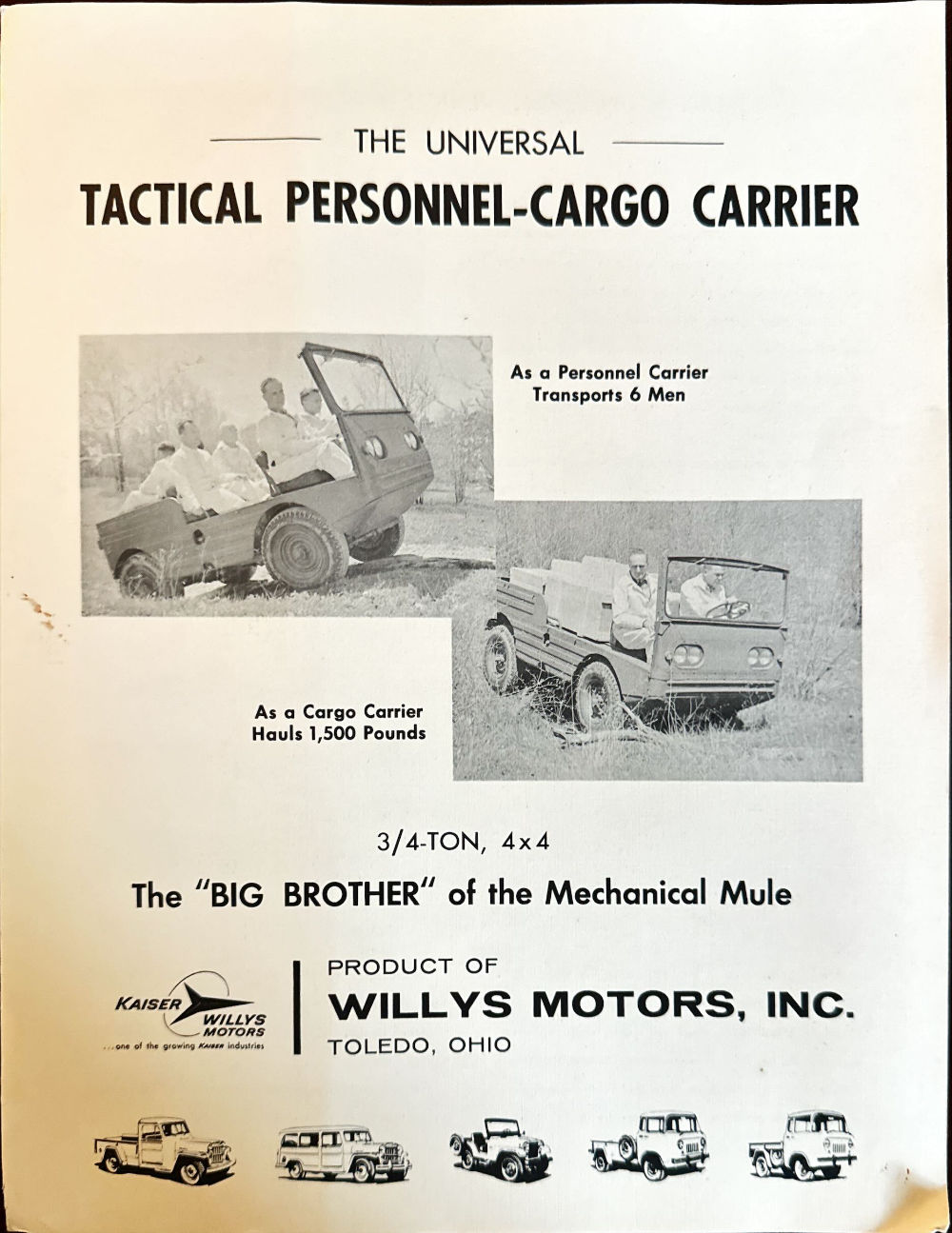
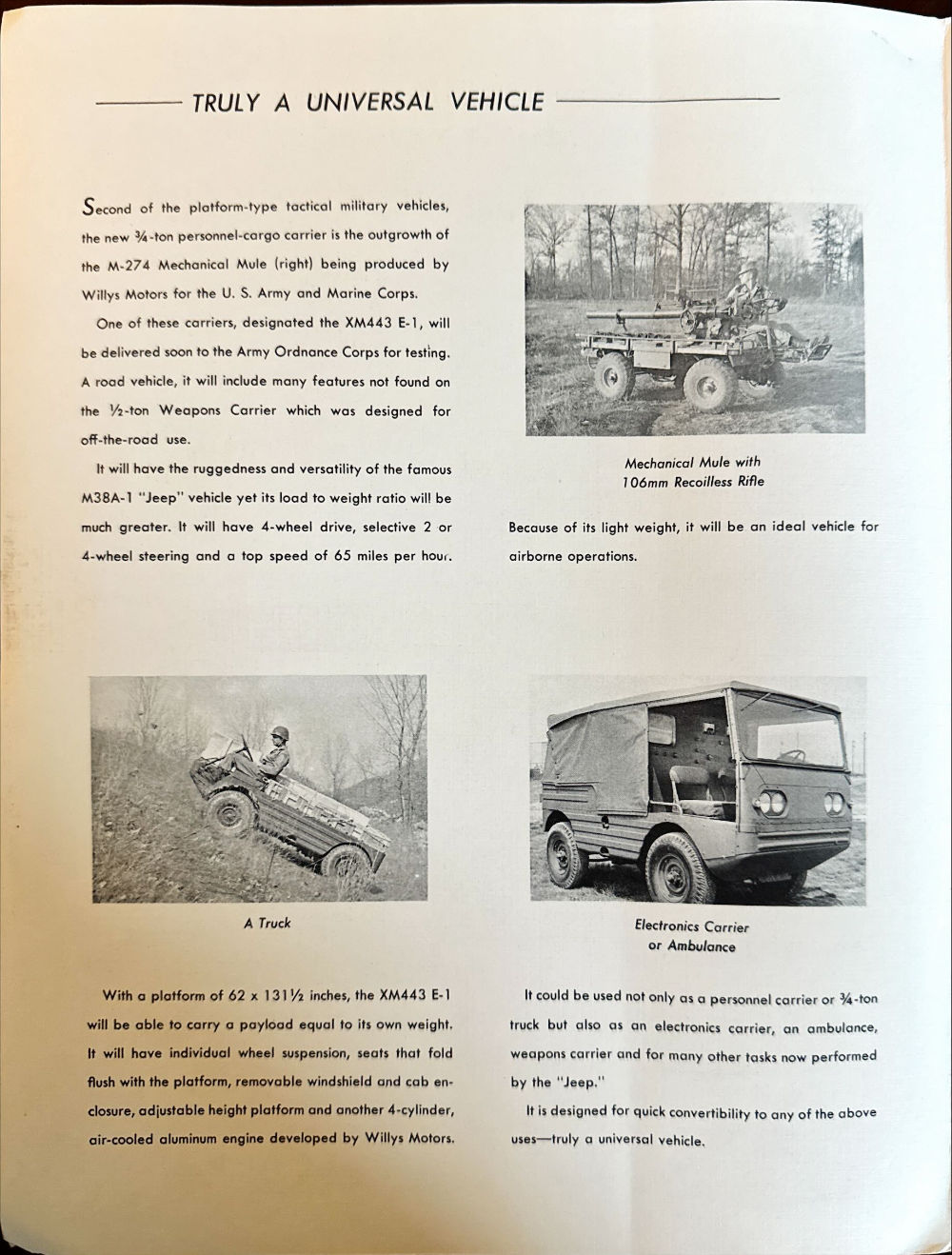
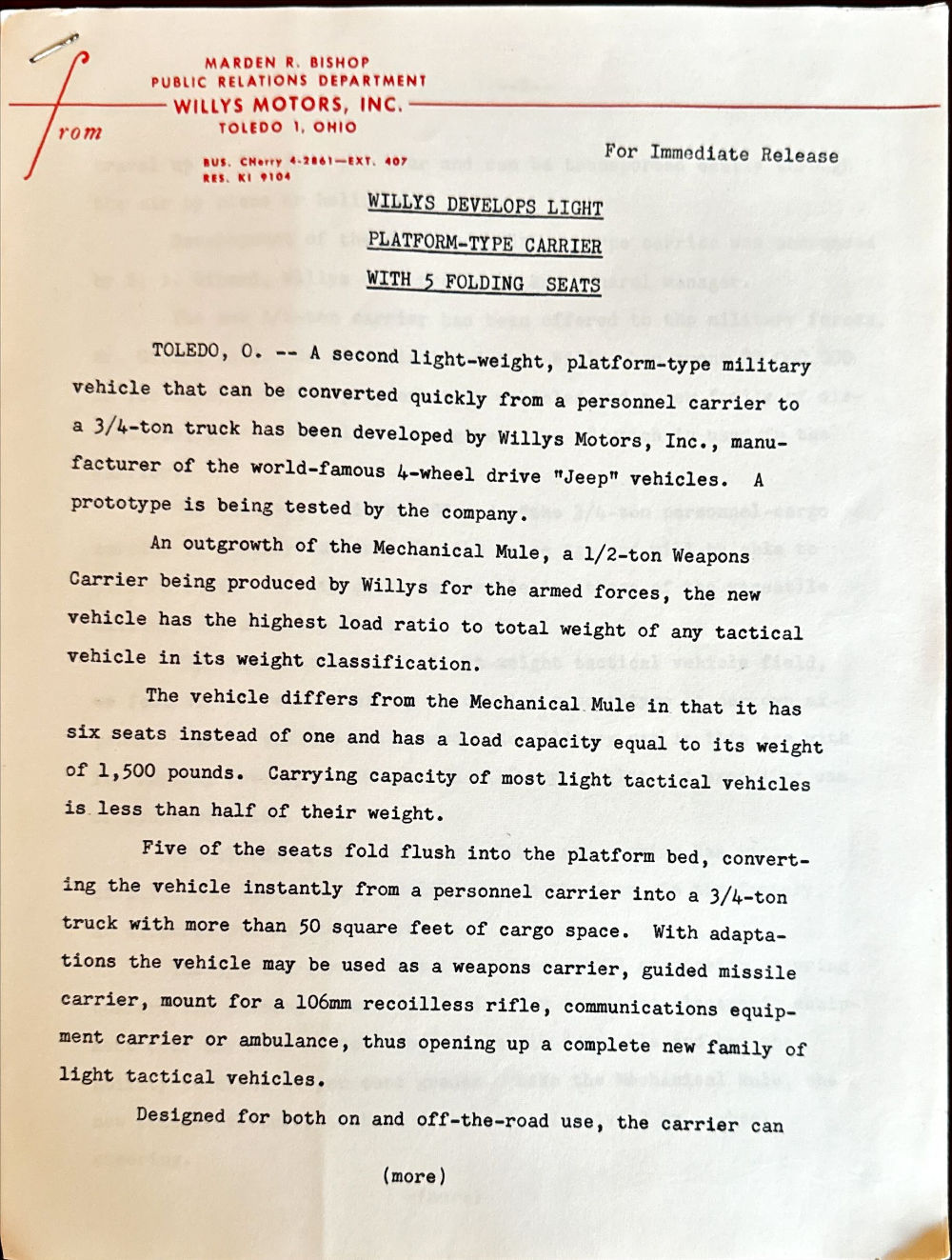
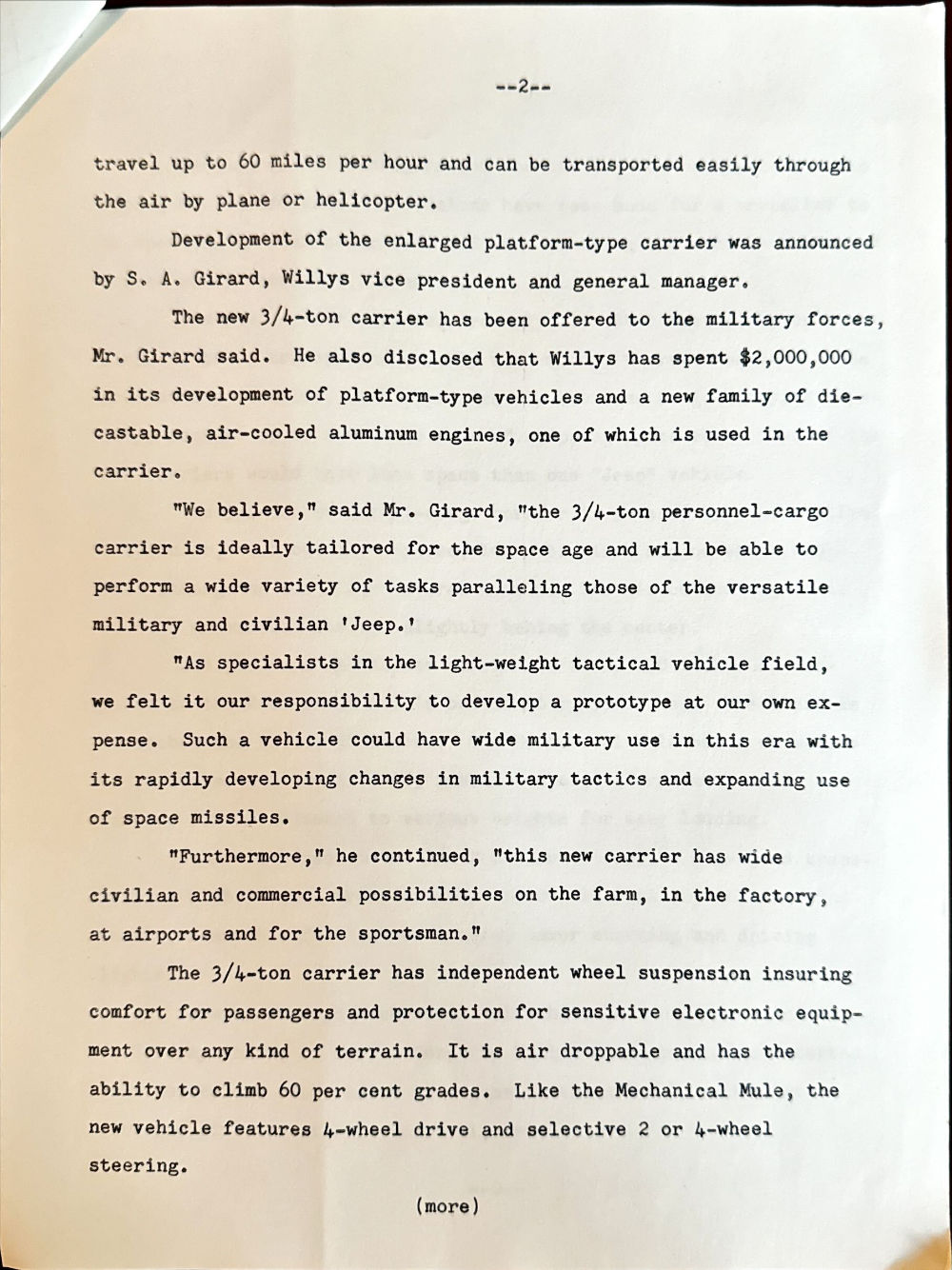
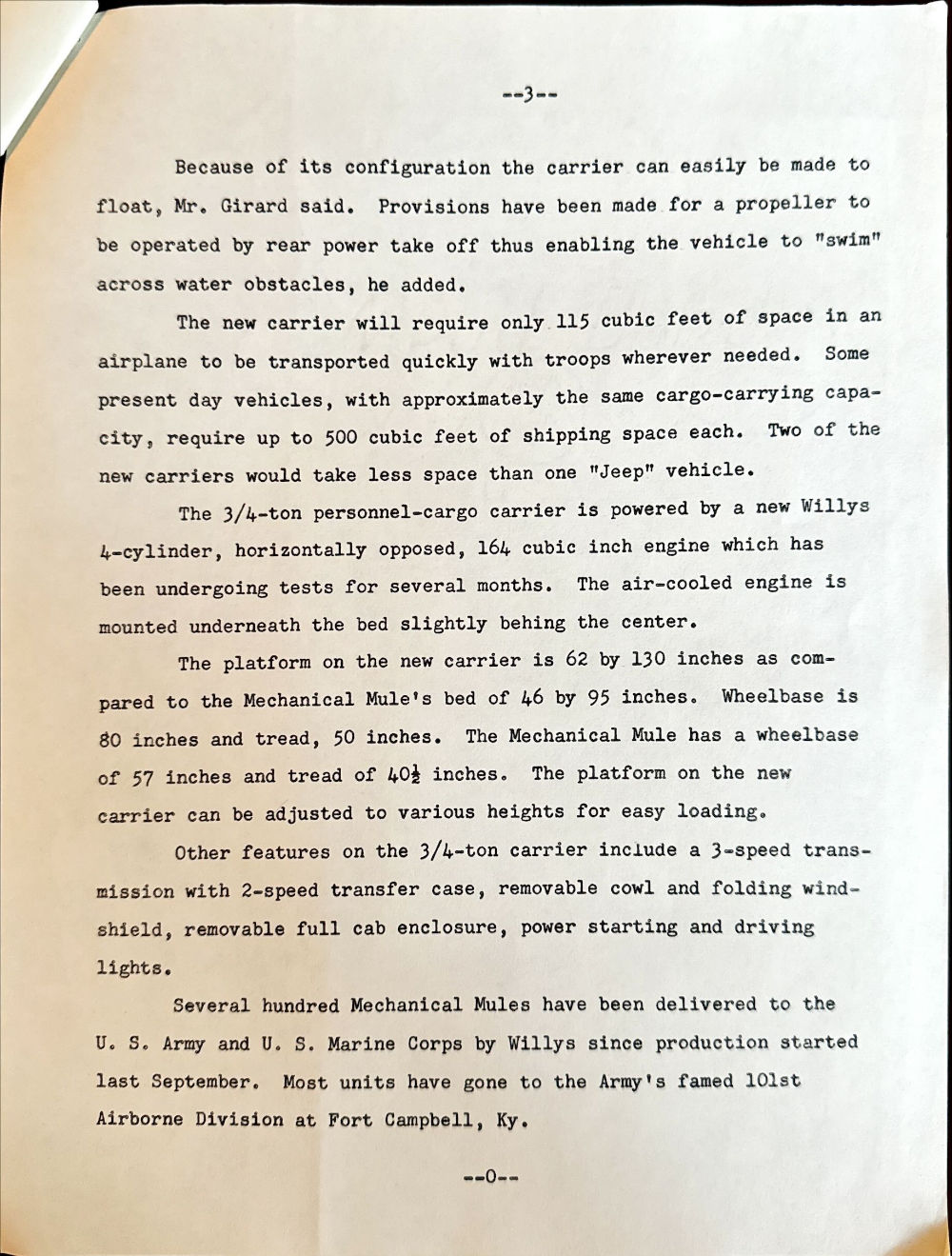
The Tactical Personnel-Cargo Carrier (TPCC), also known dryly as the XM443E1, isn’t a vehicle I’ve discussed at all, mostly because I really didn’t know much about it. I figured it was just another prototype. However, given how far along in the production process this design lasted, I figured it was worth a close look. I recently bought the four-page brochure below off of ebay, along with a press release for the TPCC, which sheds some additional information on this vehicle.
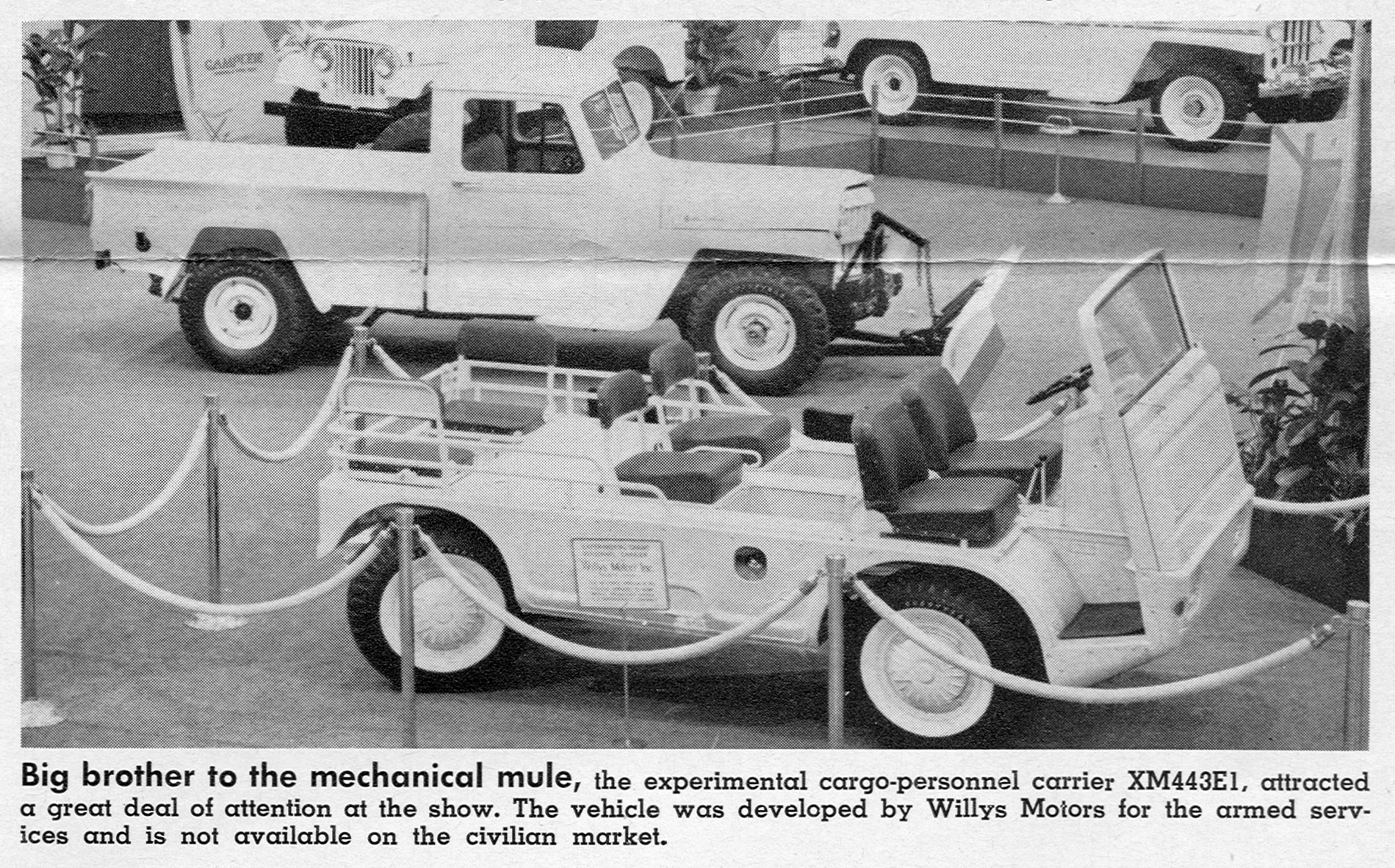
In fact, the TPCC was far enough along in development that it was featured at the 1959 Chicago Auto Show (February 1959 Jeep News):
From the February 1959 Jeep News — 1959 Chicago Auto Show where the jeeps were all featured in white.
and later in the year at the Association of U.S. Army’s Convention.
Willys Motors even created this 4-page brochure, which was likely published in 1959 (it lacks a date). So, why didn’t Willys do more with this vehicle? According to this post, numerous maintenance issues uncovered by the military doomed the vehicle.