emailNeed to contact me and don't have my email? Click on email button.
About eWillys
Welcome to eWillys.com, a website for vintage jeep enthusiasts. I update this website nearly every day with jeep deals, jeep history, interesting reader projects, jeep related info, and more.
These quick searches can help you find things on eBay. People list in the wrong categories all the time, so don't be surprised to see brochures in the parts area for example. This section used to be split into jeeps, parts and other categories, but recent changes to eBay will require this information to be recoded.
The links to posts below show jeeps grouped by models, condition, and other ways. Some of these jeeps are for sale and others have been sold. If you are unsure whether a vehicle is still for sale or not, email me at d [at] ewillys.com for more info.
Importantly, the allure of buying a project jeep can be romantic. The reality of restoring a jeep can be quite different, expensive and overwhelming without the right tools and resources. So, tread carefully when purchasing a "project". If you have any concerns about buying a vintage jeep, or run across a scam, feel free to contact me for help, comments or concerns .
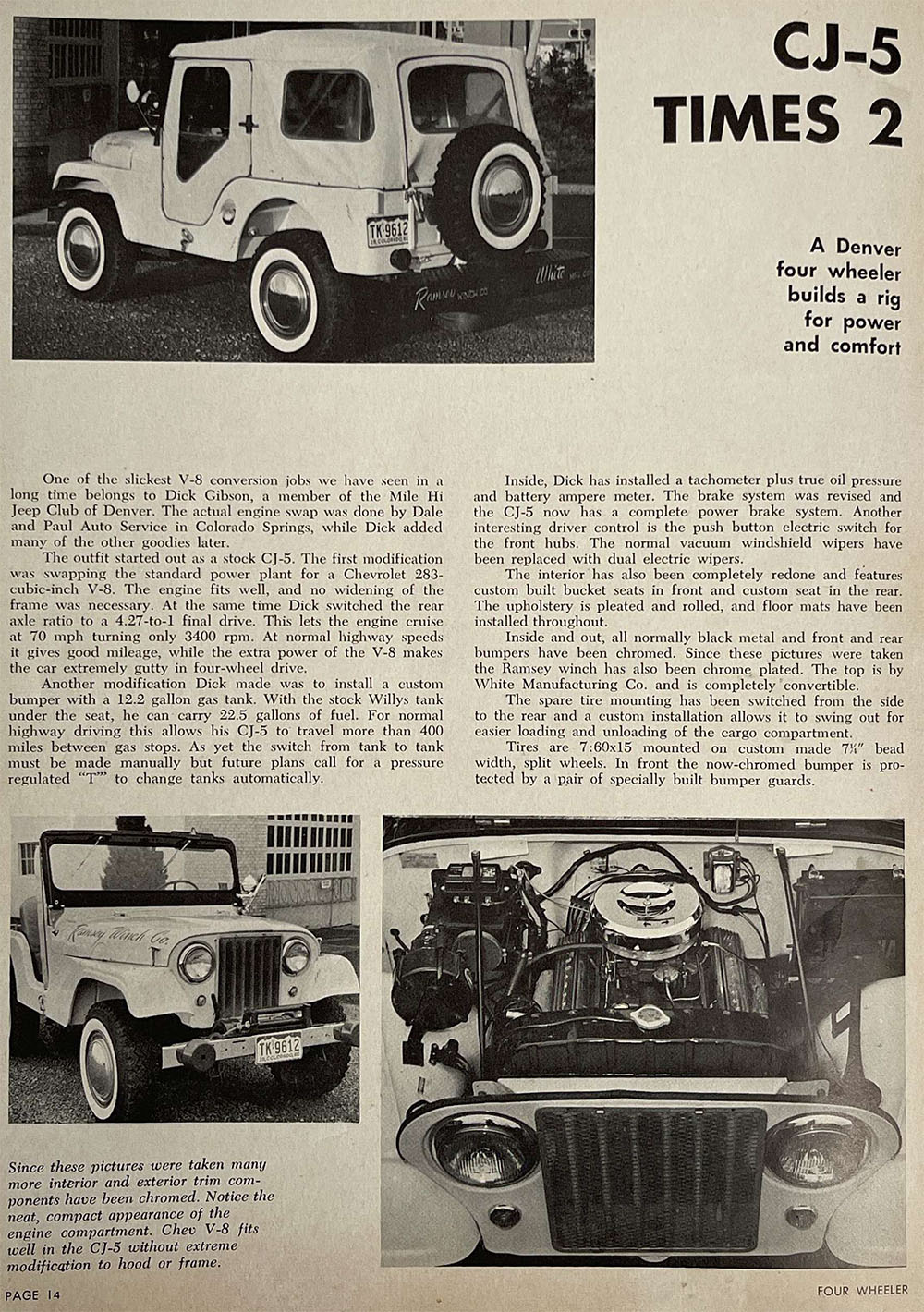
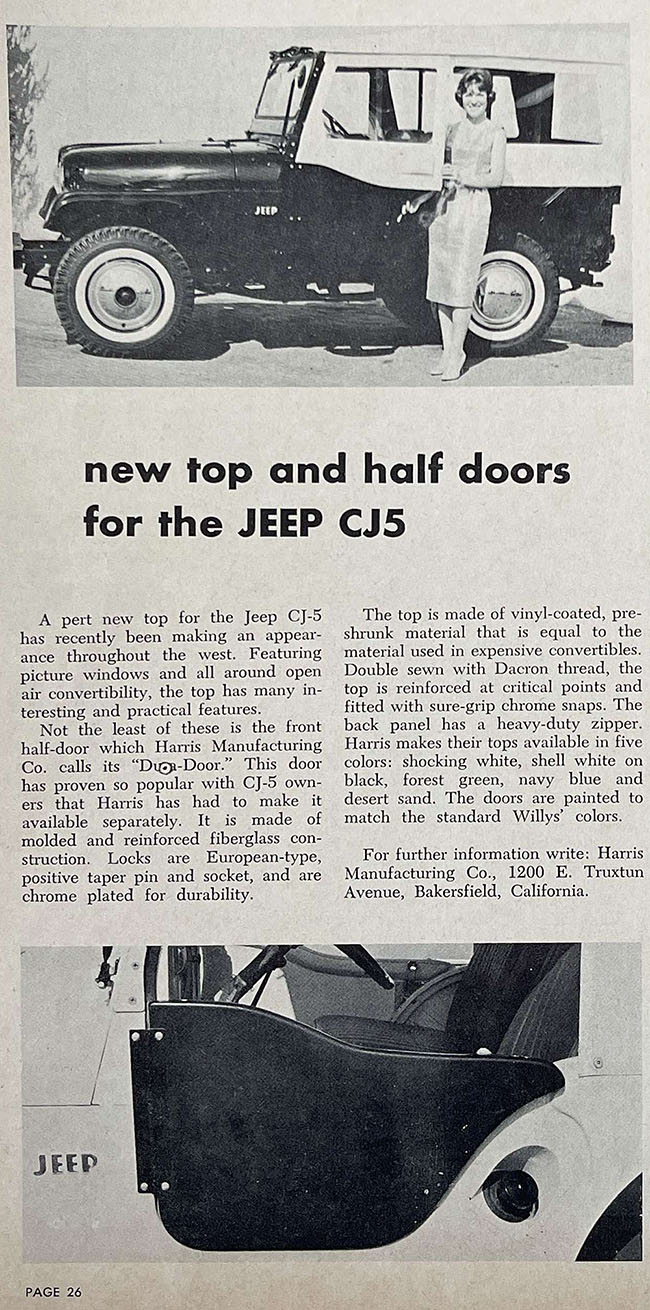
UPDATE: The October 1962 issue of Four Wheeler Magazine included an ad for the Harris top and doors, along with an article.
========================
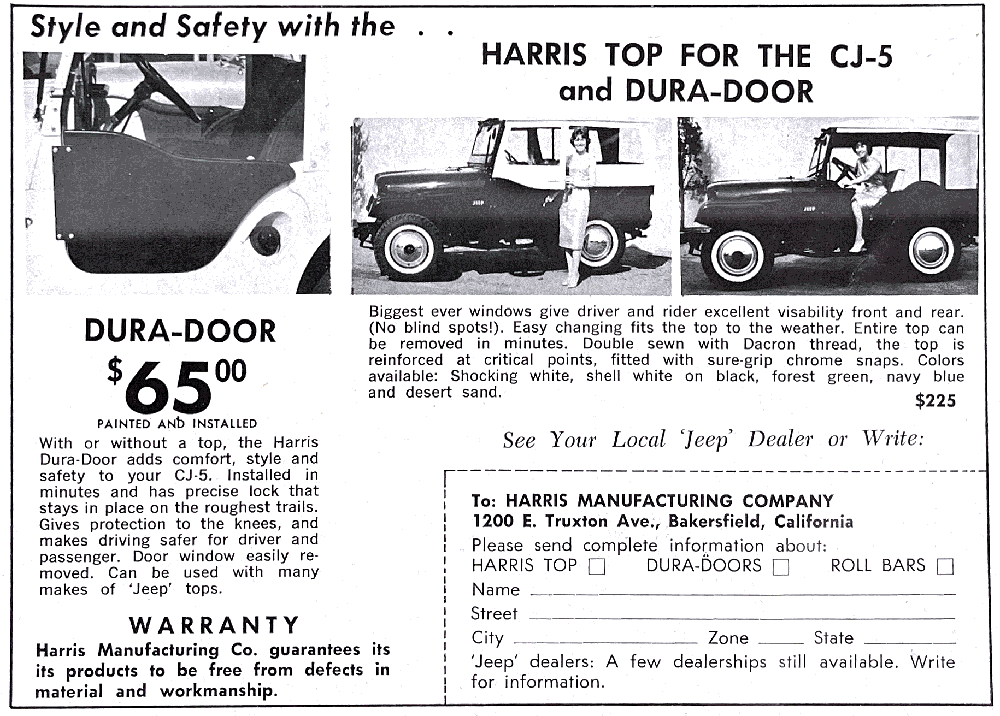
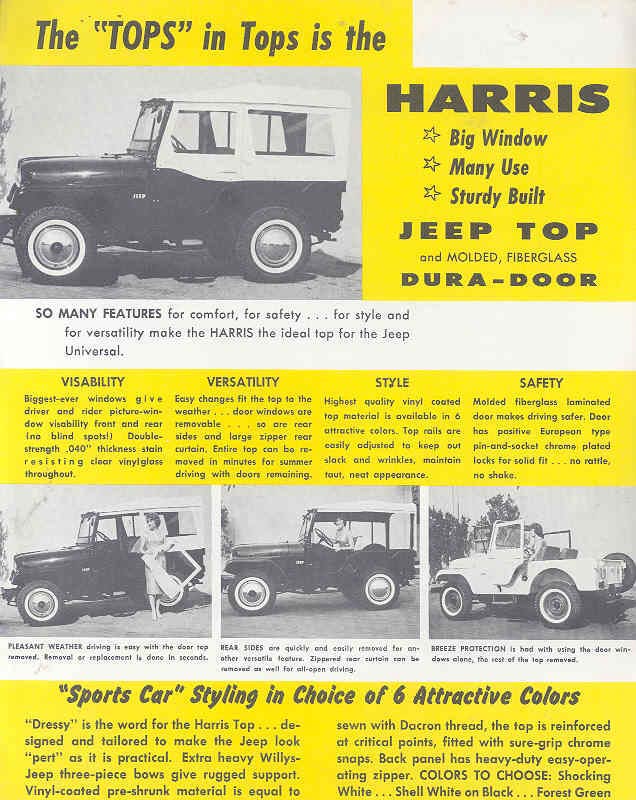
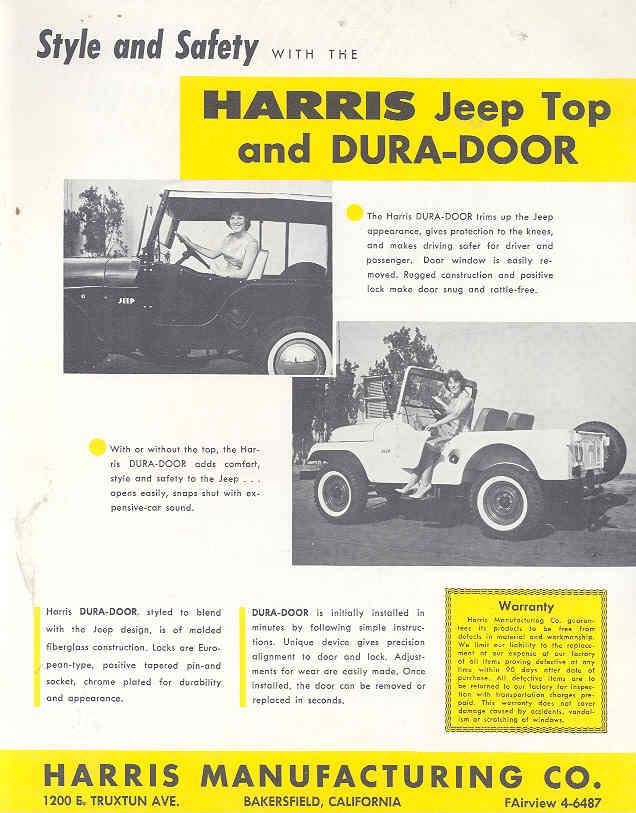
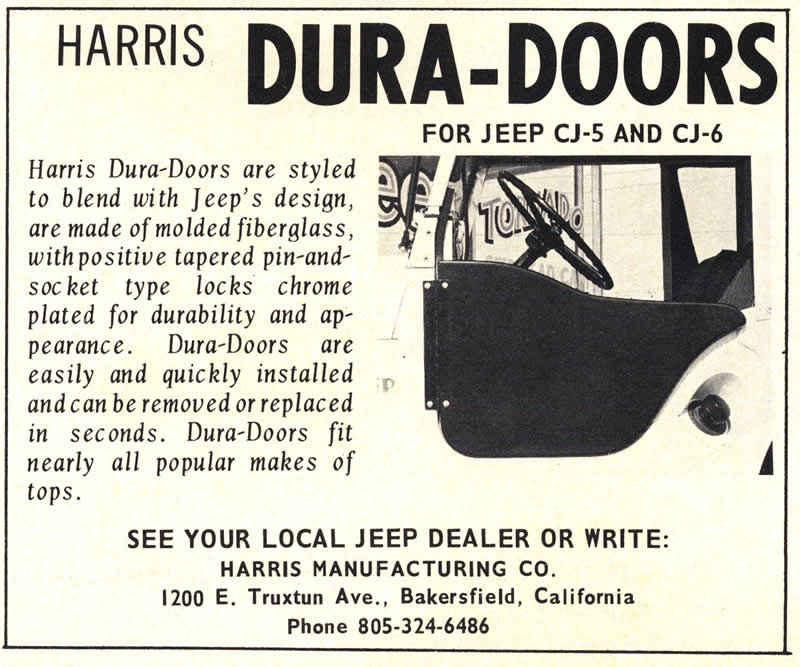
Originally Posted October 07, 2017:Here’s a rare Harris Dura-Door one-page brochure on eBay. This fiberglass half door produced out of Bakersfield, California, for CJ-5s was also advertised in Four Wheel Magazine (see ad at bottom).
This ad appeared in several Four Wheeler issues, including the June 1966 issue. I’d have to guess that by 1966, Harris had dropped its soft top product and focused on the dura-doors for jeeps.
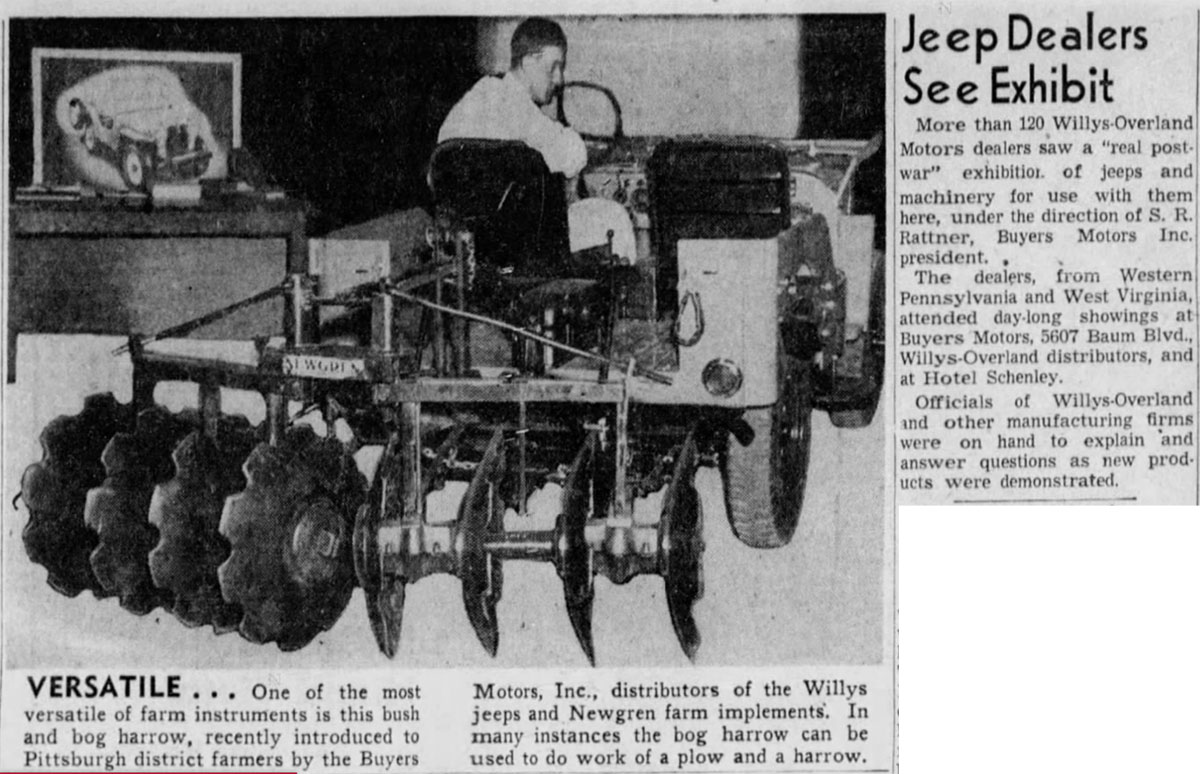
A March 06, 1949, photo in the Pittsburgh Sun-Telegraph highlighted Newgren’s recently introduced bush and bog harrow. The Pittsburgh firm of Buyers Motors was promoting this piece of equipment and others as part of a product exhibition for Willys-Overland Motors dealers.
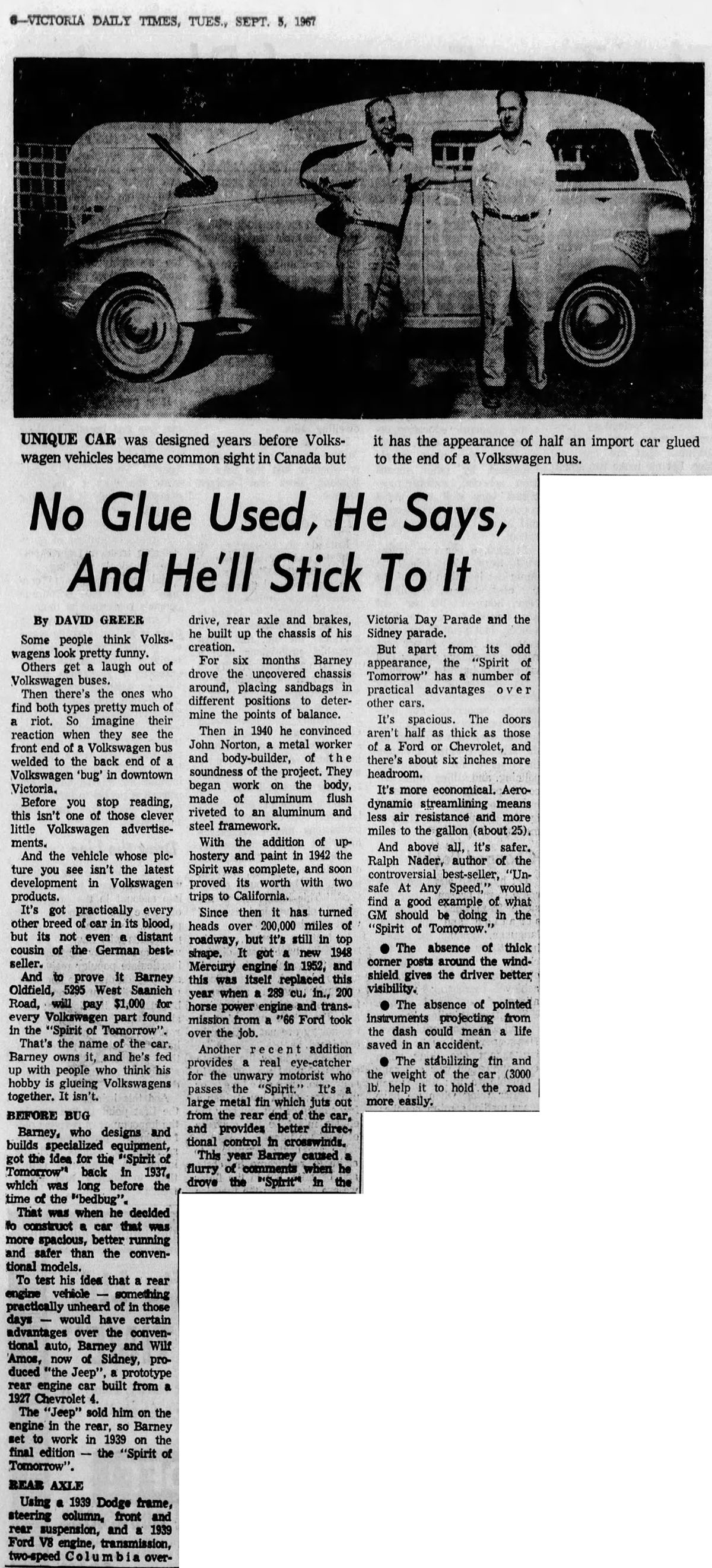
As part of the development of this uniquely styled rear-engine car, in 1937 Basil (Barney) Oldfield built a prototype he called the “Jeep”. The “Jeep” sold him on the idea of a rear engine vehicle, so he began development of a safer, more dependable vehicle built around the rear engine. Unlike Tucker’s rear-engine auto design, Barney’s “Spirit of Tomorrow”, completed in 1942, did not lead to a manufactured product. But, Barney did achieve his goals, as Ralph Nader approved of his vehicle, claiming it was roomier, safer, and had more visibility.
This September 05, 1967, article form the Victoria Colonist (Victoria, B.C.,) provides some good early history on the vehicle.
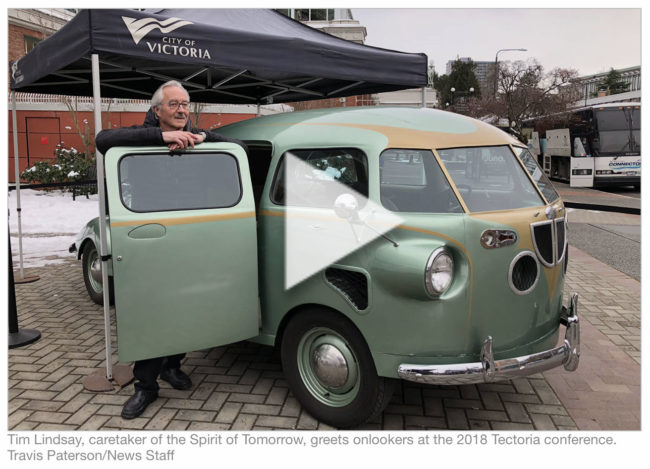
The “Spirit of Tomorrow” still runs. This 2018 video interview provides additional information:
The end of this video shows jeeps unloading, jeeps driving through a town, and a jeep navigating difficult terrain.
“L/Ss of soldiers talking to armed civilians on coastline. Various shots of man ploughing field with two ox. Several shots of war graves. Two men look at bullet holes in the helmet of which rests on grave. Various country scenes. Shots of soldiers looking out to see aided with binoculars. Various shots taken from landing craft approaching coast. L/S of jeeps coming ashore. Shots of jeeps moving through street of town. L/Ss of jeep being driven up steep mountain pass. M/Ss of soldier talking. More shots of jeep.”
UPDATE: The September 1962 issue of Four Wheeler included a full page ad for its new hardtop and half-top designs. The magazine included both a full-page ad and a short article. Given this info, it looks like the top redesign was introduced during the summer of 1962.
=============================
Originally Published July 7, 2020: Sometime in the early 1960s, Kelly Manufacturing altered the design of its angular full and half hardtops. The new tops eliminated some of the horizontal bevels and the flat back design for a slightly more elegant design; but, the tops did retain the angled top-side that was so recognizable (As I don’t have much knowledge on any interior changes, this post will stick to the major exterior differences) (See Kelly’s connection to Beck and Kemco and an early Kelly brochure) (Also see CJ-3B page Beck and Kelly histories)
Interestingly enough, Kelly branded the Flatfender tops as 23-series, but not the CJ-5 tops. Here’s a 1962 Kelly brochure that highlights a wide variety of the rear-angled design for both the CJ-5 and the flatfenders, along with the model numbers:
To make the differences more clear, let’s take a look at the early Kelly design (these early hardtops were also marketed by the Berg’s as JeepKing hardtops). Notice the horizontal bevels along the driver’s side rear and on the rear latch. Also note the flat vertical back of the hardtop.
This silent collection of videos sent by John includes footage of a jeep carrying General Eisenhower.
“Several shots of the American soldiers clearing debris in heavily bombed area. Various shots of convoy of jeeps driving through town streets, heavily bombed buildings in background. Jeep stops and General Eisenhower (Ike) gets out of jeep and enters a house. Ike leaving house with several other officers. They stand on doorstep talking. There is a three star General with Ike, possibly General Bradley. Ike puts coat on and lights cigarette, he chats a bit more, gets into jeep and leaves.”
This silent video also contains a number of scenes featuring Eisenhower:
“Various shots of General Dwight D Eisenhower presenting medals to American soldiers. Ike gives them a shot pep talk. Shots of General Eisenhower and other senior officers looking over map.
Ike and others arrive in jeep. Different angle of medal presentation and Ike’s pep talk to the men. Eisenhower climbs into jeep and leaves.
Various shots of Eisenhower talking with American officers.
Various shots of American field artillery being fired.
Shots of Troops advancing behind tanks across field. Tanks move into wooded area, possibly an orchard. Soldiers follow up behind them.
American troops with a bulldozer crush a crashed German Messerschmitt ME 109 plane. CU American star symbol painted over German cross on small tank.
Various shots of building with German abandoned staff cars.
Various shots of the broken remains of German aircraft (possibly wooden mock ups) at captured airfield in France.”
The January 1952 issue of National Geographic included an expansive article on the King Ranch in Texas, which at the time was America’s largest ranch. One of the photos included in the article showed a CJ-3A (in black) and a CJ-2A (in green) towing farm implements.