emailNeed to contact me and don't have my email? Click on email button.
About eWillys
Welcome to eWillys.com, a website for vintage jeep enthusiasts. I update this website nearly every day with jeep deals, jeep history, interesting reader projects, jeep related info, and more.
These quick searches can help you find things on eBay. People list in the wrong categories all the time, so don't be surprised to see brochures in the parts area for example. This section used to be split into jeeps, parts and other categories, but recent changes to eBay will require this information to be recoded.
The links to posts below show jeeps grouped by models, condition, and other ways. Some of these jeeps are for sale and others have been sold. If you are unsure whether a vehicle is still for sale or not, email me at d [at] ewillys.com for more info.
Importantly, the allure of buying a project jeep can be romantic. The reality of restoring a jeep can be quite different, expensive and overwhelming without the right tools and resources. So, tread carefully when purchasing a "project". If you have any concerns about buying a vintage jeep, or run across a scam, feel free to contact me for help, comments or concerns .
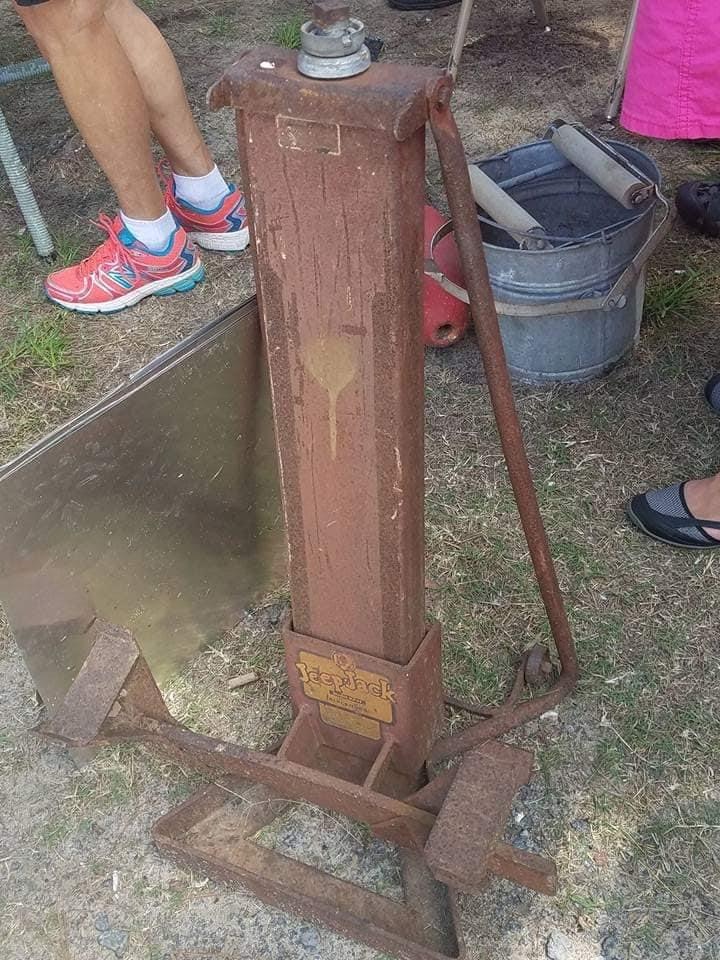
UPDATE: This brochure originally appeared on eBay in 2013. This image recently popped up on Facebook along side an actual Jack. So, I’ve included that image with this 1956 Brochure:
“Year: 1956
Type: Original Print Ad
Grade: Very Fine ++
Authentication: Dual Certificates
Image: Two-Color
Approximate Size (inches): 7.75 x 11
Approximate Size (cm): 20 x 28
Description and Condition
This is an original 1956 two-color print ad for the Jeep-Jack, from the Blackhawk Manufacturing Company in Milwaukee, Wisconsin.
UPDATE: Don makes some good points in his comment below as to why there might not be any MBs pictured.
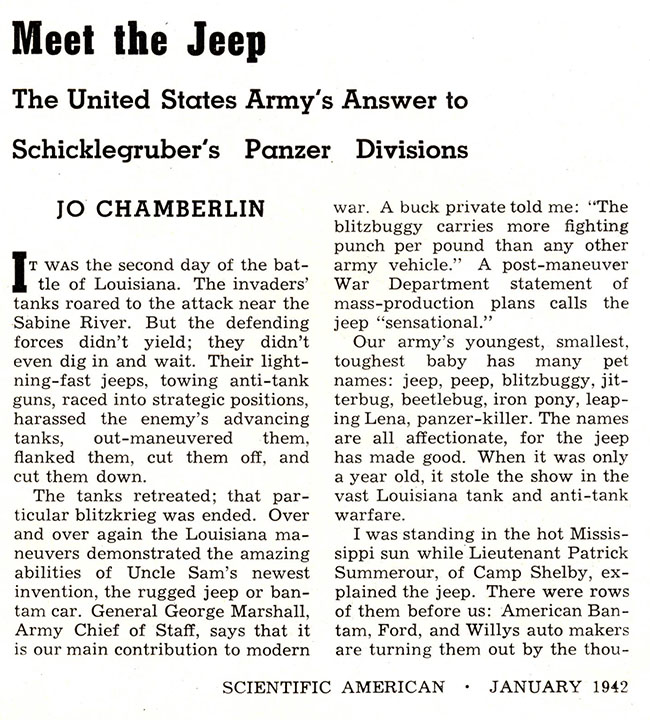
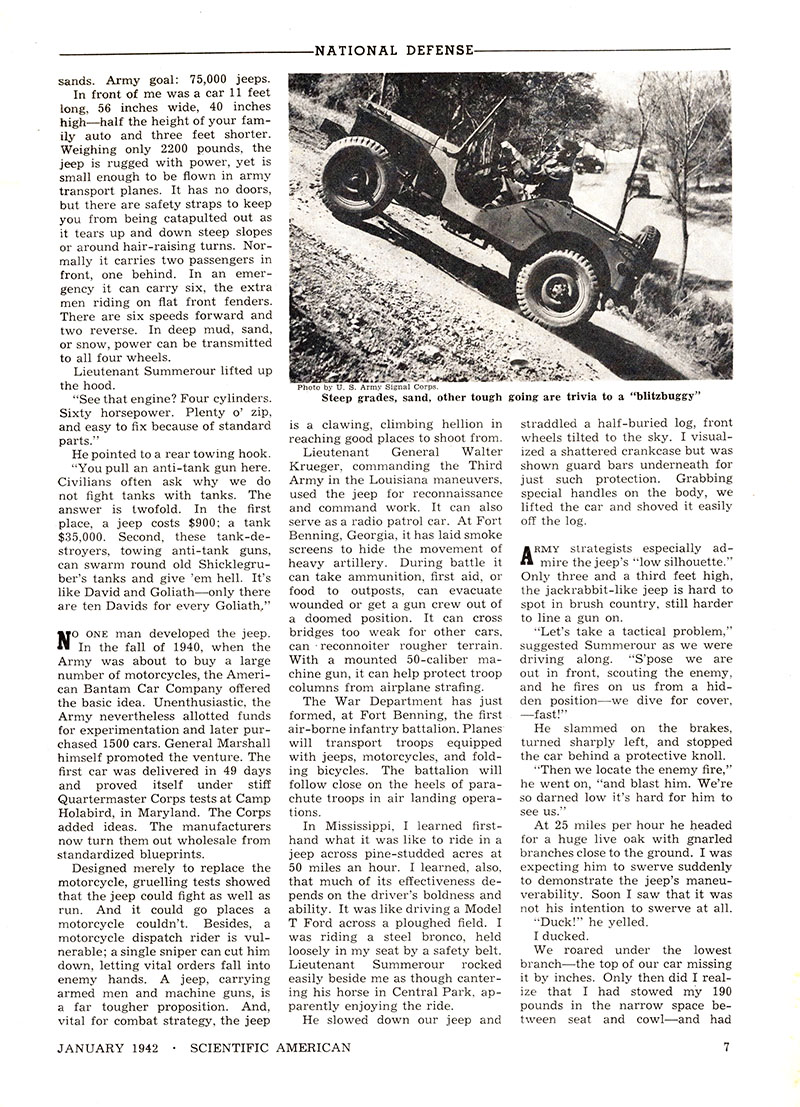
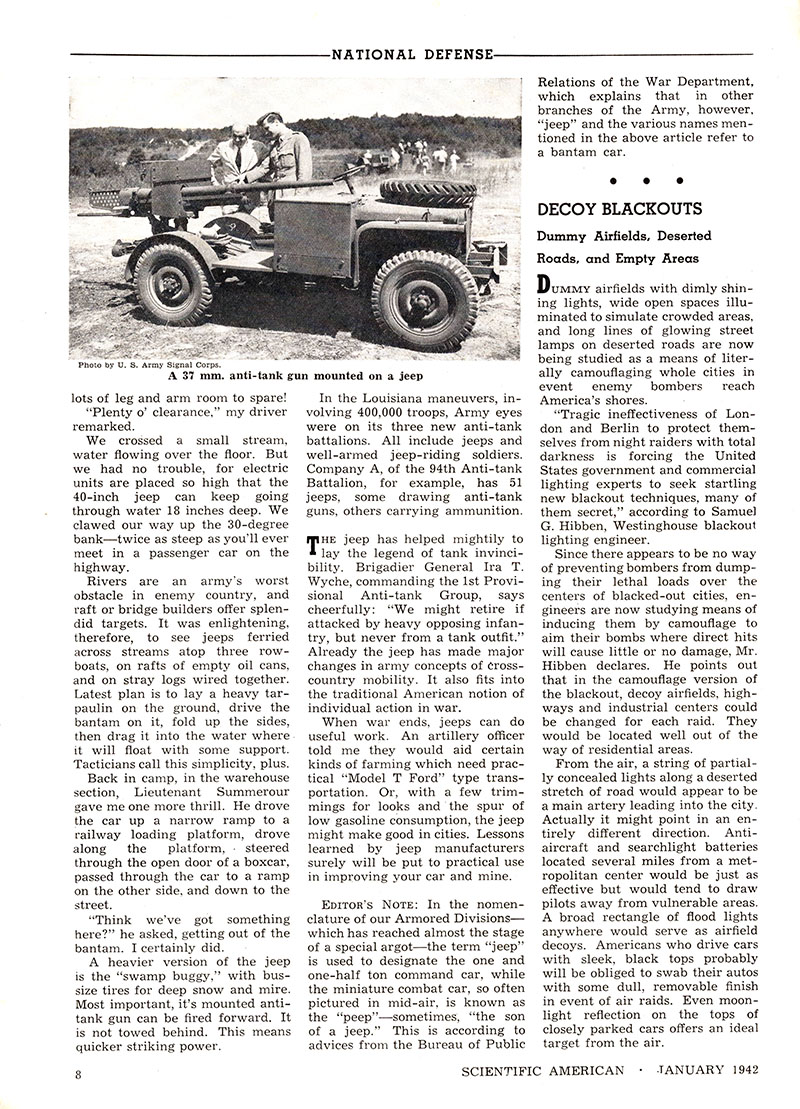
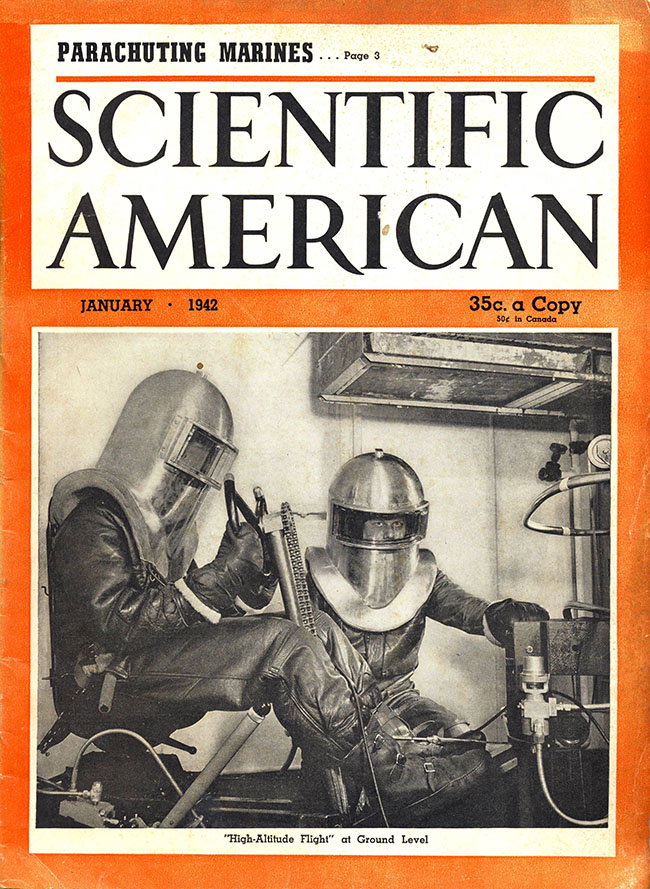
The January 1942 issue of Scientific American included an article titled “Meet the Jeep”, one I’ve been waiting about 7 years to snag. For some reason, though MBs were already being produced, no images of the MB were included. Instead, the first image shows a Ford GP. The second photo shows a Bantam BRC-40 T2E1.
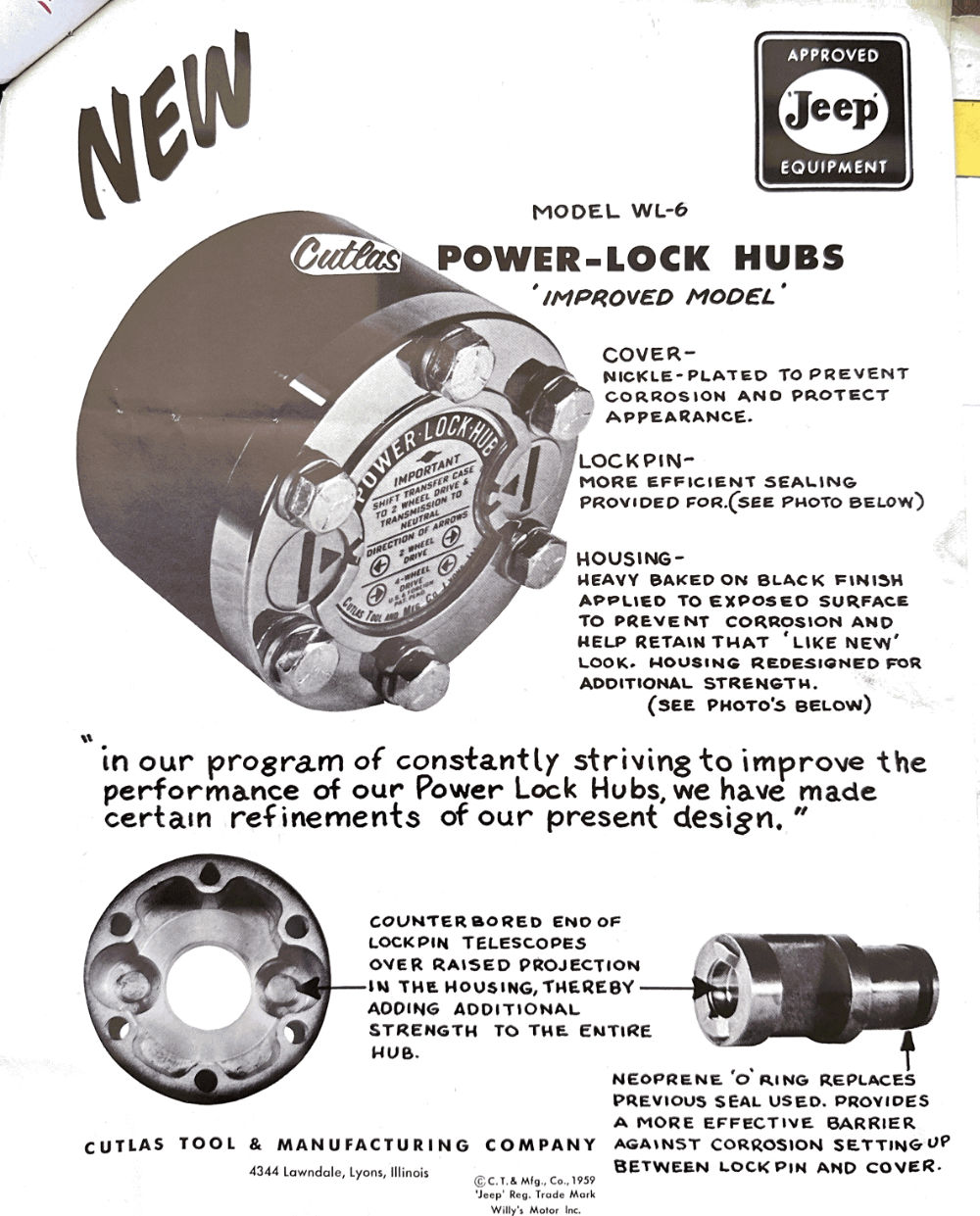
UPDATE II: This version of the Power-Lock brochure was posted to eWillys in May of 2023.
I hadn’t seen this version of the Cutlas Power-Lock brochure. Given the 1959 date, this is likely one of the earliest Power-Lock brochures. This brochure doesn’t not include a form number.
======================
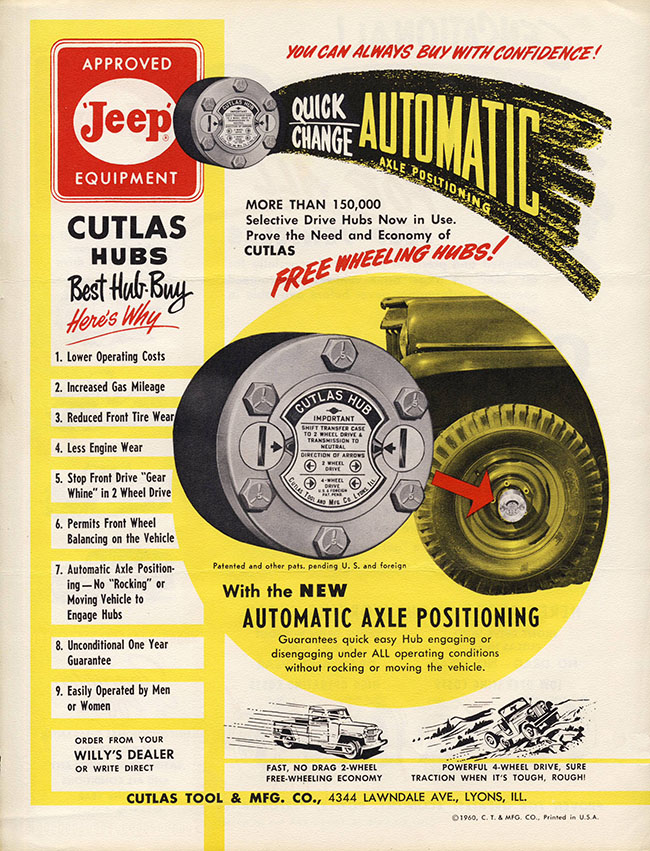
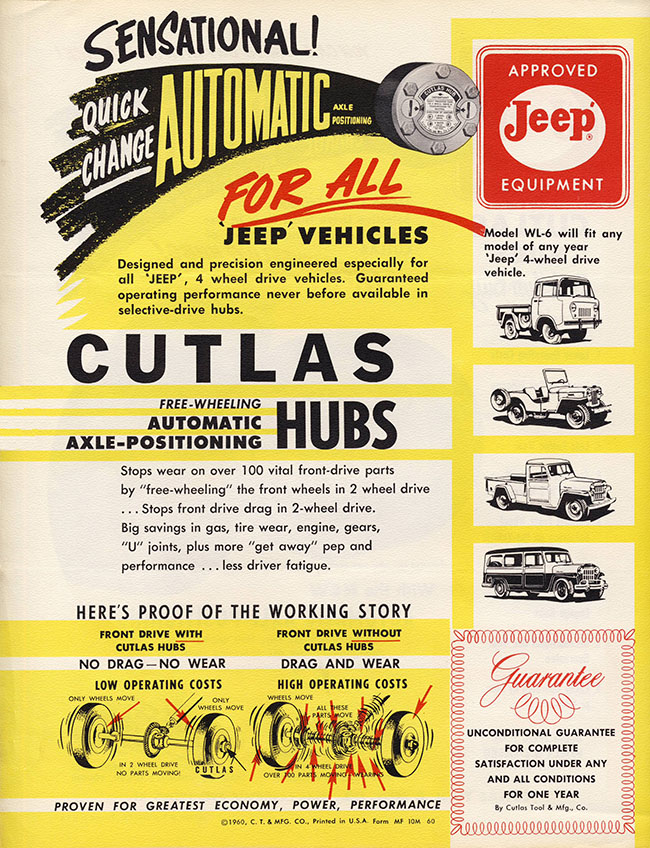
UPDATE April 16, 2020: The bottom brochure examples show a brochure from 1958, probably Cutlas’ first one. You’ll note that the brochure (and the hub itself) was branded “Power-Lock”. However, the 1960 brochure (shown just below this text) lacks any “Power-Lock”branding. Perhaps someone else knows why, but I can find no reason why. Maybe there was some concern about whether the patent would be awarded? (It wasn’t awarded until 1962).
1960 Cutlas Hub Brochure:
============================
Originally posted Feb of 2019:
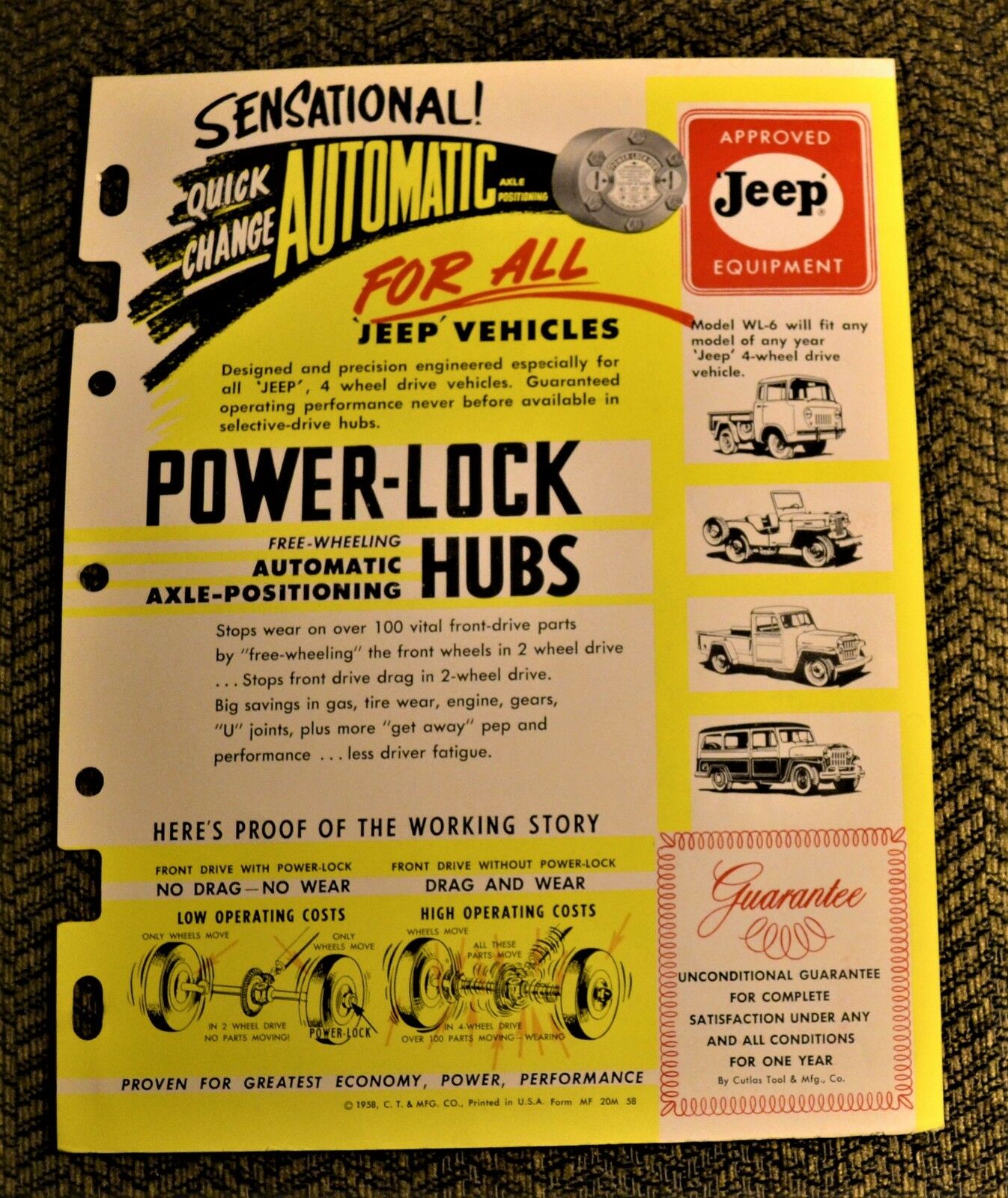
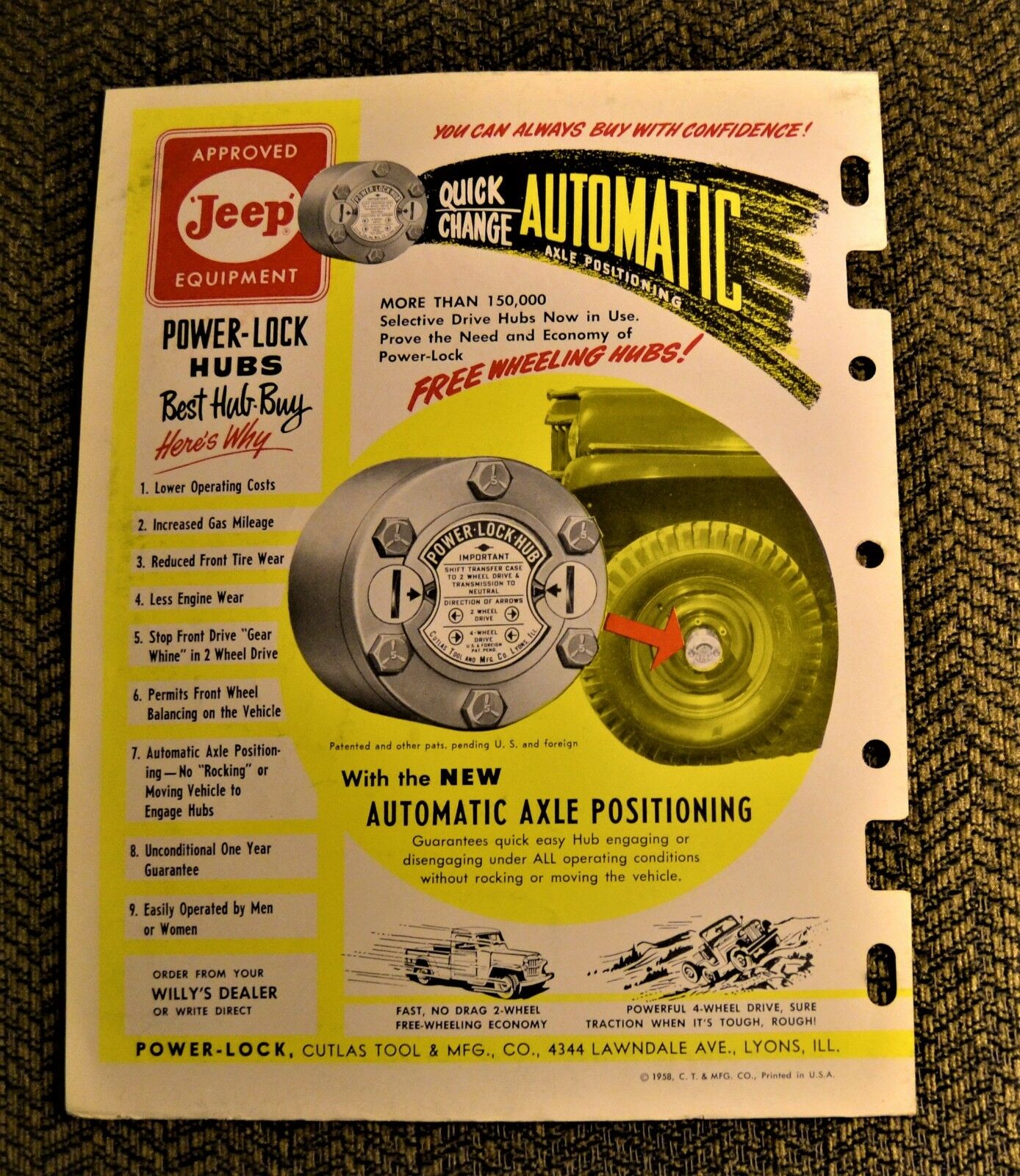
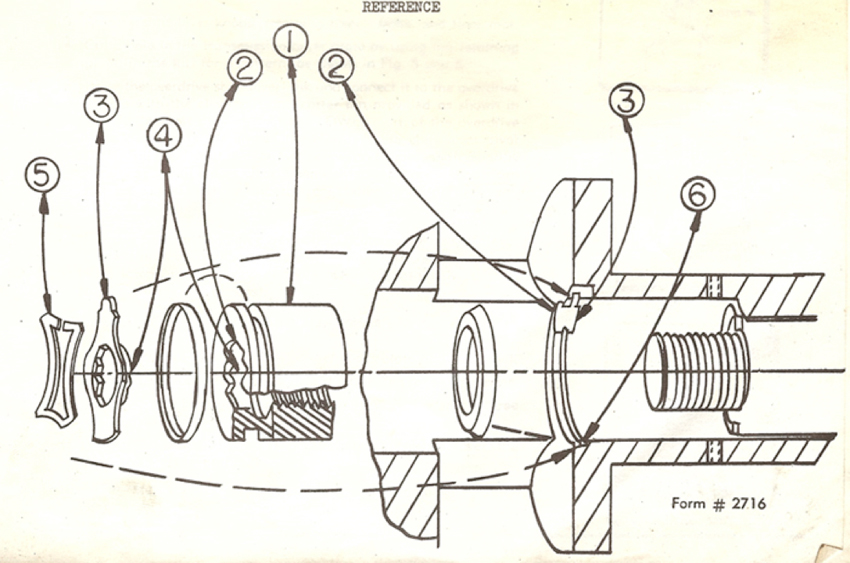
This Power-Lock was the first hub patented (1958), copyrighted (1958), and sold under the Cutlas brand. As I mention in my Free-Lock article, for reasons unknown, the president of Free-Lock became the president of Cutlas. Even more curious, the last two model of Free-Lock hubs were WL-57 and WL-58.
And, what was the Initial model of the first Cutlas hub you ask? That would be WL-6, shown below (1958 Cutlas Hub Brochure):
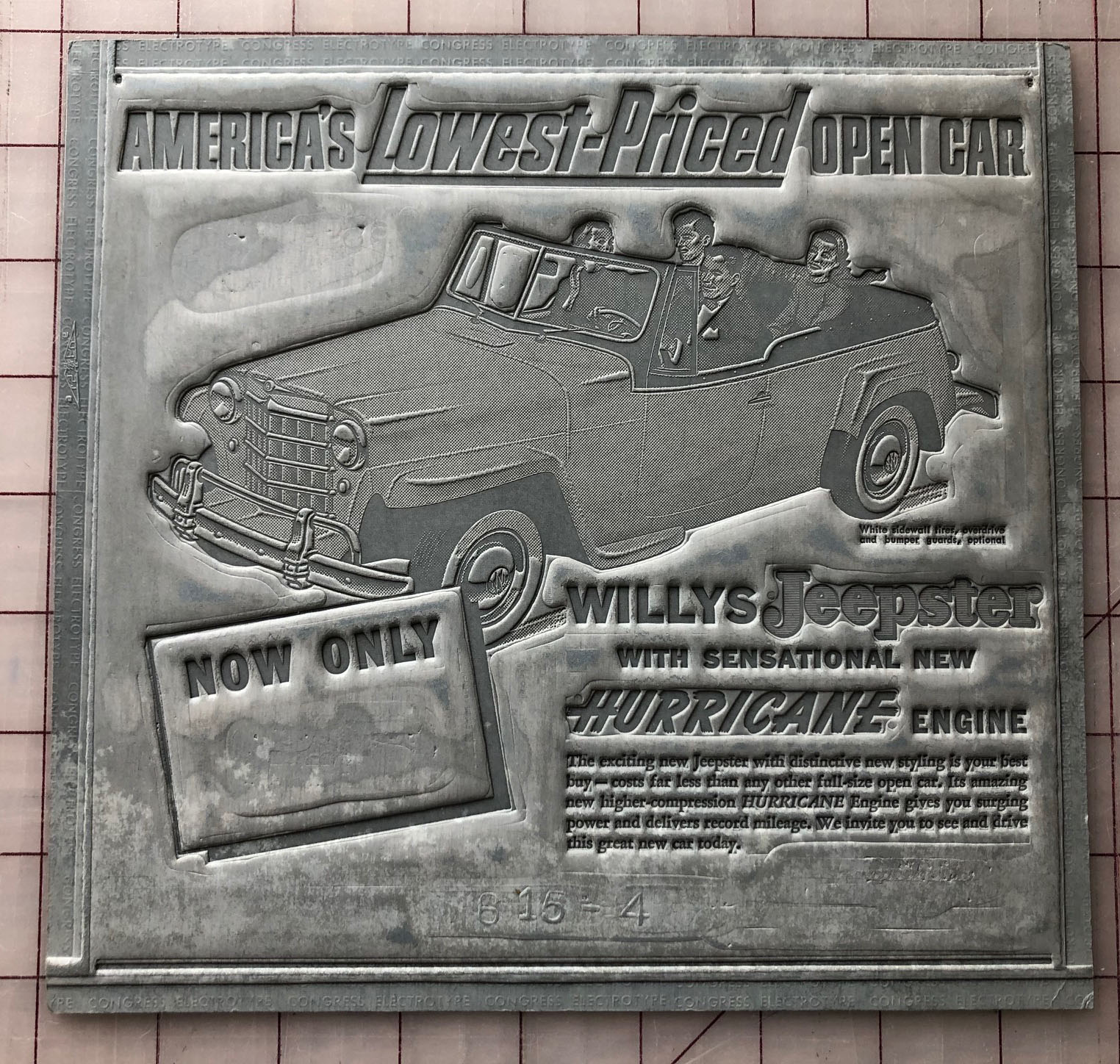
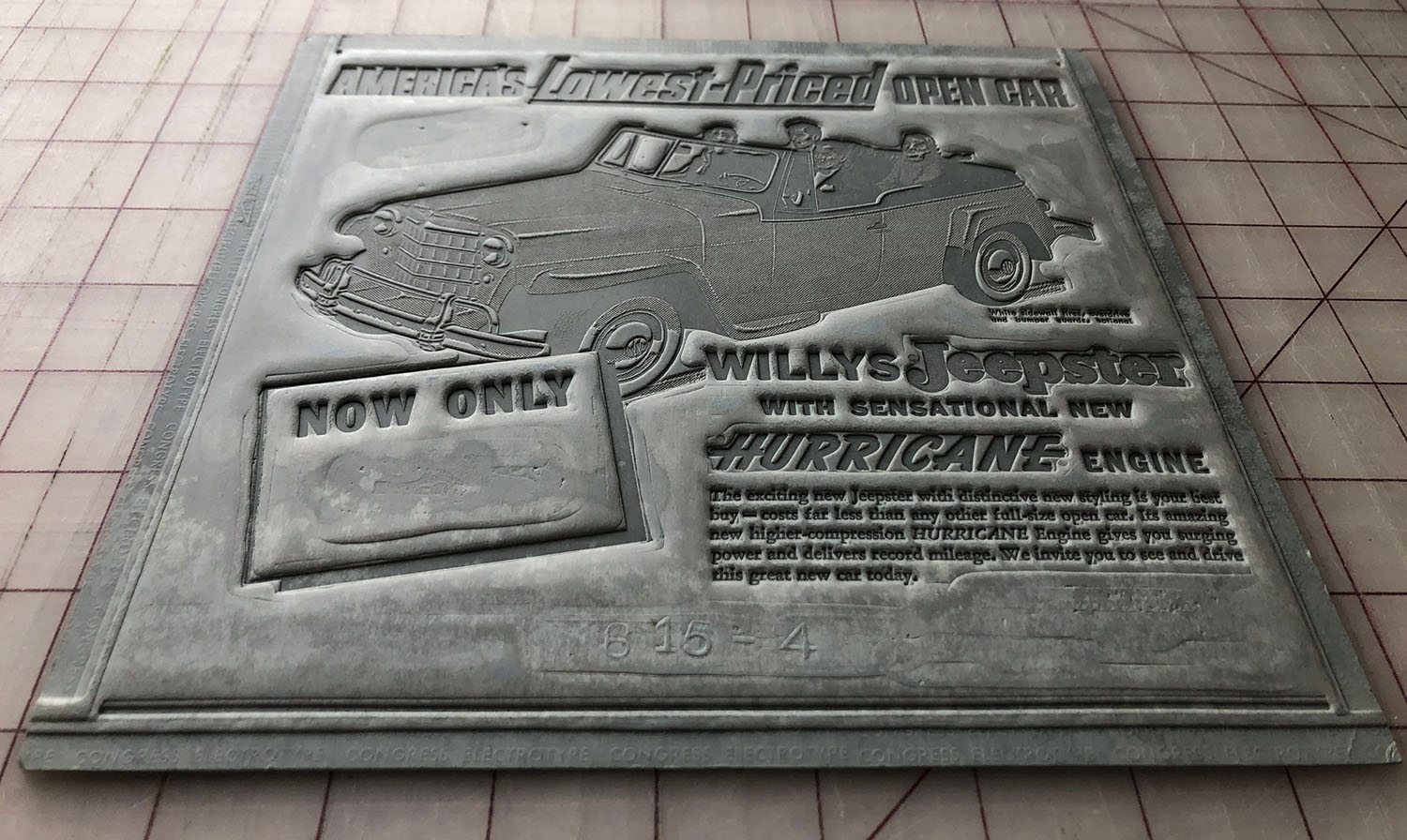
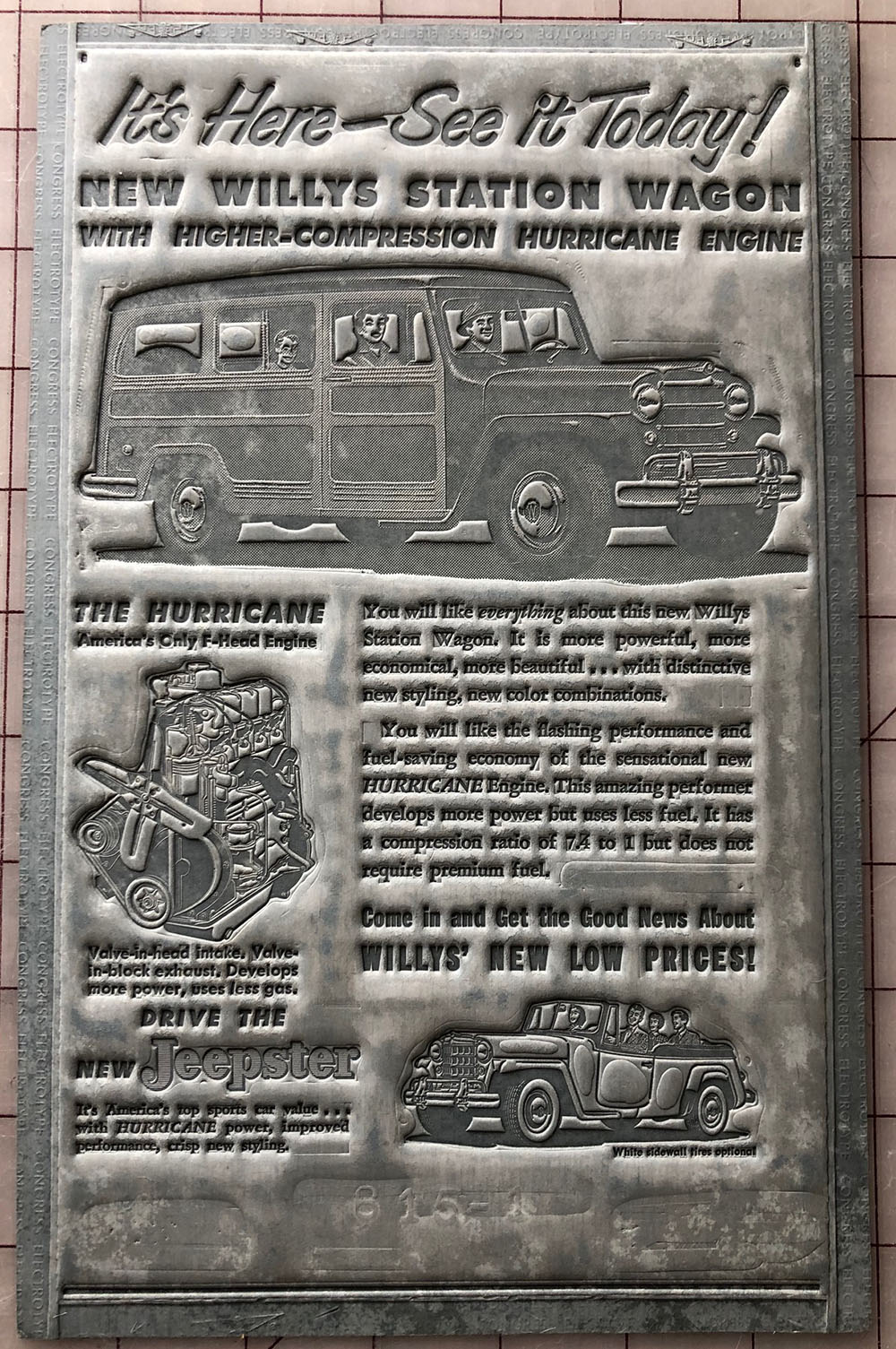
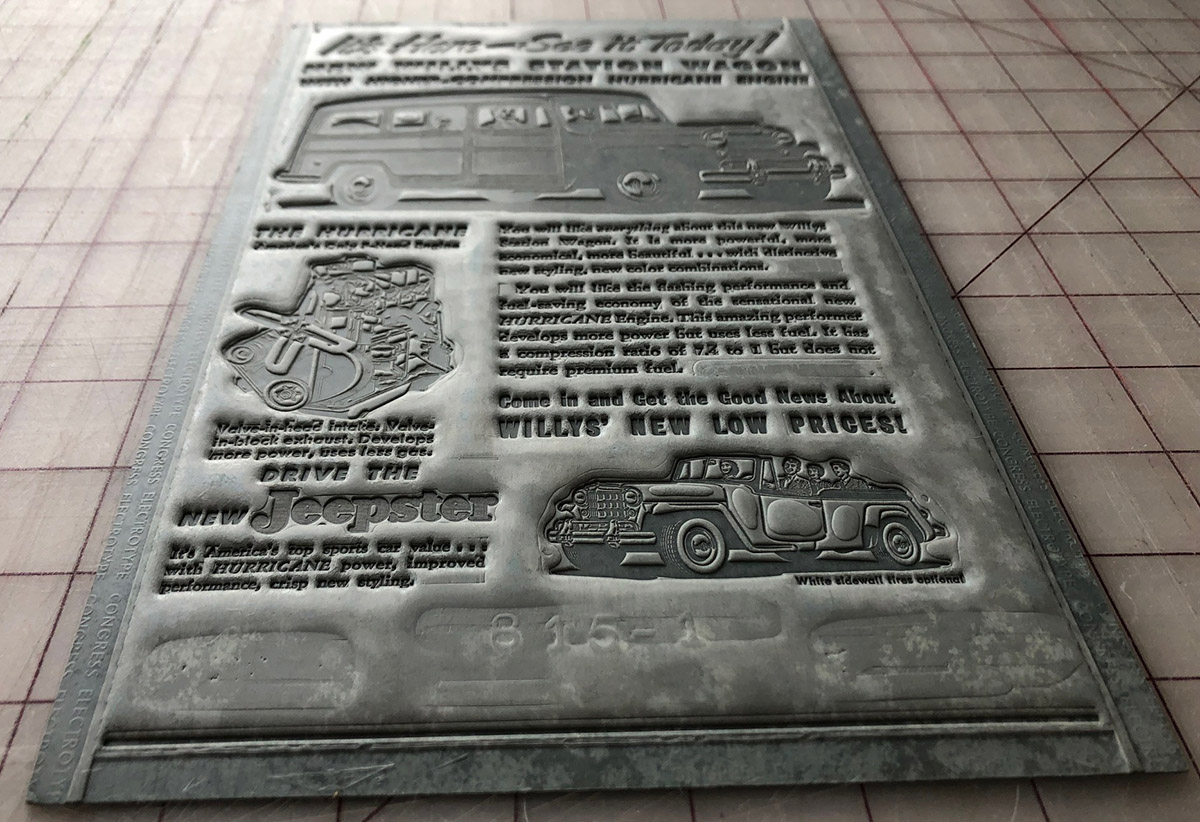
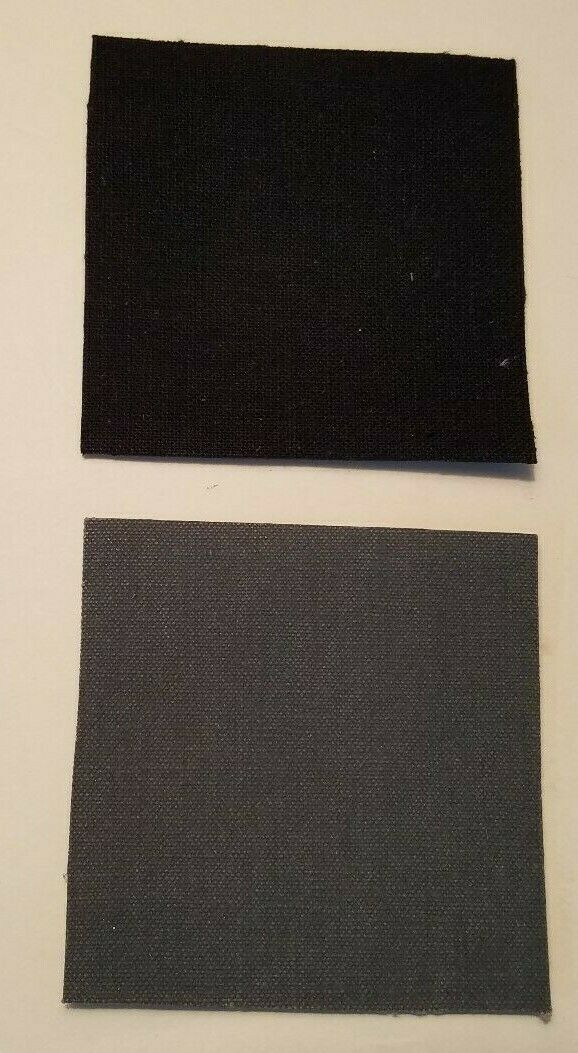
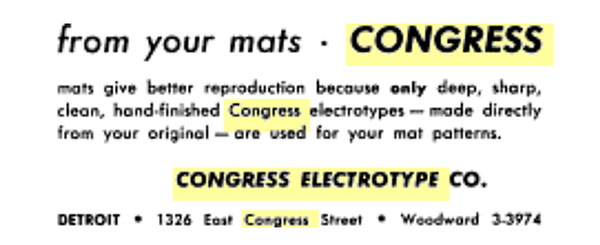
I bought these two items off of eBay. If I understand correctly, these are mats, produced by the Congress Electrotype Company, were formed from an original engraving. They were then placed wrapped onto a cylinder with other mats to form a newspaper (or magazine?) page. A metal mold is then created from that, which is used to print the pages.
I had erroneously assumed when purchasing them that they would be thick, heavy metal plates (before I understood how the process worked), but they are actually extremely light and pliable. I assume these were extras, never used? They may be a paper mâché of some type (they are that light), which was one of the processes historically used, or something similar,
I’ve taken pics from above and at an angle to show the depth. I have to say that I’m not really sure these were worth buying, but I doubt many survived (these are the first I’ve ever seen anywhere).
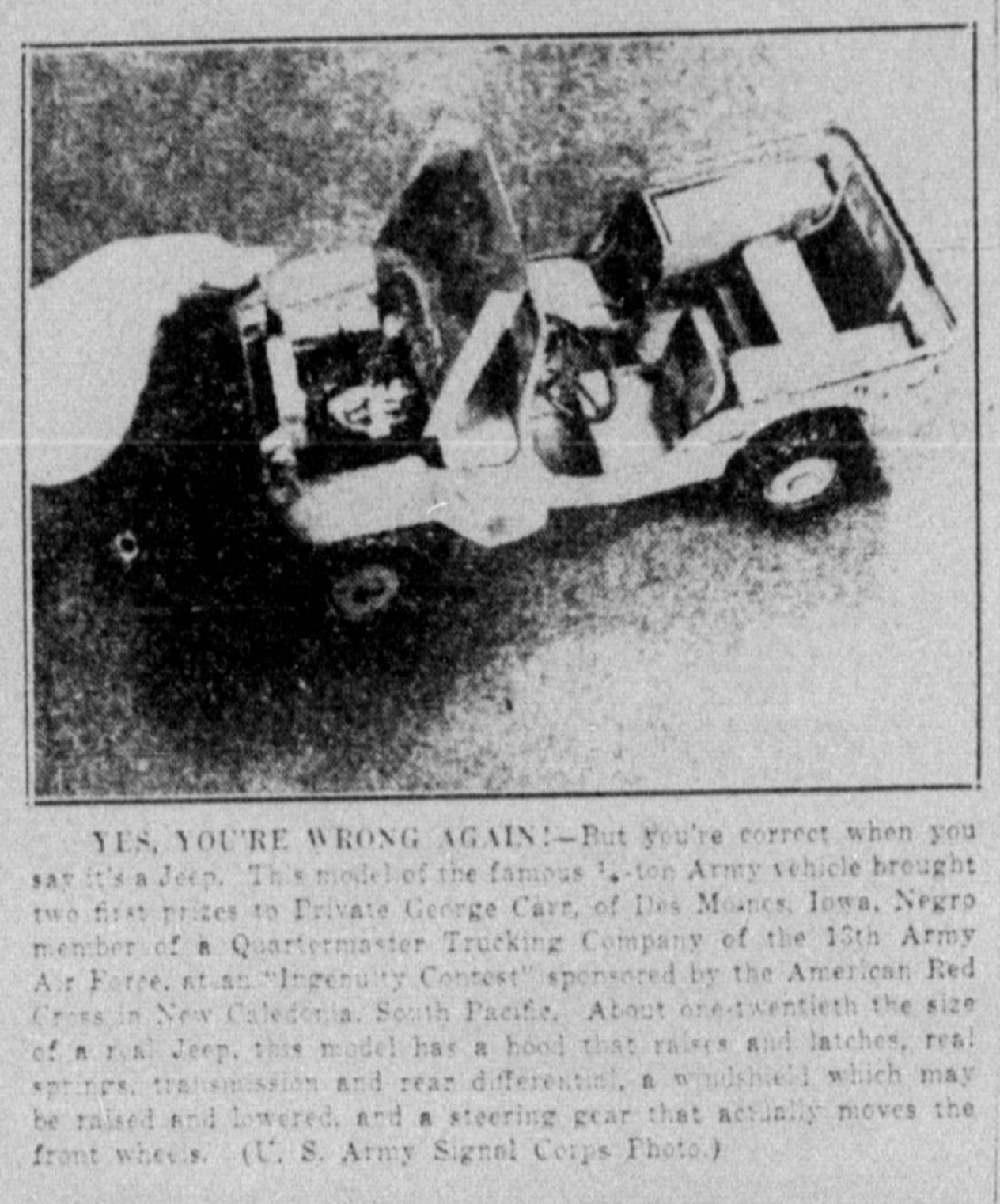
The June 24, 1944, issue of the Detroit Tribune shared the below caption and photo. I do with the picture is better. I was unable to discover any more about George Carr or the Jeep. Because the text is hard to read, I’ve transcribed it below.
YES, YOU’RE WRONG AGAIN!–But you’re correct when you say it’s a Jeep. The model of the famous 1/4 ton Army vehicle Brough two first prizes to Private George Carr, of Des Moines, Iowa, Negro member of a Quartermaster Trucking Company of the 13th Army Air Force at an “Ingenuity Contest” sponsored by the American Red Cross in New Caledonia, South Pacific. About one-twentieth the size of a real Jeep, this model has a hood that raises and latches, real springs, transmission, and rear differential, a windshield which may be raised and lowered, and a steering gear that actually moves the front wheels. (U.S. Army Signal Corps Photo.)
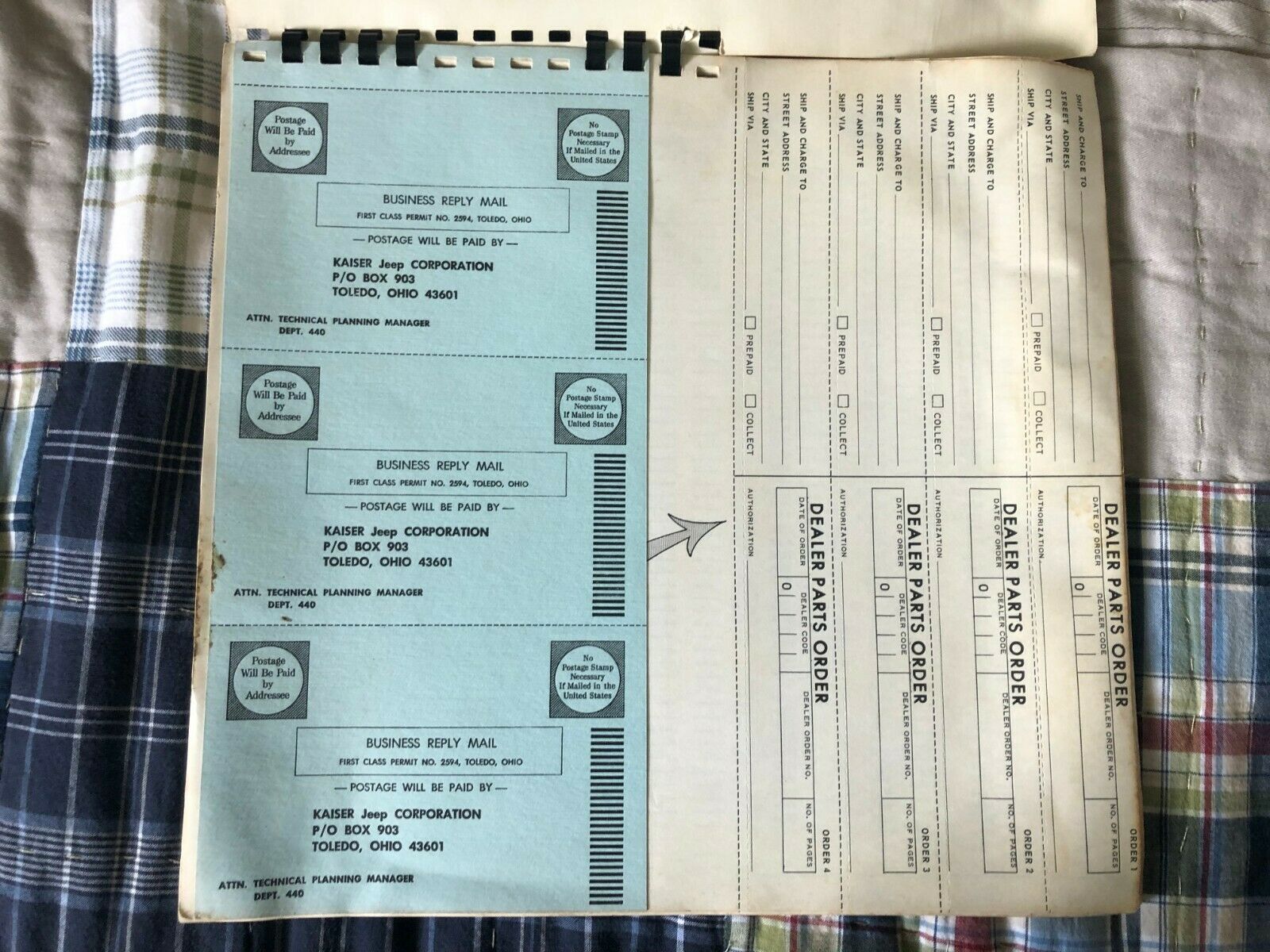
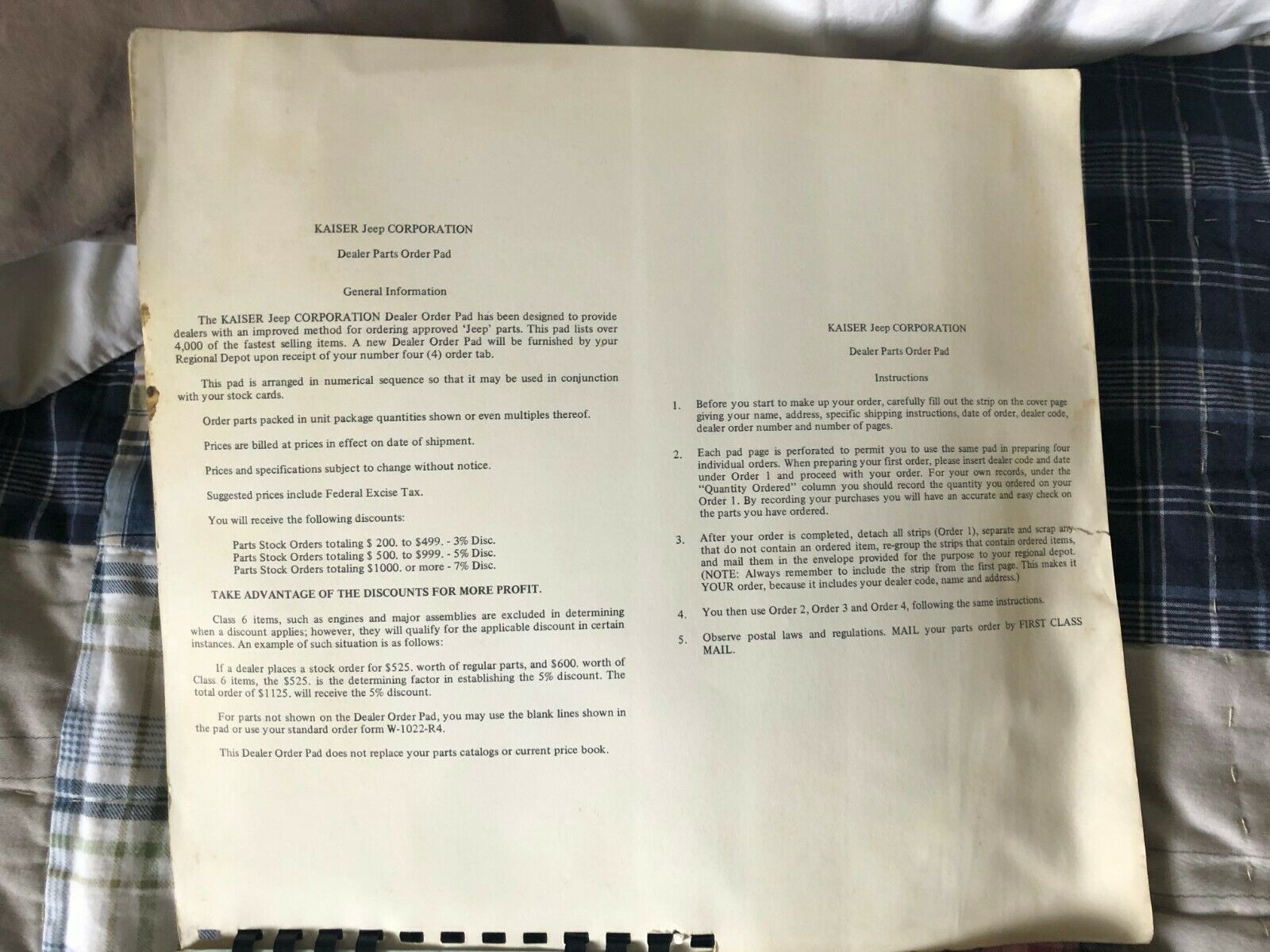
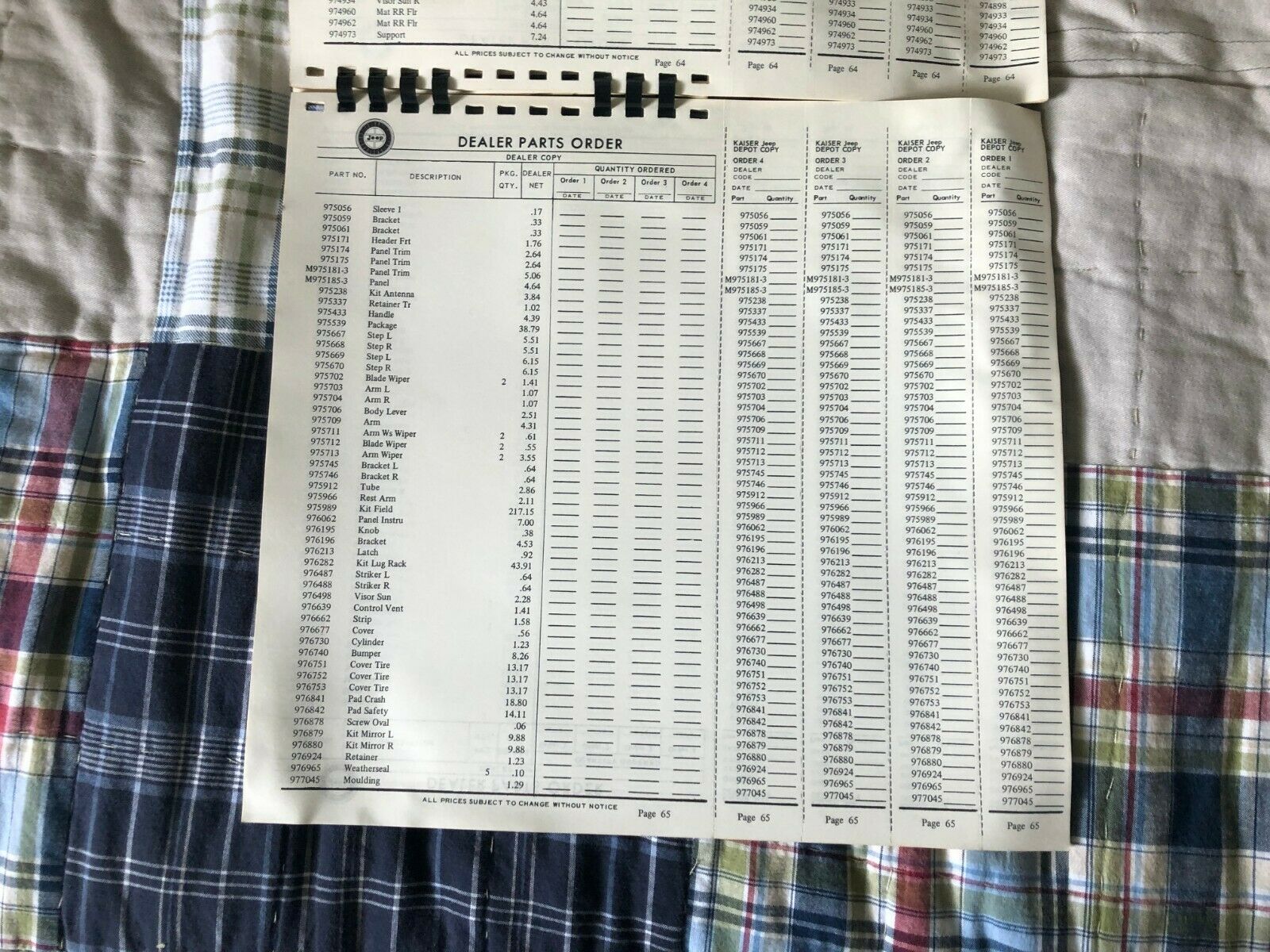
“NOS 1969-70 KAISER JEEP CHEROKEE FAST ORDER PAD DEALERSHIP ADVERTISING NEW RARE
THIS AUCTION IS FOR A 1970 JEEP DEALERSHIP ORDER PAD
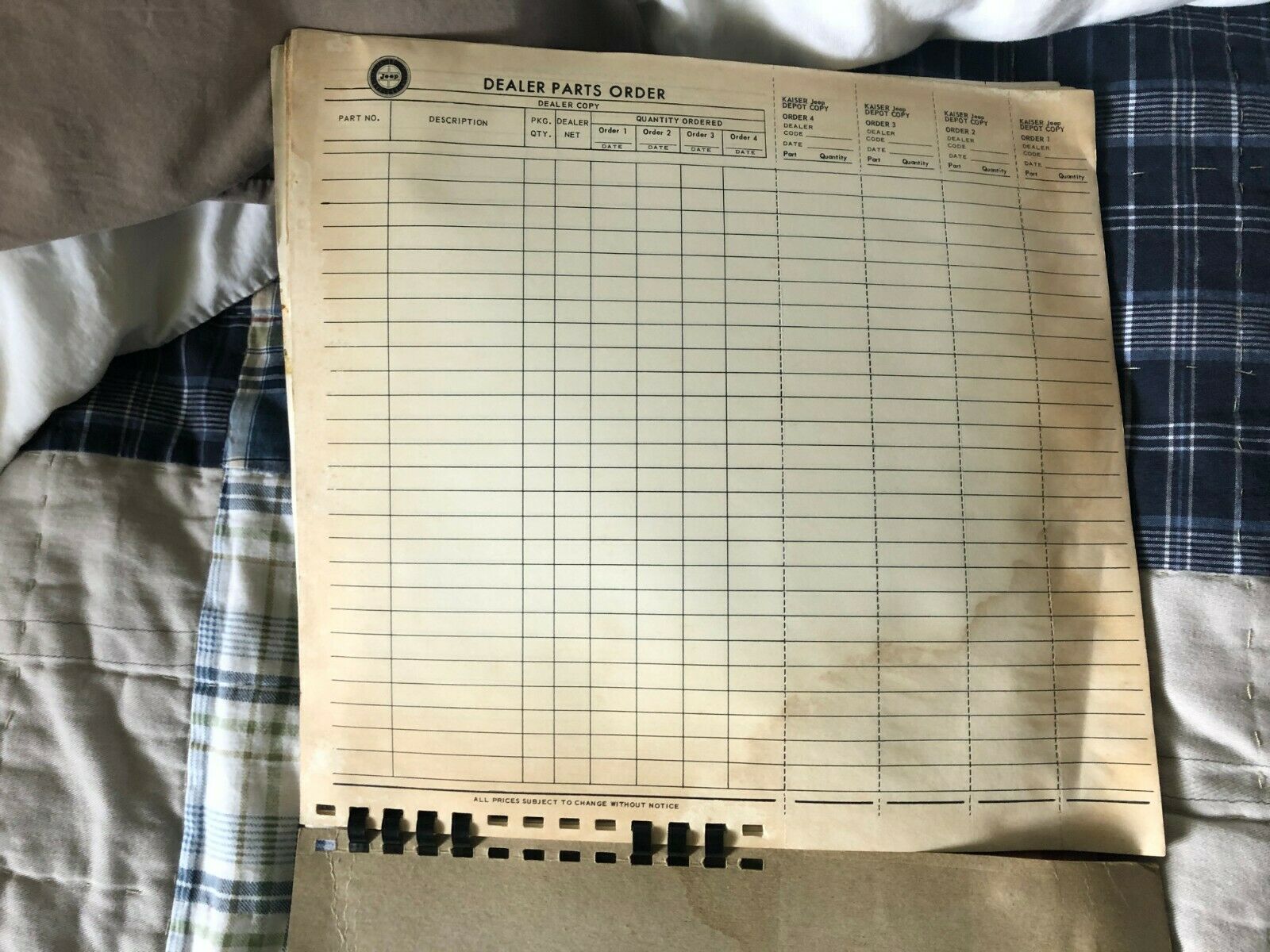
THIS ORDER PAD IS IN GOOD SHAPE BUT DOES HAVE SOME WATER DAMAGE TO THE PAGES
VERY RARE TO FIND ONE
THESE ARE HARD TO FIND
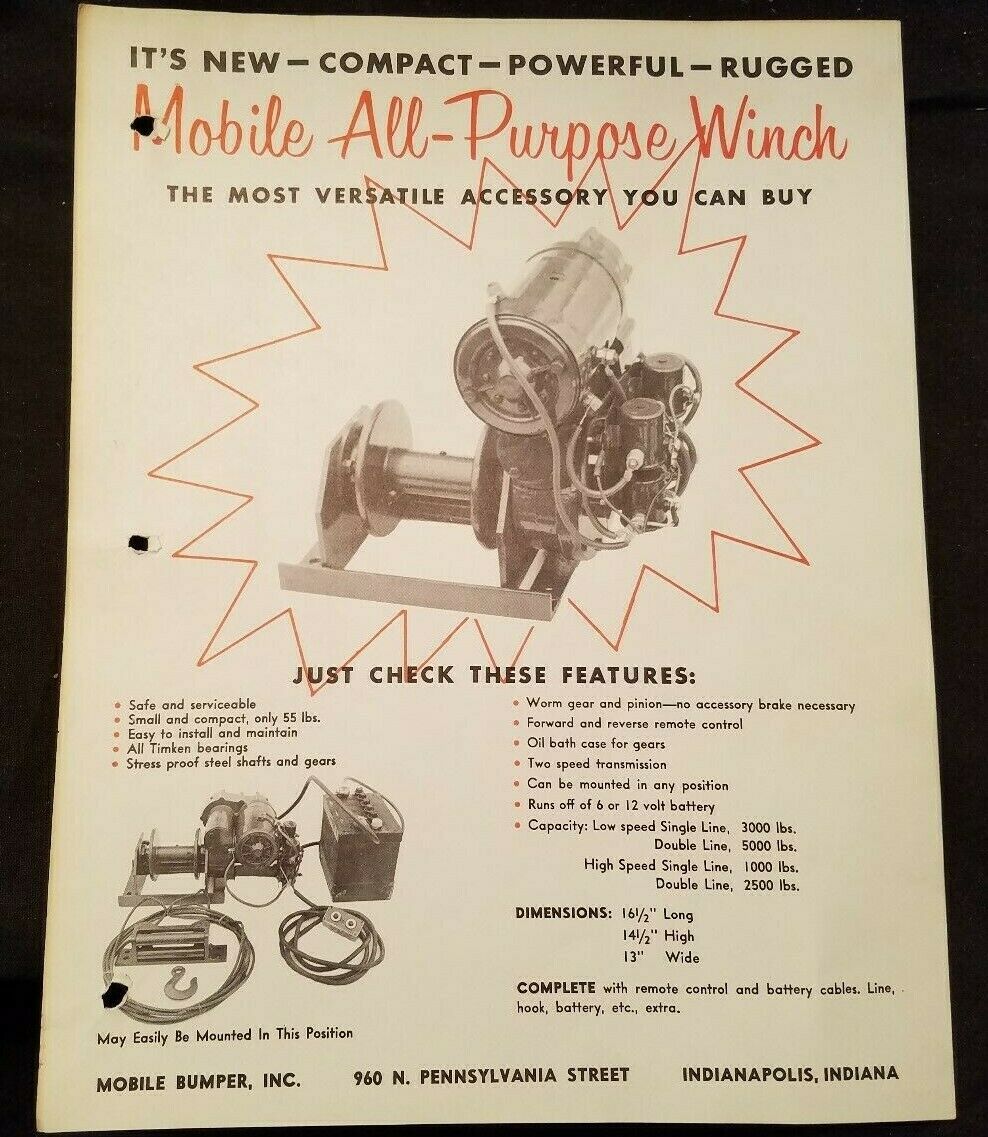
This explains the origin of some bumpers we’ve seen on trucks. I *think* I’ve also seen that winch a few times. Also, it appears that Kelly Manufacturing was a reseller of them.
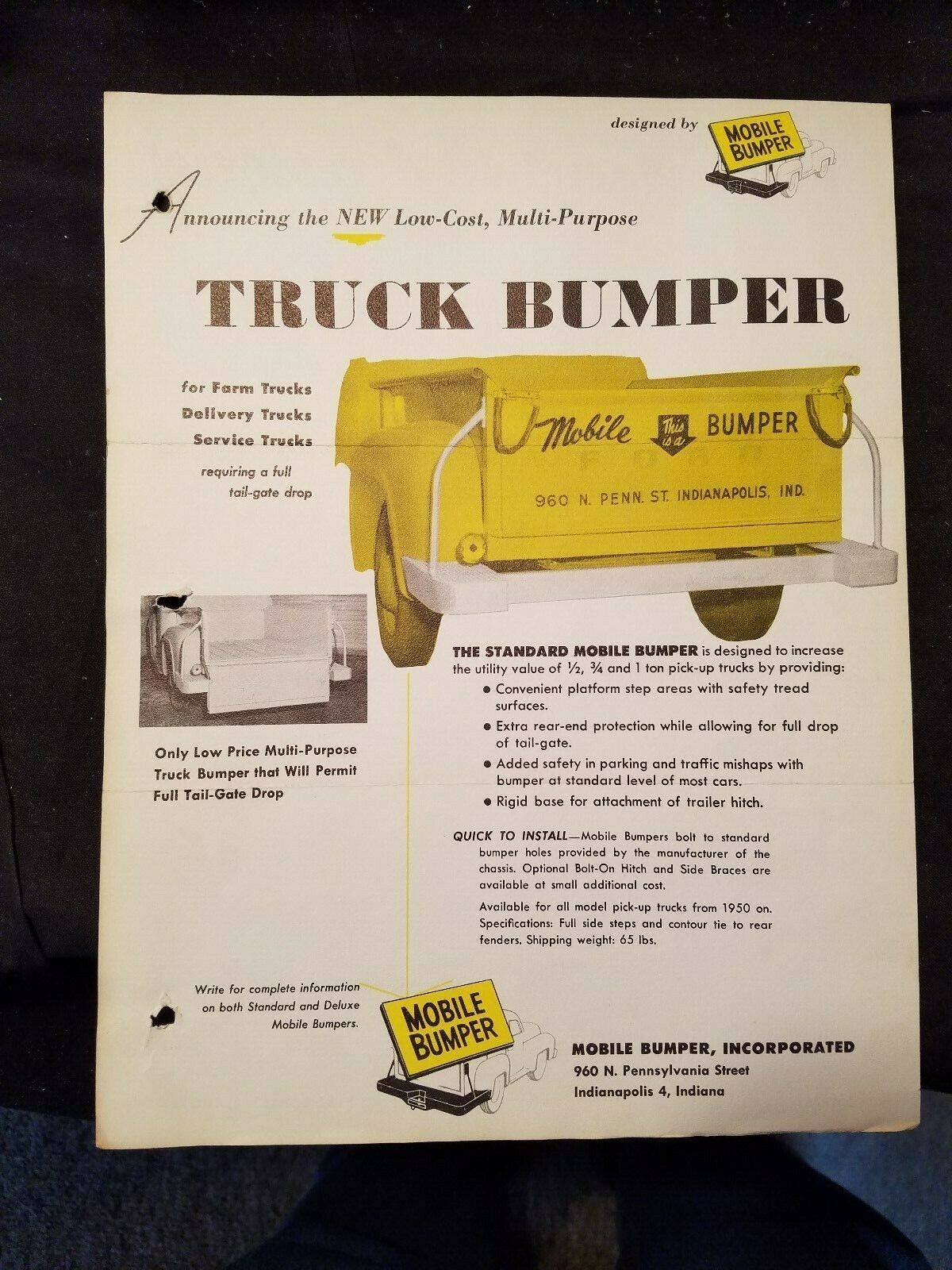
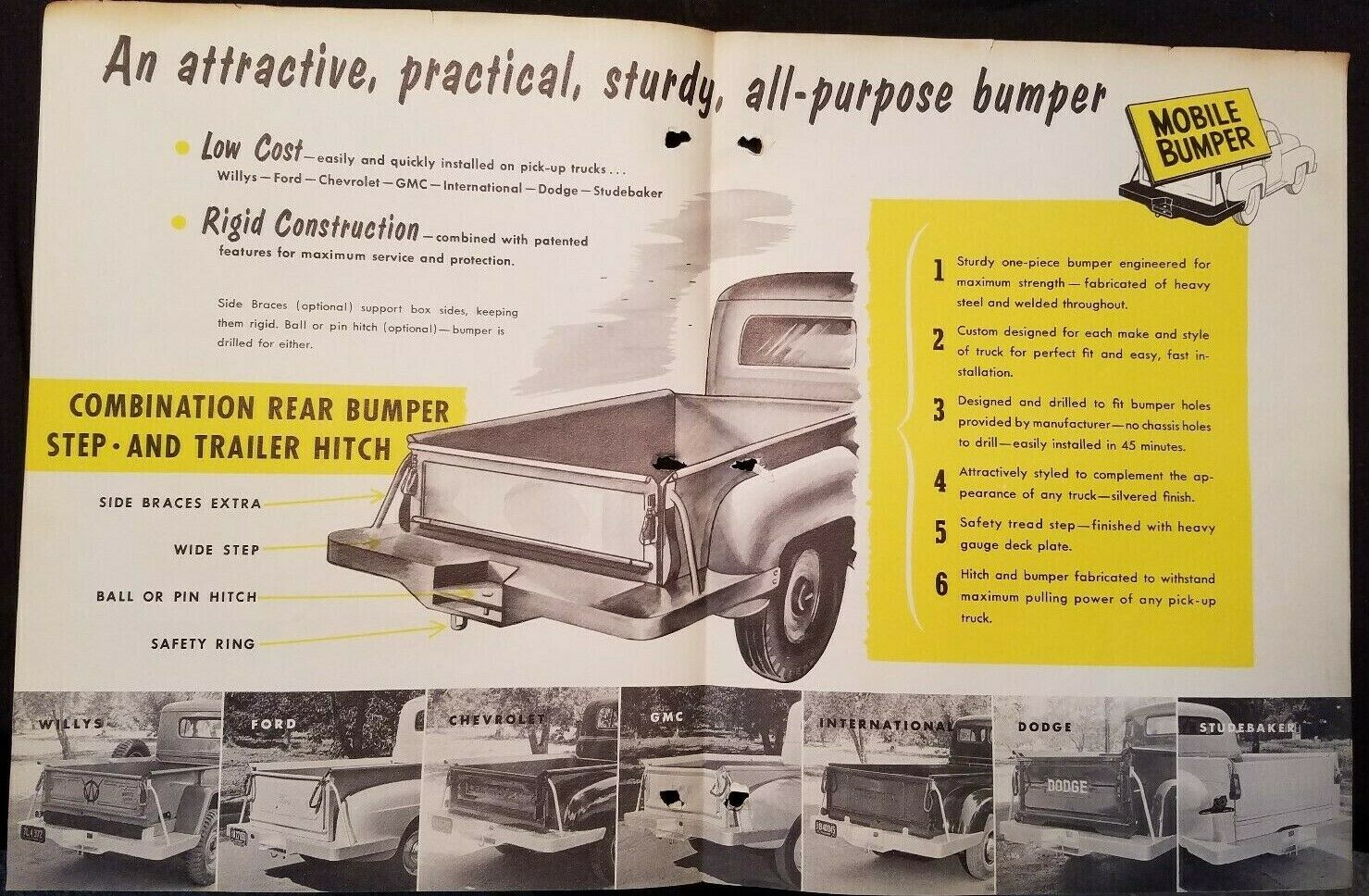
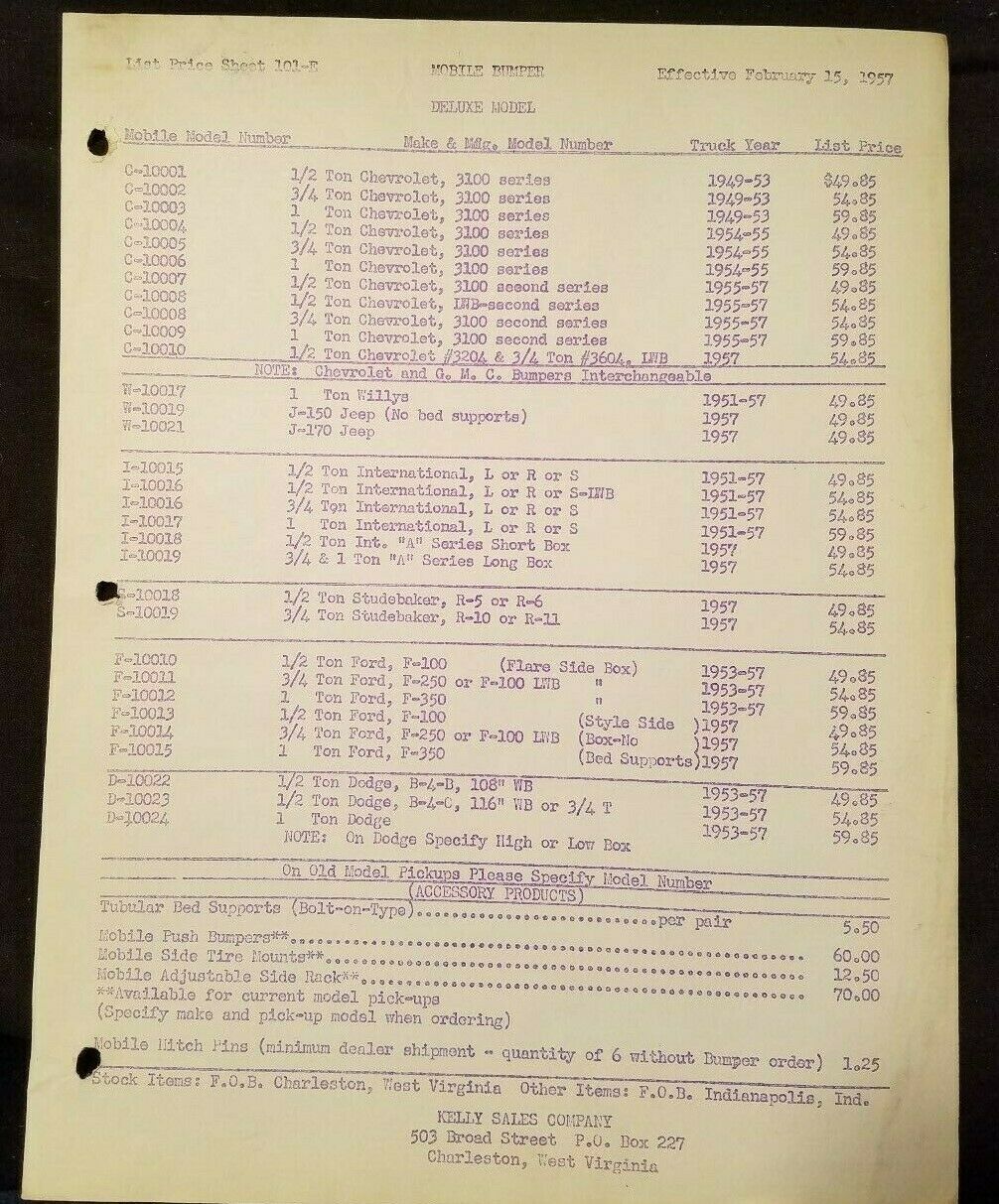
“”Mobile Bumper Inc.” Brochures for Willys, Jeep and all Pickup Truck lines, by the writers and illustrators of Mobile Bumper Inc., Indianapolis Indiana. No copyright date, but the a Price List included is effective February 15, 1957. Published by Mobile Bumper Inc. NOT Ex-Library. No ISBN – there were none in those years. Note – the photos you see are of thess brochures – no ‘Stock Photos’.
Three splendid brochures and a price sheet, various sizes, drilled for a 3-post binder (binder not included). A trifle of roughening around those holes after 2/3 Century. Lots of good Illustrations, splendid information for these 1950s-era Jeep and other brand aftermarket accessories. Here was the equipment you needed, and a bit of ‘How-To’ for improving that vehicle.
The marketer, Mobile Bumper, advertised these items for sale – interestingly, the price list is titled ‘Mobile Bumper’ but was printed by Kelly Sales, Charleston WV. In many cases equipment for aftermarket Jeep applications was made in Toledo Ohio, home of Jeep, and was marketed by other companies. Not sure if that’s the case here.
Mobile Bumper Accessories – Truck bumpers for Farm, Delivery and Service trucks with many additions beyond just the bumper. 8 1/2″ x 11″, two-sided;
A new Truck Bumper – Combination Rear bumper – Step – and Trailer Hitch, Ring or Ball, 17″ x 11″, folding down to a 4-page brochure, 8 1/2″ x 11″, advertising equipment for Willys, Ford, Chevrolet, GMC, International, Dodge and Studebaker. Heavy steel, lots of extras;
Price list, blue-purple ditto printing, parts for Jeep, Willys, Chevrolet, International, Studebaker, Ford, Dodge – GMC & Chevy are interchangeable. One page, 8 1/2″ x 11″;
Mobile All-Purpose Winch advertising from Mobile Bumper Inc. Well pictured, heavy-duty, red accents, 8 1/2″ x 11″, one side.”