emailNeed to contact me and don't have my email? Click on email button.
About eWillys
Welcome to eWillys.com, a website for vintage jeep enthusiasts. I update this website nearly every day with jeep deals, jeep history, interesting reader projects, jeep related info, and more.
These quick searches can help you find things on eBay. People list in the wrong categories all the time, so don't be surprised to see brochures in the parts area for example. This section used to be split into jeeps, parts and other categories, but recent changes to eBay will require this information to be recoded.
The links to posts below show jeeps grouped by models, condition, and other ways. Some of these jeeps are for sale and others have been sold. If you are unsure whether a vehicle is still for sale or not, email me at d [at] ewillys.com for more info.
Importantly, the allure of buying a project jeep can be romantic. The reality of restoring a jeep can be quite different, expensive and overwhelming without the right tools and resources. So, tread carefully when purchasing a "project". If you have any concerns about buying a vintage jeep, or run across a scam, feel free to contact me for help, comments or concerns .
UPDATE: I’d never seen this brochure before finding it on eBay. This is part of what was a vast vintage jeep doc and toy collection in New England. I’ve bought a few cool things from him.
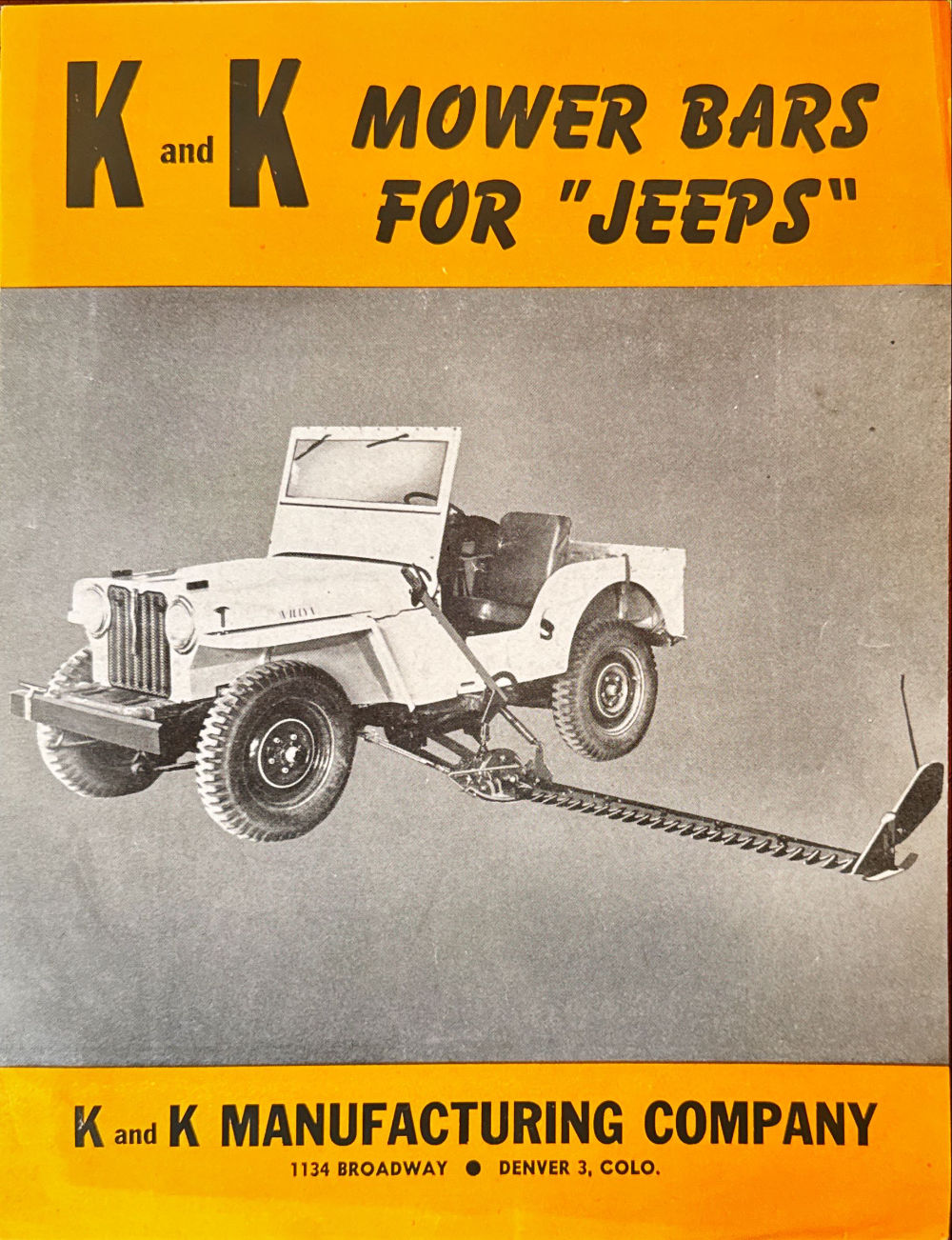
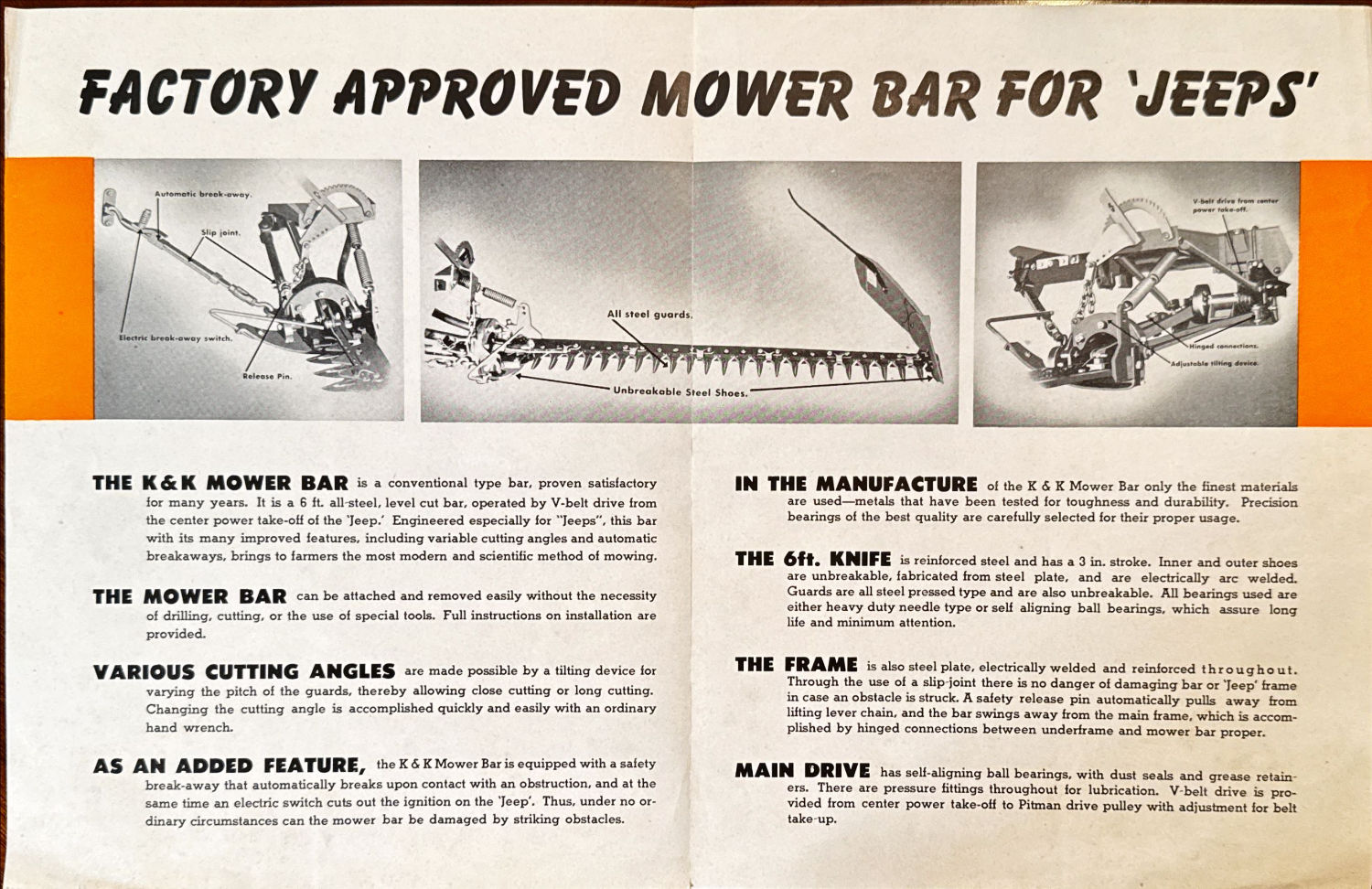
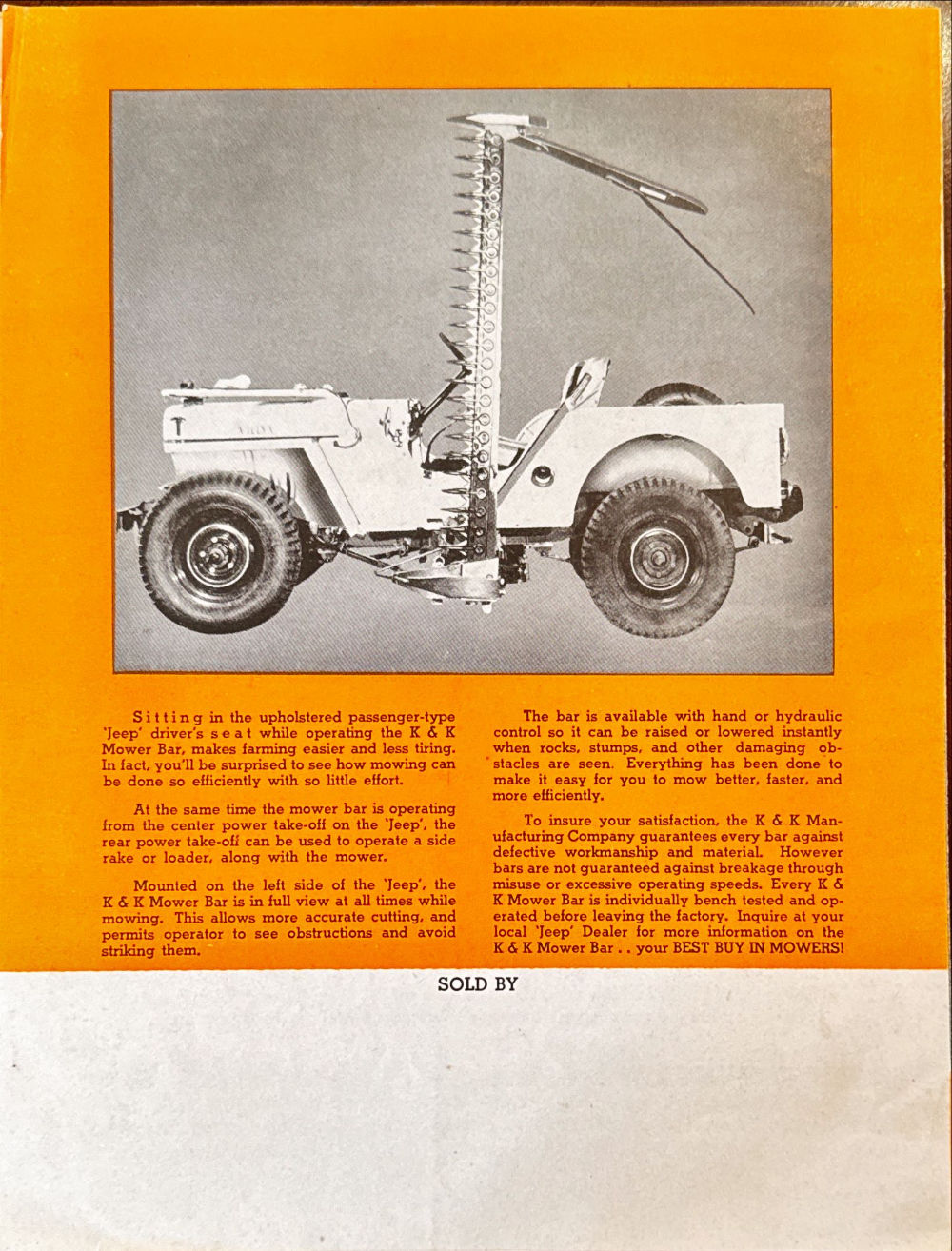
As for a date on this four-page brochure, I’d say, given the patent date of 1948, that this brochure might have also been printed in 1948, especially given the CJ-2A. My guess is that Mr. Keyser didn’t make enough money to warrant any future reproductions of it. But, that’s only a guess.
While I’ve always called this a K and K mower (that’s the manufacturer), the brochure and data tag describes it as a Jeep Mower Bar (see pics at very bottom).
=============================
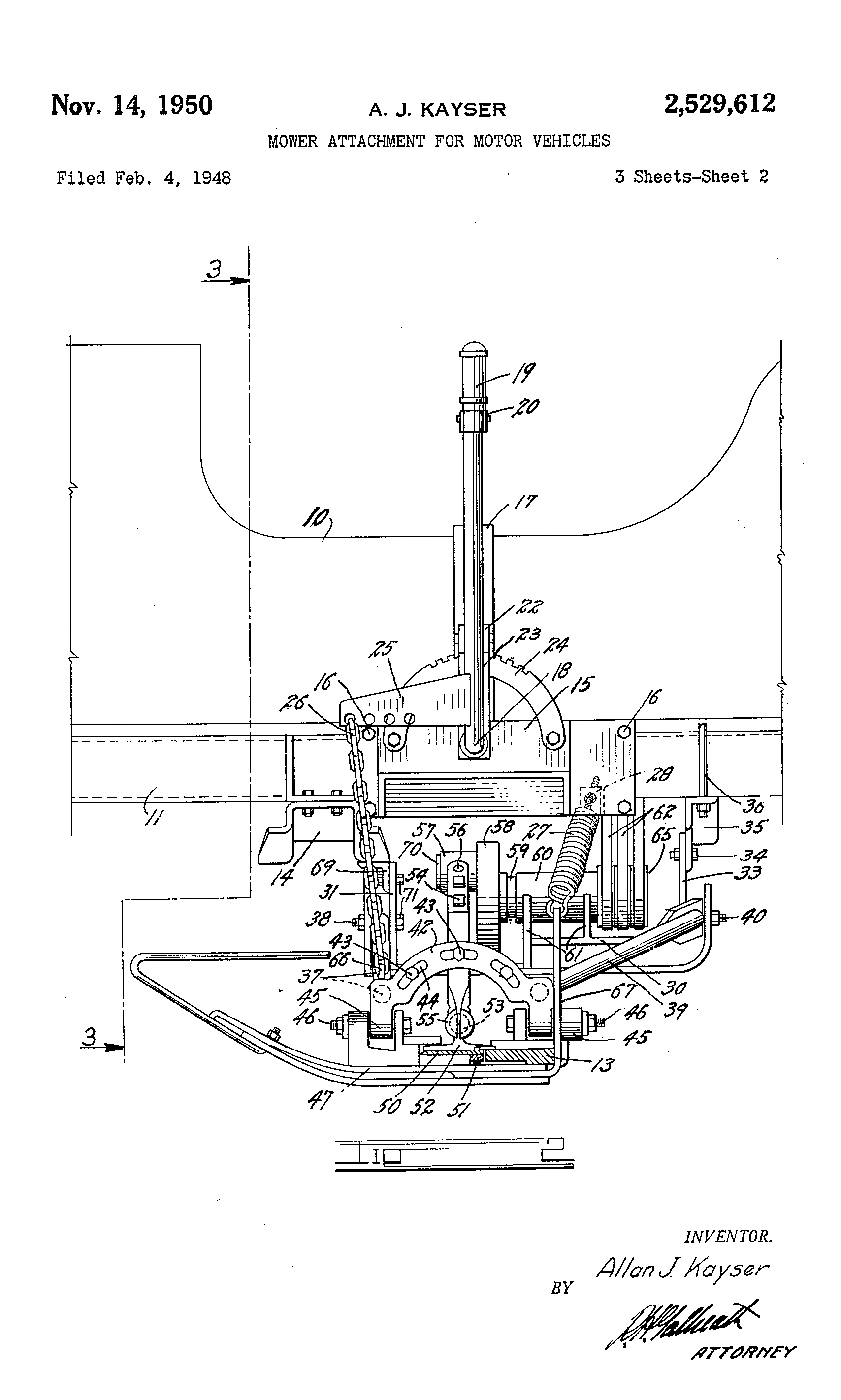
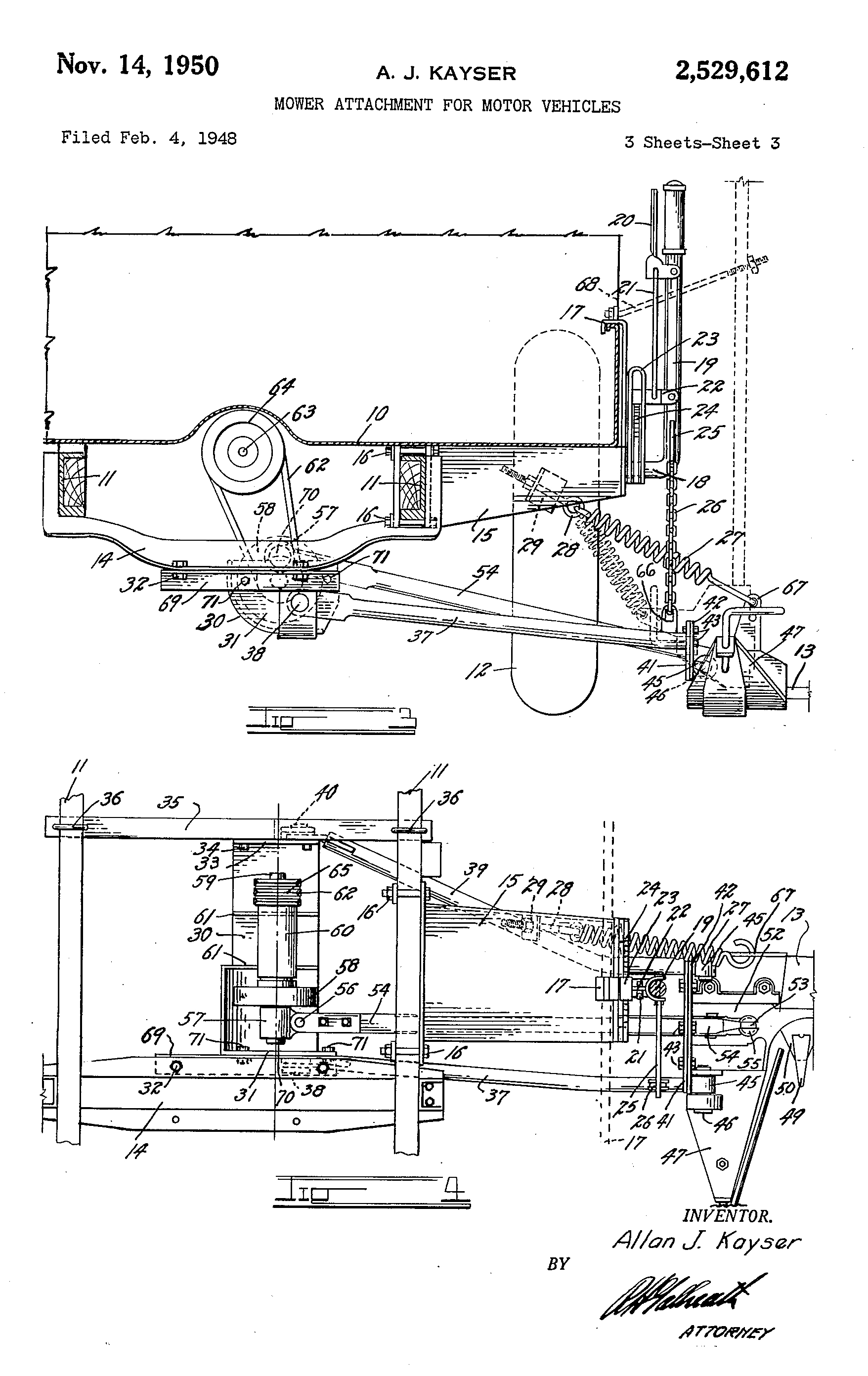
ORIGINALLY PUBLISHED MAY 17, 2019:In February of 1948 Allan Keyser filed a patent for a side mower. It appears this became the design for the K And K Manufacturing Company’s Mower as seen in the brochures at bottom. You can view other early mowing apparatuses here. Interesting that this came out of Colorado. I wouldn’t have guessed it.
“This invention relates to a mower attachment for the presently popular small, four-wheel drive, automotive vehicles popularly known as jeeps, and has for its principal object the provision of means whereby a mower bar can be quickly and easily attached to, or detached from, the vehicle so that it will be easily visible and easily controlled by the driver of the vehicle.
Another object of the invention is to provide highly efficient means whereby the angle of attack of a mower bar may be adjusted to suit the desires of the user and the requirements of the particular crop being harvested.”
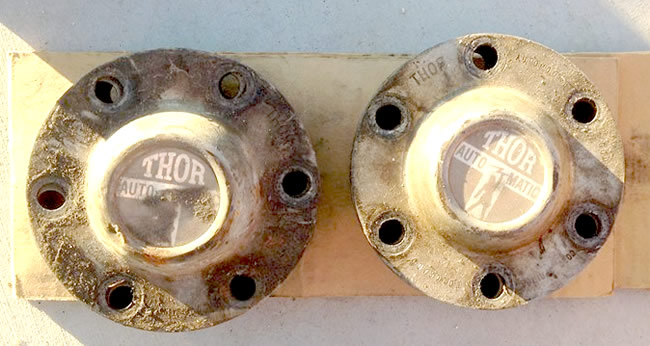
UPDATE 3: Added an Automatic hub example shared by Seth (at bottom)
=========================
Originally Posted April 28th, 2017:
UPDATE 2: Niels shared a photo of his rare Cutlas key that can be used to spin the screws of the Power-Lock Hub.
UPDATE: 1) Well, it seems I forgot to read through this and edit it (I murdered the title for example) 2) The ending of the post has changed, thanks to Paul spotting an ad in the 1976 issue of Four Wheeler Magazine.
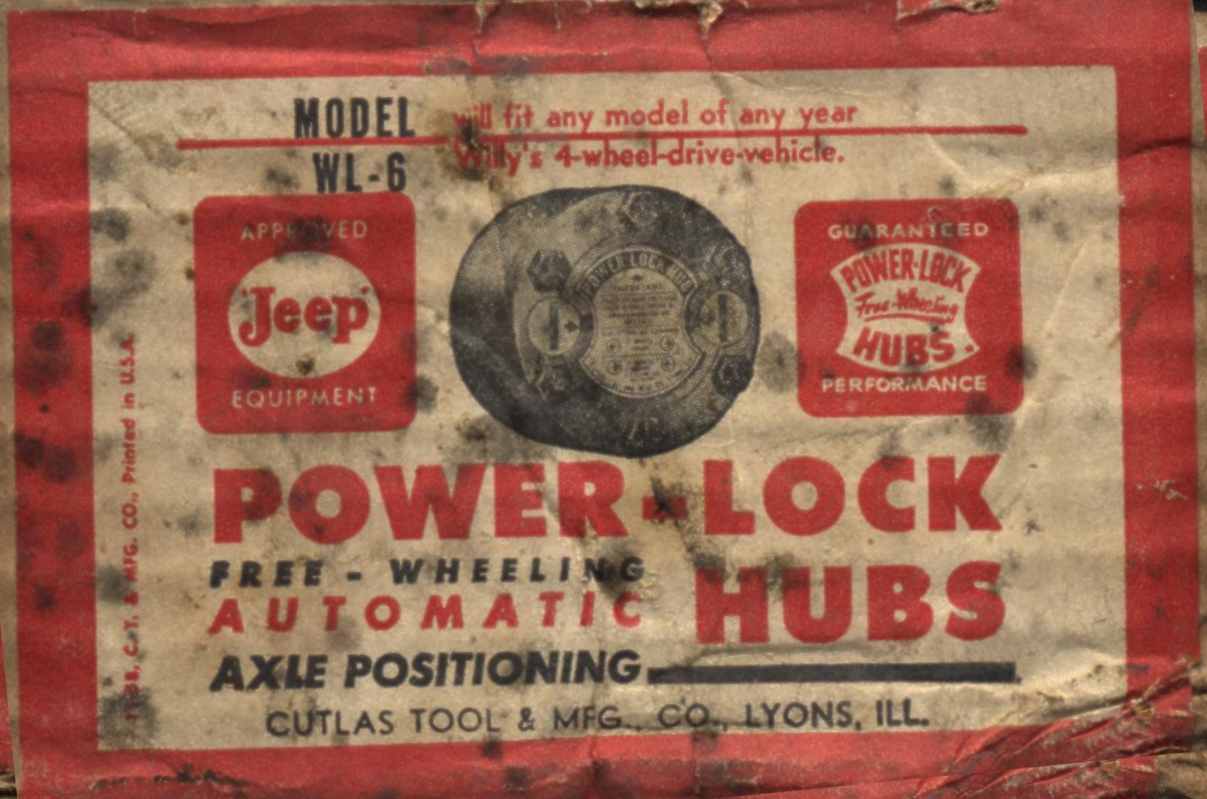
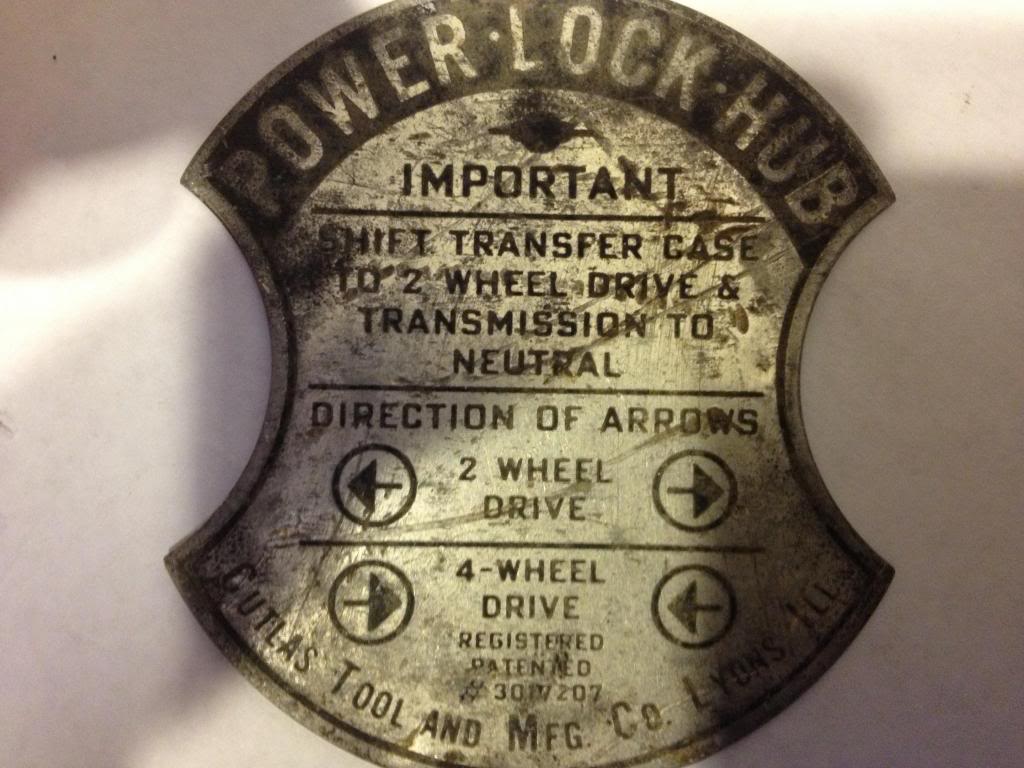
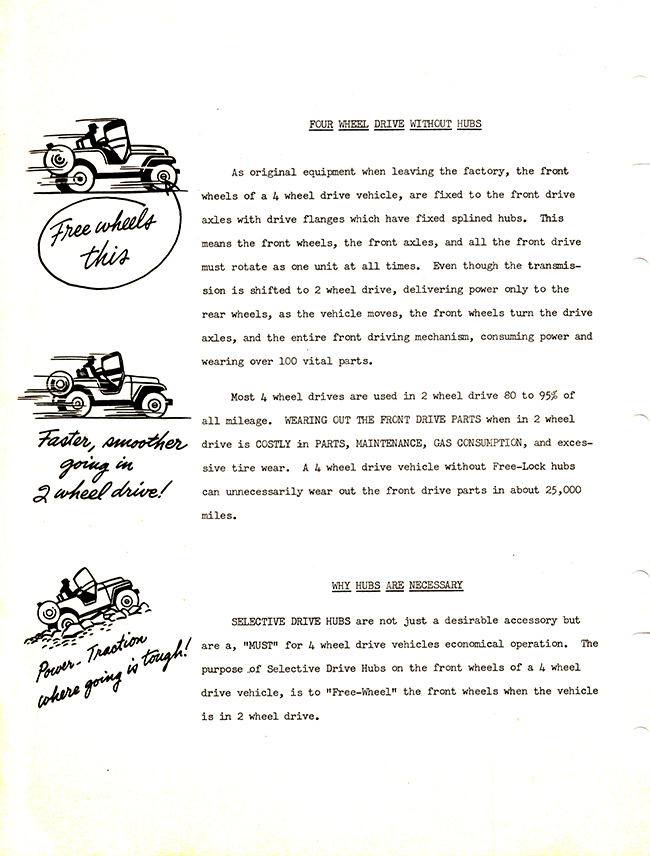
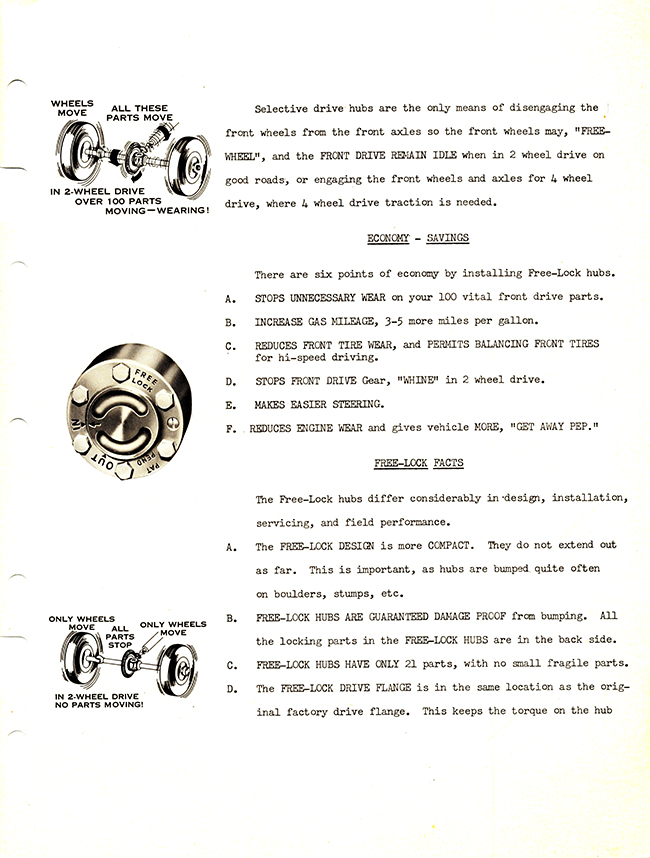
This is a Cutlas brochure for the company’s first hub, the Power-Lock.
Unlike the Free-Lock hubs, which relied on a rotating center piece to engage and disengage the hubs, the Cutlas hub had two rotating screws that had to be spun to engage and disengage the hubs.
UPDATE VI: I located a set of Free-Lock hub instructions that are a pre-view for a later set of near identical Dualmatic instructions. This is clear documentary evidence that Dualmatic was linked to Free-Lock.
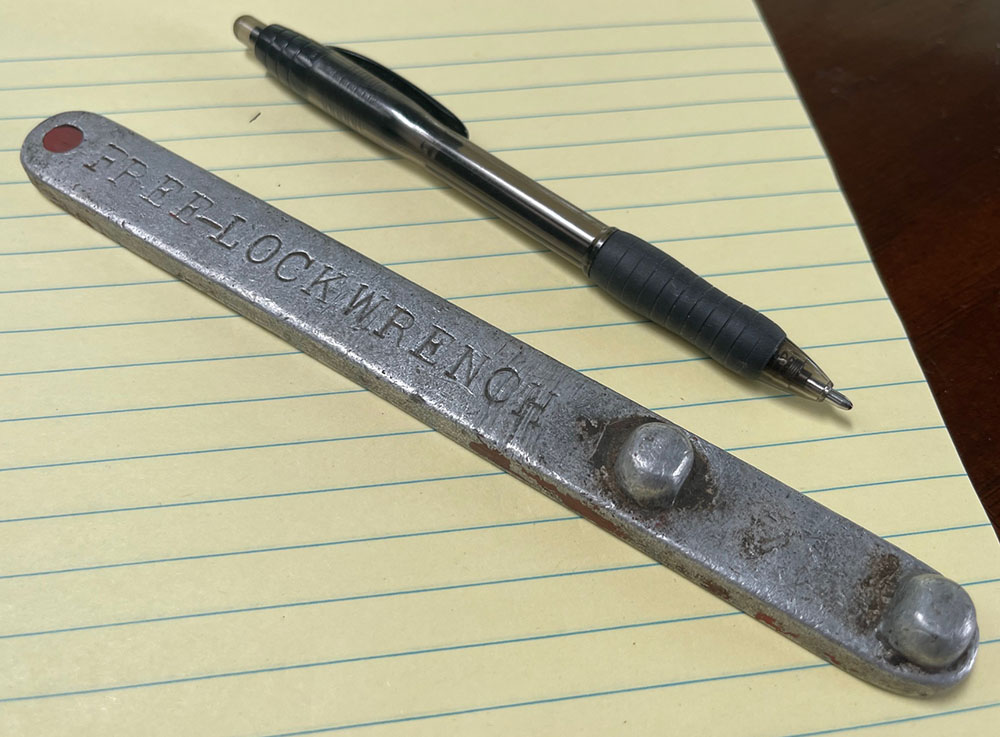
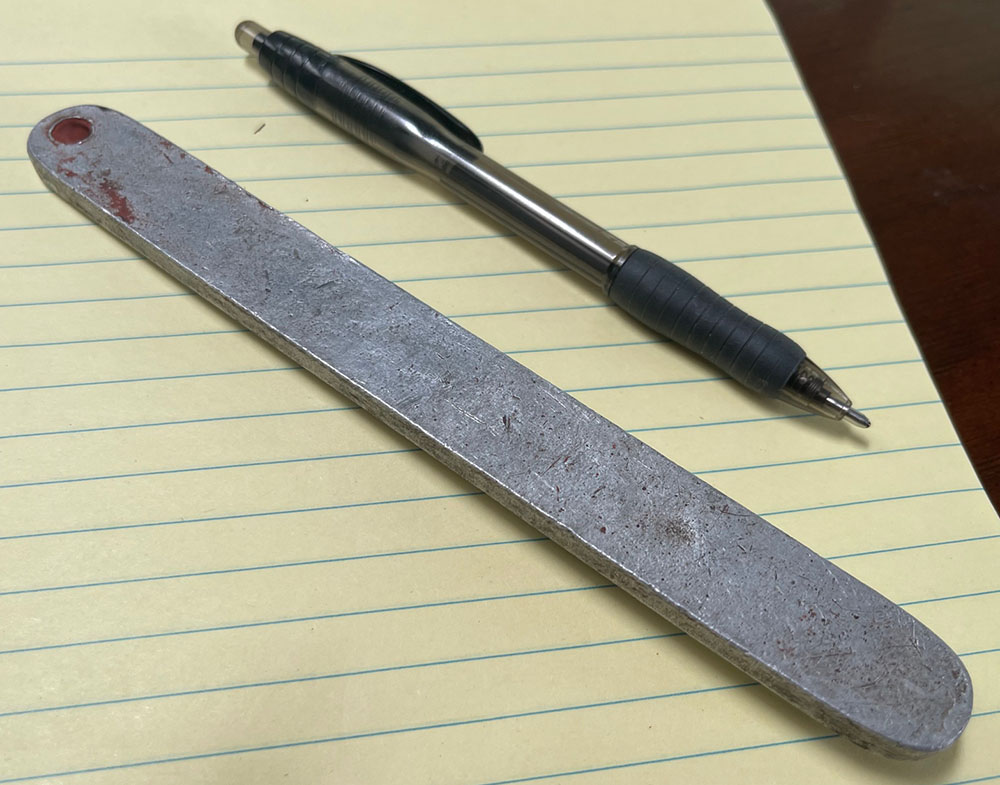
UPDATE V: I recently packed many of my father’s tools to bring them back to Prosser. I was a regular user of them when working on my bicycles, then my jeeps. So, I thought I knew them pretty well. That is why I was so surprised and did a double take when I removed this tool from a drawer and read the name stamped on it: FREE-LOCK WRENCH …
What??? Where’d that come from? I once asked Dad about Free-Lock hubs, but he didn’t know anything about them. So, I don’t know how he obtained it.
Anyway, given the primitive nature of it, I’d have to guess it was a first generation version of the wrench. As seen below, a second, more elegant curved-design with a better branding stamp was likely introduced after this version.
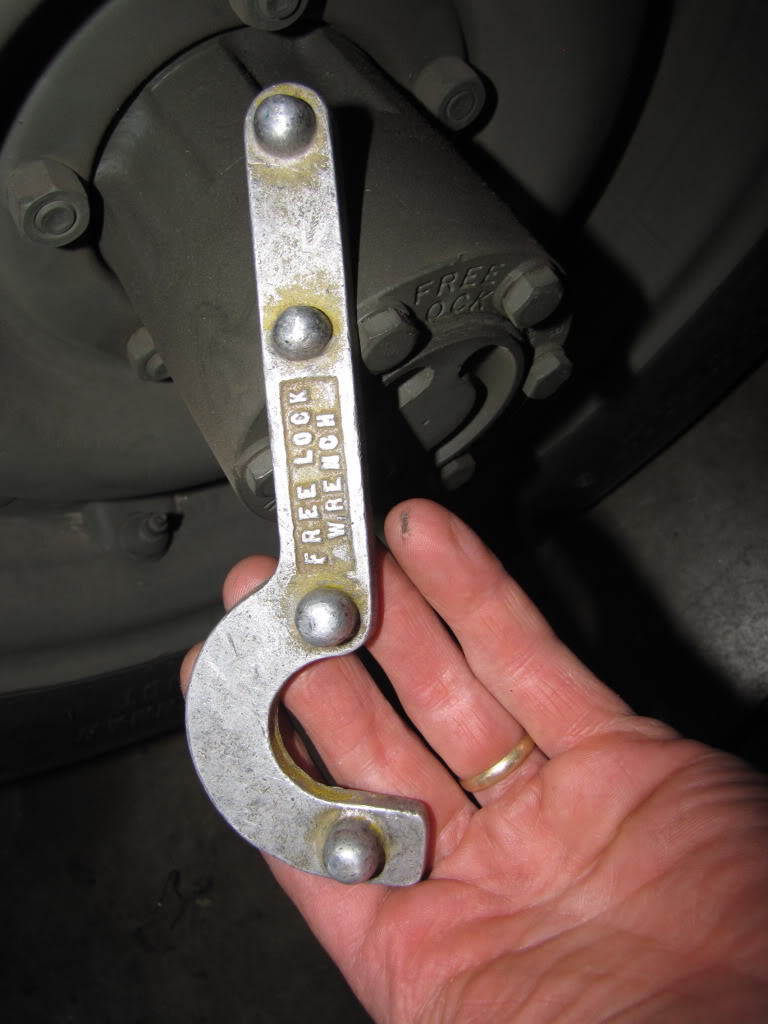
Here’s a reminder of the other version of the Free Lock Wrench:
UPDATE III: Thanks to Steve, we’ve discovered an additional version. It is now number 5, which seems to be an evolutionary step between 4 & 6.
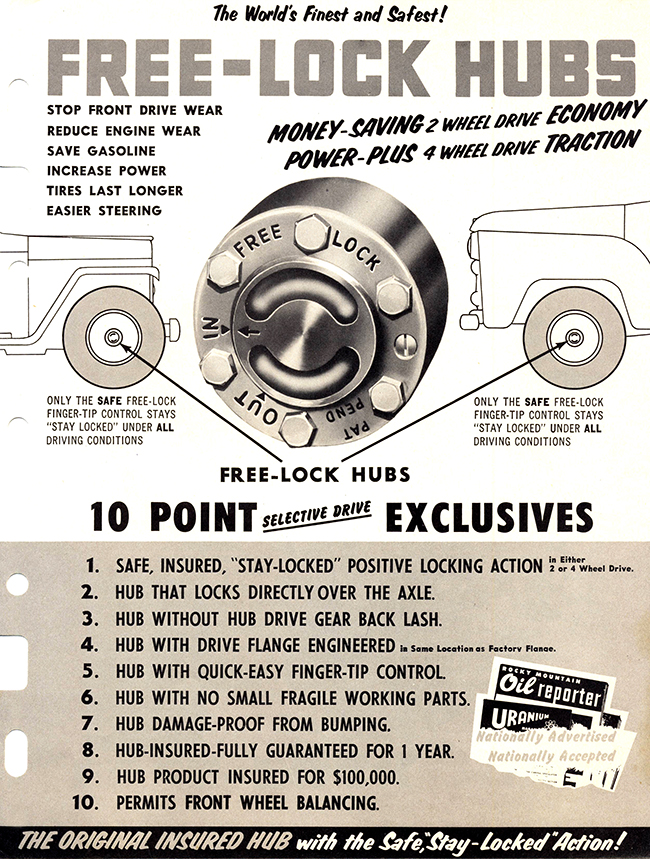
UPDATE II: Thanks to Frank Day and his grandfather Merton, who saved this rare piece, here is a scan of an eight page brochure related to the Free-Lock corporation.
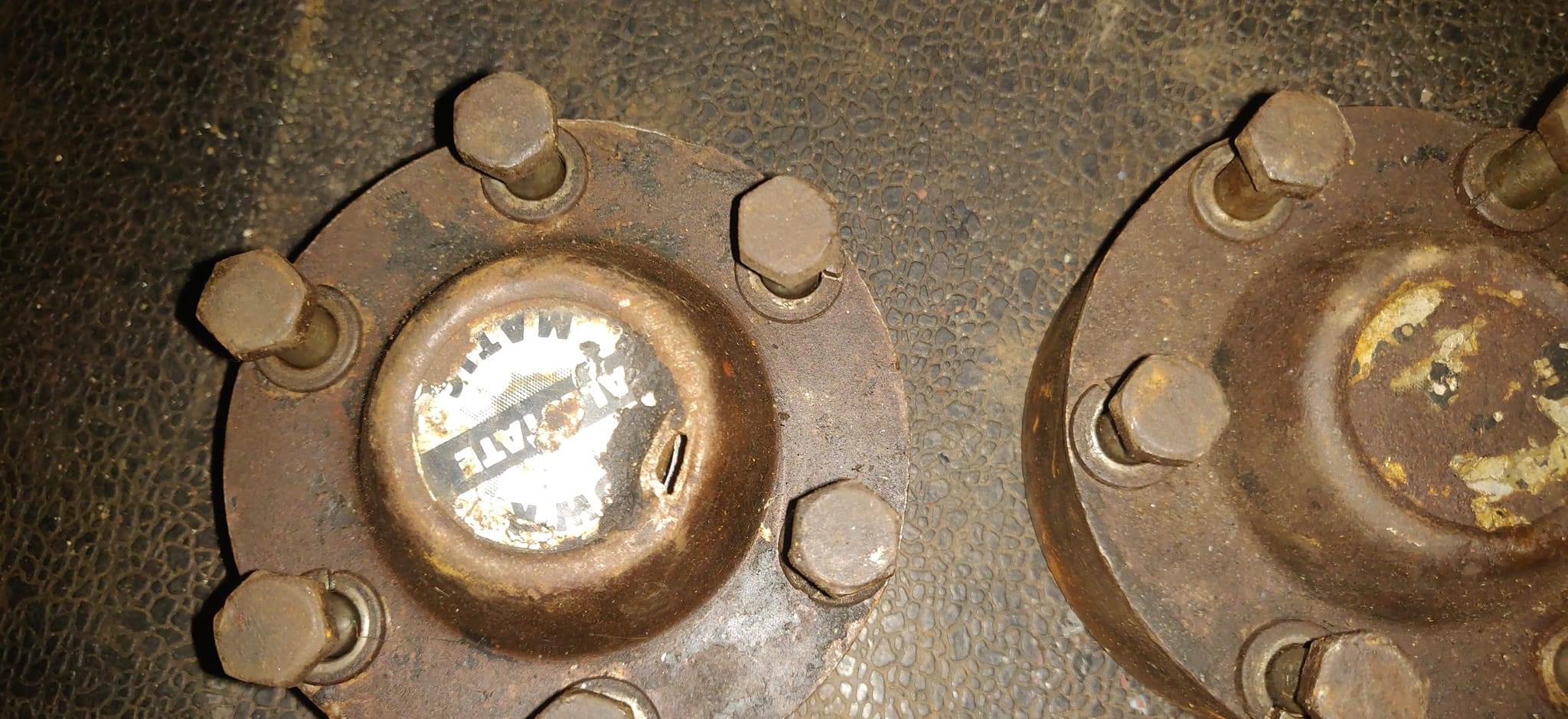
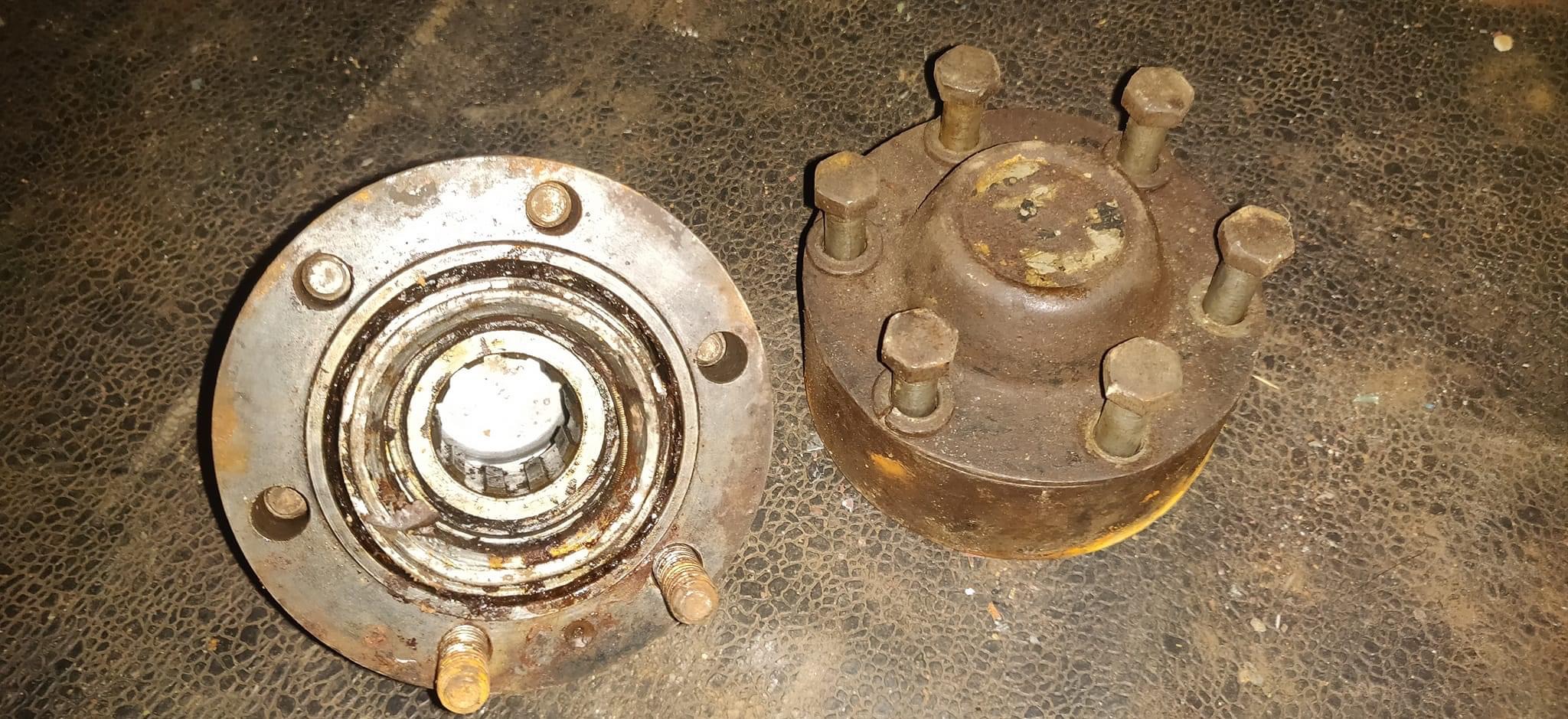
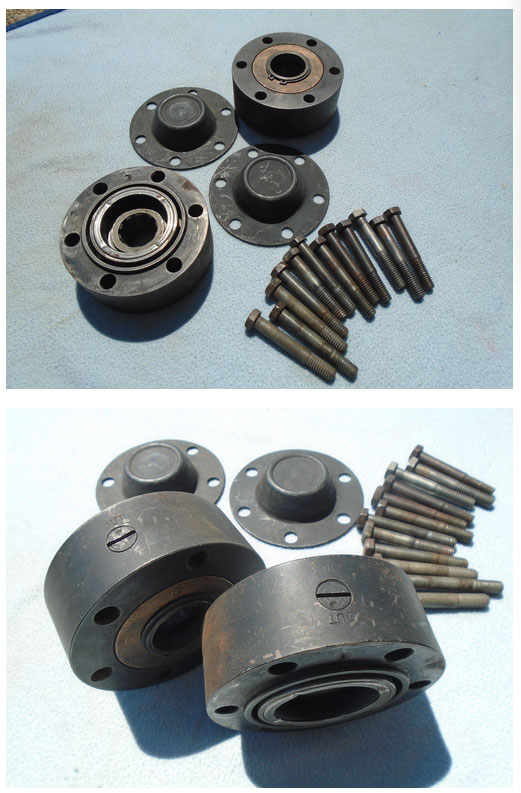
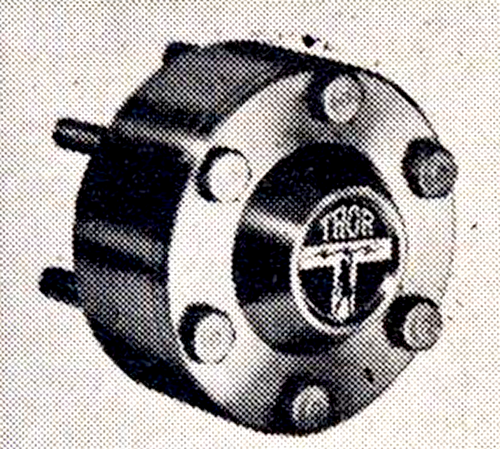
UPDATE II: Dinesh obtained these Thor-Automatic looking hubs, but on the cover they read Allstate Power Matic rather than Thor. I suspect they are Thor hubs rebranded for Allstate. Here are some pics:
Here is a the interior portion of a set of Thor hubs:
=========================
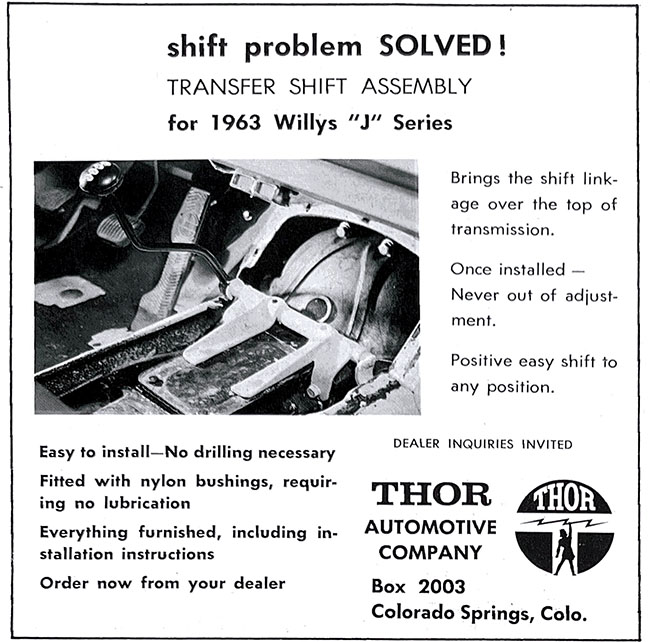
UPDATE (May 24, 2021): The October 1963 issue of Four Wheeler Magazine include this Thor-designed product to make shifting the transfercase more convenient. It moves the shifter from the passenger-side of the transmission to the driver’s side. I imagine there are few, if any, of these shifters out there.
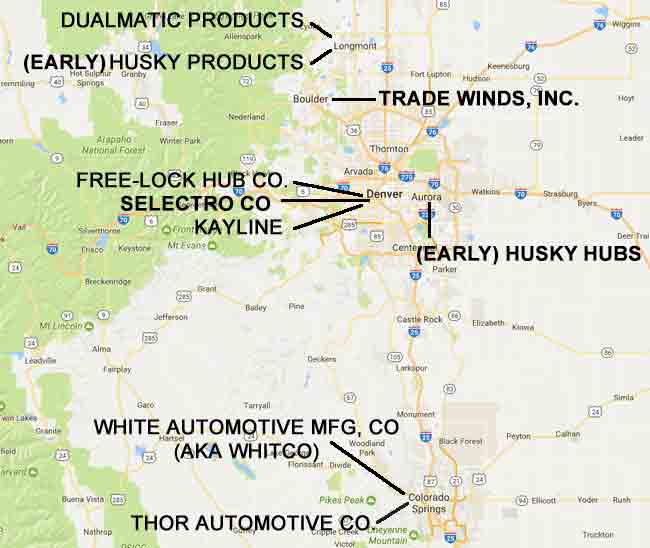
White Manufacturing Co. (also known as White Automotive and Whitco over time) was started in the late 1950s by Richard T, Bingman and partners. The company progressed at a modest level making, among other things, aluminum floral display stands. Eventually, White allied with Kaiser and began making tops. White filed for incorporation in 1959. One of the company’s earliest products was a white soft top for jeeps.
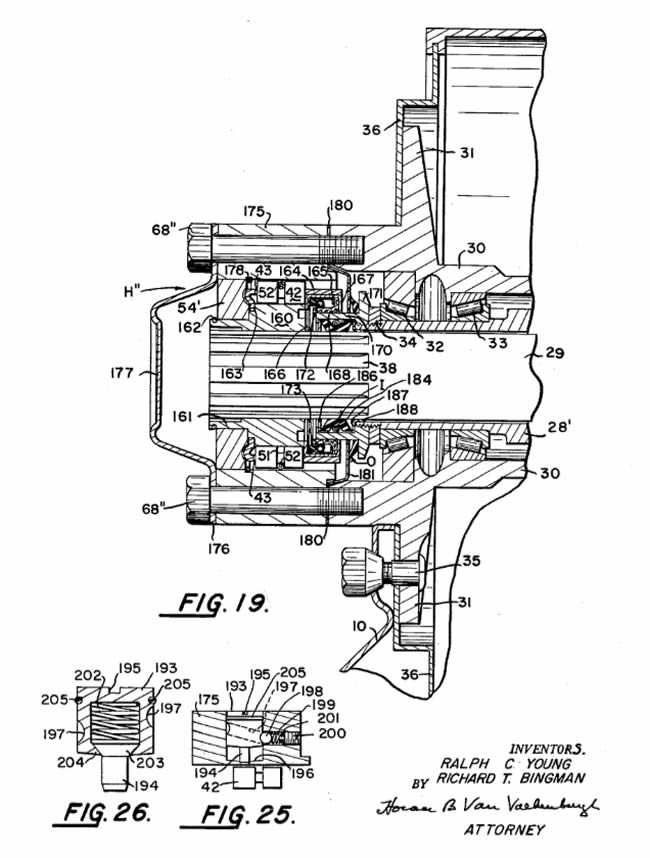
The next year, in 1960, Richard T. Bingham filed a patent for a pair of locking hubs. One set would automatically shift into gear when it sensed the axles were being powered (i.e., when the transfercase was shifted into four wheel drive). The second set of hubs added a dash-mounted button to allow for control of the hubs from the driver’s seat (assuming I have interpreted the patent correctly!).
The interesting thing is that Bingham never assigned the patents to the White Automotive Company. Instead, the patents and hubs ended up being used by Thor Products, which also operated out of Colorado Springs (though sometimes the address is Manitou Springs, a small town just west of Colorado Springs).
This suggests that Bingham had some time of relationship with Thor, but his exact connection to Thor isn’t known at this time (my guess is that it was a subsidiary or sister company of White).
1. The Thor auto-matic hub patent vs. the finished device: Continue reading →
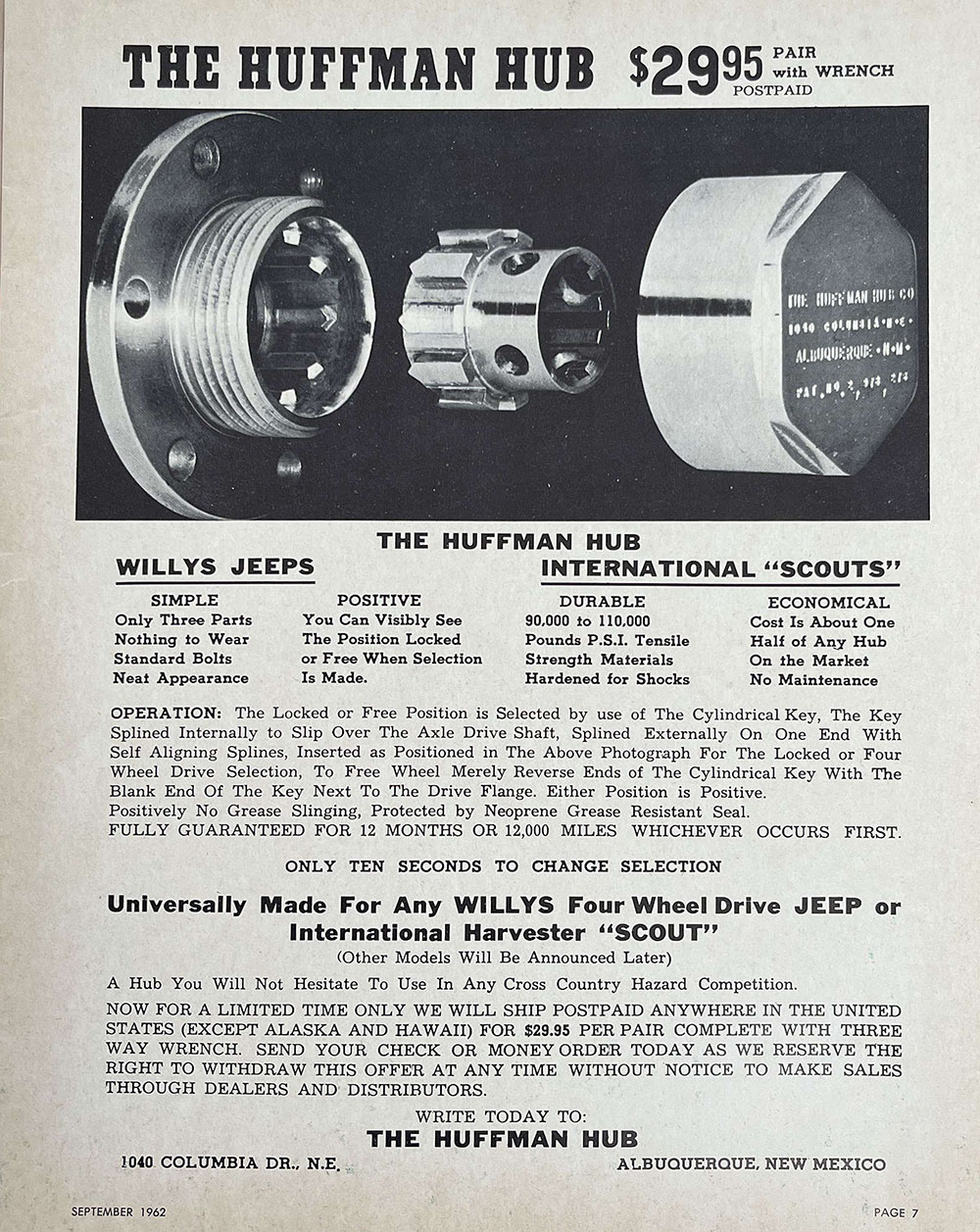
UPDATE IV: Well how about this …. There was an early Huffman hub that didn’t have the fancy ‘weapon-looking’ topper (as seen in the pics below). Instead, a cylindrical key was supplied to help select whether the hub was engaged or not. This ad is from the September 1962 issue of Four Wheeler Magazine.
======================
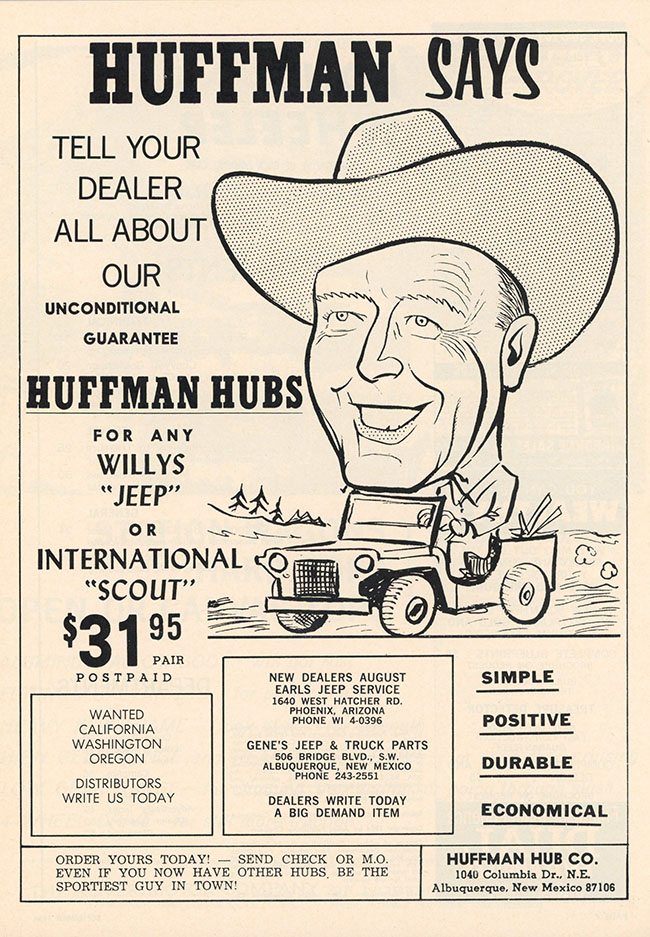
UPDATE III (May 17, 2020): In September of 1964 the Huffman Hub company posted this full-page ad in Four Wheeler Magazine —
September 1964 Four Wheeler Magazine
================================
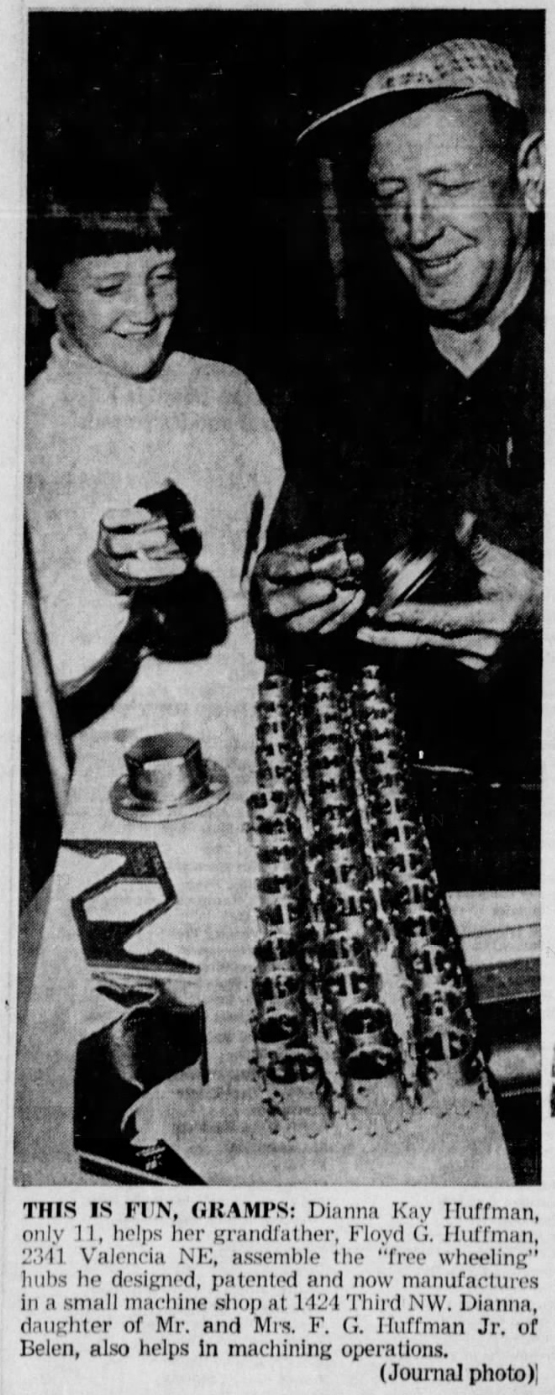
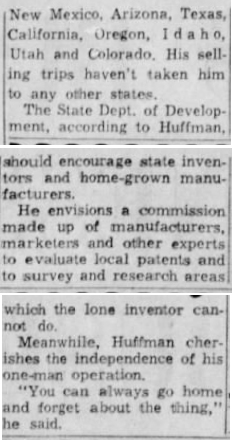
(UPDATE II: Finally got a look at the 1967 article about Floyd Huffman that appeared in the August 20, 1967, issue of the Albuquerque Journal (pg 28):
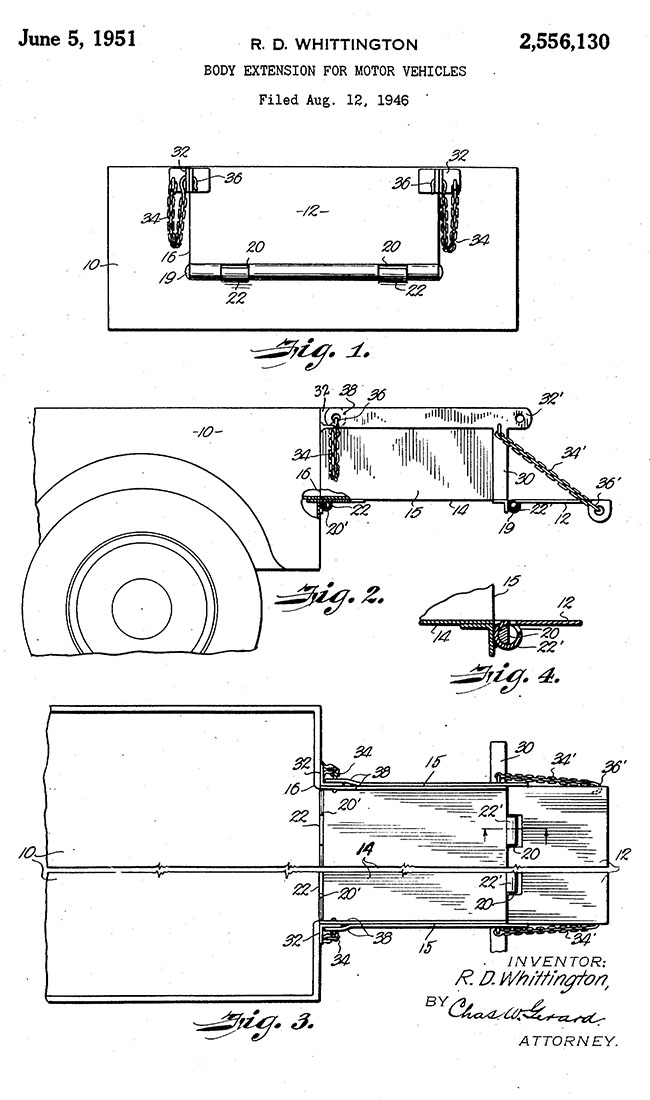
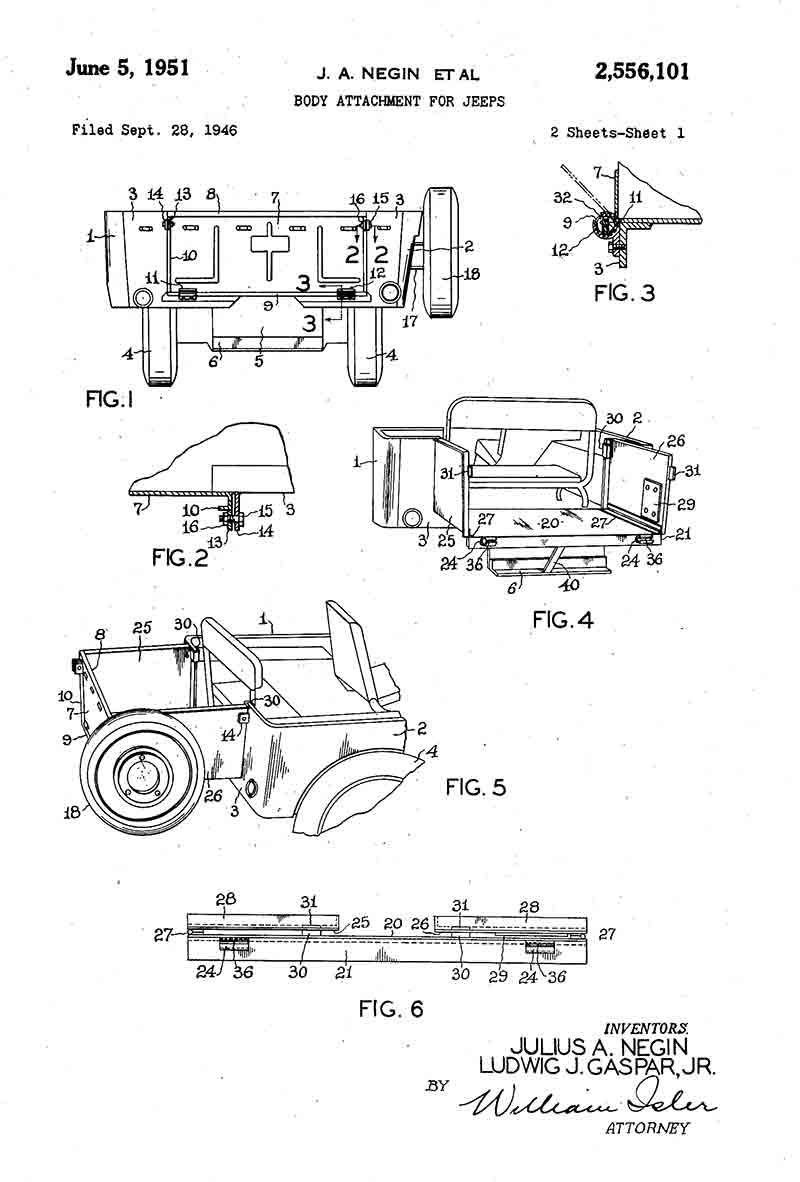
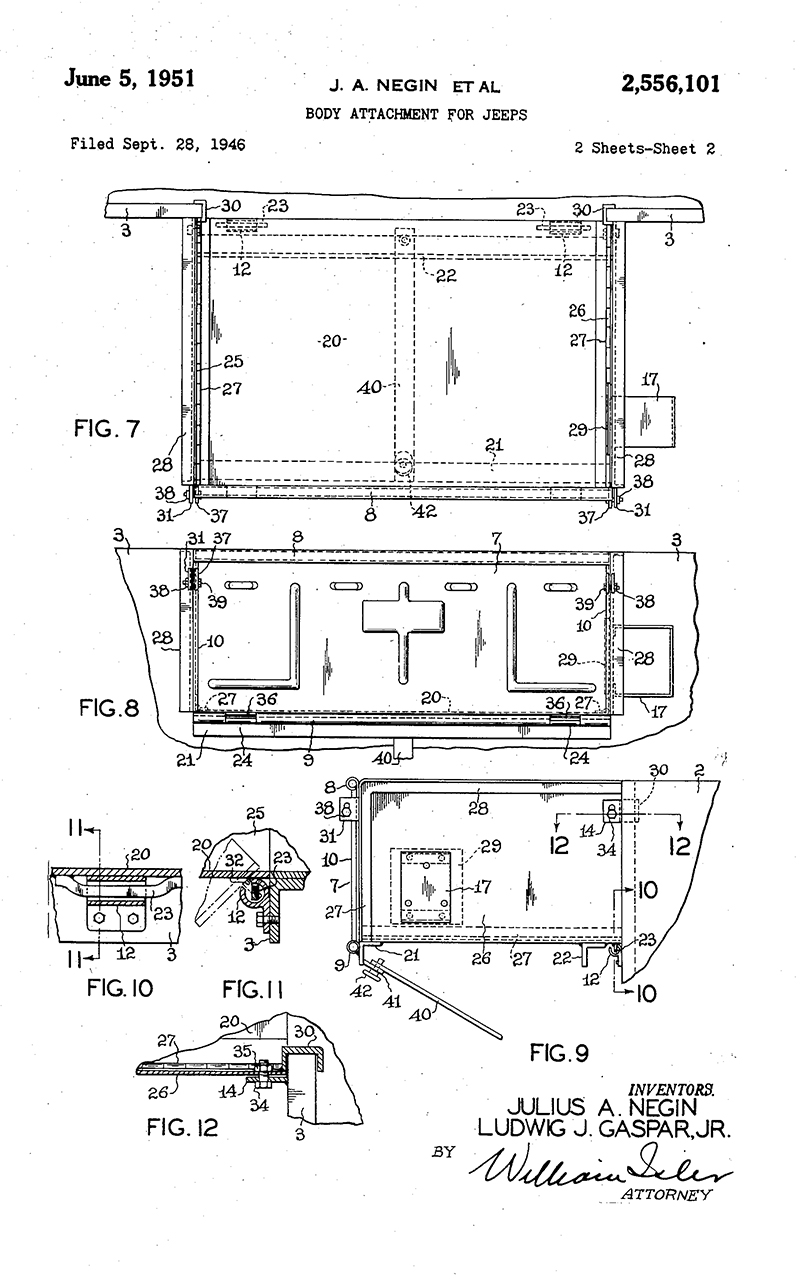
UPDATE: In 2019 I posted a patent filed in September 28, 1946, for a “body attachment”. Yesterday, on an unrelated search, I discovered the names of the same parties, under a different lawyer, related to a patent filed a month earlier (August 12, 1946) for a “body extension” for a jeep. The second patent is more detailed (seen at bottom) than the early one. Both were approved on the same date: June 5, 1951. See most of the body extensions produced over the years in this post.
Attorney Roy Whittington assigned half this patent to William Isler and half, jointly, to Julius Negin and Ludwig Gaspar, the two who also filed the patent at bottom. The whys are likely lost to history.
PATENT DESCRIPTION: June 5, 1951 R. D. WHITTINGTON BODY EXTENSION FOR MOTOR VEHICLES Filed Aug. 12, 1946 A TTORNEY.
Patented June 5, 1951 BODY EXTENSION FOR MOTOR VEHICLES Roy D. Whittington, Belton, M0., assignor of onehalf to William Isler and one-half to Julius A. -Negin and Ludwig J. Gaspar, J r., jointly, all of Cleveland, Ohio Application August 12, 1946, Serial No. 690,019 3 Claims. (01. 296-28) The present invention relates to vehicle-construction, and particularly to commercial vehicles such as trucks and the like, and aims to provide a practical form of extension for the body portion of such vehicles.
The invention has special reference tothe commercial type of motor vehicles such as have been known generally as jeeps in the army service, and which has a body of limited proportions and some forms of which have .an endgate at the rear end of the body. 7
Accordingly an object of the invention is to provide an extension of the body structure of this type of vehiclein the form of an accessory unit which is adapted to be mounted in the manner of a replacement for the endgate of the .vehiclebody and to receive said engate as a supplemental attachment serving the endgate function for said accessory unit….
I can only guess that this design was used by Newgren, as I *think* it was the only firm that built a collapsable body extension. The only thing is that Newgren had double supports, while the patent only shows a single support underneath.
PATENT DESCRIPTION: ATTORNEY Patented June 5, 1951 BODY ATTACHMENT FOR JEEPS Julius A. Negin, East Cleveland, and Ludwig J.
Gaspar, Jr., Cleveland, Ohio, assignors of onehalf to William Isler, Cleveland, Ohio Application September 28, 1946, Serial No. 700,006
11 Claims. 1
This invention relates, as indicated, to body attachments for vehicles of the type known as Jeeps.
As is well known, this type of vehicle, which was developed and extensively used during World War II, is coming into general usage for commercial purposes, but its use for such purposes is somewhat limited on account of its body shape and dimensions.
Another factor which has inhibited the use of this type of vehicle for commercial purposes is the fact that the spare tire or spare wheel of the vehicle is conventionally carried at the side of and adjacent the rear end of the body of the vehicle, in which position, it is so remote from the plane defined by the wheels of the vehicle as to constitute a hazard, particularly when attempting to park the vehicle in city streets.
The present invention has as its primary object the provision of an attachment or extension for the body of a vehicle of this type, which attachment or extension materially increases the carrying capacity of the vehicle.Continue reading →
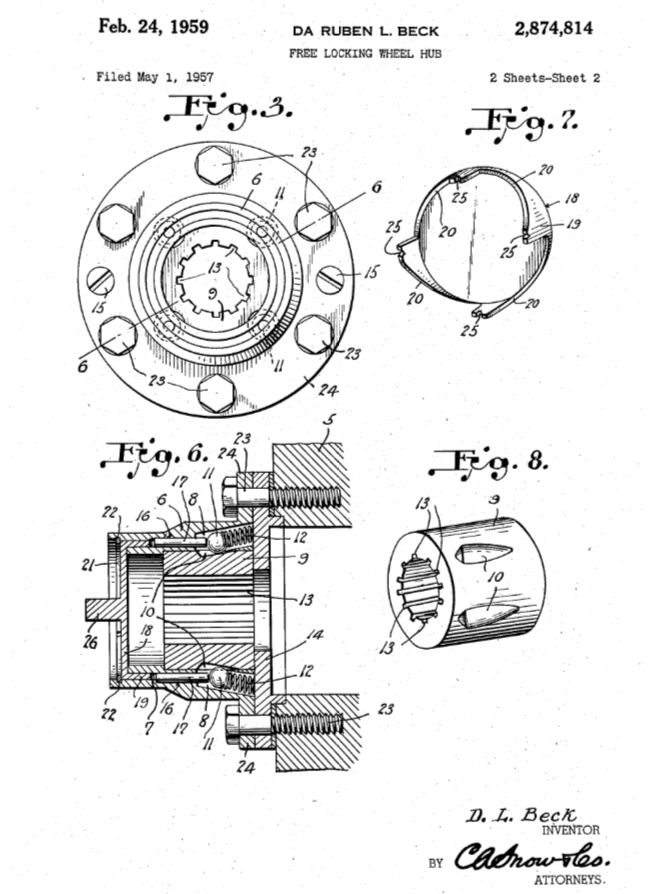
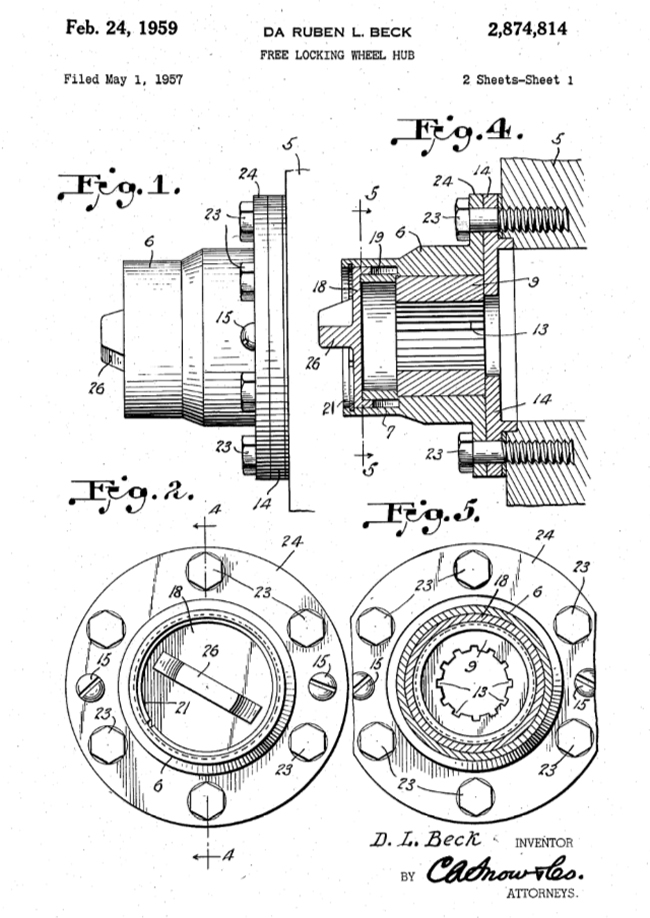
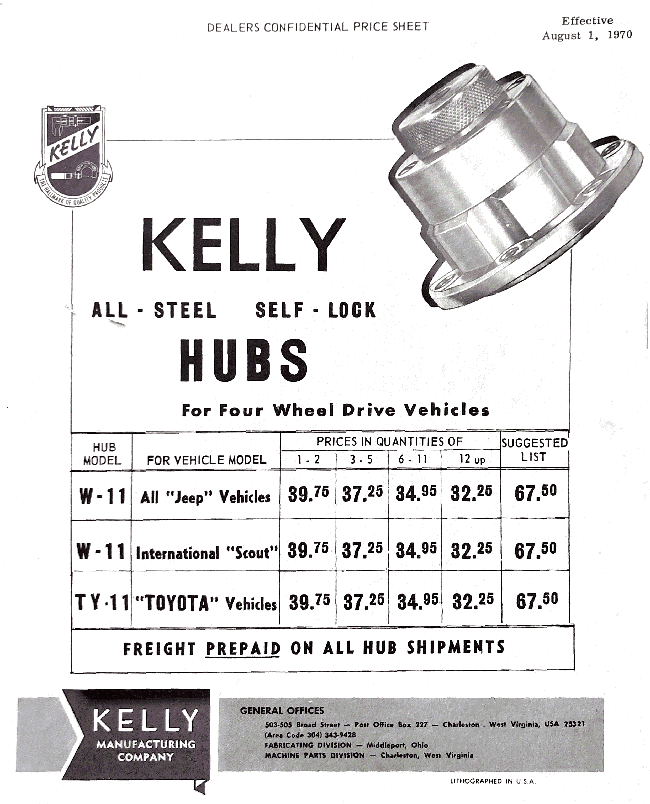
In May of 1957, DA Ruben L. Beck filed a patent for a new hub design. Beck was a dreamer and like many dreamers, some saw him a genius while others thought him just plain crazy. Beck’s goal was to create a simple, but effective, four-wheel-drive hub.
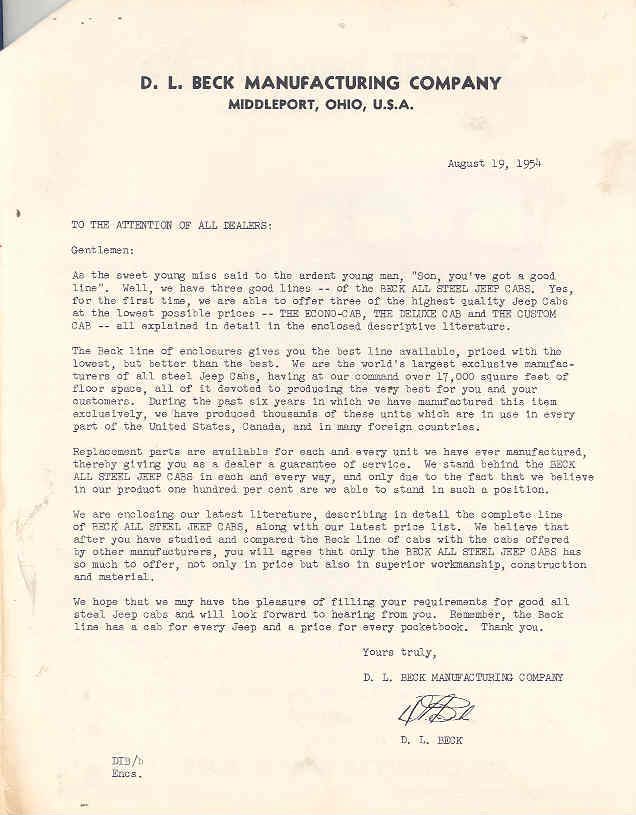
Beck had already made an early impact in the jeep world, when he founded D.L. Beck Manfucaturing in Middleport, Ohio, a company that made hardtops (see Beck hardtop history here).
Beck sold his hardtop company to Hubert A. Kelly, in the 1950s but Beck and Kelly remained in contact. The date of the sale, thought once to be 1951, is less clear after this document hit eBay in 2014. It indicates Beck was still selling hardtops in 1954.
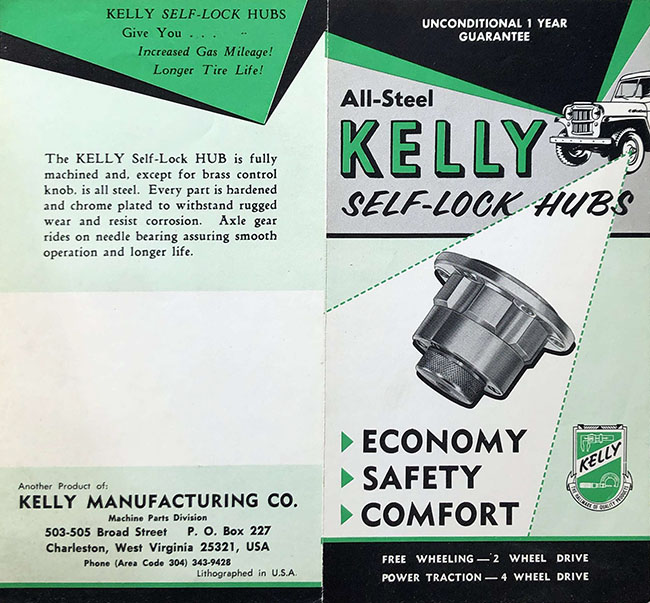
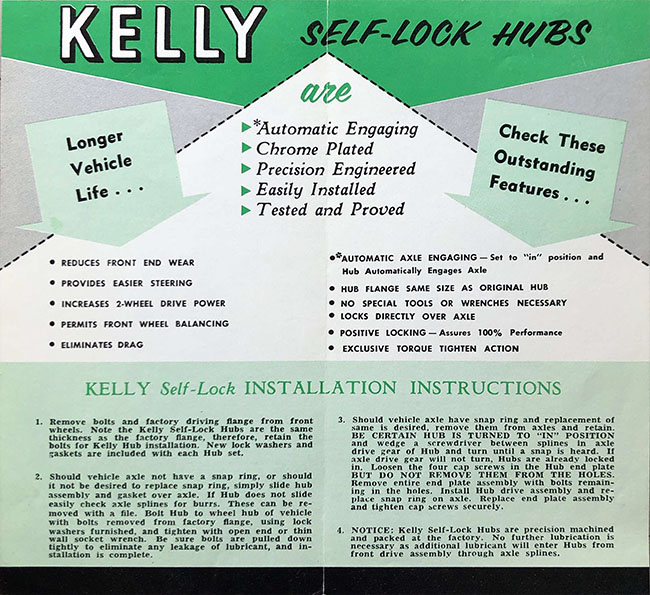
No matter when the sale occurred, Hubert took control. It wasn’t long after the patent filing that Mike Kelly, Hubert Kelly’s descendent, remembered seeing the hubs for the first time. He thought that was about 1958. I asked that he review the patent and Mike sent me the following notes:
“The Kelly Self Locking Hub I knew a was little different than the one pictured in the patent drawing. The housing was larger in diameter and had reliefs milled along the outside to allow clearance for the mounting bolts. The internal parts looked very similar to what I remember. I’m pretty sure the final Kelly product was a Beck design. I don’t recall anyone else working on it.
The hubs were manufactured in Charleston West Virginia. We already had an large machine shop there on Broad St. So moving production from Ohio to West Virgina was only logical. I know the assembling the hubs could be “interesting” if you weren’t watching what you were doing. Putting the internal workings together with the ball bearings being under spring pressure woke up more than one man who wasn’t paying attention.”
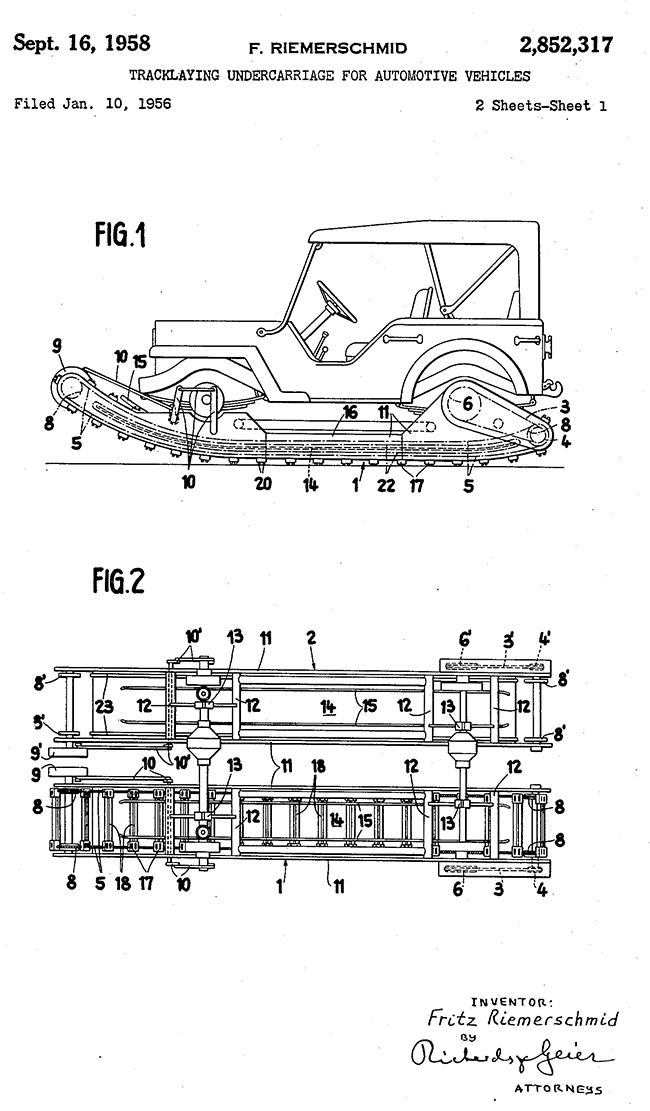
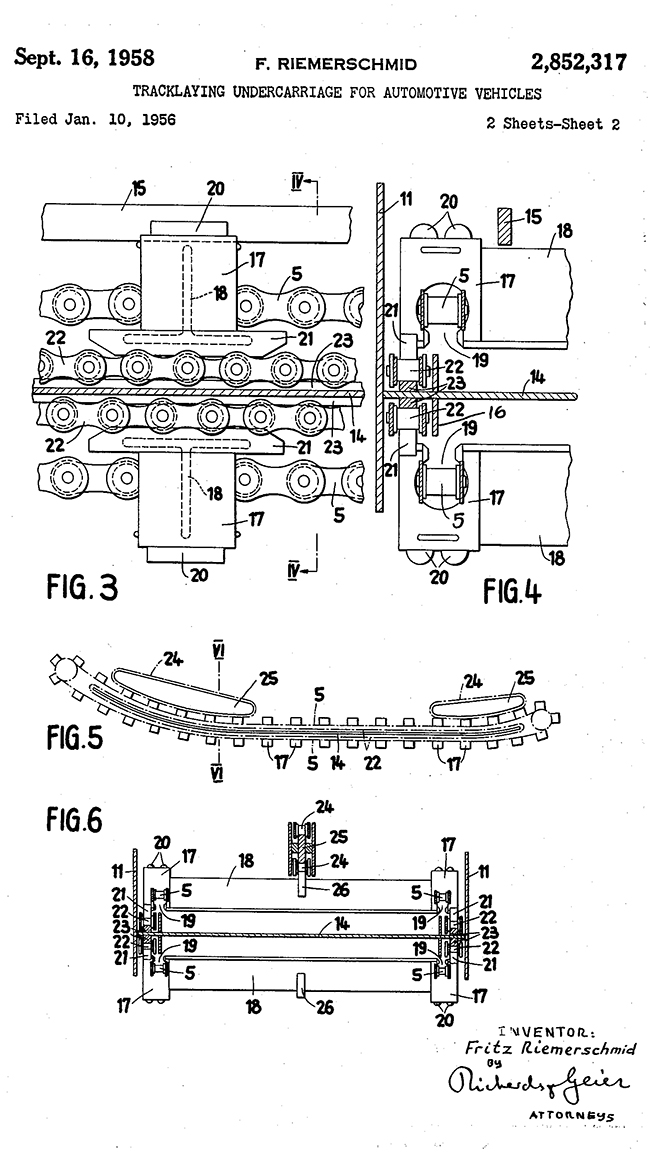
This patent application used a jeep to demonstrated how the endless track system would work on a vehicle not designed specifically for tracks. The patent was filed January 13, 1955.
According to inventor Fritz Riemerschmid, “Numerous constructions of the track! laying or crawler type have heretofore been proposed, but in all of these known cases special-type vehicles are involved, the construction of which either prohibits or renders extremely difficult the use of the vehicle under normal road and travel conditions.
Accordingly it is one of the main objects of the present invention to provide a crawler-type tracklaying undercarriage for automotive vehicles which, while being particularly suitable for travel over snow-covered terrain, can be quickly and easily substituted for the standard wheels of the vehicle. It is another object of the invention to provide a construction of the type indicated in which, except for the removal of the said standard wheels from the vehicle, requires no structural changes to be made in a given vehicle. Thus, the invention renders it possible, whenever it may be desired, to provide an automotive vehicle of any given type with a tracklaying mechanism which takes the place of the standard wheels on which the said vehicle normally travels.”
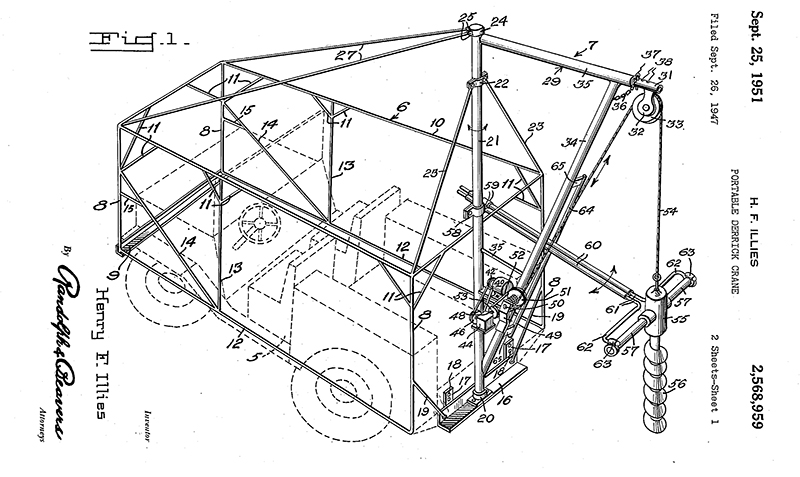
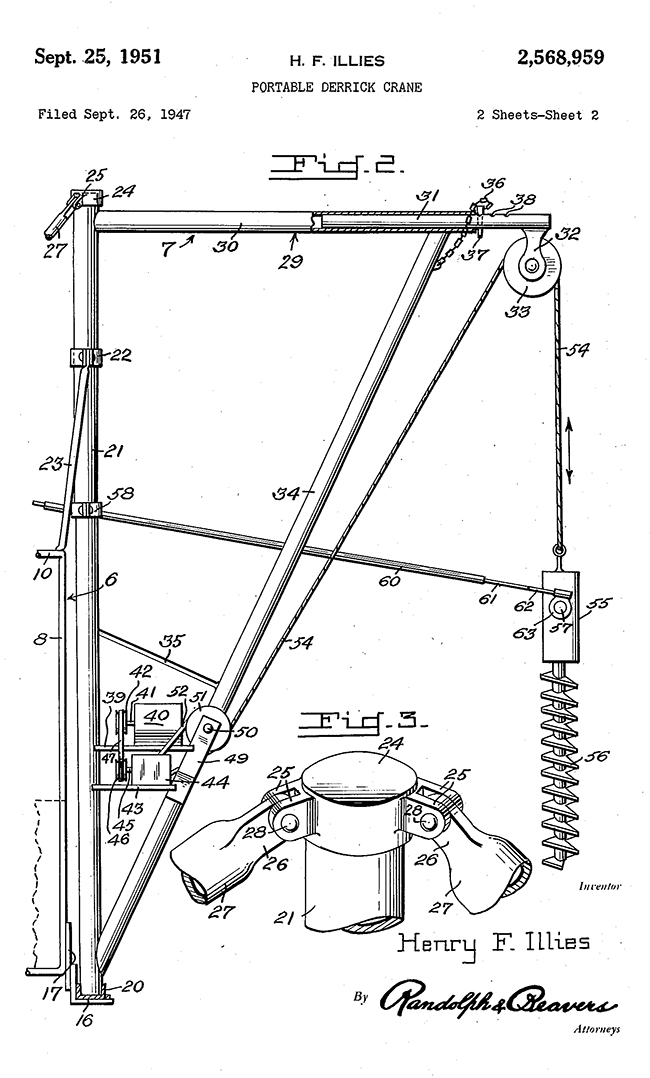
“This invention relates to a derrick crane adapted to be mounted on a small motor vehicle and while adapted generally for supporting, raising and lowering or conveying heavy objects is especially adapted to provide a support for an’– auger such as is employed for digging post holes and by means of which the auger may be adjusta- -bly supported with respect to the vehicle, lowered gradually as it advances into the ground,”
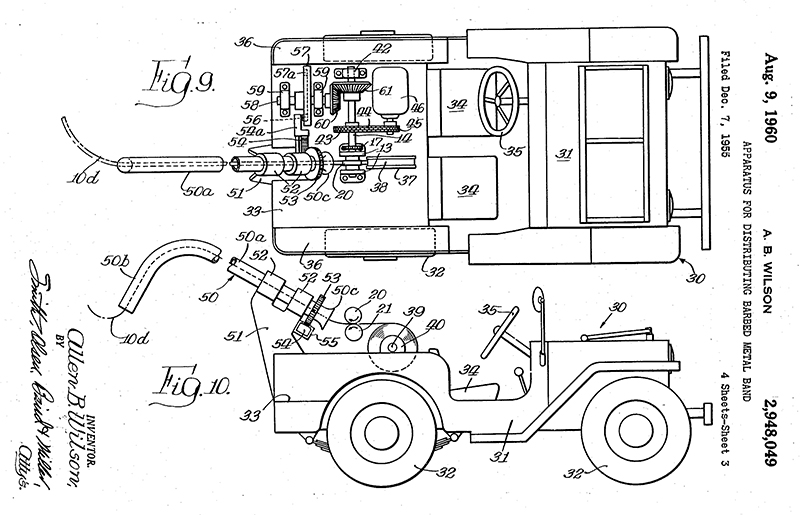
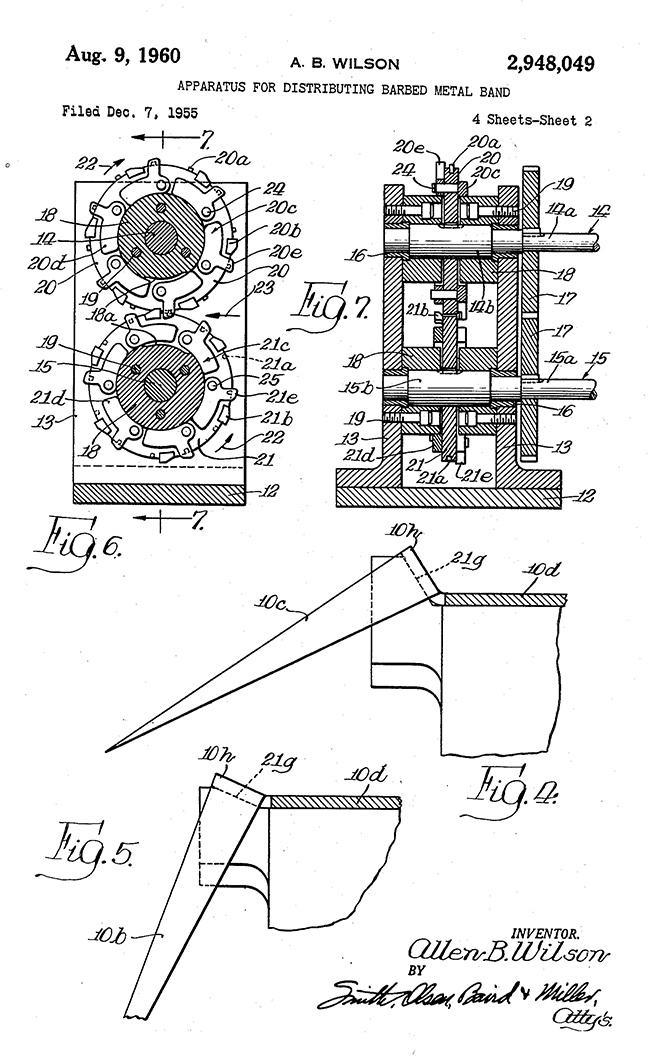
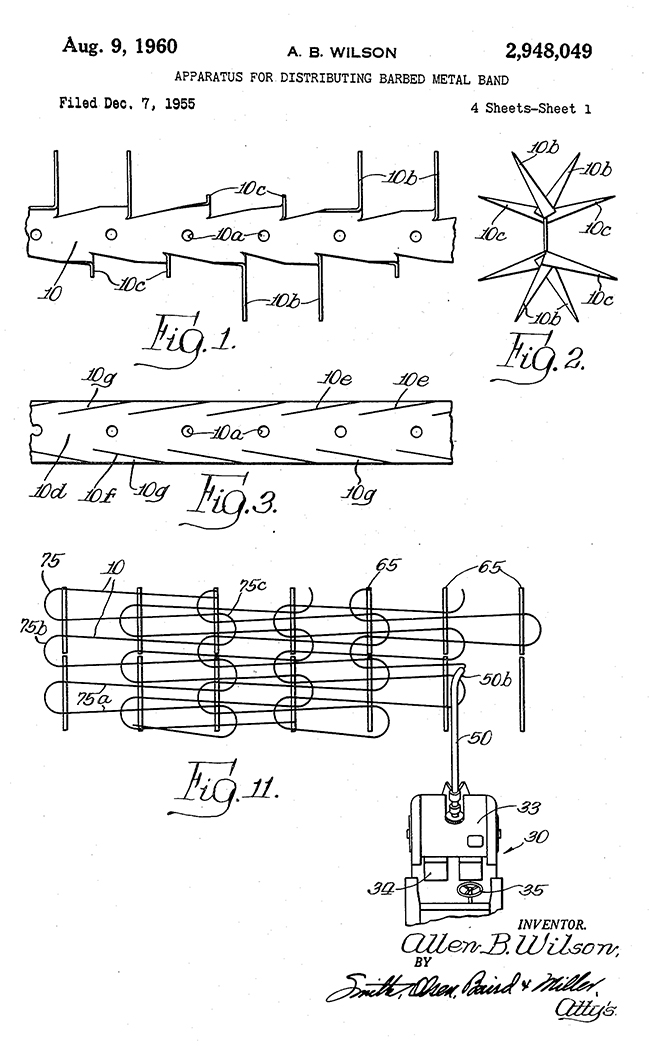
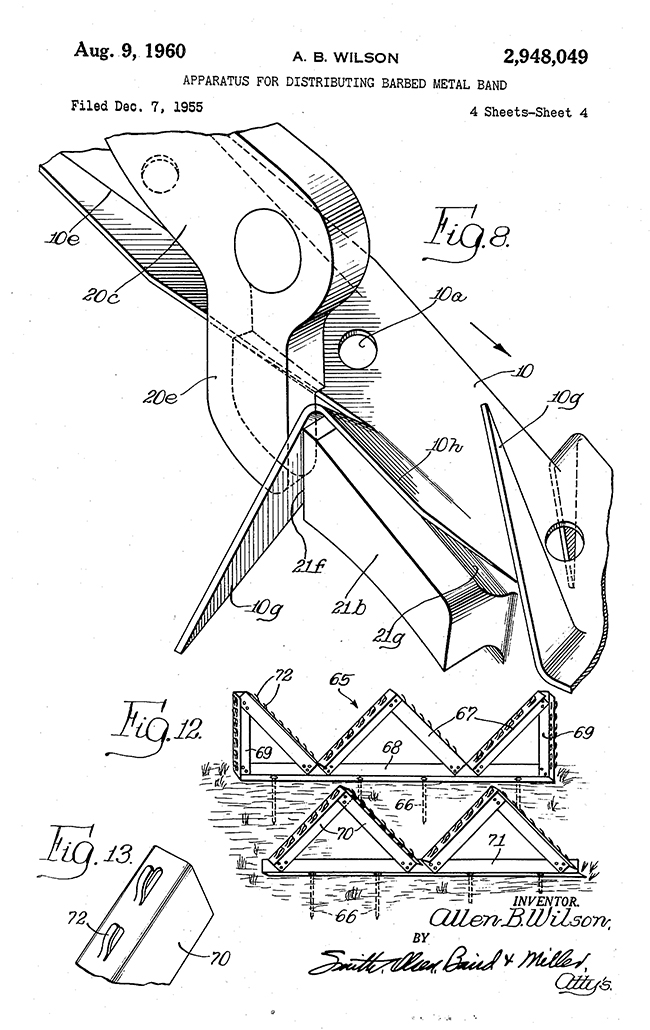
A patent for the distribution of barbed metal band from a short wheel base vehicle, preferably a jeep or jeep-like vehicle, was filed in 1955 by the Acme Steel Company.
“The purpose of the present invention is to provide novel apparatus by which barbed metal band may be formed in a continuous process and distributed as it is formed in the place and arrangement in which it is to be used. A further object of the invention is to provide apparatus for distributing barbed metal band according to a prearranged plan and supporting it in the arrangement in which it is distributed. Another object is to provide portable apparatus having means for forming barbed metal band from a supply of fiat strip ma terial and for distributing the barbed band and arranging it during the travel of the apparatus. Other objects relate to various features of construction and arrangement which will appear more fully hereinafter.”
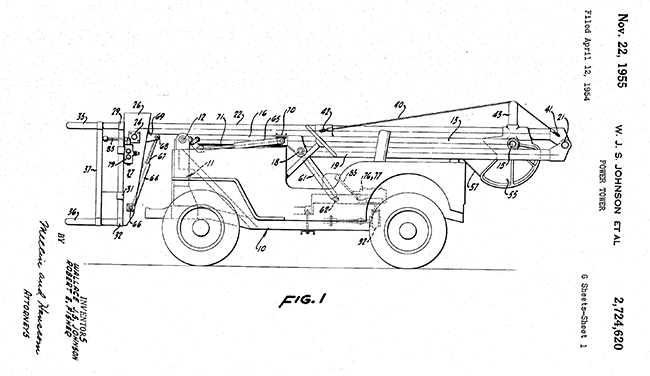
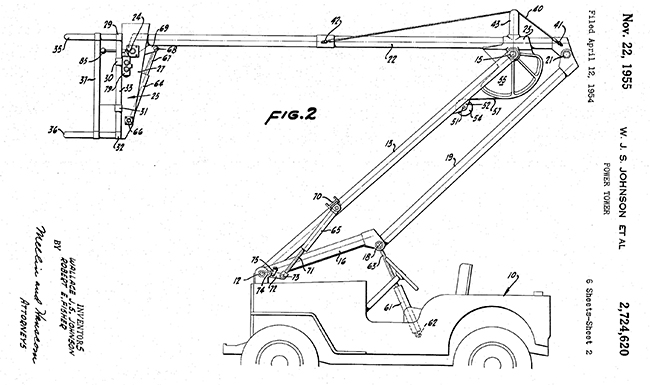
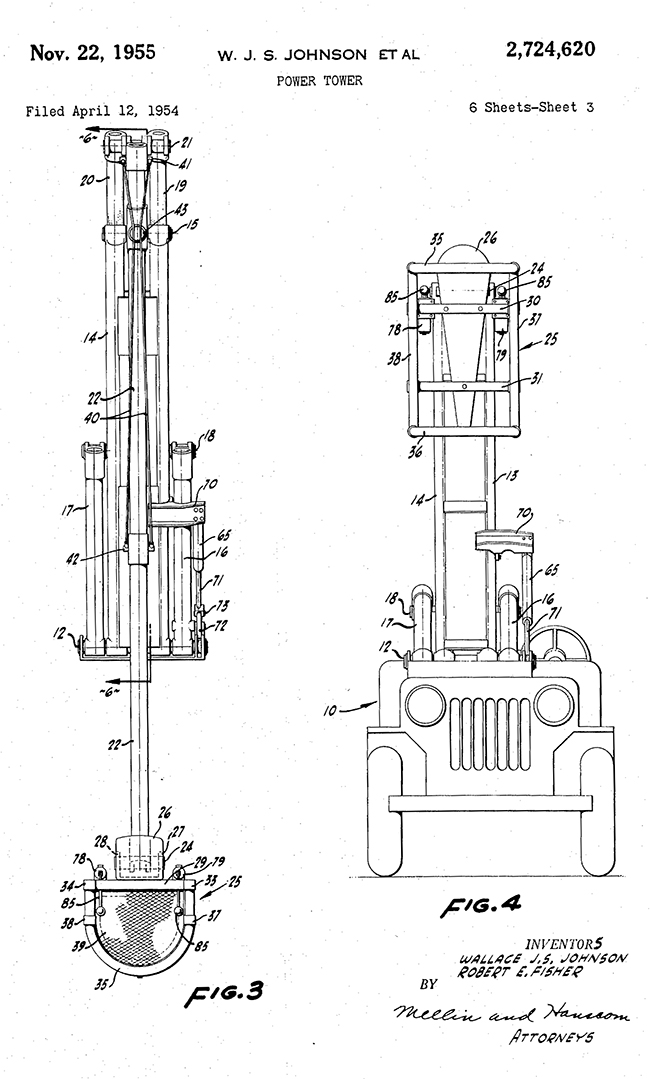
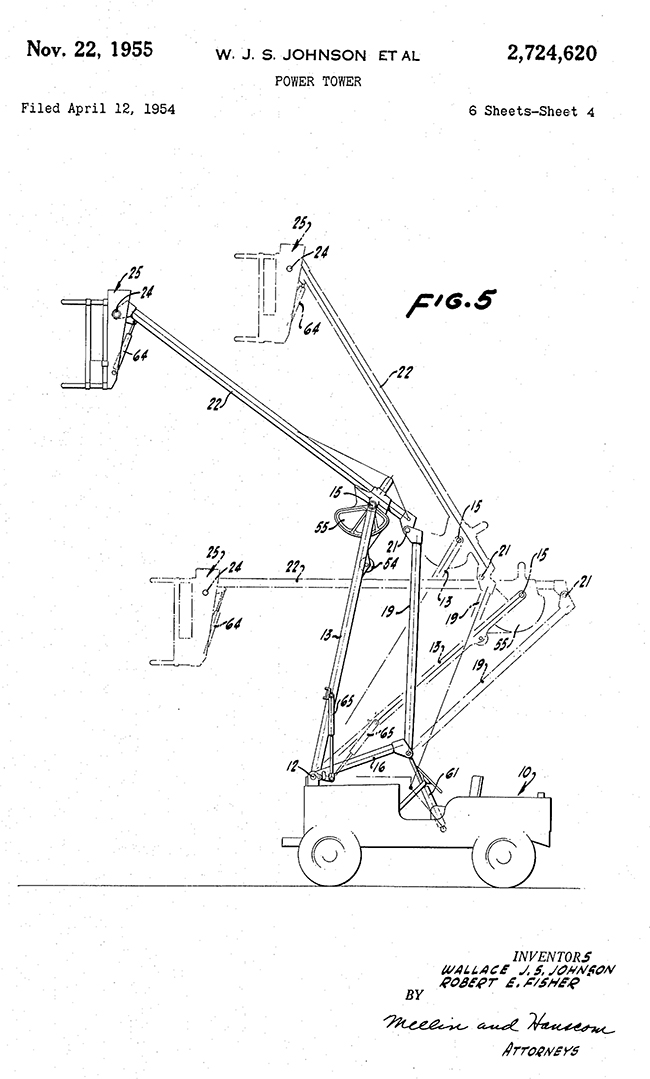
This April 12, 1954, Power Tower patent filing by Wallace Johnson and Robert Fisher was said to be designed for other vehicles besides the jeep, but given it’s length, it’s hard to imagine it would work on anything that wasn’t flat like the top of the jeep.
Here’s a description: The present invention relates to a power tower for use by workmen employed as painters, electrical fixture repairrnen, aircraft maintenance men, window washers, and a multitude of similar occupations wherein it is necessary toperform a task at some distance above the ground and thus ordinarily require the use of ladders or scaffolding of some type. More particularly, the invention relates to a workmans platform supported by a collapsible tower structure which in turn is mounted on a wheeled vehicle.
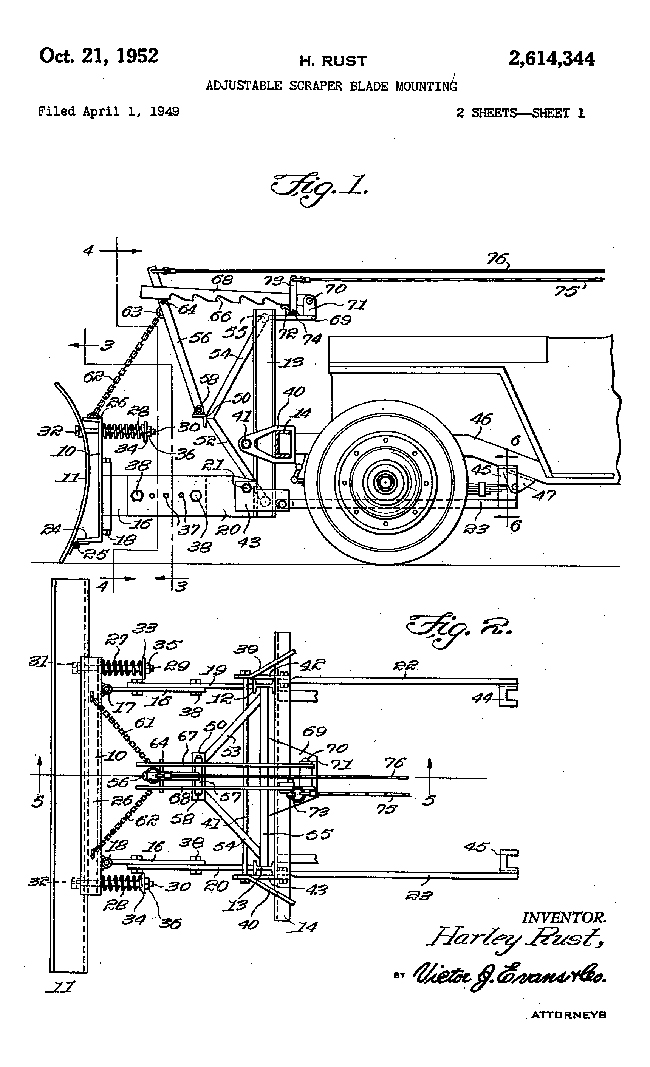
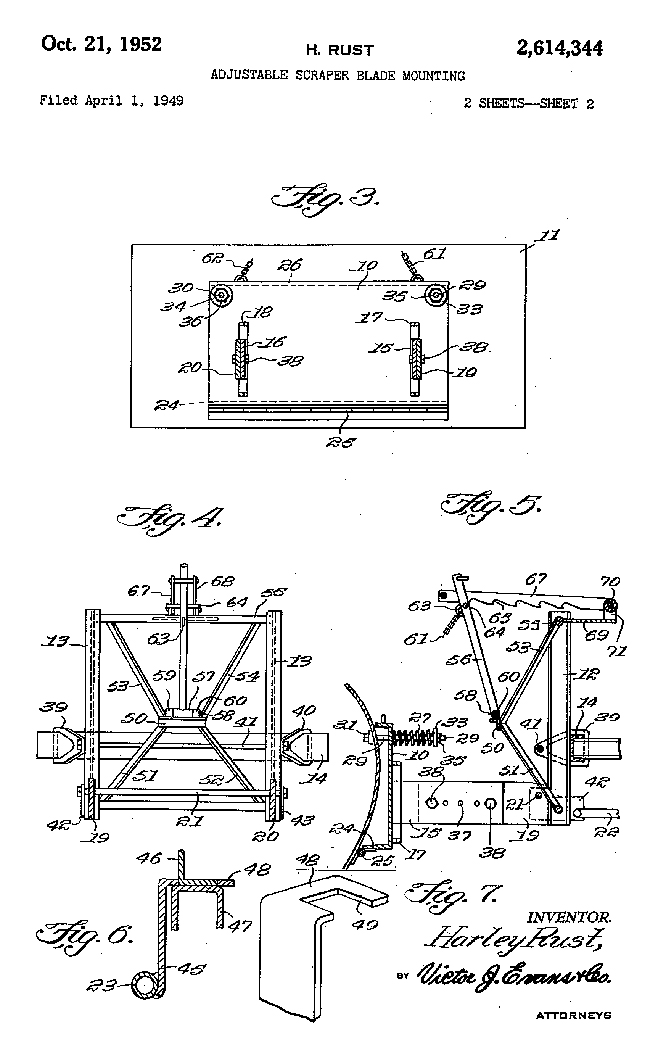
“This invention relates to scraper blades of the bulldozer type such as used in leveling or pushing snow, dirt and the like, and in particular a blade mounting for removably attaching a blade to the front of a Jeep or the like wherein the elevation of the blade is readily adjustable and in which the blade is hinged and resiliently held to provide tilting movement when the lower edge of the blade engages a fixed obstruction.”